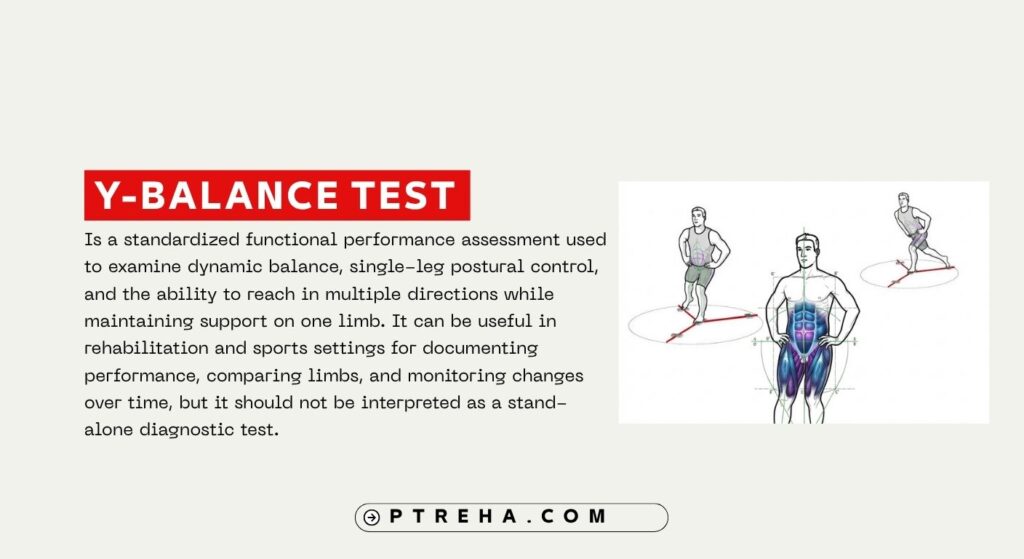
The Y-Balance Test is a standardized functional performance assessment used to examine dynamic balance, single-leg postural control, and the ability to reach in multiple directions while maintaining support on one limb. It can be useful in rehabilitation and sports settings for documenting performance, comparing limbs, and monitoring changes over time, but it should not be interpreted as a stand-alone diagnostic test.
What Is the Y-Balance Test?
The Y-Balance Test is a dynamic balance assessment derived from the Star Excursion Balance Test. The commonly used Lower Quarter Y-Balance Test evaluates single-leg stance while the opposite limb reaches in three directions: anterior, posteromedial, and posterolateral.
The individual attempts to reach as far as possible with the free limb while maintaining balance and controlling the movement of the stance limb. Reach distance can then be recorded and, depending on the protocol, normalized to limb length.
The test therefore combines balance, postural control, lower-extremity movement, and the ability to control the body while reaching outside the base of support.
It is best classified as a functional performance test and clinical measurement, rather than an orthopedic special test designed to confirm a particular tissue injury.
Purpose of the Y-Balance Test
The Y-Balance Test may be used to:
- Assess dynamic single-leg balance and postural control.
- Quantify reach performance in three standardized directions.
- Compare performance between limbs when clinically appropriate.
- Establish a baseline before rehabilitation or return-to-activity progression.
- Monitor changes in functional performance over repeated assessments.
- Identify movement or balance deficits that warrant further clinical assessment.
- Complement other examination findings in patients with lower-extremity or functional limitations.
The test should be considered one component of a broader examination rather than a complete assessment of balance, strength, mobility, or injury risk.
Y-Balance Test Indications
The Y-Balance Test may be appropriate when the clinician wants to examine dynamic single-leg performance in situations such as:
- Lower-extremity rehabilitation.
- Return-to-sport or return-to-activity assessment.
- Evaluation of functional performance following injury.
- Assessment of dynamic postural control.
- Monitoring functional changes during rehabilitation.
- Athletic screening or performance assessment when interpreted within the relevant population.
- Comparison of repeated measurements when the testing procedure is kept consistent.
Its usefulness depends on the patient’s ability to safely perform a single-leg stance and controlled reaching task.
Y-Balance Test Contraindications and Precautions
There is no single universally established list of disease-specific contraindications unique to the Y-Balance Test. Clinical judgment should determine whether the task is appropriate for the individual.
Important precautions include:
- Do not perform the test when single-leg stance or reaching is unsafe for the patient.
- Consider acute pain, substantial swelling, or recent injury that could make the task inappropriate.
- Provide an appropriate environment to reduce the risk of falling.
- Allow appropriate familiarization when required by the selected protocol.
- Stop the assessment if the patient develops significant pain, dizziness, instability, or another concerning symptom.
- Use caution with patients who have substantial balance impairment or other conditions that make unsupported single-leg activity unsafe.
A precaution is not the same as a formal contraindication. The decision to test should be based on the patient’s current clinical presentation and ability to perform the task safely.
Patient Position
For the commonly used Lower Quarter Y-Balance Test:
- The patient stands barefoot or using the footwear specified by the selected protocol on the central stance area of the testing device.
- The stance limb remains on the platform.
- The free limb is used to reach along the designated direction.
- The patient maintains balance on the stance limb throughout the reach.
- The hands are generally positioned on the hips according to the standardized Y-Balance Test procedure.
- The patient should maintain the required stance position without using the reaching limb for support.
The exact setup should follow the protocol being used because variations in footwear, familiarization, instructions, and testing procedure can affect measurement.
Examiner Position
The examiner should:
- Stand where all components of the movement can be observed safely.
- Monitor the stance limb and trunk for loss of balance or changes in technique.
- Observe whether the reaching foot contacts the appropriate portion of the measurement device.
- Ensure that the patient follows the selected testing instructions consistently.
- Record the reach measurements according to the protocol.
- Provide standardized instructions rather than coaching the patient differently between limbs or sessions.
Consistent examiner instructions are particularly important when the test is being used to monitor change over time.
How to Perform the Y-Balance Test
The following describes the commonly used Lower Quarter Y-Balance Test procedure.
- Explain the task.
Explain that the patient will stand on one leg and use the opposite leg to reach as far as possible in three directions while maintaining balance. - Familiarize the patient.
Allow practice according to the protocol being used. Familiarization can be important because the task requires coordination and understanding of the reaching technique. - Establish the testing position.
The patient assumes the standardized single-leg stance position on the testing platform. - Perform the anterior reach.
The free limb reaches forward along the anterior direction while the patient maintains control of the stance limb. - Perform the posteromedial reach.
The free limb reaches diagonally backward and toward the medial direction. - Perform the posterolateral reach.
The free limb reaches diagonally backward and toward the lateral direction. - Record the reach distance.
The maximum acceptable reach is recorded according to the standardized rules of the protocol. - Repeat as required.
The number of trials and the method used to select the recorded score should remain consistent with the chosen protocol. - Test the opposite limb.
When clinically appropriate, repeat the procedure on the other stance limb using the same instructions and conditions.
A trial may need to be repeated when the patient loses balance or fails to meet the technical requirements of the protocol. The exact error criteria should be established before testing and applied consistently.
Interpretation and Scoring
The primary outcomes are the reach distances in the anterior, posteromedial, and posterolateral directions.
Depending on the protocol, reach distance may be considered as an absolute measurement or normalized relative to limb length. A composite score may also be calculated from the three directions.
Normalized scoring is particularly useful when comparing individuals with different limb lengths, but the calculation and interpretation should follow the specific Y-Balance Test protocol being used.
The clinician should record the individual directional results rather than relying exclusively on a single composite score. Different directions can provide different information about performance.
Importantly, there is no universal Y-Balance Test score that should automatically be considered normal or abnormal for every patient. Performance can vary according to factors such as age, sex, sporting activity, training status, injury status, and testing procedures. Research has also demonstrated differences between populations, supporting population-specific interpretation rather than indiscriminate use of general cut points.
What Do Y-Balance Test Findings Mean?
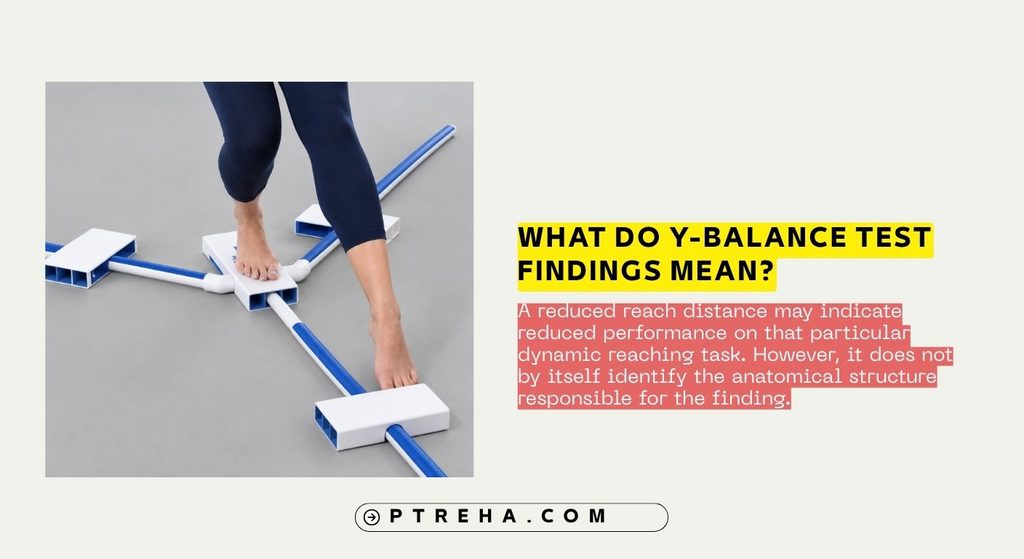
A reduced reach distance may indicate reduced performance on that particular dynamic reaching task. However, it does not by itself identify the anatomical structure responsible for the finding.
For example, a reduced anterior reach should not automatically be interpreted as evidence of weakness of a particular muscle, restriction of a particular joint, or injury to a particular ligament.
Y-Balance performance is influenced by multiple interacting factors, including movement strategy, balance, strength, joint mobility, coordination, and task familiarity. Research has identified associations between Y-Balance performance and several biomechanical factors, but associations should not be interpreted as proof that one factor caused the observed score.
As a result, an unusual score should generally prompt consideration of the broader clinical examination rather than a diagnosis based on the Y-Balance Test alone.
Anatomy Involved in Y-Balance Test
The Y-Balance Test does not isolate one anatomical structure. Successful performance requires coordinated contribution from multiple regions and physiological systems, including:
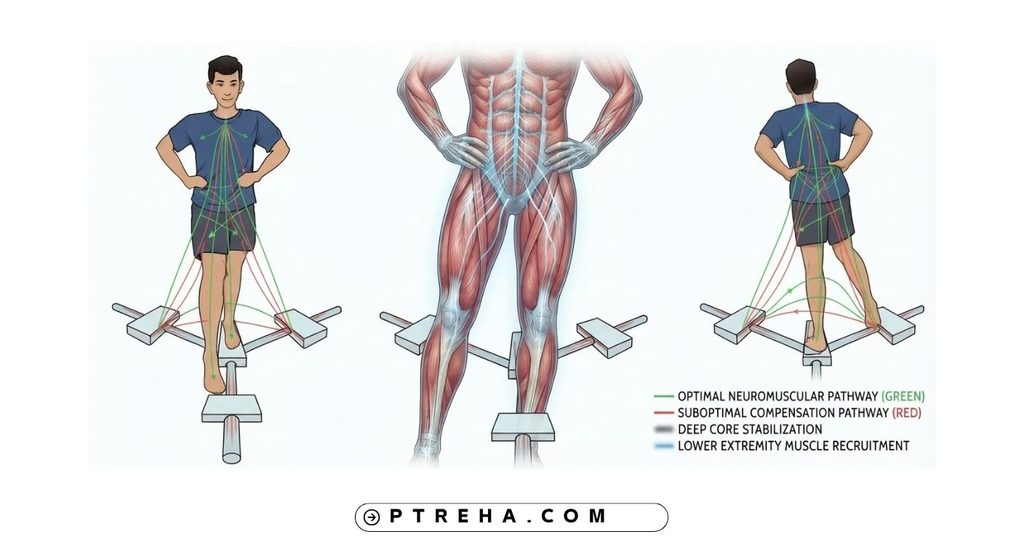
- Foot and ankle complex.
- Knee and hip joints.
- Pelvis and trunk.
- Lower-extremity muscles involved in maintaining and controlling the stance position.
- Proprioceptive and somatosensory systems.
- Visual and vestibular contributions to postural control.
- Central nervous system processes involved in motor planning and coordination.
The relative contribution of these systems can vary according to the direction of reach, individual movement strategy, and clinical condition.
Conditions Detected / Associated With the Test
The Y-Balance Test should not be described as a test that independently detects or diagnoses a specific disease.
Differences in Y-Balance performance have been reported in research involving various athletic and clinical populations, including individuals with musculoskeletal conditions. For example, studies have reported differences in Y-Balance performance in people with patellofemoral pain and chronic low back pain.
These findings indicate that Y-Balance performance can be associated with functional differences in particular populations, but they do not establish the test as a stand-alone diagnostic tool for those conditions.
The test may therefore contribute useful information when combined with history, physical examination, functional testing, and other relevant outcome measures.
Clinical Significance
The Y-Balance Test can contribute to clinical decision-making by providing a reproducible way to quantify dynamic single-leg reach performance.
Clinicians may use it to:
- Establish a functional baseline.
- Identify directional differences in performance.
- Compare the involved and uninvolved limbs when that comparison is clinically meaningful.
- Monitor changes during rehabilitation.
- Examine whether functional performance changes alongside symptoms and other examination findings.
- Provide objective measurements that complement clinical observation.
Research supports good reliability of the Lower Quarter Y-Balance Test, particularly in healthy populations, although reliability and measurement characteristics can vary according to the population and testing procedure.
A systematic review found strong evidence for inter- and intra-rater reliability in healthy adults, while later research has emphasized that interpretation can differ across populations. More recent work has also highlighted substantial variation in how Y-Balance Test procedures are reported across studies, reinforcing the importance of protocol consistency.
Sensitivity and Specificity
Sensitivity and specificity are not universally established characteristics of the Y-Balance Test as a general clinical diagnostic test.
Studies have investigated whether particular Y-Balance measurements, asymmetries, or composite scores are associated with injury occurrence or differences between populations. However, the evidence is heterogeneous, and findings depend on the population, outcome, protocol, and threshold being examined.
For this reason, a single sensitivity or specificity value should not be presented as applicable to all patients or clinical situations.
Diagnostic Accuracy
The Y-Balance Test should not be treated as a stand-alone diagnostic examination.
Its primary clinical role is functional assessment and measurement of dynamic single-leg performance. Although research has investigated discriminant and predictive validity, these concepts should not be confused with the ability to diagnose a specific condition.
A patient should not be diagnosed with an injury or disease solely because of a Y-Balance Test result.
Common Mistakes in Y-Balance Test
Common errors include:
- Changing instructions between the two limbs.
- Failing to provide adequate familiarization.
- Allowing inconsistent hand or trunk positions.
- Recording a reach despite failure to maintain the required stance position.
- Allowing the patient to use the reaching limb for support.
- Changing footwear or testing conditions between sessions without documenting the change.
- Using different trial procedures at different assessments.
- Treating one numerical value as a universal normal score.
- Interpreting limb asymmetry automatically as evidence of pathology.
- Assuming a reduced score identifies a specific weak muscle or injured structure.
- Using the test as a substitute for a complete clinical examination.
- Comparing results across sessions without considering changes in protocol or patient status.
Tips for Performing the Y-Balance Test
For more consistent clinical measurements:
- Use the same testing equipment and protocol whenever possible.
- Give standardized instructions.
- Ensure the patient understands the task before formal measurement.
- Maintain a consistent testing environment.
- Document relevant protocol variations.
- Record directional scores rather than relying only on the composite result.
- Consider limb length when using normalized scores.
- Interpret asymmetry in the context of the patient’s history and other examination findings.
- Use repeated measurements to monitor change rather than treating one result as definitive.
- Consider measurement error when deciding whether a change represents meaningful improvement or deterioration.
“A Y-Balance score is a measurement of performance, not a diagnosis.”
“Interpret the result in the context of the patient, the protocol, and the rest of the examination.”
Summary
- The Y-Balance Test is a functional performance and clinical measurement tool for assessing dynamic single-leg balance and reach performance.
- The commonly used Lower Quarter protocol examines anterior, posteromedial, and posterolateral reach directions.
- Results can be recorded as directional reach distances and, depending on the protocol, normalized or combined into a composite score.
- There is no universal score or pass/fail threshold that applies to every population.
- The test can contribute useful information during rehabilitation and functional assessment but should not independently establish a diagnosis.
The Y-Balance Test is most useful when performed consistently and interpreted alongside the patient’s history, symptoms, physical examination, functional goals, and other relevant measures. Its value comes from quantifying a specific aspect of functional performance—not from attempting to make it answer clinical questions that it was not designed to answer.
Resources and external links
- Powden CK, Dodds TK, Gabriel EH. The Reliability of the Star Excursion Balance Test and Lower Quarter Y-Balance Test in Healthy Adults: A Systematic Review. This systematic review examined intra- and inter-rater reliability and supports strong reliability evidence in healthy adults.
PubMed – Y-Balance Test Reliability Systematic Review - Plisky PJ et al. Systematic Review and Meta-Analysis of the Y-Balance Test Lower Quarter: Reliability, Discriminant Validity, and Predictive Validity. This review examined reliability, population differences, and evidence concerning injury prediction.
PubMed – Y-Balance Test Lower Quarter Systematic Review - Takahashi H et al. (2026). Reporting of Y Balance Test Measurement Procedures in Reliability and Validity Studies: A Scoping Review. This recent review highlights variation in reported testing procedures and the importance of methodological consistency.
PubMed – 2026 Y Balance Test Scoping Review - Y-Balance Test in chronic low back pain. A clinical study examining reliability and validity of Y-Balance measurements in young adults with chronic low back pain.
PubMed – Y-Balance Test and Chronic Low Back Pain - Clinic- and laboratory-based measures of postural control in patellofemoral pain. A systematic review and meta-analysis examining postural-control measures, including Y-Balance/Star Excursion testing, in patellofemoral pain.
PubMed – Postural Control in Patellofemoral Pain