Yes—De Quervain’s tenosynovitis can usually be managed by calming the irritated thumb-side wrist tendons, changing the loads that repeatedly provoke them, and gradually rebuilding thumb and wrist capacity. The key is to stop re-irritating the area without abandoning all hand use, then add motion and strength only as symptoms settle.
Understand where De Quervain’s pain comes from
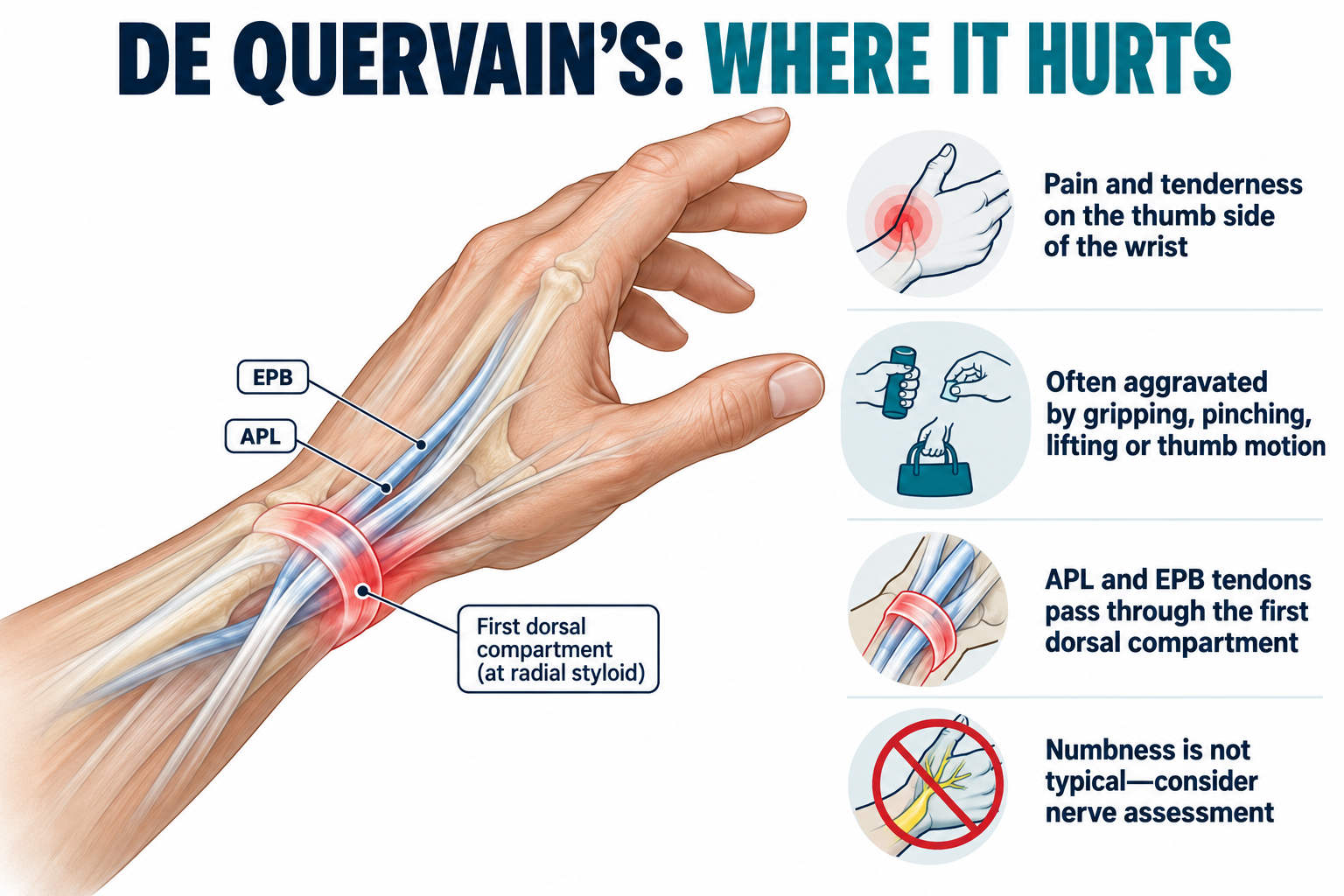
De Quervain’s affects the tendon sheath in the first dorsal compartment on the thumb side of the wrist. The abductor pollicis longus (APL) and extensor pollicis brevis (EPB) tendons pass through this tunnel and help move the thumb away from the hand and backward.
- Pain or tenderness near the bony point on the thumb side of the wrist
- Pain with gripping, pinching, lifting, wringing, or repeated thumb motion
- Discomfort that may travel a short distance into the thumb or forearm
- Swelling or a thickened feeling over the tendon compartment
- Reduced confidence or strength because painful movement is being guarded
The name “tenosynovitis” is commonly used, although persistent symptoms may involve thickening and restricted tendon gliding rather than simple inflammation alone. The AAOS overview of De Quervain’s describes the typical location, examination, and nonsurgical treatment options.
Check whether the symptom pattern fits
Thumb-side wrist pain is not automatically De Quervain’s. Thumb-base arthritis, a wrist fracture, intersection syndrome, superficial radial nerve irritation, infection, inflammatory disease, and pain referred from elsewhere can create a similar complaint.
- More consistent with De Quervain’s: focal tenderness at the radial styloid and pain with loaded thumb or wrist use.
- Consider a nerve problem: burning, persistent tingling, numbness, or altered skin sensitivity.
- Consider thumb-base joint pain: deeper pain at the carpometacarpal joint with pinch or jar opening.
- Consider another injury: symptoms began after a fall, direct impact, or sudden force.
- Seek urgent review: redness, heat, fever, rapidly increasing swelling, a wound, or severe loss of function.
A clinician may use a provocation test as one part of the examination, but a painful self-test does not confirm the diagnosis. Repeating a strong thumb-in-palm stretch can aggravate the area and is not a treatment exercise.
Identify and reduce the aggravating load
The most useful first step is to find which combination of force, repetition, grip, pinch, wrist angle, and recovery time exceeds current capacity. A task diary can reveal patterns that are missed when every painful movement is simply labeled “overuse.”
- Note the task, duration, grip type, and wrist position.
- Record the immediate response and the response later that day.
- Check sleep and next-morning hand function.
- Look for recent increases in lifting, phone use, tools, gaming, crafts, or childcare.
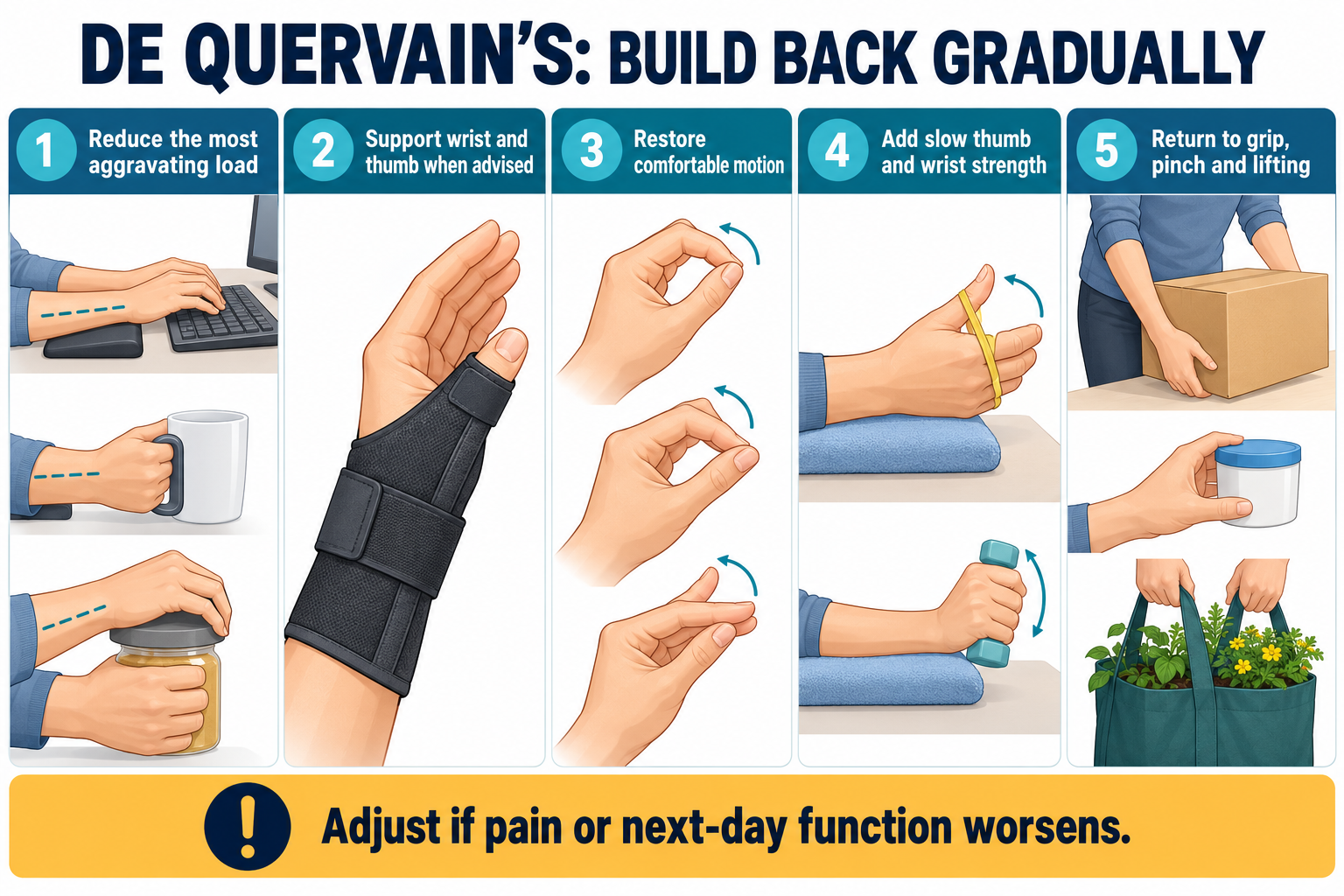
- Choose one high-impact modification instead of trying to avoid every activity.
Relative rest means reducing the provocative dose while keeping comfortable movement and necessary daily use. Complete rest may reduce symptoms temporarily, but it does not prepare the tendons for future gripping, lifting, or pinching.
Modify daily tasks to keep the wrist and thumb calmer
Small technique changes can reduce compression and friction at the first dorsal compartment. The goal is not a rigid “perfect posture,” but a lower-effort way to complete the task while symptoms are sensitive.
- Use both hands for a saucepan, box, or child when possible.
- Keep the wrist closer to neutral instead of bending toward the little finger.
- Carry with the palm up or use the forearms when the task allows.
- Choose wider handles and loosen unnecessary grip force.
- Slide an object across a surface before lifting it.
- Use voice control, a stand, or the other hand for prolonged phone tasks.
When lifting a baby, bring the body close, support with the forearm and whole hand, and avoid repeatedly scooping under the arms with the thumbs spread wide. Change positions often so the same tissues do not take every repetition.
Use a thumb-spica splint and symptom relief appropriately
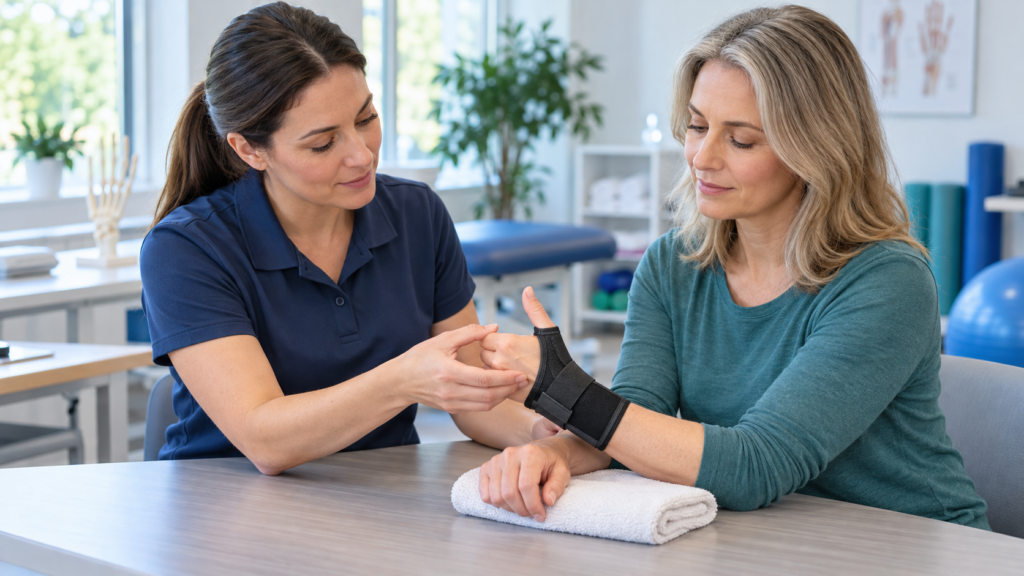
A removable thumb-spica splint supports both the wrist and thumb in a comfortable position. It can reduce painful movement during selected tasks or at night, but fit and wearing schedule matter; a splint that is too tight, poorly positioned, or worn longer than needed can create other problems.
- Confirm that the splint supports the wrist and thumb without forcing either joint.
- Check skin color, temperature, sensation, and pressure areas after fitting.
- Remove it as directed for hygiene and permitted movement.
- Do not use the splint as permission to perform heavier painful tasks.
- Seek adjustment if it causes numbness, swelling, rubbing, or more pain.
Cold or heat may offer short-term comfort for some people. Medication suitability varies with health conditions, pregnancy or breastfeeding, allergies, and other medicines, so discuss oral or topical options with a pharmacist or prescriber rather than relying on a generic recommendation.
Restore comfortable thumb and wrist movement
Begin gentle movement when the resting pain and irritability allow it. Motion should feel controlled and should not be used to chase a strong stretch across the painful tendon sheath.
- Touch the thumb gently to each fingertip.
- Slide the thumb away from and back toward the index finger on a table.
- Move the wrist slowly forward and backward with the forearm supported.
- Practice small side-to-side wrist movement without forcing the painful direction.
- Open and close the hand with relaxed, low-force motion.
Use a range that stays comfortable during the exercise and does not worsen grip, sleep, or next-day function. The NHS Dynamic Health De Quervain guidance separates symptom-calming measures from later strengthening, which helps prevent loading too aggressively during an irritable phase.
Start with low-load isometric exercises
An isometric exercise activates a muscle without visible thumb movement. It can be a useful bridge when full movement against resistance is still too sensitive, but it should remain gentle and controlled.
- Support the forearm and keep the wrist near neutral.
- Use the other index finger to resist the thumb moving gently upward.
- Resist the thumb moving gently away from the palm without letting it move.
- Keep the tip of the thumb relaxed instead of locking every joint.
- Stop if pain becomes sharp, spreads, or remains more irritable afterward.
Choose an effort and hold time that allow steady breathing and no compensation through the wrist or forearm. Increase the effort only after the same version is consistently tolerated.
Progress slow thumb and wrist strengthening
When isometrics and ordinary motion are comfortable, progress to slow resistance for the thumb and wrist. The purpose is to build load tolerance, not to force the thumb to its end range.
- Light band thumb abduction with the hand supported
- Light band thumb extension with controlled return
- Slow wrist extension with a small weight and forearm supported
- Controlled wrist side-to-side movement through a comfortable range
- Gentle grip work with the wrist neutral and thumb relaxed
Start with a resistance that keeps movement smooth. Progress resistance, repetitions, range, or task duration one variable at a time, and reduce the dose if pain or next-day hand function worsens.
Rebuild pinch, grip, lifting, and work capacity
Exercise becomes useful when it transfers to the tasks that matter. Reintroduce the most provocative grip or pinch last and begin below the usual force, speed, and duration.
- Hold a light cup with the wrist neutral before using a heavier container.
- Practice a wide, low-force pinch before a narrow, forceful pinch.
- Lift a light box with two hands before heavier one-handed lifting.
- Return to tools with shorter sessions and planned breaks.
- Alternate hands or task positions when repetition is unavoidable.
- Increase only after the current level is tolerated later that day and the next morning.
| Stage | Main goal | Examples | Progress sign |
|---|---|---|---|
| Calm irritation | Reduce the provoking dose | Task modification, selected splint use | Resting symptoms and daily function are improving |
| Restore motion | Move without forceful stretching | Thumb-to-fingertip motion, supported wrist movement | Comfortable range without a next-day flare |
| Build capacity | Reload thumb and wrist muscles | Isometrics, light band and wrist resistance | Smooth control at the current dose |
| Return to tasks | Tolerate real grip, pinch, and lifting demands | Graduated cups, boxes, tools, childcare, or sport tasks | Goal task is controlled during and after practice |
For work, sport, music, crafts, or childcare, practice the exact pattern with a reduced dose. General strength helps, but task-specific exposure is what rebuilds confidence and capacity.
Know when medical or hand-therapy care can help
Assessment is useful when the diagnosis is uncertain, symptoms are persistent, work or sleep is substantially affected, or self-management is not restoring function. A hand therapist can help with splint fit, task analysis, exercise selection, and graded return.
- Bring a timeline and the activities that changed before symptoms began.
- Point to the exact pain location with one finger.
- Report numbness, tingling, swelling, catching, or joint pain.
- Describe what has been tried and how the wrist responded.
- Bring frequently used equipment or a short video of the task when practical.
Corticosteroid injection into the tendon sheath is an established nonsurgical option and should be performed by a qualified clinician after diagnosis and risk discussion. The American Society for Surgery of the Hand patient guidance also lists splinting, medication, injection, and surgery among treatment options; surgery is generally reserved for symptoms that remain severe or fail appropriate nonsurgical care.
Conclusion
De Quervain’s tenosynovitis management works best when the diagnosis fits, the main provoking loads are modified, and thumb and wrist capacity are rebuilt gradually. Use support and symptom-relief options purposefully, avoid repeated painful self-testing, and seek assessment when symptoms are atypical, neurological, severe, or not improving.
Frequently asked questions
What does De Quervain’s pain feel like?
It usually causes focal pain and tenderness on the thumb side of the wrist, especially with gripping, pinching, lifting, wringing, or moving the thumb. Swelling or a thickened feeling may also occur.
Is De Quervain’s the same as thumb arthritis?
No. De Quervain’s involves the APL and EPB tendon compartment near the radial styloid, while thumb carpometacarpal arthritis affects the joint at the base of the thumb. The pain locations and examination findings can overlap, so assessment may be needed.
Can pregnancy or childcare contribute?
Symptoms are commonly reported during pregnancy or the postpartum period, and repeated feeding, carrying, and lifting positions can increase wrist and thumb demand. Management should also consider medication safety and practical ways to share or modify childcare loads.
Should I keep doing the Finkelstein test?
No. A clinician may use a carefully performed provocation test during assessment, but repeatedly forcing the thumb and wrist into a painful position can irritate symptoms and does not speed recovery.
Should I wear a splint all day?
Not automatically. A thumb-spica splint can reduce painful movement, but the schedule should match symptom irritability, activities, skin tolerance, and the clinician’s plan. Remove it as advised for hygiene and permitted movement.
Are stretches helpful for De Quervain’s?
Gentle comfortable motion can help maintain mobility, but a strong stretch into thumb flexion and wrist deviation may compress or tension an irritable tendon compartment. Do not force a painful stretch simply because the area feels tight.
When should strengthening begin?
Start strengthening after resting pain and ordinary movement are settling and low-load activation is tolerated. Begin below the level that provokes symptoms and progress according to control and the later-day and next-day response.
Can I continue working or exercising?
Often yes, with temporary changes to force, repetition, grip, wrist angle, and session length. Stop or modify tasks that cause escalating pain or poorer function afterward rather than assuming every hand activity must be avoided.
When is a steroid injection considered?
A qualified clinician may recommend a corticosteroid injection when the diagnosis is clear and symptoms warrant it. The discussion should cover expected benefits, alternatives, individual risks, and aftercare rather than treating injection as a universal first step.
When should I seek urgent assessment?
Seek prompt care after significant trauma or for severe swelling, redness, heat, fever, a wound, marked weakness, or loss of function. Persistent numbness or tingling is not typical of uncomplicated De Quervain’s and also deserves assessment.