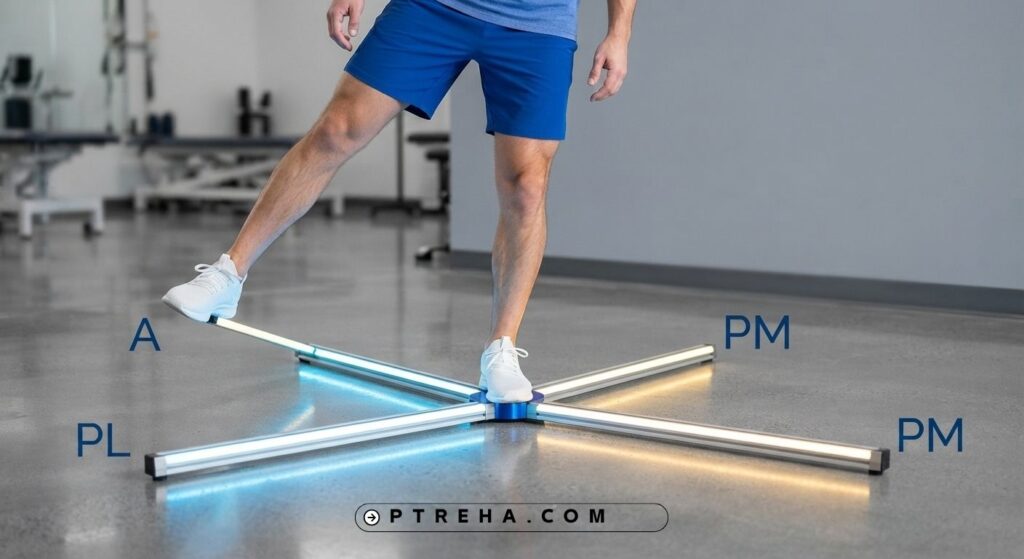
The Star Excursion Balance Test (SEBT) is a functional performance test used to assess dynamic postural control during single-leg stance. It challenges the person to maintain support on one limb while reaching the opposite limb in multiple directions, providing information about how effectively balance, mobility, strength, and neuromuscular control are coordinated during a demanding task.
What Is the Star Excursion Balance Test?
The Star Excursion Balance Test is a lower-extremity functional assessment in which a person stands on one leg and reaches as far as possible with the other leg along several predetermined directions. The original SEBT uses multiple reach directions arranged around the stance limb, creating a star-shaped testing pattern.
The test is commonly used to examine dynamic balance and postural control rather than static balance alone. Performance depends on the interaction of several factors, including the ability to control the stance limb, move the reaching limb, maintain trunk control, and use available joint mobility effectively.
Modified versions of the test have reduced the number of reach directions. The commonly used three-direction version uses anterior, posteromedial, and posterolateral reaches and is closely related to the Lower Quarter Y-Balance Test.
Because different protocols can produce different results, the exact testing method should be documented and kept consistent when results are compared over time.
Purpose of the Star Excursion Balance Test
The SEBT can be used to:
- Assess dynamic postural control during a single-leg task.
- Examine functional performance of the lower extremity.
- Identify asymmetries in reach performance between limbs when an appropriate comparison is made.
- Contribute to assessment following selected lower-extremity injuries.
- Monitor changes in performance during rehabilitation.
- Provide a challenging task for evaluating movement coordination under dynamic conditions.
- Complement other measures of balance, mobility, strength, and functional performance.
The SEBT should not be interpreted as a standalone measure of overall balance, lower-extremity strength, joint stability, or fall risk.
Star Excursion Balance Test Indications
The test may be useful when evaluating:
- Lower-extremity functional performance.
- Dynamic balance or postural-control deficits.
- Patients returning to higher-level functional or sporting activities.
- Changes in performance during lower-extremity rehabilitation.
- Differences in reach performance between limbs.
- Athletes undergoing movement or injury-risk assessment as part of a broader evaluation.
- Functional performance following selected ankle, knee, or other lower-extremity problems.
The clinical value depends on the patient’s presentation, the purpose of testing, and the protocol used.
Star Excursion Balance Test Contraindications and Precautions
There is not a single universally established list of SEBT-specific absolute contraindications. Clinical judgment should determine whether the person can safely perform a demanding single-leg balance task.
Important precautions include:
- Avoid or modify the test when single-leg loading is currently unsafe.
- Consider pain, swelling, acute injury, or substantial loss of weight-bearing tolerance.
- Consider the patient’s ability to understand and follow the instructions.
- Provide an appropriate environment to reduce the risk of falling.
- Allow adequate familiarization before formal measurement.
- Stop the test if the patient develops significant pain, dizziness, instability, or another concerning symptom.
- Use an appropriate level of guarding or assistance when clinically indicated.
The test should not be performed simply because it is available; its loading demands should be appropriate for the individual’s current clinical status.
Patient Position
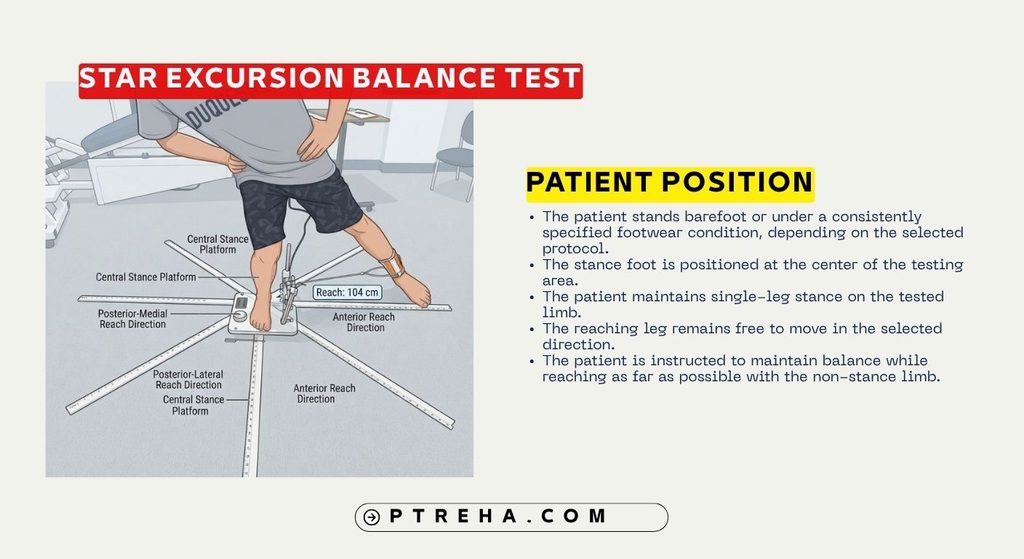
A commonly used SEBT setup includes:
- The patient stands barefoot or under a consistently specified footwear condition, depending on the selected protocol.
- The stance foot is positioned at the center of the testing area.
- The patient maintains single-leg stance on the tested limb.
- The reaching leg remains free to move in the selected direction.
- The patient is instructed to maintain balance while reaching as far as possible with the non-stance limb.
The exact foot, arm, trunk, and reaching-leg requirements should be standardized because changes in technique can influence performance.
Examiner Position
The examiner should:
- Stand where the relevant reach direction and stance limb can be observed clearly.
- Monitor whether the stance foot remains appropriately positioned.
- Observe balance, technique, and compensatory movements.
- Record the reach distance according to the selected protocol.
- Provide standardized instructions and avoid giving additional cues during one trial that are not provided during another.
- Ensure the testing surface and surrounding area are safe.
A consistent examiner position helps improve observation and reduces unnecessary variation between trials.
How to Perform the Star Excursion Balance Test
A commonly used multi-directional procedure can be performed as follows:
- Place the testing lines on the floor so that the selected reach directions are clearly marked from a common center point.
- Explain the task and demonstrate the movement before formal testing.
- Position the patient with the tested foot at the center of the testing area.
- Ask the patient to maintain single-leg stance while reaching with the opposite limb along the selected line.
- The patient reaches as far as possible without losing balance or violating the specified technique.
- The examiner records the furthest valid reach according to the selected measurement method.
- The patient returns the reaching limb to the starting position while maintaining control.
- Repeat the procedure for the remaining directions included in the chosen protocol.
- Test the opposite limb using the same procedure when bilateral comparison is clinically relevant.
- Use the same instructions, setup, measurement method, and scoring procedure when comparing performance between sessions.
The test should include sufficient familiarization before formal measurements. Recent evidence indicates that protocol variables—including how repetitions are selected and whether arm movement is restricted—can affect measured performance. Therefore, consistency is particularly important when the test is used to monitor change.
Interpretation and Scoring
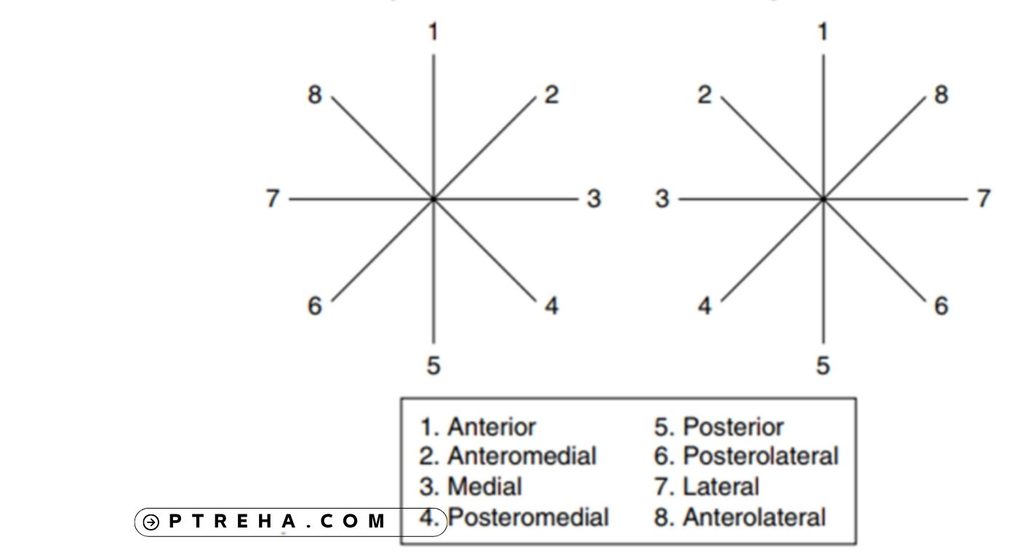
The primary outcome is reach distance in the selected directions.
Depending on the protocol, clinicians may record raw reach distances or normalize reach distance to limb length. Normalization can facilitate comparison between individuals with different limb lengths, but the calculation method and testing procedure should remain consistent.
The SEBT does not have one universal score that separates all individuals into “normal” and “abnormal” performance.
Interpretation should consider:
- The patient’s age and physical characteristics.
- The clinical population.
- The testing protocol.
- Familiarization and learning effects.
- The direction of reach.
- Performance of the opposite limb when an appropriate comparison is available.
- Symptoms and movement quality observed during testing.
- Changes across repeated assessments.
A difference between limbs can be clinically informative, but it should not automatically be interpreted as evidence of a particular injury or pathological structure.
What Do Reduced or Asymmetrical Reach Distances Mean?
Reduced reach performance may indicate difficulty completing the dynamic task, but the result does not identify a single underlying cause.
Performance can be influenced by multiple interacting factors, including:
- Postural control.
- Lower-extremity strength.
- Joint mobility.
- Trunk control.
- Neuromuscular coordination.
- Pain or apprehension.
- Previous injury.
- Familiarity with the task.
- Testing technique.
Research has reported associations between SEBT performance and lower-extremity injury or functional status in specific populations. These associations should not be interpreted as proof that a particular SEBT result diagnoses an injury.
Anatomy Involved in the Star Excursion Balance Test
The SEBT is a whole-task assessment rather than a test that isolates one anatomical structure.
Relevant systems and regions include:
- Foot and ankle: provide the base of support and contribute to postural control during single-leg stance.
- Knee: contributes to controlled loading and movement of the stance limb.
- Hip: contributes to control of the pelvis and lower extremity during reaching.
- Trunk and pelvis: help maintain the body’s center of mass over the supporting limb.
- Neuromuscular system: coordinates sensory information and motor responses required to maintain balance.
- Reaching limb: contributes to the task through controlled movement toward the target direction.
The test therefore reflects the combined performance of multiple anatomical and physiological systems rather than the isolated function of one muscle, ligament, joint, or nerve.
Conditions Associated With the Test
The SEBT has been studied in relation to various lower-extremity conditions and populations, including:
- Ankle injuries and chronic ankle instability.
- Lower-extremity musculoskeletal injuries.
- Individuals undergoing lower-extremity rehabilitation.
- Athletic populations.
Studies have also examined whether SEBT performance can contribute to injury-risk assessment. However, the relationship between reach performance and injury is population- and protocol-dependent, and the test should be combined with other clinical information rather than used as a standalone diagnostic tool.
Clinical Significance
The SEBT can be useful because it places substantial functional demands on the patient while requiring relatively simple equipment.
Clinically, it may help the therapist:
- Establish a baseline of dynamic functional performance.
- Compare performance between limbs when appropriate.
- Monitor changes during rehabilitation.
- Identify movement or balance deficits that warrant further assessment.
- Complement strength, range-of-motion, pain, and patient-reported measures.
- Evaluate performance in tasks that are more demanding than simple static standing.
The test is particularly useful when the clinician interprets the result as one component of a larger examination rather than as a diagnostic answer.
“A reach distance is a measurement of task performance—not a diagnosis.”
Reliability and Measurement Considerations
Reliability evidence for the SEBT is relatively strong in healthy adults, although the exact reliability depends on the direction and protocol used. A systematic review found consistently high intra-rater and inter-rater reliability across the commonly studied anterior, posteromedial, and posterolateral directions in healthy adults.
However, reliability evidence in healthy participants should not automatically be generalized to every patient population.
Protocol consistency is essential. Differences in familiarization, reach calculation, arm movement, footwear, and other testing variables can influence the measured result.
Sensitivity and Specificity
Sensitivity and specificity are not universal properties of the SEBT itself.
They depend on the specific population, condition, outcome definition, protocol, and cutoff being investigated. Because there is no single universally accepted diagnostic cutoff for the SEBT across clinical populations, a general sensitivity or specificity value should not be presented as applicable to all patients.
Diagnostic Accuracy
The Star Excursion Balance Test should not be regarded as a standalone diagnostic test for a particular musculoskeletal condition.
Research supports its use as a functional assessment of dynamic postural control and lower-extremity performance. Its results can contribute to clinical reasoning, but diagnosis requires integration with the history, physical examination, symptoms, and other appropriate investigations.
Common Mistakes in Star Excursion Balance Test
Common sources of error include:
- Changing the instructions between trials.
- Using different testing setups between assessment sessions.
- Failing to provide adequate familiarization.
- Allowing inconsistent arm or trunk movements.
- Allowing the stance foot to move when the protocol requires it to remain fixed.
- Recording an invalid reach as a successful trial.
- Comparing results obtained with different protocols.
- Treating a single reach distance as diagnostic.
- Ignoring pain or compensatory movement.
- Overinterpreting differences between limbs without considering individual characteristics and testing conditions.
Tips for Performing the Star Excursion Balance Test
For more consistent clinical testing:
- Use clearly marked reach lines.
- Standardize the patient’s instructions.
- Explain the rules before beginning formal trials.
- Provide familiarization before recording measurements.
- Keep the testing surface consistent.
- Use the same footwear condition when repeated testing is planned.
- Document the directions tested.
- Document the scoring or normalization method.
- Keep the procedure consistent between assessment sessions.
- Record relevant symptoms or technique problems that may affect interpretation.
- Combine the result with other examination findings.
“Consistency in the protocol is essential when using the SEBT to monitor change.”
Summary
- The Star Excursion Balance Test is a functional performance test used primarily to assess dynamic postural control during challenging single-leg tasks.
- It requires coordinated control of the stance limb, reaching limb, pelvis, trunk, and neuromuscular system.
- Several versions and protocols exist, so the exact method should be clearly defined and consistently applied.
- Reach distance and asymmetry can provide useful clinical information, but they do not independently establish a diagnosis.
- The SEBT is best interpreted alongside the patient’s symptoms, physical examination, functional goals, and other relevant outcome measures.
The SEBT is a practical way to challenge dynamic balance and observe functional lower-extremity performance. Its greatest clinical value comes from standardized testing and careful interpretation rather than from treating any single score as a universal diagnostic threshold.
Resources
- Powden et al. — Reliability of the Star Excursion Balance Test and Lower Quarter Y-Balance Test: systematic review of intra- and inter-rater reliability in healthy adults. PubMed
- Gribble et al. — Using the Star Excursion Balance Test to Assess Dynamic Postural-Control Deficits and Outcomes in Lower Extremity Injury: literature and systematic review of the SEBT. PubMed
- Zając et al. — Influence of Protocol Variables on SEBT, mSEBT and Y-Balance Test Outcomes: systematic review examining protocol-related effects on performance. PubMed
- Clinical measurement evidence: systematic review of the measurement properties and clinical relevance of the SEBT. PubMed