
Ankle instability can improve when proprioception and balance drills are progressed from safe, supported tasks to the movements you need for walking, work or sport. The goal is not simply to stand on one leg for as long as possible; it is to regain control, strength and confidence without repeatedly provoking pain, swelling or giving way.
What ankle instability and proprioception mean
Ankle instability often feels like the ankle may roll, wobble or give way, particularly on uneven ground or during quick direction changes. It can follow one or more lateral ankle sprains, but similar symptoms can also arise from other ankle problems.
Proprioception is the nervous system’s awareness of joint position and movement. Balance drills challenge the combined work of sensation, muscle response, vision and whole-body control; they do not merely “wake up” one ligament.
- Notice which tasks trigger giving way.
- Compare confidence as well as balance time.
- Record pain or swelling after activity.
The APTA Orthopedics ankle sprain guideline includes balance and functional assessment in the management of ankle stability and movement-coordination problems.
Make sure balance drills are appropriate now
A recurrently unstable ankle deserves assessment if the cause is unclear. Do not use balance exercises to test a new injury when you cannot bear weight comfortably or when a fracture, tendon injury or another condition is possible.
- Seek urgent assessment for major deformity, severe pain or inability to bear weight after injury.
- Get medical advice for rapidly increasing swelling, numbness, a cold or discoloured foot.
- Arrange review for repeated giving way, locking, persistent swelling or failure to improve.
After an operation or a diagnosed fracture, follow the surgeon’s or rehabilitation team’s restrictions. A generic ankle-instability routine cannot replace a protected weight-bearing plan.
Set up a safe training space.
Use a clear, level floor beside a stable counter or heavy chair that will not slide. A support surface is part of good exercise setup, not a sign that the drill has failed.
- Wear the footwear recommended for your current stage.
- Move pets, loose rugs and other trip hazards away.
- Keep the support within easy reach.
- Train when you can concentrate rather than when you are rushed or exhausted.
The NHS balance exercise guidance also advises building up slowly and practising near a wall or stable chair. Anyone with a significant fall risk may need direct supervision.
Begin with weight shifts on two feet
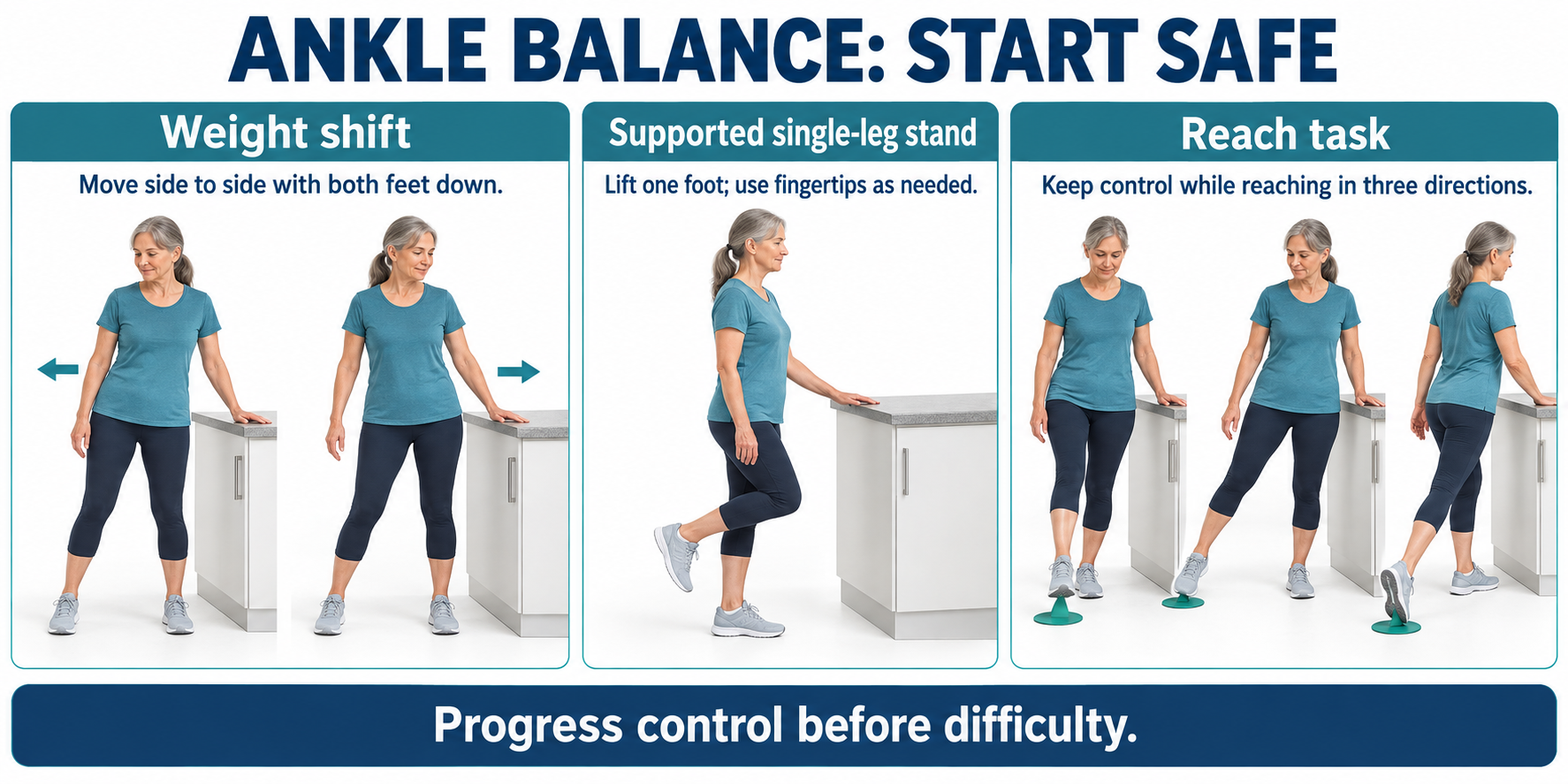
Stand at a counter with both feet flat and comfortably apart. Slowly move your body weight toward one foot, then back through the middle and toward the other side.
- Keep both heels in contact with the floor.
- Move the body rather than rolling onto the edge of the foot.
- Use your hands as much as needed.
- Work within a comfortable ankle range.
This is a useful bridge when a single-leg task is not yet controlled. Leeds Teaching Hospitals’ ankle guidance includes side-to-side weight transfer before later balance work.
Progress to a supported single-leg stand
Stand next to the counter and shift onto the affected leg. Lift the other foot only a little, keep the standing foot flat and use fingertip support to prevent a loss of balance.
- Keep a soft bend in the standing knee.
- Keep the pelvis reasonably level and the trunk upright.
- Replace your hand immediately when control is lost.
- Finish before fatigue turns the drill into repeated stumbling.
The AAOS foot and ankle conditioning programme describes single-leg balance beside a stable support, with hands replaced as needed. Treat any published hold time as an example rather than a requirement.
Add controlled reach tasks
Once a supported stand is steady, add a small task instead of immediately moving to unstable equipment. The free foot can lightly tap the floor in front, to the side and behind while the stance foot stays controlled.
- Use small reach distances first.
- Keep the knee tracking in line with the foot.
- Touch down between reaches if needed.
- Stop if the ankle repeatedly rolls outward or inward.
A hand reach toward safe targets is another option, but the target should stay close enough that you can return without grabbing the counter. Quality matters more than how far you reach.
Combine balance with ankle and leg strength
Balance is only one part of ankle rehabilitation. Calf raises, suitable resisted ankle work and hip or knee strength may be needed because the whole leg helps control landing and direction changes.
- Start heel raises with both feet and stable hand support.
- Lift and lower under control rather than bouncing.
- Progress toward more work on the affected side only when ready.
- Follow individual advice for resistance-band direction and load.
North Bristol NHS Trust’s ankle rehabilitation guidance progresses comfortable weight bearing to balance and calf strength, then builds toward impact and sport.
| Stage | Example drill | Useful progression check |
|---|---|---|
| Two-foot control | Side-to-side weight shifts | Feet stay flat and symptoms remain manageable |
| Supported balance | Single-leg stand with hand support | Less reliance on the hands without repeated stepping |
| Dynamic balance | Free-foot taps or gentle reaches | Stance foot, knee and trunk remain controlled |
| Higher demand | Direction changes, landing or sport-specific task | Required speed and complexity are rebuilt gradually |
This table is a framework, not a fixed timetable. A harder surface or faster movement is not automatically better if control deteriorates.
Progress one variable at a time
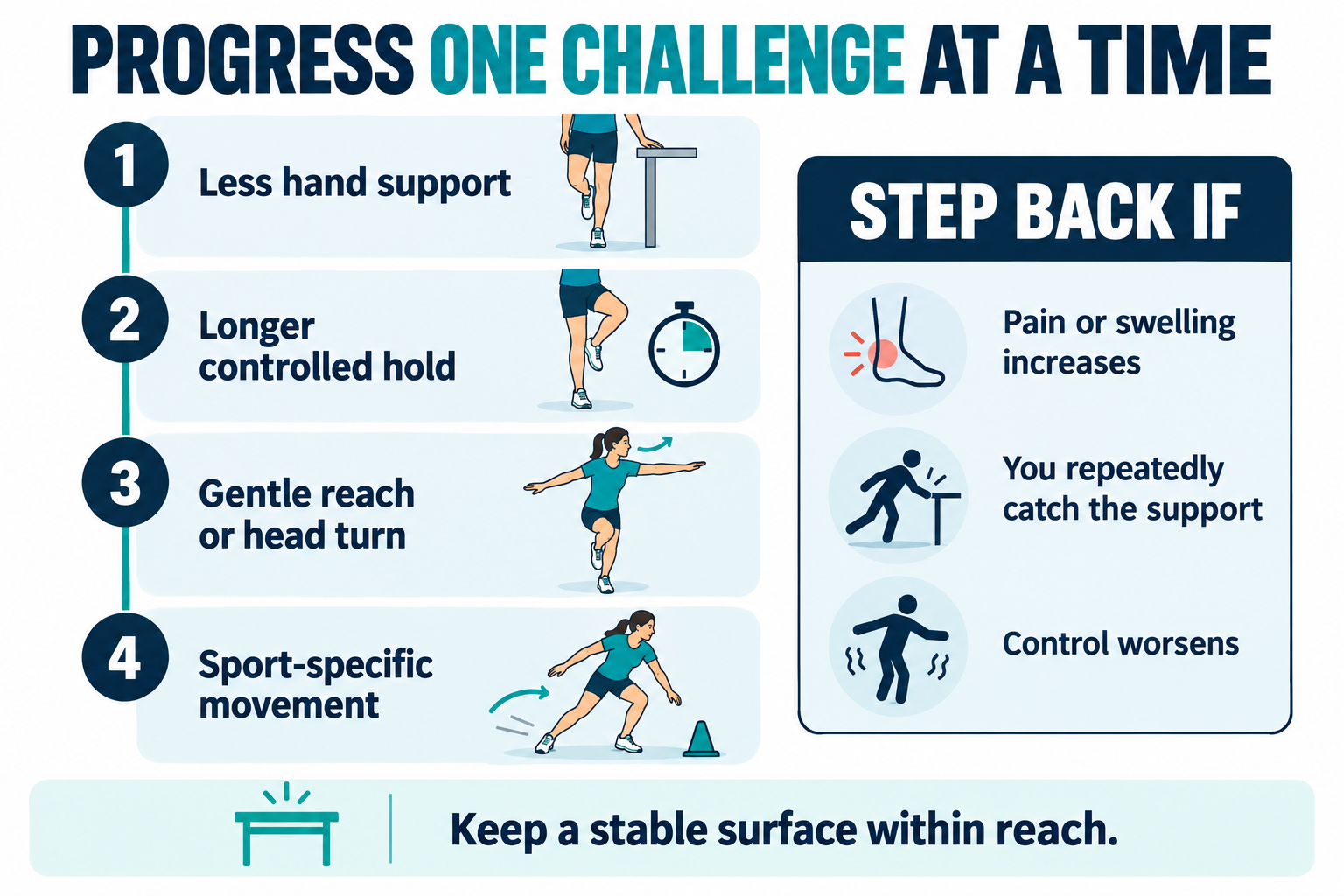
Balance drills can be made harder by changing hand support, duration, reach distance, movement speed or task complexity. Change one variable so you can judge the response.
- Reduce hand pressure before removing support completely.
- Extend a controlled hold gradually.
- Add a small reach or gentle head turn only after steady basic balance.
- Introduce sport-specific movement after strength and landing control are ready.
Closing the eyes or standing on an unstable surface sharply changes the challenge and fall risk. Those options are not required for everyone and are better used with professional guidance when appropriate.
Use symptoms and movement quality to adjust
Check the ankle during the drill, afterward and the next morning. Increasing pain, swelling, limping or repeated giving way means the current dose or difficulty needs review.
- Reduce the hold, reach or number of attempts.
- Restore hand support or return to two feet.
- Allow recovery before the next demanding session.
- Seek assessment if simple adjustments do not settle the response.
Cambridge University Hospitals notes that ankle exercise can feel acceptable during the session but become painful afterward when progression is too fast. A delayed response is therefore part of the decision, not an inconvenience to ignore.
Prepare for walking, running and sport demands
A quiet single-leg stand does not test every real-world demand. Return to running or sport may require calf endurance, hopping, landing, acceleration, braking and direction changes.
- Restore comfortable walking on level ground first.
- Practise uneven-ground tasks in a controlled setting.
- Build straight-line impact before fast cutting.
- Rehearse the actual movements of your activity before full participation.
The Cambridge University Hospitals ankle guide describes a graded progression from balance and strength toward straight-line jogging and later direction changes. Return decisions should also consider swelling, confidence and repeated instability.
Know when professional assessment adds value
A physiotherapist can assess ankle range, strength, dynamic balance, movement confidence and the tasks that provoke instability. Examination also helps distinguish functional control problems from mechanical laxity or another diagnosis.
- Ask for help after recurrent sprains or frequent giving way.
- Seek review when pain, swelling or locking persists.
- Get individual guidance if work or sport demands rapid direction changes.
- Discuss braces or taping as part of a wider plan rather than a replacement for rehabilitation.
Testing may include a controlled reach task such as a modified Star Excursion Balance Test. It should be used to guide rehabilitation, not as an unsupervised contest for maximum reach.
Conclusion
Ankle instability training works best when it begins with safe weight transfer and supported balance, then adds reach, strength and activity-specific movement. Keep a stable support nearby, progress one challenge at a time and use symptoms and movement quality to guide the dose. Recurrent giving way or unresolved pain deserves assessment.
Frequently asked questions
What is proprioception?
Proprioception is the nervous system’s awareness of body and joint position and movement. Ankle drills train it together with muscle response, vision and whole-body control.
Are balance drills enough for ankle instability?
Usually not by themselves. An effective plan may also address ankle movement, calf and leg strength, walking, landing and the specific demands of work or sport.
Should I balance barefoot or in shoes?
Use the footwear appropriate for your stage and environment. Barefoot work changes the task and is not automatically better, especially if you need support or have reduced foot sensation.
How long should I hold a single-leg stand?
Use a duration you can control without repeated grabbing or stepping. Build gradually rather than forcing a universal target time.
Is wobbling during balance exercise normal?
Small corrections are expected, but repeated ankle rolling or large uncontrolled movements mean the task is too hard. Add support or return to an easier version.
Should I close my eyes to make the drill harder?
Not routinely. Removing vision greatly increases the challenge and fall risk, so it should only be used when suitable and with a safe setup or professional guidance.
Do I need a wobble board?
No. Weight shifts, supported single-leg standing and controlled reaching can all be progressed on a level floor before unstable equipment is considered.
Can I do balance exercises after a new ankle sprain?
Early movement and loading depend on the injury and your ability to bear weight. Obtain assessment when a fracture or significant injury is possible, then follow the staged plan provided.
When can I return to running?
Running requires more than quiet balance. Comfortable walking, suitable strength and control during impact should be restored before a graded running progression.
Why does my ankle still give way despite practising?
The exercise may not yet match the cause or real-life demand, or another problem may be present. Recurrent giving way is a good reason for clinical assessment and a more individual plan.