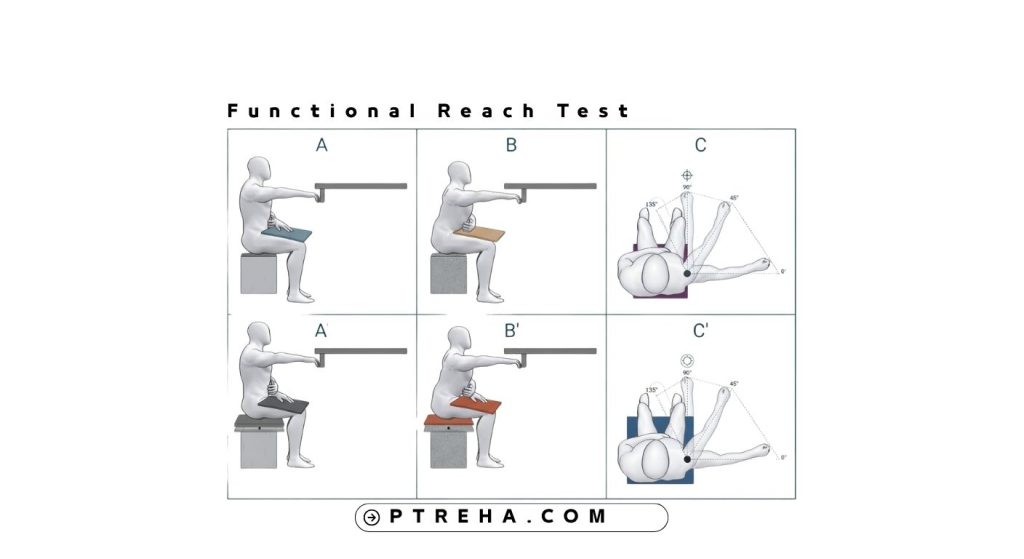
The Functional Reach Test is a simple, quick, and widely used clinical measure of standing balance and dynamic stability. It assesses how far a person can reach forward while standing in a fixed position without taking a step. Because it requires minimal equipment and space, it is commonly used in geriatric, neurologic, and general rehabilitation settings to screen balance performance, monitor change over time, and contribute to falls-risk assessment when combined with other measures.
What Is the Functional Reach Test?
The Functional Reach Test (FRT) is a functional performance measure, not a provocative orthopedic special test. It quantifies the maximal distance a person can reach forward beyond arm’s length while maintaining a fixed base of support in standing.
The test was developed to provide a practical, low-cost way to measure dynamic balance and stability limits. It is often described as a measure of the margin of stability and the ability to move the center of mass toward the limits of the base of support without losing balance.
What it measures:
- Forward reach distance in standing
- Dynamic standing balance and stability limits
- Ability to control the center of mass during a voluntary reaching task
What it does NOT measure:
- It is not a diagnostic test for any specific disease or pathology
- It does not isolate individual muscle strength
- It does not assess balance in all directions (only forward reach is tested)
- It does not measure gait, endurance, or reaction to perturbation
- It does not replace a comprehensive balance or falls-risk evaluation
Its clinical role is that of a screening and outcome measure that contributes to the broader assessment of balance and mobility.
Purpose of the Functional Reach Test
- To quantify forward reach distance as an indicator of dynamic standing balance
- To screen for reduced balance performance in older adults and clinical populations
- To monitor change in balance performance over time or after intervention
- To contribute to falls-risk assessment alongside other measures
- To provide a baseline measure that can be repeated easily in most clinical settings
- To guide treatment planning by identifying limited stability limits
Functional Reach Test Indications
- Older adults, particularly those with a history of falls or balance concerns
- Patients with neurologic conditions such as stroke, Parkinson’s disease, or peripheral neuropathy
- Patients with vestibular disorders affecting standing balance
- Post-operative or post-fracture patients who are weight-bearing and medically stable
- Patients in geriatric rehabilitation or community-dwelling fall-prevention programs
- Individuals whose balance and stability limits need to be documented or tracked
The test is not appropriate for every patient with these conditions. Clinical judgment regarding weight-bearing status, medical stability, and safety must guide its use.
Functional Reach Test Contraindications and Precautions
- Inability to stand safely without maximal assistance or with an unsteady standing balance
- Acute lower extremity injury, recent fracture, or unstable joint that limits weight-bearing
- Non-weight-bearing or partial weight-bearing restrictions on the tested limb
- Acute cardiovascular instability, uncontrolled hypertension, or recent cardiac event
- Severe vestibular symptoms, vertigo, or orthostatic hypotension that may cause falls
- Significant cognitive impairment that prevents understanding of instructions or safe participation
- Severe pain that limits forward reach or compromises safety
- Patients at high risk of falling who cannot be safely guarded
Modifications such as seated reach or using a gait belt with close guarding may be considered when appropriate, but results from modified protocols should not be compared with standard standing values.
Equipment
- A ruler, yardstick, or measuring tape mounted horizontally at shoulder height on a wall or stand
- A stable wall or surface for mounting the measurement device
- A sturdy chair or parallel bars for guarding and safety, if needed
- A gait belt for safety in patients at risk of falling
Patient Position
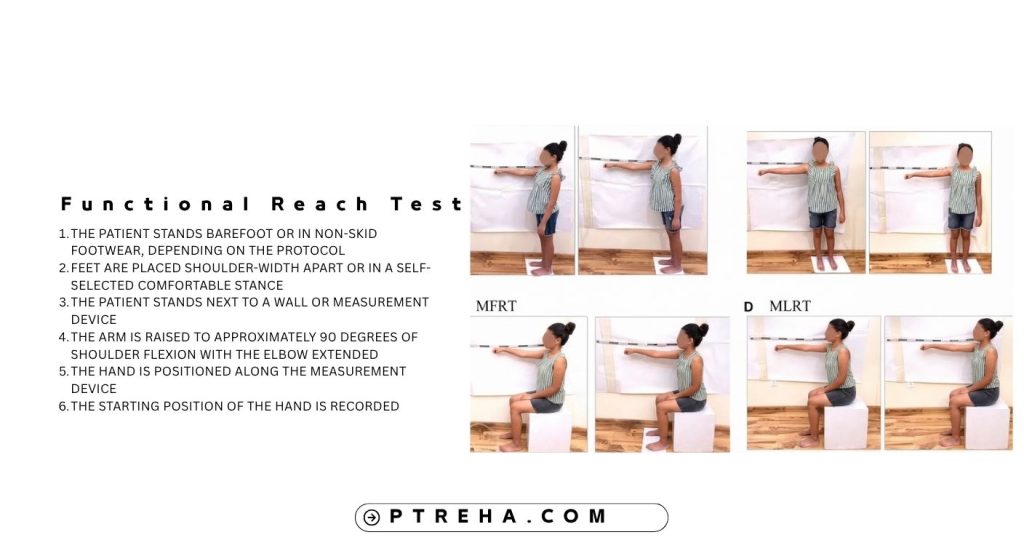
- The patient stands barefoot or in non-skid footwear, depending on the protocol
- Feet are placed shoulder-width apart or in a self-selected comfortable stance
- The patient stands next to a wall or measurement device
- The arm is raised to approximately 90 degrees of shoulder flexion with the elbow extended
- The hand is positioned along the measurement device
- The starting position of the hand is recorded
Protocol variation exists in the literature. Some versions specify a fixed foot position, while others allow a self-selected stance. The measurement device may be mounted at shoulder height or at the height of the patient’s fist. Clinicians should document the protocol used so that repeated measurements remain comparable.
Examiner Position
- The examiner stands close to the patient on the side of the reaching arm or behind the patient
- The examiner provides guarding without physically assisting the movement
- The examiner observes the feet, trunk, and reaching arm for compensatory movements
- The examiner records the start and end positions of the hand along the measurement device
- Physical assistance is generally not permitted during the test, as it would alter the measurement
How to Perform the Functional Reach Test
- Explain the test to the patient and obtain consent.
- Position the patient standing next to the measurement device.
- Instruct the patient to raise the arm to about 90 degrees of shoulder flexion with the elbow straight.
- Record the starting position of the hand along the measurement device.
- Instruct the patient to reach forward as far as possible without taking a step, without touching the wall, and without losing balance.
- Observe the patient’s feet, trunk, and arm during the reach.
- Record the end position of the hand at the furthest point of the reach.
- Calculate the reach distance as the difference between the start and end positions.
- Allow the patient to return to the starting position and rest briefly.
- Repeat for the established number of trials, typically three, and record each attempt.
- Use the average or the best of the trials according to the chosen protocol.
Trials in which the patient takes a step, touches the wall, or loses balance are considered invalid and should be repeated. Documenting invalid trials is important for accurate interpretation.
Scoring and Interpretation
The score is the forward reach distance, usually measured in centimeters or inches. It is calculated by subtracting the starting hand position from the ending hand position.
Higher scores generally indicate greater forward stability limits and better dynamic balance performance. Lower scores generally indicate reduced forward reach and limited stability limits, which may be associated with increased falls risk in some populations.
Interpretation depends on the population, the protocol used, and the purpose of testing. A score that is low for one population may be acceptable for another. There is no single universal cutoff that applies to all patients.
Clinicians should consider the score alongside other balance measures, gait assessment, strength testing, and the patient’s functional history. A single score should not be used in isolation to determine falls risk or to make treatment decisions.
Reference Values and Cutoffs
Reference values for the Functional Reach Test vary by population, age, protocol, and measurement method. Published values differ between community-dwelling older adults, institutionalized older adults, and individuals with specific neurologic or musculoskeletal conditions.
A threshold of approximately 15 cm has been used in some older adult populations to identify reduced performance or increased falls risk. This value should not be applied universally. It reflects findings from specific studies with specific populations and protocols, and it may not be appropriate for younger adults, patients with neurologic conditions, or individuals tested with a modified protocol.
There is no single universally accepted cutoff for this assessment. Clinicians should refer to population-specific reference values when available and interpret results in the context of the individual patient.
Anatomy and Structures Involved in the Functional Reach Test
- Ankle dorsiflexors and plantarflexors, which contribute to forward and backward postural adjustments
- Hip extensors and flexors, which help control trunk and pelvis position during the reach
- Trunk extensors and abdominal muscles, which stabilize the spine and pelvis
- Shoulder flexors, which raise and control the reaching arm
- Visual system, which contributes to postural orientation
- Vestibular system, which contributes to balance and spatial orientation
- Somatosensory system, including proprioception and plantar cutaneous input, which informs postural control
- Central nervous system processing for motor planning, coordination, and postural adjustments
The test is a functional measure of balance and stability limits. It does not isolate any single muscle or structure.
Conditions and Populations Associated With the Functional Reach Test
- Older adults with balance concerns or a history of falls
- Patients with Parkinson’s disease
- Patients after stroke
- Patients with vestibular disorders
- Patients with peripheral neuropathy
- Patients in geriatric rehabilitation or fall-prevention programs
- Patients with lower extremity fractures or joint replacements who are weight-bearing and medically stable
The test may be useful for describing balance performance in these populations, but it does not diagnose any of these conditions.
Clinical Significance
- Provides a quick, objective measure of forward dynamic balance
- Can help identify patients with limited stability limits who may benefit from balance training
- Can be repeated to monitor change over time
- Contributes useful information when combined with other balance and mobility measures
- Helps guide treatment planning by highlighting specific balance limitations
- Is easy to administer in most clinical settings with minimal equipment
The Functional Reach Test should not be used alone to determine falls risk or to make a diagnosis. It is one piece of a broader clinical picture.
Reliability and Validity
The Functional Reach Test has been studied in a variety of populations, including older adults, patients with neurologic conditions, and individuals in rehabilitation settings. Reliability and validity findings vary depending on the population, protocol, and measurement method.
- Test-retest reliability has generally been reported as acceptable in many populations, though values differ across studies
- Inter-rater and intra-rater reliability have been reported as acceptable in several studies, but results vary with examiner experience and protocol standardization
- Validity as a measure of balance and stability limits is supported in some populations, but the test does not capture all aspects of balance
- Correlations with other balance measures vary, and the test should not be treated as equivalent to a comprehensive balance assessment
Clinicians should interpret reliability and validity findings in the context of the specific population and protocol used.
Sensitivity and Specificity
The Functional Reach Test is primarily a functional and clinical outcome measure. It is not designed as a stand-alone diagnostic test, and sensitivity and specificity values vary substantially across studies, populations, cutoffs, and reference standards.
- Reported values differ by population, such as community-dwelling older adults versus institutionalized older adults
- Values depend on the cutoff used and the outcome being predicted
- Values depend on the reference standard, such as prospective falls, balance scale scores, or clinical judgment
- No single sensitivity or specificity value applies universally to all patients
Because of this variation, clinicians should not rely on a single sensitivity or specificity figure when interpreting the test.
Diagnostic Accuracy
This assessment is primarily a functional or clinical outcome measure and should not be interpreted as a stand-alone diagnostic test. It does not diagnose any specific condition, and its diagnostic accuracy has not been established in a way that supports using it as a definitive diagnostic tool.
When the test is used as part of a broader assessment, it can contribute useful information about balance performance and stability limits. It should be combined with other measures and clinical judgment.
Common Mistakes in the Functional Reach Test
- Allowing the patient to take a step or lift the heels during the reach
- Failing to standardize the starting hand position
- Using inconsistent instructions between trials or between sessions
- Measuring from an incorrect reference point or reading the device inaccurately
- Providing physical assistance that alters the reach distance
- Failing to guard the patient adequately, increasing fall risk
- Not documenting invalid trials or compensatory movements
- Comparing scores from different protocols as if they were equivalent
- Interpreting a score outside the population in which it was validated
- Using the test as a stand-alone falls-risk or diagnostic measure
Tips for Performing the Functional Reach Test
- Use a consistent protocol and document it clearly for future comparisons
- Demonstrate the movement before testing to improve patient understanding
- Use a gait belt and stand close for guarding in patients at risk of falling
- Ensure the measurement device is stable and mounted at the correct height
- Give clear, concise instructions and avoid leading the patient
- Record each trial and note any invalid attempts
- Allow adequate rest between trials to reduce fatigue effects
- Maintain the same examiner and protocol when tracking change over time
- Combine the test with other balance and mobility measures for a fuller picture
Limitations of the Functional Reach Test
- It measures only forward reach, not balance in other directions
- It does not assess gait, endurance, or reaction to external perturbation
- Performance can be influenced by fear of falling, motivation, and pain
- Results vary with protocol, including foot position, arm height, and number of trials
- Reference values differ across populations, limiting universal interpretation
- It does not diagnose any specific condition
- It should not be used alone to determine falls risk or to guide treatment decisions
- Measurement error can occur with inconsistent positioning or reading of the device
Related Tests and Assessments
- Timed Up and Go Test: assesses mobility, balance, and functional transitions
- Berg Balance Scale: provides a broader assessment of static and dynamic balance
- Functional Gait Assessment: evaluates balance during walking tasks
- 5 Times Sit-to-Stand Test: measures lower extremity strength and functional transitions
- Single Leg Stance Test: assesses static standing balance
- Dynamic Gait Index: evaluates gait adaptability and balance during walking
- Fall risk screening tools: provide broader context for falls-risk assessment
These assessments provide complementary information and should be selected based on the patient’s presentation and clinical goals.
Frequently Asked Questions
What is a normal Functional Reach Test score?
There is no single normal score that applies to all patients. Reference values vary by age, population, protocol, and measurement method. Clinicians should use population-specific values when available and interpret the score in context.
Is the Functional Reach Test a diagnostic test?
No. It is a functional performance measure that contributes to the assessment of balance and stability limits. It does not diagnose any specific condition.
How many trials should be performed?
Many protocols use three trials and record the average or the best performance. The number of trials and the method of summarizing results should be consistent and documented.
Can the Functional Reach Test predict falls?
Reduced reach distance has been associated with increased falls risk in some populations, but the test should not be described as predicting falls. Falls risk is multifactorial and should be assessed with multiple measures.
What equipment is needed?
A ruler, yardstick, or measuring tape mounted horizontally at shoulder height, a stable wall or stand, and a gait belt for safety when needed.
Is physical assistance allowed during the test?
Physical assistance is generally not permitted because it would alter the reach distance and the measurement. Guarding without assistance is appropriate for safety.
Can the test be performed in sitting?
A seated version has been described, but it uses a different protocol and should not be compared with standing values. The standard test is performed in standing.
Why is the Functional Reach Test used in older adults?
It is quick, requires minimal equipment, and provides useful information about forward dynamic balance and stability limits. It is often included in geriatric and fall-prevention assessments alongside other measures.
Summary
- The Functional Reach Test is a functional performance measure of forward dynamic balance and stability limits in standing.
- It is performed by measuring how far a patient can reach forward beyond arm’s length without taking a step.
- The score is the difference between the starting and ending hand positions, usually measured in centimeters or inches.
- Lower scores generally indicate reduced forward stability limits and may be associated with increased falls risk in some populations, but interpretation depends on the population and protocol.
- The test is not diagnostic and should be combined with other balance and mobility measures for a comprehensive assessment.
“The Functional Reach Test is best understood as one useful window into forward balance, not as a complete picture of a patient’s stability.”
“A single reach distance tells you how far a patient moved, but it does not tell you why, so clinical reasoning must always follow the measurement.”
The Functional Reach Test remains a practical and widely used tool in physical therapy and rehabilitation. When performed with a consistent protocol, interpreted within the appropriate population context, and combined with other clinical measures, it provides valuable information about balance performance and can support treatment planning and monitoring over time.