
The Timed Up and Go Test is a functional performance assessment used to examine basic mobility during a short sequence of everyday movements.
It measures the time required to stand from a chair, walk, turn, return, and sit, while also giving the clinician an opportunity to observe how the patient performs each component of the task.
What Is the Timed Up and Go Test?
The Timed Up and Go Test, commonly abbreviated TUG, is a functional performance test and clinical mobility assessment.
It is not an orthopedic special test and is not intended to identify a lesion of a particular muscle, ligament, joint, or nerve.
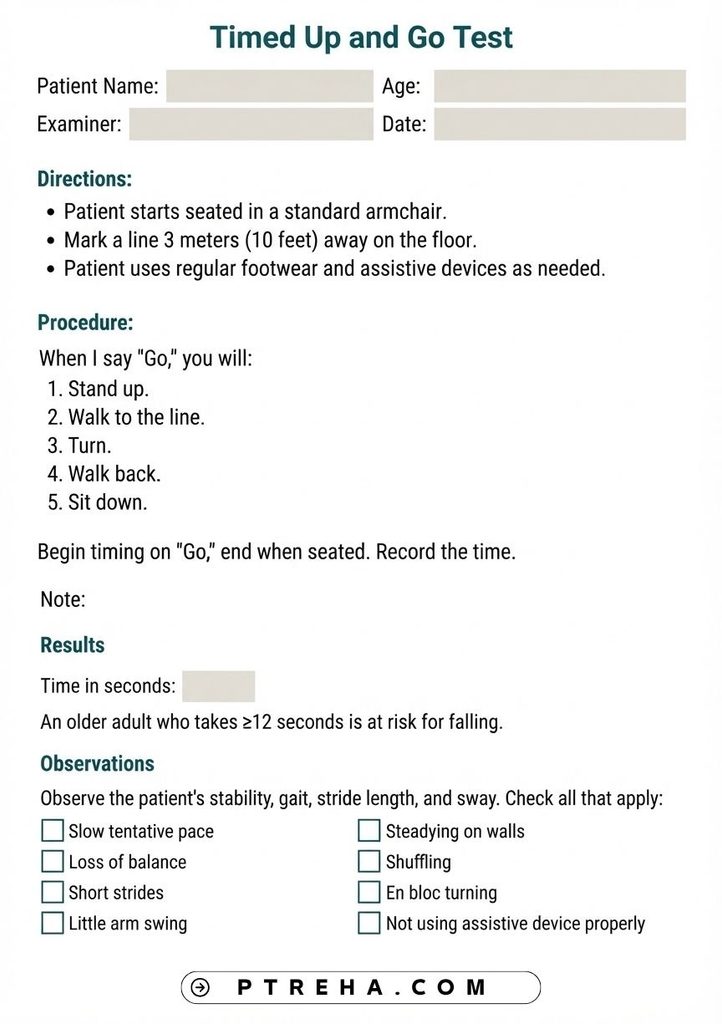
In the commonly used 3-meter protocol, the patient begins seated in a chair, stands when instructed, walks to a marked point, turns, walks back, and sits down again.
The examiner records the elapsed time for the complete task.
The original Timed Up and Go was developed as a timed version of the earlier Get Up and Go assessment to provide a practical measure of basic functional mobility.
It has since been used extensively in geriatric, neurological, rehabilitation, and community settings.
The result is generally reported as time in seconds.
However, the numerical result should be interpreted together with the patient’s functional status, gait, turning strategy, use of an assistive device, symptoms, and the exact testing protocol.
Purpose of the Timed Up and Go Test
The Timed Up and Go Test can be used to:
- Assess functional mobility during a standardized task.
- Measure performance of sit-to-stand, walking, turning, and sitting as part of one continuous activity.
- Identify mobility limitations that may warrant further clinical assessment.
- Establish a baseline for rehabilitation.
- Monitor changes in functional mobility over time.
- Contribute to a broader assessment of fall risk when combined with other relevant clinical information.
The test is particularly useful because it is simple, requires little equipment, and reflects several components of everyday mobility within a single task.
Timed Up and Go Test Indications
The TUG may be appropriate for patients who can safely perform the task and who require assessment of functional mobility.
Common clinical applications include:
- Older adults with mobility limitations.
- Patients participating in gait or balance rehabilitation.
- Individuals after stroke who are able to walk.
- Patients with Parkinsonian movement disorders.
- Patients with neurological disorders affecting mobility.
- Individuals recovering from selected musculoskeletal conditions.
- Patients whose functional mobility needs to be monitored during rehabilitation.
The test should be selected according to the patient’s abilities and the clinical question.
A person who cannot safely complete the task may require a different assessment or a modified approach.
Timed Up and Go Test Contraindications and Precautions
There is no universally accepted list of disease-specific contraindications unique to the TUG.
The major consideration is whether the patient can perform the task safely.
Relevant precautions include:
- Do not perform the test when the patient cannot safely stand, walk, turn, or sit with the assistance available.
- Keep the walking pathway free of obstacles and unnecessary distractions.
- Stay close enough to protect the patient if balance is impaired.
- Allow the patient’s usual assistive device when clinically appropriate and document its use.
- Consider dizziness, acute pain, marked weakness, instability, or other symptoms that could make the task unsafe.
- Stop the test when continuing would create an unreasonable safety risk.
The assessment is intended to measure functional performance, not to force a patient to complete a mobility task that is beyond their safe level of function.
Patient Position
For the commonly used 3-meter TUG protocol:
- The patient starts seated in a stable armchair.
- The patient is positioned securely with the back supported before the test begins.
- A clearly marked walking point is placed approximately 3 meters from the chair.
- The patient’s usual footwear and walking aid may be retained according to the testing protocol.
- The patient begins from the seated position and waits for the examiner’s instruction.
When repeated measurements are being compared, maintaining similar equipment, instructions, environment, and assistance is important.
Examiner Position
The examiner should:
- Stand close enough to the patient to provide assistance if necessary.
- Maintain a position that allows observation of the entire task.
- Ensure that the walking path remains clear.
- Use consistent instructions and timing procedures.
- Observe not only the final time but also the quality and safety of movement.
The examiner should pay particular attention to the transitions from sitting to standing and standing to sitting, as well as gait initiation, turning, and any evidence of instability.
How to Perform the Timed Up and Go Test
The following describes the commonly used 3-meter TUG protocol.
- Seat the patient in the chair and ensure a stable starting position.
- Place a visible marker on the floor at the prescribed walking distance of 3 meters.
- Explain the complete task before timing begins.
- Instruct the patient to stand from the chair, walk to the marker at their usual safe walking pace, turn around, return to the chair, and sit down.
- Give the starting command.
- Start the stopwatch when the patient begins the movement according to the selected protocol.
- Allow the patient to complete the sequence without unnecessary additional assistance or coaching.
- Stop the timer when the patient has returned to the chair and completed the sitting portion of the task according to the protocol being used.
- Record the elapsed time.
- Document relevant observations, including assistive-device use, gait deviations, hesitation, instability, difficulty turning, or difficulty controlling the descent into the chair.
Different versions and adaptations of the TUG exist.
The protocol should therefore be specified whenever the result is documented or compared with research findings.
Interpretation of the Timed Up and Go Test
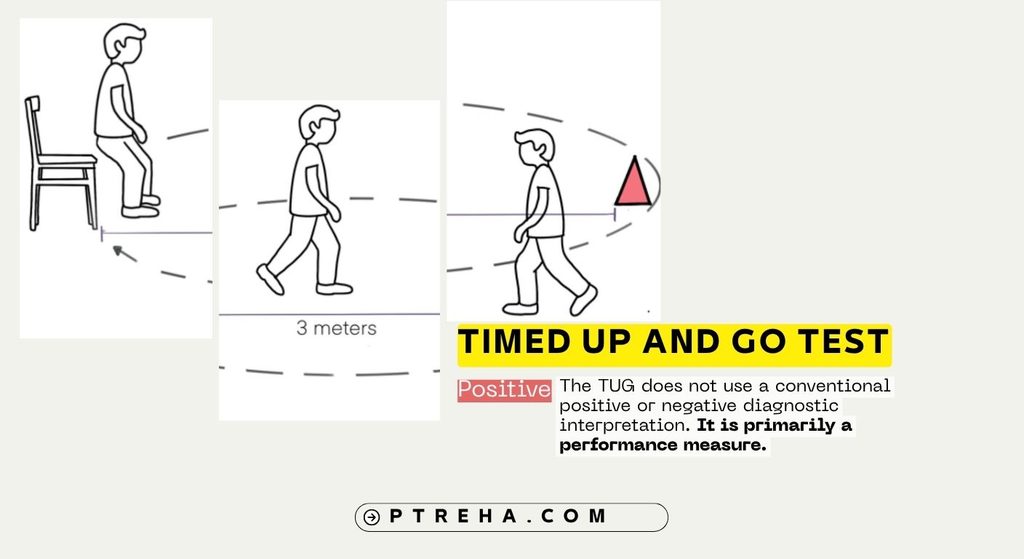
The TUG does not use a conventional positive or negative diagnostic interpretation.
It is primarily a performance measure.
A longer completion time indicates that the patient took more time to complete the standardized mobility sequence.
This can reflect limitations in one or more parts of the task, but the time itself does not identify the underlying cause.
A slower performance could be influenced by reduced lower-extremity function, impaired balance, gait abnormalities, pain, neurological impairment, reduced confidence, difficulty with turning, or other factors.
These possibilities should be examined clinically rather than assumed from the TUG result alone.
Some clinical protocols use specific time thresholds for screening purposes.
For example, the CDC STEADI materials use a 12-second threshold within their older-adult fall-risk assessment protocol.
This value should not be treated as a universal normal value or pass/fail rule for every patient, because performance depends on the population, clinical context, protocol, and purpose of testing.
What Does a Longer Timed Up and Go Result Mean?
A longer TUG time means slower completion of the tested functional mobility task.
It may indicate reduced mobility or difficulty with one or more task components, but it does not establish a diagnosis.
For example, a patient may have a prolonged time primarily because of difficulty rising from the chair, slow gait, cautious turning, or difficulty sitting down safely.
Two patients with the same total time may therefore have very different clinical problems.
The most useful interpretation combines the measured time with direct observation and other relevant assessments.
Anatomy Involved in Timed Up and Go Test
The Timed Up and Go Test involves coordinated activity across multiple anatomical and physiological systems.
- Lower-extremity joints and muscles: contribute to rising, walking, turning, and controlled sitting.
- Trunk musculature: contributes to postural control during transitional and walking tasks.
- Central nervous system: coordinates movement planning, sequencing, postural responses, and gait.
- Visual system: contributes to spatial orientation and environmental awareness.
- Vestibular system: contributes to orientation and balance.
- Somatosensory system: provides information used for postural and movement control.
- Cardiorespiratory system: supports the physiological demands of functional walking and repeated transitional movement.
The TUG should not be described as a test of any single muscle or anatomical structure.
Successful completion depends on integrated system performance.
Conditions Detected or Associated With the Test
The Timed Up and Go Test is used across a range of populations and can contribute to assessment in patients with:
- Parkinson’s disease and other movement disorders.
- Stroke.
- Multiple sclerosis.
- Vestibular and balance-related disorders.
- Musculoskeletal conditions affecting mobility.
- Neurological impairments affecting gait and transfers.
- General mobility limitations in older adults.
These are clinical contexts in which the test may provide useful functional information.
The TUG itself does not independently confirm any of these diagnoses.
Clinical Significance
The TUG can contribute to clinical decision-making in several ways:
- Provides a simple baseline measure of functional mobility.
- Helps document mobility during rehabilitation.
- Allows comparison over time when the testing protocol is consistent.
- Helps identify patients who may require more detailed gait or balance assessment.
- Provides information about functional transitions that may not be captured by isolated strength measurements.
- Can contribute to a broader fall-risk assessment when interpreted alongside history and other clinical measures.
A particularly useful feature of the TUG is that the clinician can observe the patient’s movement strategy while simultaneously recording a measurable outcome.
For rehabilitation, this can make the test useful for monitoring change even when the patient’s principal goal is not related specifically to fall risk.
Sensitivity and Specificity
Sensitivity and specificity are not universal characteristics of the Timed Up and Go Test.
Research examining the TUG for identifying or predicting falls has used different patient populations, protocols, follow-up periods, and cutoff values.
Systematic reviews have found substantial variation between studies, and the overall ability of the TUG alone to distinguish people who will or will not fall is limited.
One systematic review and meta-analysis of community-dwelling older adults found limited ability of the TUG to predict future falls when used alone.
Another large systematic review reported that derived cut points varied considerably and concluded that no single TUG cut point could be recommended universally across older populations.
For this reason, sensitivity and specificity values should only be interpreted together with the population, outcome, protocol, and cutoff from the study in which they were obtained.
Diagnostic Accuracy
The TUG is best considered a functional mobility measure, not a general diagnostic test.
Its diagnostic accuracy depends entirely on the clinical question.
A test that measures mobility may have value for functional classification or screening without being appropriate for diagnosing a disease.
Research has particularly highlighted limitations when the TUG is used alone to predict future falls.
The evidence suggests that fall risk is multifactorial and should not be inferred from one mobility test in isolation.
A TUG result should therefore complement, rather than replace, history-taking, physical examination, gait assessment, balance assessment, and other clinically relevant measures.
Common Mistakes in Timed Up and Go Test
- Changing the distance between repeated tests.
- Using a different chair or substantially different setup without documenting it.
- Inconsistently allowing or removing the patient’s usual walking aid.
- Starting or stopping the stopwatch at different points.
- Giving additional coaching during one assessment but not another.
- Changing the walking-speed instruction between assessments.
- Ignoring movement quality because the final time appears acceptable.
- Failing to observe the turning and sitting phases carefully.
- Standing too far away from a patient who requires close supervision.
- Comparing TUG scores from different protocols as though they were directly interchangeable.
Tips for Performing the Timed Up and Go Test
- Explain the task clearly before starting the timer.
- Use the same protocol when monitoring progress.
- Keep the environment consistent whenever practical.
- Document the assistive device and relevant modifications.
- Watch the entire movement sequence rather than focusing only on the stopwatch.
- Record clinically important observations alongside the time.
- Consider whether pain, fear, fatigue, dizziness, or another factor influenced performance.
- Interpret the result in the context of the patient’s diagnosis, age, functional level, and clinical goals.
- Use additional assessments when the TUG result raises a clinical question that the TUG itself cannot answer.
Summary
- The Timed Up and Go Test is primarily a functional performance and mobility assessment, not a conventional orthopedic or neurological diagnostic test.
- The commonly used protocol involves standing from a chair, walking approximately 3 meters, turning, returning, and sitting down while the elapsed time is recorded.
- A longer time indicates slower performance of the tested task but does not independently establish the cause of the limitation or a specific diagnosis.
- Movement quality, assistive-device use, safety, and the exact testing protocol are important when interpreting the result.
- TUG performance can contribute to broader mobility and fall-risk assessment, but it should not be used as the sole basis for diagnosing a condition or predicting an individual’s future falls.
The Timed Up and Go Test remains useful because it combines a simple quantitative outcome with direct observation of functional movement.
Its greatest clinical value comes from standardized administration and careful interpretation within the patient’s broader assessment rather than from treating one number as a universal threshold.
Resources and External Links
CDC STEADI – Timed Up & Go Assessment
Centers for Disease Control and Prevention: Timed Up & Go
Original Timed Up and Go Study
Podsiadlo D, Richardson S.
The timed “Up & Go”: a test of basic functional mobility for frail elderly persons
Systematic Review – TUG and Falls in Older Adults
Timed Up and Go test and risk of falls in older adults: a systematic review
Systematic Review and Meta-analysis – Predicting Falls in Community-Dwelling Older Adults
Is the Timed Up and Go test a useful predictor of risk of falls in community dwelling older adults?
Systematic Review and Meta-analysis – Discriminative Ability and Predictive Validity
Discriminative ability and predictive validity of the Timed Up and Go test
Systematic Review – Fall Risk Assessment in Community-Dwelling Older Adults
Determining Risk of Falls in Community Dwelling Older Adults