
The Dynamic Gait Index (DGI) is a standardized clinical assessment of walking performance under increasingly demanding conditions. It was developed to examine the ability to modify balance and gait when the walking task changes, rather than assessing only steady-state walking.
What Is the Dynamic Gait Index?
The DGI contains eight gait tasks, each scored on an ordinal scale from 0 to 3, giving a possible total score from 0 to 24. Higher scores represent better performance within the scoring system, but the total should be interpreted in the context of the patient’s diagnosis, functional status, age, assistive-device use, and the testing protocol.
The DGI is therefore best classified as a functional performance test and outcome measure, rather than an orthopedic special test or a diagnostic neurological test.
“The DGI examines how effectively gait adapts when the walking task changes.”
Purpose of the Dynamic Gait Index
The DGI is designed to assess functional walking under conditions that require the patient to modify gait or postural control.
- Assess gait adaptability during different walking tasks.
- Examine dynamic balance during functional ambulation.
- Identify task-specific gait limitations that may not be obvious during ordinary walking.
- Monitor functional change during rehabilitation.
- Contribute to a broader clinical assessment of balance and mobility.
- Help characterize walking performance in people with neurological or vestibular disorders.
The DGI should complement, rather than replace, other examinations of strength, sensation, vestibular function, cognition, cardiovascular status, and functional mobility when those domains are clinically relevant.
Dynamic Gait Index Indications
The assessment may be useful when a clinician needs to examine walking under changing environmental or motor demands.
- Patients with gait or dynamic-balance limitations.
- People recovering from stroke.
- Individuals with Parkinson disease or other movement disorders.
- Patients with multiple sclerosis.
- People undergoing assessment for vestibular or balance-related walking difficulties.
- Patients in neurological or rehabilitation settings where changing walking demands are clinically relevant.
- Older adults in whom gait adaptability and mobility are important components of the functional assessment.
Use should remain population-specific. Evidence for the DGI is not equally established across every diagnosis or care setting.
Dynamic Gait Index Contraindications and Precautions
There is no single universal list of DGI-specific medical contraindications established across all populations. The main issue is safe execution of the walking tasks.
- Do not proceed with a task when the patient cannot perform it safely under the available level of supervision or assistance.
- Consider the patient’s current ability to walk, need for an assistive device, and ability to negotiate obstacles or stairs.
- Use appropriate guarding and environmental safety precautions for patients with impaired balance.
- Consider symptoms such as marked dizziness, presyncope, acute medical instability, or substantial fatigue that could make walking unsafe.
- Use additional assistance or modify the assessment plan when the patient’s condition changes during testing.
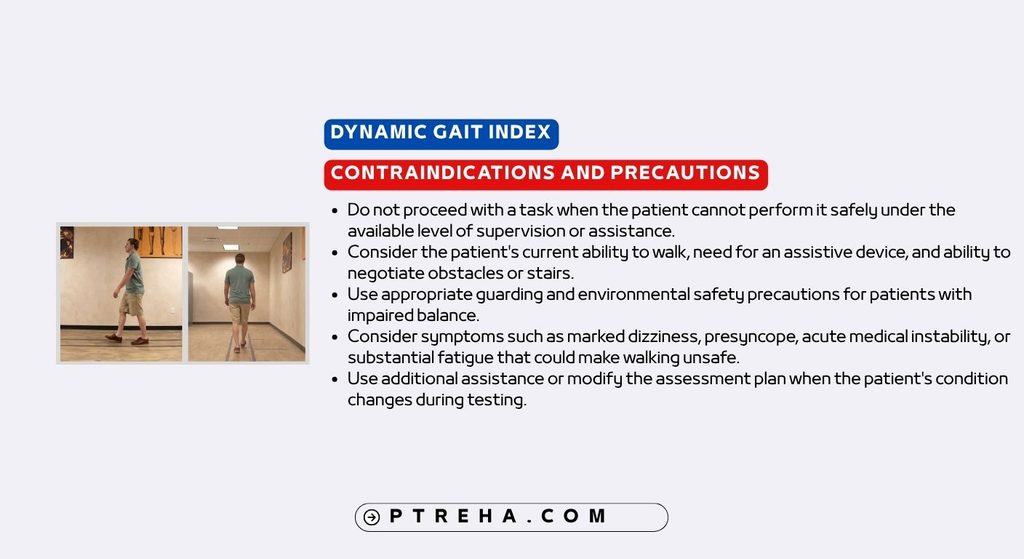
Safety precautions should be determined from the patient’s clinical presentation rather than from an invented DGI-specific contraindication list.
Patient Position
The patient begins in a standing position at the designated starting point and performs the walking tasks according to the standardized DGI instructions.
- Upright standing at the beginning of the walking task.
- Appropriate footwear should be maintained consistently when possible.
- The patient’s customary assistive device may be used when permitted by the protocol and appropriate for the individual.
- The walking environment should be prepared before testing begins.
The commonly described DGI setup includes a marked walking pathway, obstacles, and stairs. The RehabMeasures Database describes a 20-foot (6.1-meter) pathway, two obstacles, a shoe box, and stairs as required equipment.
Examiner Position
The examiner should be positioned so that the patient can be observed throughout the task while maintaining appropriate safety supervision.
- Maintain a position that permits observation of gait and balance.
- Remain close enough to provide assistance if required.
- Avoid unnecessary interference with the patient’s natural walking pattern.
- Maintain consistent instructions and scoring criteria across repeated assessments.
Because the DGI is an observer-rated measure, examiner consistency is important when comparing scores over time. Reliability findings differ among populations and individual items, so standardized administration is preferable.
How to Perform the Dynamic Gait Index
The original DGI contains eight tasks. The exact wording and scoring instructions should follow the version of the instrument being used.
1. Gait on a level surface
The patient walks along the designated pathway at the instructed usual pace. The examiner observes gait quality, balance, and the patient’s ability to complete the walking task.
2. Change in gait speed
The patient changes walking speed according to the examiner’s instructions, demonstrating the ability to transition between different walking speeds.
The important clinical observation is not simply how fast the person walks, but whether the change in speed can be achieved while maintaining functional gait and balance.
3. Gait with horizontal head turns
The patient walks while turning the head horizontally according to verbal instructions.
This task introduces an interaction between head movement and walking, requiring the patient to adapt gait while maintaining forward progression.
4. Gait with vertical head turns
The patient walks while moving the head vertically as instructed.
This adds another head-movement demand to walking and allows observation of how gait changes when the visual and vestibular demands of ambulation are altered.
5. Gait and pivot turn
The patient walks and performs a pivot turn according to the standardized instructions before continuing or completing the task.
The examiner observes turning control, gait continuity, and balance during the directional change.
6. Step over an obstacle
The patient walks toward an obstacle and steps over it rather than simply walking around it.
This task increases the environmental demand on walking and requires appropriate foot clearance, forward progression, and postural control.
7. Step around obstacles
The patient negotiates obstacles while continuing to walk.
The examiner observes whether the patient can alter the walking path while preserving adequate balance and gait control.
8. Stairs
The patient ascends and descends stairs according to the test instructions while the examiner observes safety, gait pattern, balance, and level of assistance required.
The DGI therefore progresses from relatively straightforward walking to tasks involving speed changes, head movements, turning, obstacle negotiation, and stairs.
Scoring and Performance Criteria
Each DGI item receives an ordinal score from 0 to 3.
- 3: best performance category described by the item.
- 2: mild reduction in performance.
- 1: moderate reduction in performance.
- 0: severe limitation according to the item’s scoring criteria.
The total score is calculated by adding the eight item scores, producing a possible range of 0–24. The individual item scores are clinically useful because two patients with the same total score may have very different task-specific limitations.
The DGI is not interpreted in the same way as a special test in which a particular maneuver produces a “positive” or “negative” result. It is a performance measure, so the clinically meaningful information is the pattern and degree of performance across the eight tasks.
Interpretation
A lower DGI score reflects greater difficulty completing the standardized walking tasks within the instrument’s scoring framework. However, the score does not identify a specific diagnosis or prove that a particular neurological, vestibular, muscular, or orthopedic impairment is responsible.
A higher score indicates better observed performance on the tested tasks, but it should not automatically be interpreted as proof that the individual’s overall balance or fall risk is normal.
Interpretation should consider:
- The patient’s diagnosis and stage of recovery.
- Baseline walking ability.
- Use of an assistive device.
- Environmental demands.
- Individual item scores.
- Other balance and mobility assessments.
- Change in score across repeated assessments.
The DGI has also been reported to have a ceiling effect, particularly in some people with vestibular dysfunction and in higher-functioning populations. This can make the measure less sensitive to improvement when a patient already performs near the top of the scale.
Anatomy Involved in Dynamic Gait Index
The DGI does not isolate a single anatomical structure. Performance depends on coordinated activity across multiple systems.
- Central nervous system: cortical, subcortical, cerebellar, and brainstem processes involved in gait adaptation and postural control.
- Vestibular system: contributes to orientation and stabilization during head movement.
- Visual system: provides information important for navigation, obstacle negotiation, and spatial orientation.
- Somatosensory system: contributes information about body position and interaction with the support surface.
- Musculoskeletal system: the lower limbs, trunk, and upper body provide the movement and mechanical control needed for walking.
- Cardiorespiratory and systemic factors: endurance and physiological tolerance can influence the ability to perform walking tasks.
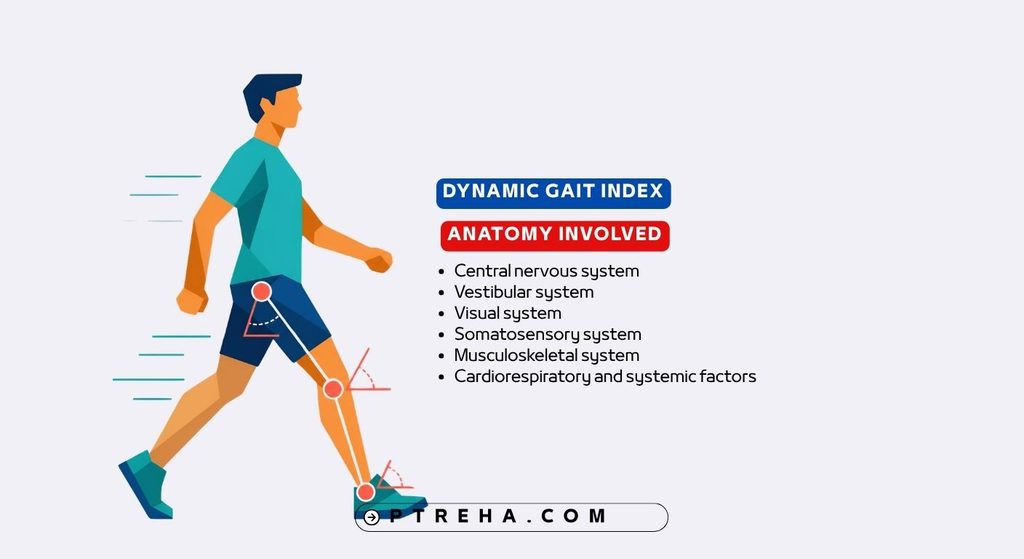
Because the DGI is an integrated functional assessment, an observed score should not be interpreted as a direct measurement of the function of any single muscle, nerve, joint, ligament, or sensory organ.
Conditions Associated With the Test
The DGI has been studied or clinically used in several populations, particularly neurological and vestibular rehabilitation.
- Stroke
- Parkinson disease
- Multiple sclerosis
- Vestibular disorders
- Traumatic brain injury and other neurological conditions
- Older adults with balance or mobility limitations
These are populations in which the measure has been evaluated or recommended to varying degrees; the DGI does not independently establish any of these diagnoses.
Clinical Significance
The greatest clinical value of the DGI is often in identifying which walking demands challenge the patient, rather than focusing only on the total score.
- Difficulty with head-turning tasks may indicate that walking performance changes when additional sensory or motor demands are introduced.
- Difficulty changing gait speed may reveal limited adaptability that is not obvious during ordinary walking.
- Poor obstacle negotiation can highlight problems with environmental navigation during ambulation.
- Difficulty with pivoting can identify a task-specific turning limitation.
- Stair performance provides additional information about functional mobility under a more demanding walking condition.
- Item-level findings can help guide rehabilitation goals and task-specific gait training.
The DGI has demonstrated relationships with other balance and mobility measures in several populations, but correlation does not mean that the tests measure exactly the same construct.
“A DGI score is most useful when interpreted as part of the patient’s overall functional examination.”
Sensitivity and Specificity
Sensitivity and specificity for the DGI are not universal characteristics of the test. Reported diagnostic or fall-related classification values depend on the population studied, the outcome being predicted, and the selected score threshold.
For example, studies involving community-dwelling older adults have reported results using a DGI threshold below 19 points, but the reported sensitivity and specificity differed between samples. These findings should therefore be viewed as population-specific evidence, not as a universal pass/fail rule for clinical practice.
The distinction is important: a DGI score can contribute to assessment of gait and factors associated with falls, but it should not be treated as a stand-alone diagnostic test for an underlying disease.
Diagnostic Accuracy
The DGI is not primarily a disease-diagnosis instrument. Its principal role is the standardized assessment of functional gait performance and the ability to adapt walking to different task demands.
Evidence supports relationships between DGI performance and other measures of balance, mobility, and fall history in selected populations, but those relationships do not establish diagnostic accuracy for a particular medical condition.
A clinician should therefore avoid statements such as “a low DGI confirms vestibular dysfunction” or “a high DGI rules out fall risk.” Neither conclusion follows from the test alone.
Common Mistakes in Dynamic Gait Index
- Treating the DGI as a neurological or orthopedic special test with positive and negative findings.
- Using a score threshold from one population as a universal cutoff.
- Ignoring individual item scores and focusing only on the total.
- Changing instructions between baseline and reassessment.
- Allowing excessive physical assistance that changes the nature of the task.
- Ignoring the patient’s usual assistive-device use when interpreting results.
- Allowing inconsistent environmental setup between assessments.
- Assuming a high score means that all aspects of balance or walking are normal.
- Confusing an observed gait limitation with a specific diagnosis.
- Using the original DGI when another measure may be more appropriate because of a ceiling effect.
The Functional Gait Assessment (FGA) is a modification of the DGI developed to address some limitations of the original measure, including ceiling effects and aspects of administration and scoring. It adds or changes walking tasks rather than simply representing the same instrument under another name.
Tips for Performing the Dynamic Gait Index
- Use the same DGI version and instructions at each assessment.
- Prepare the walking path and equipment before beginning.
- Explain each task clearly without providing unnecessary coaching.
- Maintain appropriate safety guarding throughout.
- Document assistive-device use and any assistance required.
- Record individual item scores, not only the total score.
- Compare results with other relevant measures of balance and mobility.
- Interpret change within the context of the patient’s clinical status.
- Be cautious about ceiling effects in high-functioning patients.
- Select a different or complementary outcome measure when the DGI does not adequately capture the patient’s functional limitations.
Limitations of the Dynamic Gait Index
The DGI provides useful information about gait adaptability, but it does not comprehensively measure every component of mobility.
Some patients may perform well enough to approach the upper end of the scale, limiting the ability to detect further improvement. Evidence regarding reliability and responsiveness also varies according to population, with some studies reporting stronger results than others.
The DGI should therefore be selected because its tasks are clinically relevant to the individual being assessed, not simply because it produces a numerical score.
Summary
- The Dynamic Gait Index is a functional performance test and standardized outcome measure, not an orthopedic special test.
- It assesses the ability to adapt walking to changing demands, including speed changes, head movements, turning, obstacles, and stairs.
- The original DGI contains eight items, each scored from 0 to 3, for a possible total of 0–24.
- The score describes observed functional performance and does not independently establish a diagnosis.
- Interpretation should consider the individual patient’s condition, assistive-device use, item-level performance, and the limitations of the test, including possible ceiling effects.
The Dynamic Gait Index is most valuable when it is used as one component of a broader physical therapy examination. Its task-specific observations can help the clinician understand how gait changes when walking becomes more complex and can provide a practical basis for rehabilitation planning and outcome monitoring.
Resources and External Links
Shirley Ryan AbilityLab – Dynamic Gait Index, RehabMeasures Database
Dynamic Gait Index assessment details, scoring, populations, and measurement evidence
American Physical Therapy Association – Dynamic Gait Index for Stroke
APTA test and measure resource for the Dynamic Gait Index in stroke rehabilitation
American Physical Therapy Association – Functional Gait Assessment
APTA information on the Functional Gait Assessment and its relationship to the DGI
Shumway-Cook et al. – Predicting the Probability for Falls in Community-Dwelling Older Adults
PubMed record for the foundational fall-related DGI research
Shumway-Cook et al. – Expanding the Scoring System for the Dynamic Gait Index
PubMed record describing the Modified Dynamic Gait Index and expanded scoring approach
Clinical Practice Guideline – Core Set of Outcome Measures for Adults With Neurologic Conditions
Peer-reviewed clinical practice guideline discussing the DGI and related gait and balance measures