The Four-Square Step Test (FSST) is a brief, performance-based measure of dynamic standing balance and stepping ability. It requires the patient to step in a set sequence over four low obstacles arranged in a square, which challenges weight shifting, voluntary stepping, and postural control in multiple directions. Clinicians use it to document balance performance, to screen for reduced dynamic stability, and to monitor change over time in neurological and geriatric rehabilitation. It is a functional outcome measure, not a diagnostic special test.
What Is the Four-Square Step Test?
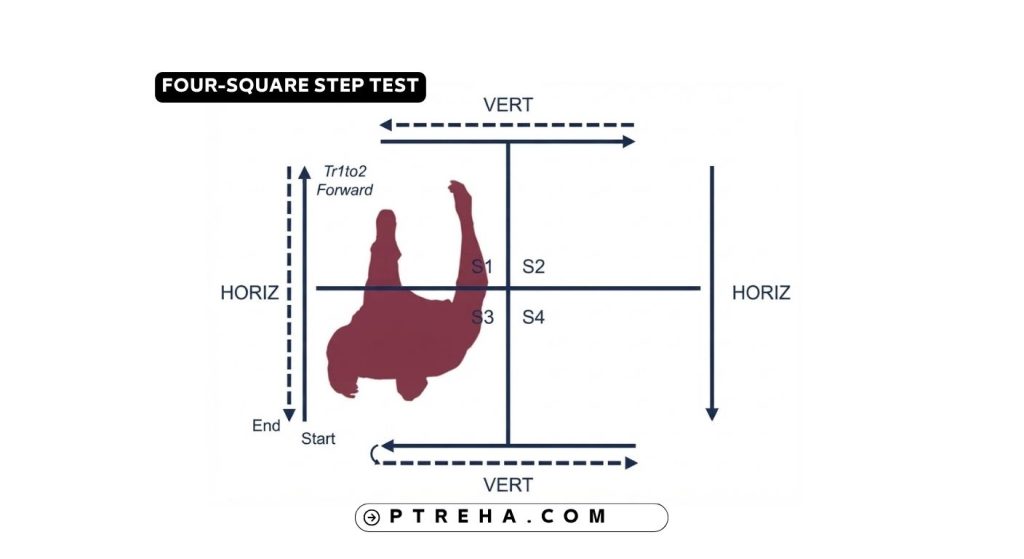
The FSST is a timed functional test of dynamic balance that involves stepping forward, sideways, and backward over four canes or rods laid on the floor in a cross pattern. The patient must move from square to square in a fixed sequence and return to the starting square. The score is the time taken to complete the sequence.
The test primarily reflects dynamic standing balance, rapid voluntary stepping, and the ability to shift weight in four directions while maintaining postural control. It also draws on lower limb strength, reaction time, and the ability to plan and sequence movements.
The FSST does not measure static balance in isolation, gait speed over distance, endurance, or aerobic capacity. It does not identify a specific diagnosis, and it does not localize a lesion or identify which structure is injured. Its clinical role is to quantify dynamic balance performance and to contribute to a broader falls-risk and mobility assessment.
The test was developed as a clinical balance measure for use with older adults and has since been studied in neurological populations. It was designed to be quick, low-cost, and easy to administer in a typical clinic room.
Purpose of the Four-Square Step Test
- To quantify dynamic standing balance and stepping performance in a standardized way.
- To document a baseline measure of balance that can be repeated to monitor change.
- To contribute to a multifactorial falls-risk assessment alongside gait, strength, and history.
- To identify patients who have difficulty with rapid, multidirectional stepping.
- To evaluate the effect of balance training, gait training, or vestibular rehabilitation over time.
- To provide a short, practical balance measure when longer scales are not feasible.
Four-Square Step Test Indications
- Older adults with reported unsteadiness, near-falls, or a history of falls.
- Patients with neurological conditions such as stroke, Parkinson’s disease, or vestibular disorders, when they can stand and step safely.
- Patients in geriatric rehabilitation or community re-integration programs.
- Patients after lower limb orthopedic surgery or injury, once weight-bearing and stepping are permitted.
- Monitoring progress during a balance or falls-prevention program.
- As part of a comprehensive mobility assessment before discharge planning.
The test is not appropriate for every patient with these conditions. Suitability depends on the patient’s ability to stand, follow instructions, and step without maximal assistance.
Four-Square Step Test Contraindications and Precautions
- Inability to stand and step safely, even with supervision.
- Non-weight-bearing or restricted weight-bearing status that prevents stepping over obstacles.
- Acute lower limb injury, acute fracture, or recent surgery where stepping is not yet permitted.
- Severe, unstable cardiovascular or respiratory conditions that make brief exertion unsafe.
- Acute vestibular symptoms with severe vertigo, vomiting, or inability to maintain posture.
- Significant cognitive impairment that prevents understanding of the stepping sequence.
- High risk of falling during stepping despite guarding; consider a less demanding balance measure first.
- Presence of a medical or surgical condition where a fall would carry serious risk.
Use caution with patients who use a walking aid, have severe visual impairment, or fatigue quickly. In these cases, modify the test or select a different measure. Always confirm that the patient can perform the task safely before timing begins.
Equipment
- Four canes, rods, or poles of equal length, or four low obstacles of similar height.
- A stopwatch or timer.
- A non-slip floor surface with adequate space.
- A chair or support nearby for rest if needed.
- A gait belt if guarding is required.
Patient Position
- The patient stands in the starting square, facing the direction of the first step.
- The patient should be able to stand without upper limb support, or with the minimum support allowed by the protocol.
- Footwear should be secure and appropriate; bare feet or unstable footwear may affect performance.
- Published protocols vary in the exact layout and starting orientation, so state the protocol used in your documentation.
Examiner Position
- Stand close enough to guard the patient without obstructing movement.
- Position yourself so you can see the feet and the stepping sequence clearly.
- Do not provide physical assistance during the timed trial unless safety requires it.
- If assistance is required, the trial is usually not valid as a timed score; document the assistance provided.
- Keep the environment clear of hazards and ensure the floor is dry and non-slip.
How to Perform the Four-Square Step Test
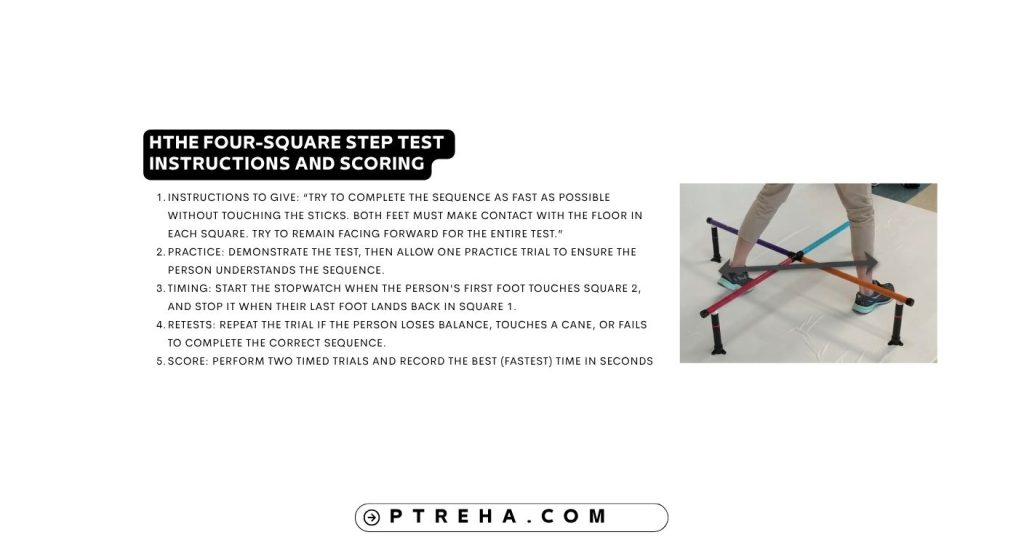
- Arrange four canes or rods on the floor to form four squares in a cross pattern, with the rods crossing at right angles.
- Ask the patient to stand in the starting square and face the first square to be entered.
- Explain the sequence: step forward into square 2, then sideways into square 3, then backward into square 4, then sideways back into square 1.
- Demonstrate the sequence and allow the patient to practice once if the protocol permits.
- Instruct the patient to complete the sequence as quickly and safely as possible without touching the rods.
- Start the timer when the patient begins the first step and stop it when both feet return to the starting square.
- Record the time in seconds, including any errors or contacts with the rods, as required by the protocol.
- Repeat the trial according to the protocol used; many protocols use the best of two or three trials.
- Allow rest between trials if the patient fatigues, and document any rest periods.
- Record the protocol, number of trials, and any assistance or errors in the documentation.
Scoring and Interpretation
The score is the time taken to complete the stepping sequence, usually recorded in seconds. A lower time indicates better performance, and a higher time indicates slower or more impaired dynamic balance and stepping.
There is no single universal cutoff for the FSST. Thresholds vary by population, protocol, and the purpose of testing. A value that indicates reduced performance in one group may not apply to another. Interpretation should consider the patient’s age, diagnosis, baseline function, and the reason for testing.
In general, slower times are associated with reduced dynamic balance and increased falls risk in some older adult and neurological populations. This association does not mean the test predicts falls in an individual patient. It should be used as one part of a broader assessment.
“The Four-Square Step Test measures how quickly a person can step in four directions while maintaining balance, so the score reflects dynamic stability rather than static steadiness.”
Reference Values and Cutoffs
Published reference values for the FSST differ across studies and populations. Values reported for healthy older adults, people with stroke, and people with Parkinson’s disease are not interchangeable. There is no single universally accepted cutoff for this assessment.
When a cutoff is used, it should be matched to the population, the protocol, and the clinical question. For example, a threshold used to identify reduced performance in community-dwelling older adults may not be appropriate for patients in acute stroke rehabilitation. Always report the source and context of any cutoff you apply.
| Population | Typical Use of Score | Interpretation Notes |
|---|---|---|
| Community-dwelling older adults | Screening for reduced dynamic balance | Slower times may indicate increased falls risk; values vary by study |
| Stroke rehabilitation | Monitoring balance change over time | Reference values differ from older adult norms |
| Parkinson’s disease | Documenting dynamic balance performance | Performance may fluctuate with medication timing |
| Vestibular disorders | Assessing multidirectional stepping | Interpret alongside vestibular and gait findings |
Anatomy and Structures Involved in the Four-Square Step Test
- Systems assessed: dynamic standing balance, postural control, and voluntary multidirectional stepping.
- Muscles contributing: hip abductors and extensors, knee extensors, ankle dorsiflexors and plantar flexors, and trunk stabilizers.
- Sensory systems involved: visual, vestibular, and somatosensory input for postural orientation.
- Broader systems: motor planning, reaction time, and cardiovascular response to brief exertion.
The FSST does not isolate a single muscle or joint. It is a whole-body functional task, and its result reflects the integration of multiple systems.
Conditions and Populations Associated With the Four-Square Step Test
- Older adults with balance impairment or a history of falls.
- Stroke and acquired brain injury.
- Parkinson’s disease and other movement disorders.
- Vestibular disorders and dizziness.
- Peripheral neuropathy and other sensory impairments.
- Post-orthopedic lower limb surgery once stepping is permitted.
- General deconditioning in older adults.
The FSST can contribute to the assessment of these populations, but it does not diagnose any of these conditions.
Clinical Significance
- Provides an objective, repeatable measure of dynamic balance for documentation.
- Helps identify patients who have difficulty with rapid, multidirectional stepping.
- Can be used to monitor change during rehabilitation, though the minimal detectable change varies by population and protocol.
- Supports treatment planning by highlighting which direction of stepping is difficult.
- Should be combined with gait, strength, and history-taking rather than used alone.
- Useful for communicating performance to other team members in a short, standardized format.
“A slow Four-Square Step Test time tells you that stepping is difficult, not why it is difficult; the clinical reasoning comes from the rest of the examination.”
Reliability and Validity
Published studies report acceptable test-retest and inter-rater reliability for the FSST in several populations, including older adults and people with neurological conditions. Reliability estimates vary by population, protocol, and rater experience, so exact coefficients should not be generalized across all settings.
Validity evidence supports the FSST as a measure of dynamic balance, with moderate correlations reported with other balance and mobility measures. It is not a diagnostic test, and its validity as a predictor of falls in individual patients is limited. Reliability and validity should be considered separately; a reliable test is not automatically a diagnostic one.
Sensitivity and Specificity
- Reported sensitivity and specificity values for the FSST vary widely by study, population, and cutoff used.
- Values derived from one population should not be applied to another without caution.
- The FSST is not intended as a stand-alone diagnostic test for any condition.
- Any diagnostic or predictive claim should be supported by evidence specific to the population and outcome.
Diagnostic Accuracy
This assessment is primarily a functional or clinical outcome measure and should not be interpreted as a stand-alone diagnostic test. Diagnostic accuracy statistics such as likelihood ratios and predictive values depend heavily on the population studied, the cutoff chosen, and the reference standard used. These values are not universally applicable and should be interpreted with caution.
Common Mistakes in the Four-Square Step Test
- Using inconsistent rod spacing or obstacle height between sessions.
- Giving unclear or changing instructions to the patient.
- Allowing the patient to touch or move the rods without documenting it.
- Failing to standardize the number of trials and rest periods.
- Providing physical assistance during a timed trial and still recording the time as valid.
- Not guarding appropriately, increasing fall risk.
- Interpreting a score using norms from a different population.
- Ignoring compensatory movements such as excessive trunk lean or grabbing for support.
- Timing from the wrong start or stop point.
Tips for Performing the Four-Square Step Test
- Set up the square the same way each time and mark the floor if possible.
- Demonstrate the sequence slowly, then let the patient practice once.
- Use consistent verbal instructions and a standard starting command.
- Guard closely but avoid blocking the patient’s path.
- Record the protocol, number of trials, and any errors in the note.
- Allow rest between trials for patients who fatigue.
- Use a gait belt when guarding is required.
- Repeat the test at the same time of day when monitoring change, especially in patients with fluctuating conditions.
Limitations of the Four-Square Step Test
- It measures dynamic balance and stepping, not gait endurance or aerobic capacity.
- It cannot determine the cause of balance impairment.
- Performance can be affected by footwear, floor surface, fatigue, pain, and motivation.
- Protocol variation affects scores, making comparison across clinics difficult.
- Reference values are population-specific and not universally applicable.
- It should not be interpreted in isolation when assessing falls risk or planning care.
- Ceiling effects may occur in high-functioning patients.
Related Tests and Assessments
- Timed Up and Go (TUG): measures mobility and transfers; often used alongside the FSST.
- Berg Balance Scale: provides a broader assessment of static and dynamic balance.
- Functional Gait Assessment: assesses gait under varied conditions.
- Functional Reach Test: measures stability limits in standing.
- 5 Times Sit-to-Stand: assesses lower limb strength and transfer ability.
- Dynamic Gait Index: evaluates gait adaptability.
These measures provide complementary information. No single test confirms the findings of another.
Frequently Asked Questions
What is a normal Four-Square Step Test time?
There is no single normal value. Times vary by age, population, and protocol. Reference values from one group should not be applied to another. Compare the patient’s score to appropriate norms and to their own baseline.
How many trials should I perform?
Protocols vary. Many use two or three trials and record the best time. Follow the protocol you are using and document the number of trials.
Can I use the FSST to predict falls?
The FSST is associated with falls risk in some populations, but it does not predict falls in an individual patient. Use it as part of a multifactorial falls assessment.
Is the FSST reliable?
Studies report acceptable reliability in several populations, but values vary by population and protocol. Reliability does not mean the test is diagnostic.
What if the patient touches the rods?
Document the contact according to your protocol. Some protocols add time or count the trial as an error. Consistency in scoring is essential.
Can the FSST be used with a walking aid?
Some protocols allow a walking aid, but this changes the task and the interpretation. State clearly in your documentation whether an aid was used.
When should I avoid the FSST?
Avoid the test when the patient cannot stand or step safely, has restricted weight-bearing, or has an acute condition where stepping poses a serious risk.
Does a slow time mean the patient will fall?
No. A slow time indicates reduced dynamic balance performance. It does not mean the patient will fall, and it should be interpreted with the rest of the examination.
Summary
- The Four-Square Step Test is a timed functional measure of dynamic balance and multidirectional stepping.
- It is performed by stepping in a set sequence over four low obstacles arranged in a cross pattern.
- The score is the time to complete the sequence; lower times indicate better performance.
- Slower times are associated with reduced dynamic balance and increased falls risk in some populations, but the test does not predict falls in individuals.
- Its main limitation is that it measures performance without identifying the cause of impairment, so it must be combined with other assessments.
The Four-Square Step Test is a practical, low-cost tool that adds objective information about dynamic balance to a physical therapy examination. Used with clear protocols, appropriate guarding, and careful interpretation, it supports clinical reasoning, documentation, and monitoring of change in balance and stepping performance.