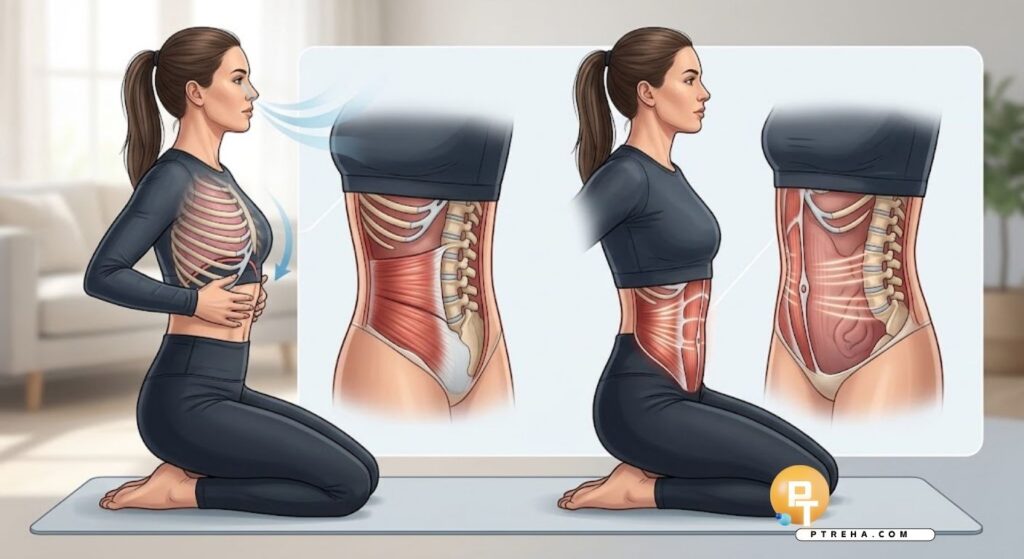
Core breathing and transverse abdominis activation are often taught as the foundation of trunk-control exercise, but effective training involves more than simply “pulling the stomach in.” In physical therapy, the goal is usually to coordinate breathing with gentle abdominal control, maintain comfortable spinal positioning, and then carry that control into progressively harder movements and everyday tasks.
What Core Breathing and Transverse Abdominis Activation Mean
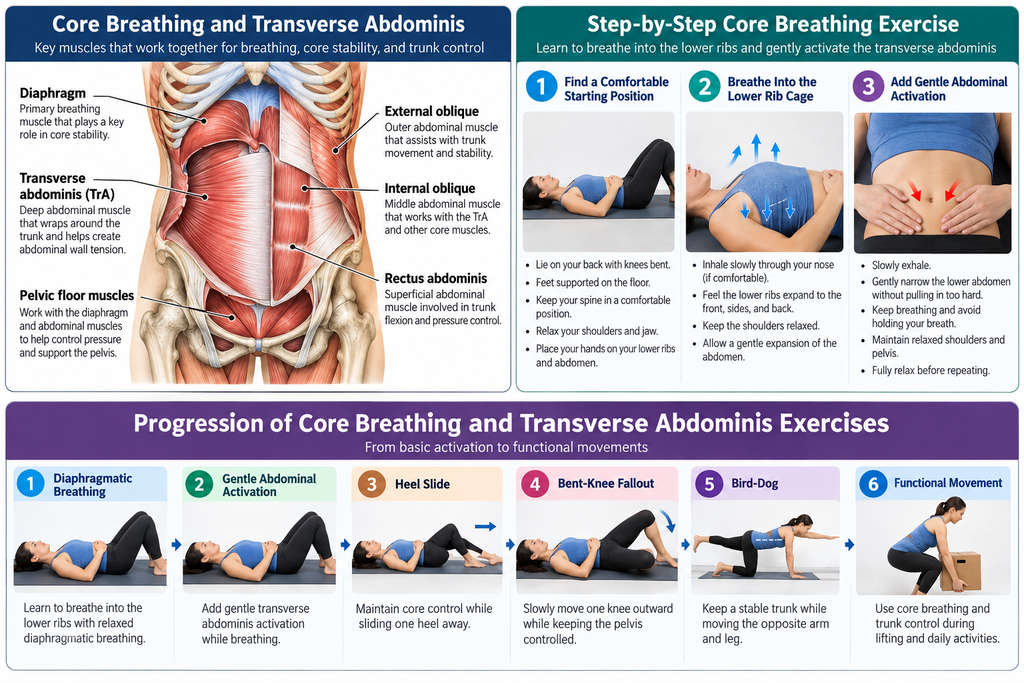
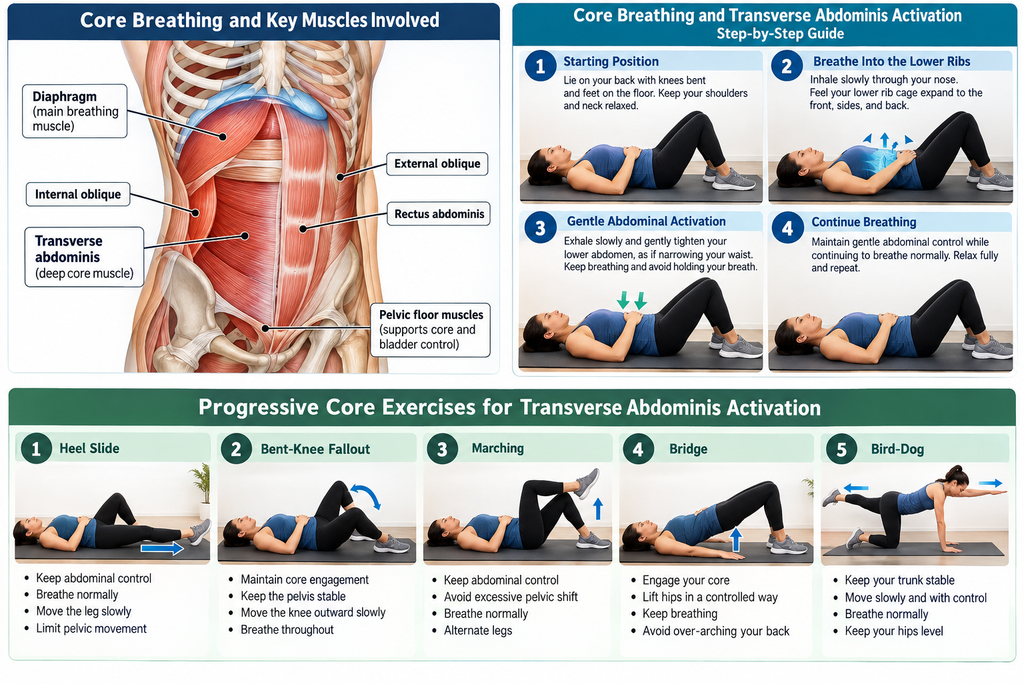
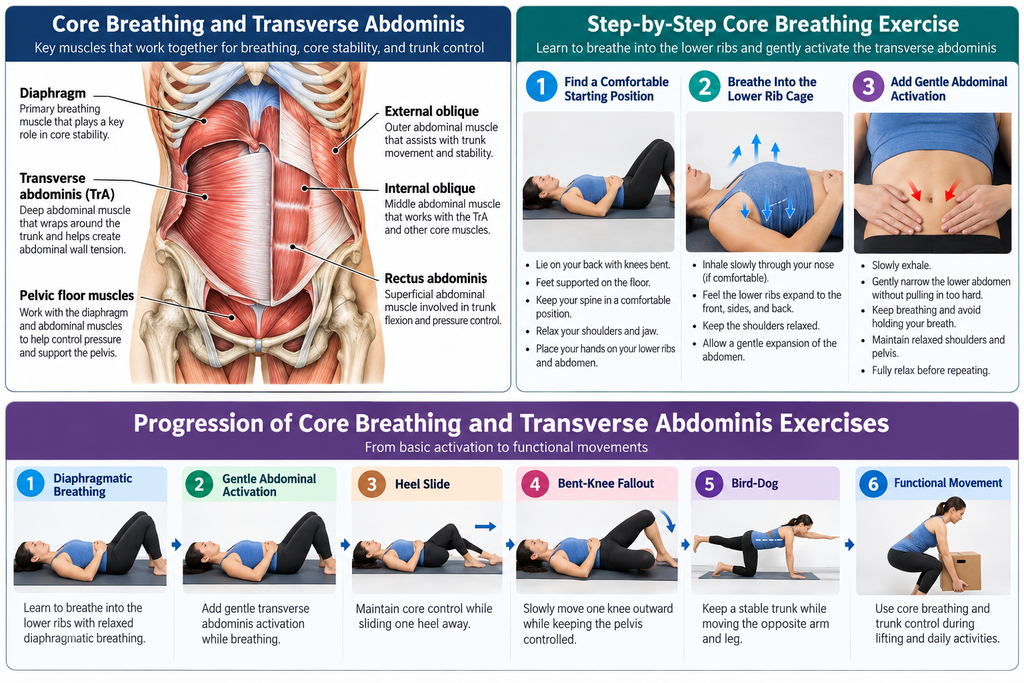
The transverse abdominis, often shortened to TrA, is one of the deeper abdominal muscles.
Its fibers wrap around the trunk and contribute to abdominal wall tension and trunk control together with other muscles rather than working independently.
The diaphragm, abdominal wall, pelvic floor, spinal muscles, and larger trunk muscles interact as part of a pressure and movement-control system.
During normal breathing, this system is constantly changing rather than remaining rigid.
Important structures involved include:
- Diaphragm
- Transverse abdominis
- Internal oblique
- External oblique
- Multifidus
- Pelvic floor muscles
- Rectus abdominis
- Erector spinae
- Latissimus dorsi during some tasks
- Hip and pelvic muscles during movement
In practice, I do not teach patients to completely isolate the transverse abdominis.
True functional movement requires coordinated recruitment of several muscles.
The more useful objective is learning how to create enough trunk support for the task without unnecessary stiffness or breath-holding.
How the Diaphragm and Deep Abdominal Muscles Work Together
The diaphragm is primarily a respiratory muscle, but breathing also interacts with postural control.
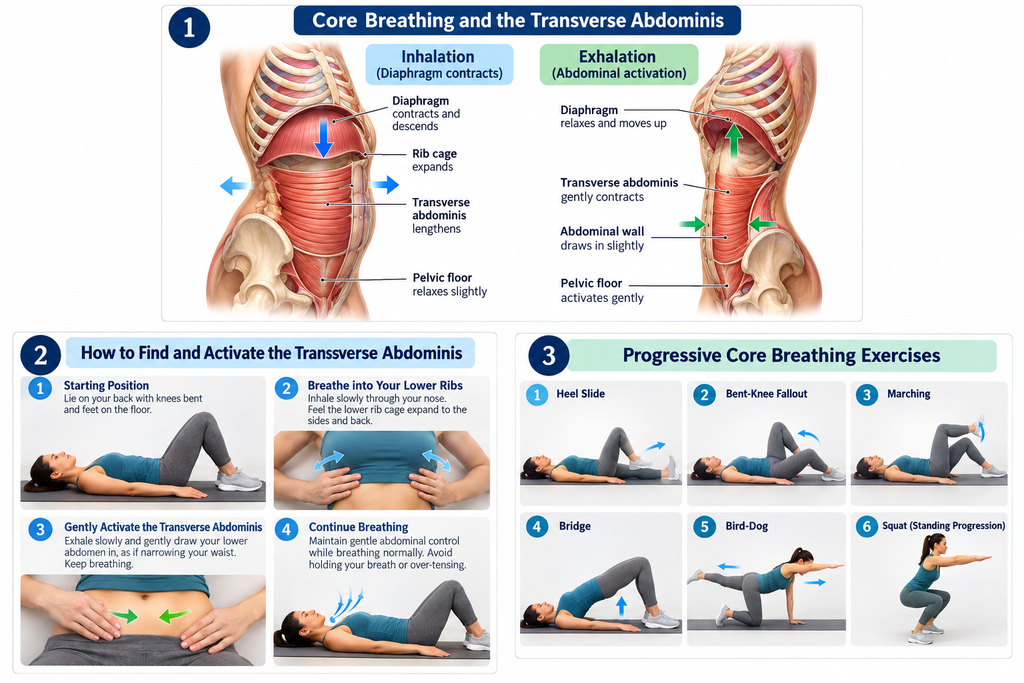
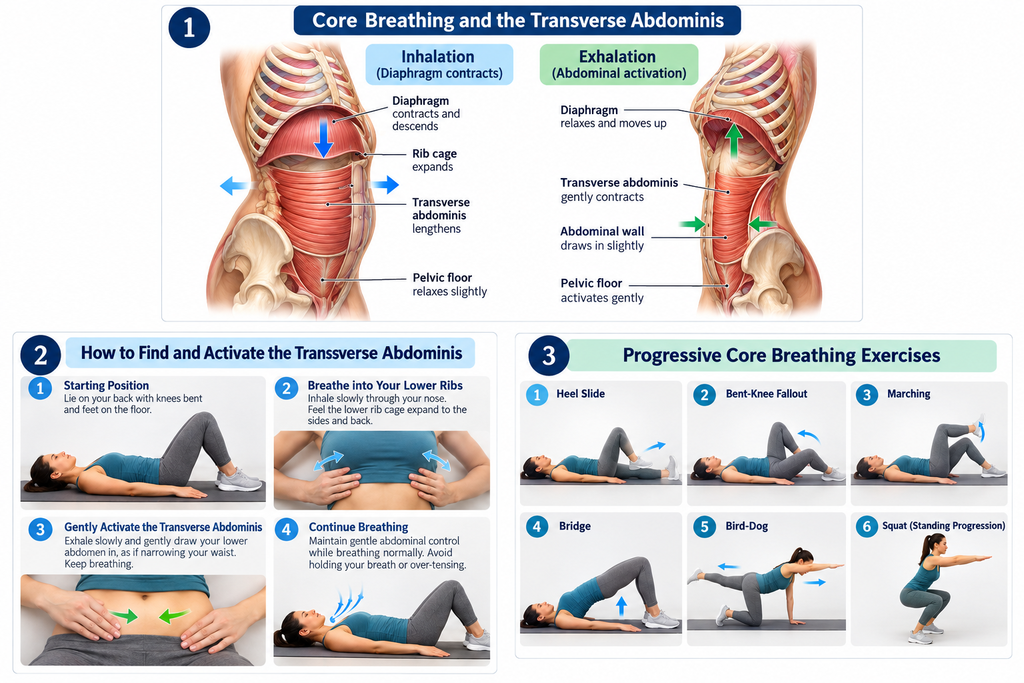
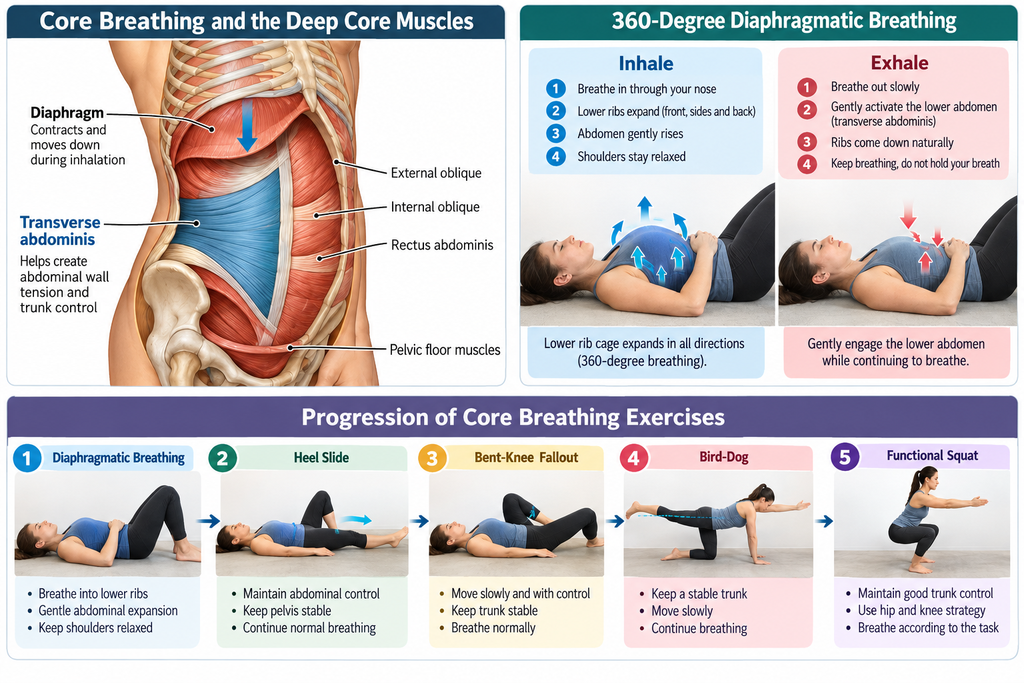
When you inhale, the diaphragm contracts and descends.
The lower rib cage should normally expand rather than the breath occurring only through elevation of the upper chest.
The abdominal wall adapts to this change in pressure.
During exhalation, the diaphragm relaxes upward and the abdominal wall can contribute more actively, particularly during forceful expiration.
A useful breathing pattern during early rehabilitation therefore involves:
- Quiet nasal inhalation when comfortable
- Expansion around the lower rib cage
- Movement into the sides and back of the ribs
- Minimal unnecessary shoulder elevation
- Relaxed abdominal expansion during inhalation
- Gentle abdominal tension during exhalation
- No aggressive stomach sucking
- No prolonged breath-holding
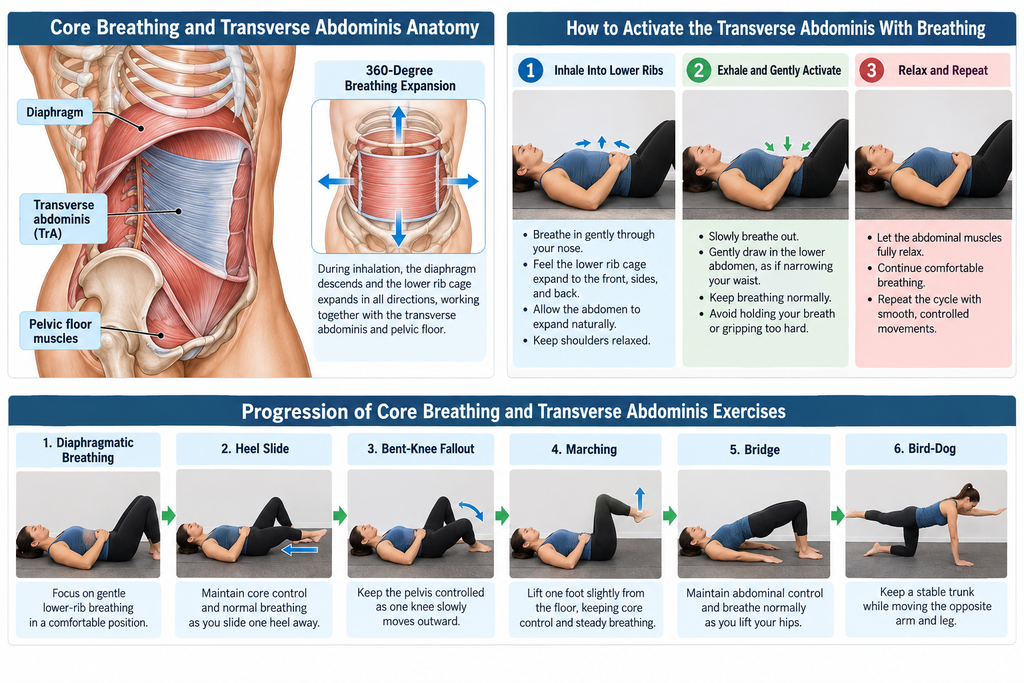
This is sometimes described as 360-degree breathing because the lower rib cage expands in several directions rather than only pushing the abdomen forward.
Research examining diaphragmatic training in people with nonspecific low back pain suggests that breathing-focused rehabilitation may improve pain and function when used as part of rehabilitation.
It should be considered an adjunct rather than a replacement for progressive physical activity and exercise.
The findings are summarized in this [systematic review of diaphragmatic training for nonspecific low back pain] .
How to Find the Transverse Abdominis
A common clinical starting position is lying on your back with the knees bent and feet supported.
This reduces the balance demands of the exercise so you can concentrate on breathing and abdominal control.
Try the following:
- Lie comfortably on your back.
- Bend both knees.
- Keep your feet resting on the floor or treatment table.
- Allow your spine to remain in a comfortable position.
- Place your fingertips just inside the front of your hip bones.
- Take a comfortable breath into the lower ribs.
- Slowly breathe out.
- As you exhale, gently narrow the lower abdomen.
- Continue breathing instead of holding your breath.
- Relax completely before repeating.
You may notice gentle tension developing underneath your fingertips.
The contraction should not feel like a maximal abdominal brace.
A cue I commonly use clinically is:
“Gently tighten the lower abdomen as though you are preparing your trunk for a small movement, but keep breathing normally.”
Different cues work for different people.
Some respond better to “narrow the waist,” while others understand “lightly tension the lower abdomen.”
The cue should produce controlled movement rather than excessive stiffness.
Abdominal Drawing-In Versus Abdominal Bracing
These two techniques are related but not identical.
An abdominal drawing-in maneuver emphasizes gentle activation of the deeper abdominal wall.
Bracing usually produces broader contraction of several abdominal and trunk muscles.
Neither should automatically be considered superior.
| Technique | Main Goal | What It Feels Like | Common Use |
|---|---|---|---|
| Quiet core breathing | Coordinate breathing and trunk motion | Relaxed lower-rib expansion | Early motor-control training |
| Gentle abdominal drawing-in | Increase awareness of deeper abdominal control | Mild lower abdominal tension | Early rehabilitation |
| Abdominal bracing | Increase global trunk stiffness | Broader abdominal tension | Lifting and higher-load tasks |
| Functional trunk control | Match muscle activity to movement | Variable, task-specific effort | Exercise, work and daily activity |
For a simple low-load exercise, excessive bracing may create more tension than necessary.
For a demanding lift, however, the trunk naturally requires substantially more muscle activity.
A useful progression is therefore:
- Learn comfortable breathing.
- Develop gentle abdominal control.
- Maintain breathing while moving the limbs.
- Increase resistance.
- Introduce stronger trunk bracing when the task requires it.
- Progress toward normal functional movement.
A systematic review examining motor-control training found improvements in transverse abdominis contraction behavior as well as pain and disability in people with chronic low back pain, although changes in resting muscle thickness were not superior to other interventions.
This distinction is important because rehabilitation should focus on function rather than attempting to make one deep muscle structurally larger.
See the [systematic review of motor-control training and trunk muscle outcomes] .
Step-by-Step Core Breathing Exercise
Start in a comfortable crook-lying position with your knees bent.
Do not force the lower back flat against the floor.
Step 1: Find a Comfortable Starting Position
Keep the head, shoulders, pelvis, and legs relaxed.
Check that you are not already tensing your stomach before beginning.
Look for:
- Relaxed shoulders
- Comfortable neck position
- Neutral or comfortable lumbar position
- Feet supported
- Jaw relaxed
- No deliberate pelvic tilt
Step 2: Breathe Into the Lower Rib Cage
Place your hands around the lower ribs if this helps you feel the movement.
Inhale quietly and notice the rib cage widening.
Think about sending the breath toward:
- Front of the lower ribs
- Sides of the rib cage
- Back of the lower ribs
You do not need an exaggerated abdominal movement.
The goal is comfortable diaphragmatic breathing rather than forcing the largest possible breath.
Step 3: Add Gentle Abdominal Activation
Slowly exhale and gently tension the lower abdominal wall.
Imagine slightly narrowing the region between your hip bones without aggressively pulling the abdomen toward the spine.
Check that you can still:
- Continue breathing
- Speak normally
- Keep the shoulders relaxed
- Avoid clenching the buttocks
- Keep the pelvis relatively still
- Avoid pushing the ribs downward forcefully
Then relax the abdomen fully.
Repeated relaxation is just as important as learning contraction because permanent abdominal gripping is not the objective.
Common Core Activation Mistakes I See in Practice
Many patients initially try too hard.
The result can be a rigid trunk, breath-holding, excessive pelvic movement, or strong activity in muscles that were not required for the task.
Holding the Breath
This is one of the most frequent errors.
If you cannot breathe comfortably while performing a low-level activation exercise, decrease the effort.
Pulling the Stomach In as Hard as Possible
More contraction is not automatically better.
A low-load motor-control exercise requires only enough activity to control the intended movement.
Flattening the Back Forcefully
A strong posterior pelvic tilt is not required simply to activate the abdominal wall.
Allow the lumbar spine to remain comfortable unless your therapist has specifically chosen a different position for you.
Tightening the Gluteal Muscles
If your buttocks are strongly contracting during a basic abdominal activation drill, you may be substituting instead of controlling the trunk.
Lifting the Upper Chest During Every Breath
Excessive upper-chest breathing often accompanies unnecessary neck and shoulder tension.
Try expanding the lower ribs instead.
Other signs that the exercise needs adjustment include:
- Shaking from excessive effort
- Jaw clenching
- Neck tension
- Rib flaring
- Pelvic rocking
- Breath-holding
- Bearing down
- Increasing pain
- Difficulty relaxing afterward
These observations do not automatically indicate an abnormal muscle.
They simply help guide exercise technique.
Progressing From Breathing to Functional Core Exercise
Core activation becomes clinically useful when it transfers into movement.
Once you can breathe comfortably while maintaining gentle trunk control, begin moving an arm or leg.
Heel Slide
Lie on your back with the knees bent.
Gently establish abdominal control, then slowly slide one heel away.
Focus on:
- Normal breathing
- Controlled pelvic position
- Smooth leg movement
- Minimal unnecessary trunk tension
Return the foot and repeat with the opposite side.
Bent-Knee Fallout
Allow one knee to slowly move outward while keeping the pelvis controlled.
The goal is not preventing every millimeter of movement.
The goal is preventing excessive or unwanted movement while continuing to breathe.
Marching
Lift one foot slightly from the floor and return it.
Progress only when you can avoid large pelvic shifts.
Useful progression options include:
- Heel slides
- Bent-knee fallout
- Supine marching
- Bridge variations
- Quadruped arm movements
- Quadruped leg movements
- Bird-dog progressions
- Dead-bug variations
- Side-plank variations
- Carrying exercises
- Squatting
- Lifting patterns
The difficulty should eventually match the activities you actually need to perform.
A patient who needs to lift boxes at work requires a very different final exercise level from someone whose main goal is comfortable bed mobility.
How to Use Core Breathing During Lifting and Exercise
You should not try to maintain a low-level drawing-in maneuver every minute of the day.
Trunk muscle activity naturally changes according to the task.
During a light movement, relatively little stiffness may be necessary.
During a heavy or rapid task, broader co-contraction and stronger bracing may occur.
For example, when preparing to lift an object:
- Position yourself close to the load.
- Establish stable foot contact.
- Prepare the trunk for the expected effort.
- Use an appropriate hip and knee strategy.
- Keep the load controlled.
- Avoid unnecessary twisting under load.
- Breathe according to the demands of the activity.
The objective is not to keep the spine perfectly motionless.
Human spines are designed to move.
Rehabilitation should improve your capacity to tolerate and control movement rather than create fear of spinal motion.
Core Breathing for People With Low Back Pain
Core breathing can be useful for some people with low back pain, particularly when pain, guarding, fear, or poor movement coordination makes exercise difficult.
However, low back pain should not automatically be blamed on a “weak transverse abdominis.”
Pain is influenced by multiple factors, and two people with similar symptoms may need very different rehabilitation programs.
A physical therapy assessment may consider:
- Symptom behavior
- Movement tolerance
- Strength
- Mobility
- Neurological findings
- Functional limitations
- Work demands
- Exercise capacity
- Sleep and recovery
- Fear of movement
- Previous episodes
Motor-control exercises are one possible part of rehabilitation rather than a universal solution.
Major clinical guidance for low back pain also emphasizes remaining active and using exercise according to the individual’s needs, capabilities, and preferences rather than relying on one specific exercise technique.
This is reflected in the [NICE guidance on exercise and self-management for low back pain] .
When Core Activation Should Become More Challenging
A common mistake in rehabilitation is remaining indefinitely with very gentle floor exercises.
Early motor-control drills can teach awareness, but they are usually preparation for more demanding activity.
Once basic control becomes easy, consider progressing:
- Lever length
- Range of movement
- Resistance
- Speed
- Exercise position
- Balance demands
- External load
- Carrying tasks
- Rotational control
- Sport-specific movements
- Work-related movements
Someone returning to recreational running may progress toward standing, single-leg and impact-control tasks.
Someone returning to physical work may need loaded squats, carries, pushing, pulling, and lifting practice.
The deep abdominal muscles do not need to be consciously controlled forever during every movement.
With practice, trunk coordination should become increasingly automatic.
When to Stop and Seek Assessment
Core breathing exercises are generally low-load activities, but they are not a substitute for clinical assessment when symptoms require investigation.
Stop the exercise and seek appropriate professional assessment if you develop significant or unexplained symptoms.
Examples include:
- New or progressive leg weakness
- Significant loss of sensation
- New bladder or bowel disturbance
- Numbness around the saddle region
- Severe symptoms after significant trauma
- Unexplained systemic illness symptoms
- Shortness of breath that is unusual for you
- Chest pain
- Dizziness or fainting
- Rapidly worsening neurological symptoms
For ordinary muscular discomfort or difficulty performing an exercise, a physical therapist can modify the position, load, breathing pattern, or progression.
The safest rehabilitation program is one that considers the person’s complete clinical presentation rather than applying the same core routine to everyone.
Practical Core Breathing Routine
For someone learning the technique, I usually prefer a few high-quality movements over a long collection of exercises.
A simple sequence might include:
- Comfortable lower-rib breathing
- Gentle abdominal activation on exhalation
- Heel slides
- Bent-knee fallout
- Alternating marching
- Bridge
- Quadruped arm or leg movement
- Bird-dog progression
Quality matters more than forcing a predetermined number of repetitions.
Stop the set when you can no longer:
- Breathe comfortably
- Maintain reasonable movement control
- Perform smooth repetitions
- Keep unnecessary muscle tension low
- Maintain acceptable symptoms
As the exercises become easier, progress the movement rather than simply performing the same introductory exercise indefinitely.
Conclusion
Core breathing and transverse abdominis activation are best viewed as motor-control skills rather than a method for isolating one “stabilizing” muscle.
Begin with comfortable lower-rib breathing, add gentle abdominal control, maintain normal breathing, and then progressively challenge the trunk through limb movement, resistance, standing tasks, lifting, and other activities relevant to your goals.
In clinical practice, the most useful question is rarely, “Can you activate your transverse abdominis?” A better question is whether your trunk can produce the right amount of support while you breathe, move, lift, exercise, and perform the activities that matter to you.
Frequently Asked Questions
1. What is transverse abdominis activation?
Transverse abdominis activation refers to contraction of one of the deeper abdominal muscles.
In rehabilitation it is usually trained as part of coordinated trunk control rather than attempting to completely isolate the muscle from the rest of the abdominal wall.
2. Should I pull my belly button toward my spine?
That cue helps some people, but it can cause others to pull the abdomen in too strongly or hold their breath.
A gentler cue such as “lightly narrow the lower abdomen while continuing to breathe” often produces better control.
3. Should I hold my transverse abdominis all day?
No.
Normal movement requires trunk muscles to increase and decrease their activity according to the task.
Maintaining continuous abdominal tension throughout the day is unnecessary and may make normal breathing and movement less comfortable.
4. Should the stomach expand when I inhale?
Some abdominal movement is normal as the diaphragm descends during inhalation.
Rather than intentionally pushing the stomach forward, focus on comfortable expansion through the lower rib cage, including the front, sides, and back.
5. Should I flatten my lower back during core activation?
Not necessarily.
A forced posterior pelvic tilt is not required for basic transverse abdominis training.
A comfortable spinal position is usually appropriate unless a specific exercise intentionally uses pelvic movement.
6. Is transverse abdominis weakness the cause of low back pain?
It is too simplistic to attribute low back pain to weakness of a single muscle.
Changes in trunk muscle recruitment have been identified in some people with low back pain, but pain is multifactorial and muscle findings vary between individuals.
7. Is core breathing enough to treat low back pain?
Usually not by itself.
Breathing and motor-control exercises may be useful components of rehabilitation, but most people benefit from progression toward general strength, movement, aerobic activity, and tasks related to their individual functional goals.
8. What should transverse abdominis activation feel like?
You may feel gentle tension developing across the lower abdominal wall while the pelvis and rib cage remain relatively controlled.
You should normally still be able to breathe and speak during a basic low-load exercise.
9. When should I progress my core exercises?
Progress when the current movement feels controlled and you can perform it while breathing normally without significant unwanted movement or symptom aggravation.
Progression may involve longer limb movements, different positions, additional resistance, standing exercises, or functional lifting.
10. Do I need to consciously activate my core before every movement?
No.
Conscious activation can be useful while learning motor control or during rehabilitation, but normal trunk muscle recruitment eventually needs to become automatic.
The final goal is comfortable, adaptable movement rather than continuously thinking about one abdominal muscle.