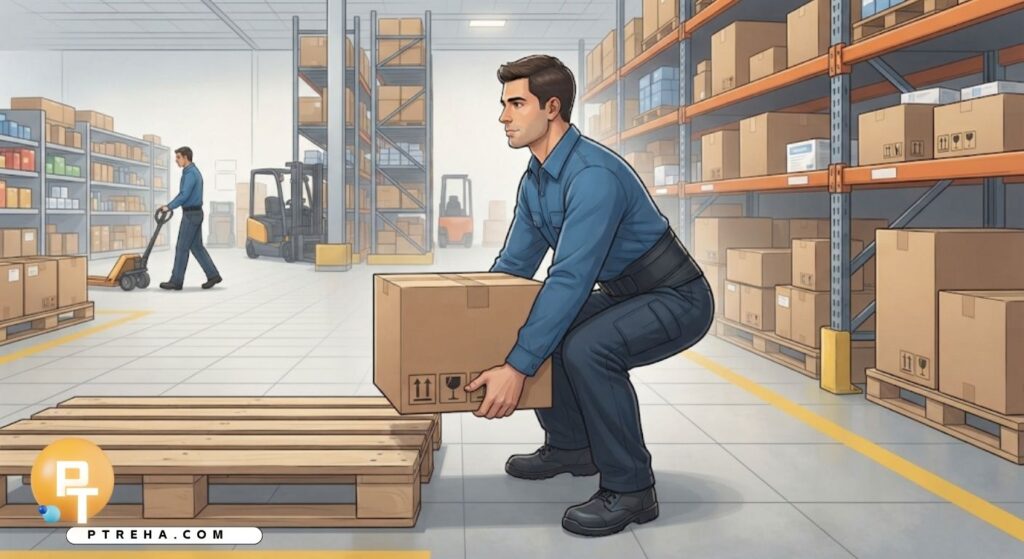
Lifting technique ergonomics for retail and warehouse workers is about more than simply “lifting with your legs.” Safe material handling depends on how close the load is to the body, the height and distance of the lift, twisting, repetition, grip, workspace, and whether mechanical assistance can be used.
For workers moving cartons, stock, packages, pallets, or merchandise, improving the task itself and using efficient body mechanics can help reduce unnecessary physical strain and support safer, more sustainable work.
Why Lifting Ergonomics Matters at Work
Retail and warehouse jobs can involve hundreds of handling movements during a shift.
Workers may lift boxes from pallets, place products onto shelves, move cartons between storage areas, load vehicles, or repeatedly handle smaller items.
Common ergonomic stressors include lifting from the floor, reaching overhead, carrying loads away from the body, bending repeatedly, twisting while holding a load, and performing similar movements for long periods.
These factors can increase physical demands on the lower back, shoulders, arms, and legs.
Lifting technique ergonomics should therefore be viewed as part of a larger workplace system.
A good technique cannot completely compensate for an excessively demanding workstation, poorly positioned stock, excessive repetition, or a load that should have been moved mechanically.
Useful principles include:
- Keep the load as close to your body as practical.
- Plan the movement before starting.
- Avoid unnecessary twisting while holding a load.
- Use stable footing.
- Keep the lifting path clear.
- Use both hands when the load allows.
- Avoid sudden or jerking movements.
- Reduce the distance the load must be carried.
- Use mechanical assistance when appropriate.
- Report recurring handling problems rather than repeatedly compensating for them.
Prepare Before You Lift
The safest lift often begins before the worker touches the object.
Look at the package, its position, its handles, its stability, and the destination.
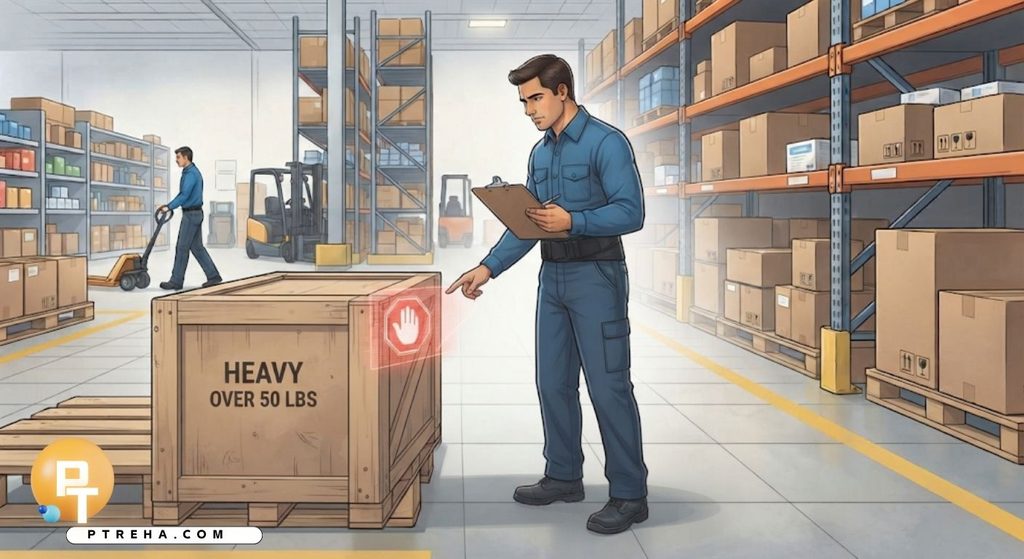
Consider whether the item can be moved by a trolley, pallet jack, lift table, conveyor, or another handling device instead.
Before lifting, check:
- What is the approximate weight?
- Is the load stable?
- Can the contents shift?
- Does the package have usable handles?
- Is the floor clear?
- Is there enough space to turn?
- Where will the load be placed?
- Can the destination be brought closer?
- Can the load be divided into smaller units?
- Do you need another worker or mechanical assistance?
A worker should not discover halfway through a lift that the destination is blocked or that the package is awkward to grip.
For example, if a retail employee needs to move a large carton from a stockroom to the sales floor, positioning a trolley close to the carton may eliminate unnecessary carrying.
The ergonomic improvement comes from changing the task, not simply telling the employee to adopt a different posture.
Position Your Body for the Lift
Good lifting technique does not require maintaining one rigid posture.
Instead, aim for a stable position that allows the load to remain close to the body while avoiding excessive bending, twisting, or reaching.
Stand close enough to the object that you do not have to reach far forward.
Place your feet in a stable position and allow enough space to move without becoming trapped between the load and surrounding equipment.
Before raising the load:
- Face the general direction of the destination.
- Place your feet securely.
- Bring the load closer before lifting when possible.
- Use a comfortable hand position.
- Keep the object within your available working space.
- Avoid reaching around obstacles.
- Keep your trunk controlled rather than abruptly flexing or rotating.
- Use your hips and knees as needed to lower your body.
- Maintain a stable base throughout the movement.
There is no requirement to keep the spine perfectly straight during every lift.
Real work involves different postures, and the objective is to manage the overall physical demands of the task rather than treating one spinal position as universally safe.
How to Lift a Box From a Low Position
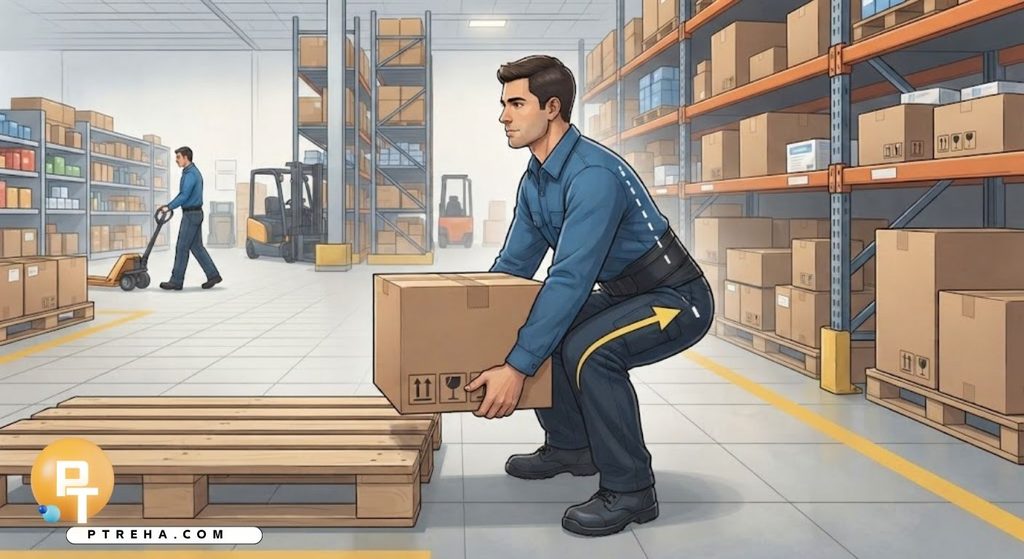
Boxes stored on the floor or low pallets can create greater physical demands because the worker must lower the body and then raise the load.
Move close to the box first.
If possible, position the box so that its handles or strongest gripping surfaces are accessible.
A practical sequence is:
- Clear the area around the box.
- Stand close to the load.
- Establish a stable foot position.
- Lower yourself using your hips and knees as appropriate.
- Obtain a secure grip.
- Bring the load toward your body.
- Begin rising while keeping the load close.
- Move smoothly rather than jerking upward.
- Reposition your feet before changing direction.
- Place the load at the destination without excessive reaching.
Do not interpret this as “always squat as deeply as possible.” A deep squat is not automatically safer, and it may be impractical in a narrow warehouse aisle.
The appropriate movement depends on the object, available space, worker characteristics, and task requirements.
For a carton positioned on a pallet, the worker may be able to improve the task by repositioning the carton before lifting it.
Raising frequently handled products to a more accessible working height can also reduce repeated low-level handling.
Keep Loads Close to Your Body
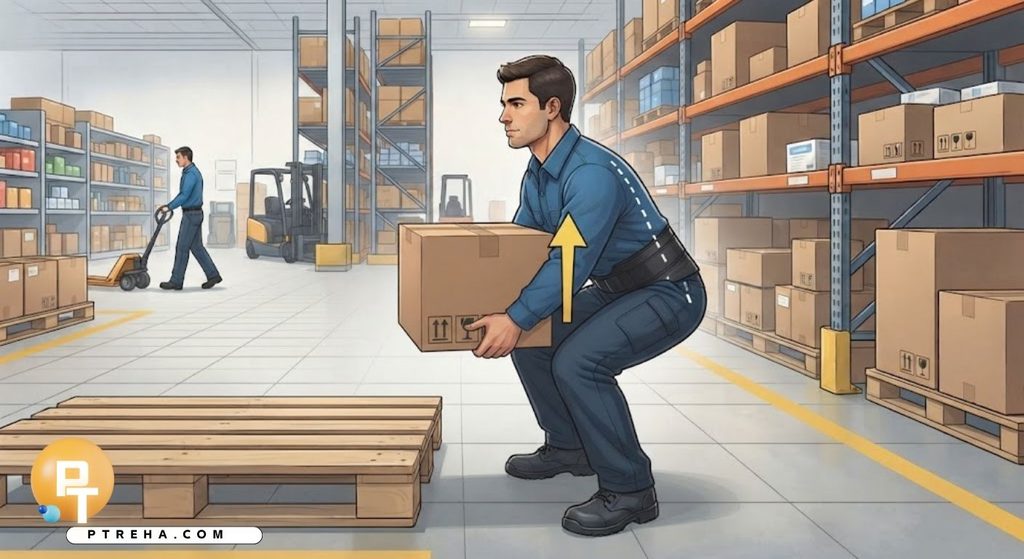
Horizontal distance is an important component of lifting demand.
As an object moves farther away from the body, the mechanical demand on the trunk can increase.
This is particularly relevant when workers reach into deep shelving or lift a box from the far side of a pallet.
Try to:
- Step closer instead of reaching farther.
- Pull the object toward you before lifting when appropriate.
- Avoid carrying large loads with the arms fully extended.
- Reposition your feet instead of leaning sideways.
- Reduce the distance between the pickup and destination.
- Use shelving arrangements that keep frequently handled products accessible.
Consider a warehouse worker retrieving a carton from the back of a deep pallet.
Pulling the carton toward the front before lifting may reduce the need for prolonged forward reaching.
This is an example of why lifting technique ergonomics is not simply a matter of “using your legs.” The location of the load can fundamentally change the physical demands of the task.
Avoid Twisting While Carrying
Turning while holding a load is common in retail and warehouse environments.
A worker may lift a carton from one direction and then rotate toward a shelf, pallet, conveyor, or trolley.
Whenever possible, turn by moving your feet rather than rotating the trunk while the load is held away from the body.
Useful strategies include:
- Face the destination before lifting when practical.
- Move your feet to change direction.
- Keep the load close while turning.
- Avoid reaching behind yourself with a load.
- Clear pathways before starting.
- Position pallets and trolleys to reduce awkward turns.
- Avoid placing frequently handled items in locations that require repeated rotation.
A small amount of natural trunk rotation during work is not inherently dangerous.
The concern is excessive or repeated twisting combined with load handling, particularly when the load is far from the body or the movement is performed rapidly and frequently.
Reaching, Shelving, and Overhead Handling
Retail workers frequently place products onto shelves, while warehouse employees may retrieve or store items at different heights.
High shelves can require elevated arms, reaching, and sometimes holding a load away from the body.
These demands can become more challenging when the item is large, unstable, or difficult to grip.
For frequently handled products:
- Keep heavier or bulky items within practical working heights.
- Avoid unnecessary overhead storage of heavy merchandise.
- Use step equipment designed for the workplace when access requires elevation.
- Do not stretch or lean excessively to reach a product.
- Bring the item toward the body before moving it when possible.
- Reposition yourself instead of reaching across a large distance.
- Use mechanical handling equipment when appropriate.
A worker should not climb shelving or improvise with unstable objects to reach merchandise.
Workplace access equipment should be appropriate for the task and used according to workplace procedures.
Carrying Loads Through the Workplace
Lifting is only one part of manual handling.
Carrying can create additional demands because the worker must maintain control of the object while walking.
Before carrying a package, consider whether the distance can be reduced or whether a trolley or other device can be used.
When carrying:
- Keep the load close.
- Maintain a clear line of sight where possible.
- Use stable walking mechanics.
- Avoid carrying more than you can comfortably control.
- Keep pathways clear.
- Slow down around corners.
- Avoid sudden changes of direction.
- Use a cart or trolley for longer or repeated transport when available.
- Ask for assistance when the load cannot be safely controlled by one person.
- Put the load down rather than continuing if control is deteriorating.
A large box may be manageable for lifting but difficult to carry because it blocks vision.
In this situation, the problem is not simply the weight; the size and shape of the object may create an important handling hazard.
Repetitive Lifting and Fatigue
A lift performed once is different from a lift performed repeatedly throughout a shift.
Warehouse case picking, stock replenishment, order fulfillment, and unloading can involve repeated lifting and lowering.
Repetition, duration, load position, and recovery periods all contribute to the overall physical demands of the job.
OSHA identifies repetitive handling, awkward postures, bending, reaching, and lifting or lowering as relevant ergonomic risk factors in warehouse work.
Watch for signs that the task is becoming increasingly difficult:
- Technique becomes less controlled.
- The worker begins rushing.
- The load is held farther from the body.
- Reaching replaces stepping closer.
- Twisting becomes frequent.
- Grip begins to deteriorate.
- The worker repeatedly changes position because of fatigue.
- The same body region becomes increasingly uncomfortable.
- The worker begins avoiding certain movements.
- Work pace makes recovery difficult.
If these patterns occur repeatedly, changing the task may be more useful than simply reminding the worker to “lift correctly.”
Possible workplace strategies include task rotation where appropriate, improved stock placement, mechanical handling, smaller containers, better workflow design, and appropriate recovery opportunities.
Use Equipment Instead of Relying on Lifting Technique Alone
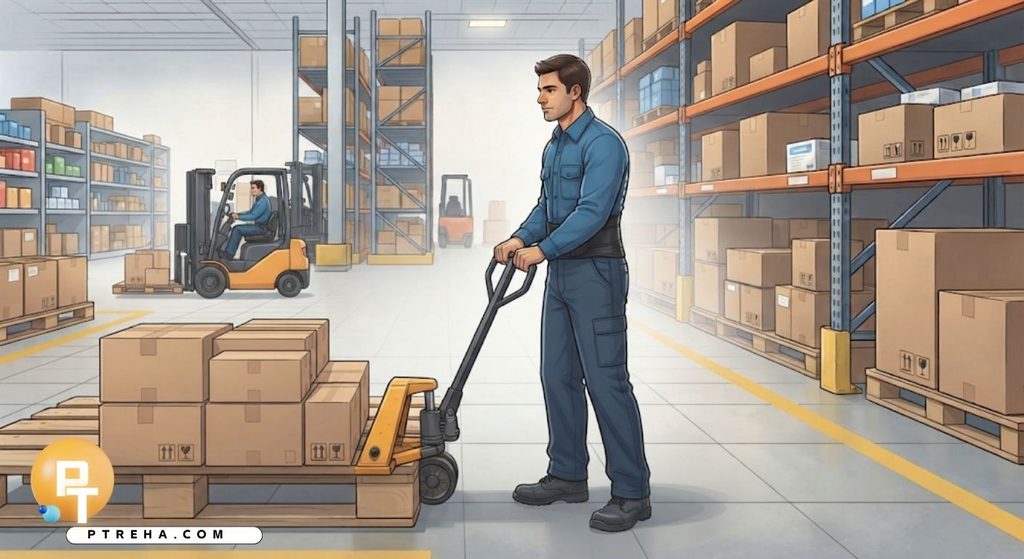
Engineering controls can reduce manual handling demands more effectively than training alone.
Depending on the workplace, useful equipment may include:
- Pallet jacks.
- Hand trucks.
- Platform carts.
- Conveyor systems.
- Lift tables.
- Hoists.
- Forklifts operated by appropriately trained personnel.
- Adjustable-height work surfaces.
- Gravity-flow or accessible shelving systems.
- Other task-specific material-handling devices.
The principle is simple: if a task can be redesigned so that a worker does not have to manually lift or carry a difficult load, that option should be considered.
OSHA specifically identifies mechanical handling solutions and improved positioning of materials as strategies for reducing manual handling demands.
Common Lifting Problems and Better Alternatives
| Common work situation | Main ergonomic concern | Practical improvement |
|---|---|---|
| Box picked from the far side of a pallet | Extended reaching | Reposition the box or approach the load closer |
| Heavy carton lifted from the floor | Large vertical travel and awkward starting position | Use a raised storage position or mechanical assistance |
| Box carried across a warehouse | Carrying distance and fatigue | Use a trolley or reduce transport distance |
| Product placed repeatedly overhead | Elevated arm position and awkward reach | Reorganize frequently handled stock |
| Worker twists while placing boxes | Combined rotation and load handling | Face the destination and move the feet |
| Large box blocks vision | Reduced environmental awareness | Use a cart or change the carrying method |
| Small boxes handled hundreds of times | High repetition | Improve workflow, positioning, or task distribution |
| Unstable package | Poor load control | Stabilize, repackage, or use appropriate equipment |
| Load has no usable handholds | Difficult grip | Use suitable handling equipment or packaging |
| Two workers lift an awkward object | Coordination difficulty | Plan the movement and communicate before lifting |
The goal is not to find one perfect posture for every situation.
Ergonomic risk assessment considers the entire task, including load characteristics, posture, frequency, duration, workplace dimensions, and available controls.
NIOSH’s Revised Lifting Equation is one assessment method for certain two-handed lifting tasks and considers variables such as load weight, horizontal and vertical location, travel distance, asymmetry, frequency, duration, and coupling.
When a Lift Should Be Reconsidered
There is no single universal weight that automatically makes a lift safe or unsafe for every worker and every workplace.
A load that feels manageable when held close to the body may become substantially more demanding when lifted from the floor, held away from the body, moved repeatedly, or rotated during handling.
Reconsider the task when:
- The object cannot be gripped securely.
- The load is unstable.
- The load obstructs vision.
- The worker must reach far forward.
- The worker must repeatedly twist.
- The destination requires excessive reaching.
- The object is difficult to control.
- The task is highly repetitive.
- The worker cannot maintain control of the movement.
- Mechanical assistance is available and appropriate.
For complex or repetitive lifting jobs, a formal ergonomic assessment may be appropriate.
The NIOSH lifting equation is designed for specific two-handed manual lifting tasks and should not be treated as a universal calculator for every carrying, pushing, pulling, lifting, or workplace activity.
Practical Examples for Retail and Warehouse Workers
Example: Restocking a Supermarket Shelf
A worker receives a carton of packaged products from the stockroom and needs to place individual products on shelves.
Instead of carrying the entire carton repeatedly, the worker can position the carton close to the shelving area, use a trolley when appropriate, and arrange the products so that frequently handled items are within practical reaching heights.
The ergonomic objective is to reduce unnecessary carrying, reaching, and awkward positioning.
Example: Loading a Delivery Cart
A worker needs to move several cartons from a pallet onto a delivery cart.
Rather than repeatedly lifting from the floor, the worker can position the cart close to the pallet and organize the load so that the heaviest or most awkward items do not require unnecessary low-level handling.
If the cartons are difficult to control manually, mechanical assistance or additional personnel may be appropriate depending on workplace procedures.
Example: Warehouse Order Picking
An order picker retrieves products from different storage locations throughout a shift.
If frequently selected items are consistently stored at difficult heights or deep inside shelving, the issue is partly a storage-design problem.
Reorganizing product locations can reduce repeated bending, reaching, and carrying.
Example: Moving a Large but Lightweight Box
A large cardboard box may not be especially heavy but can still be difficult to handle because of its size.
If the box blocks vision or cannot be held close to the body, a cart or other handling method may be more appropriate than simply asking the worker to change lifting posture.
A Simple Lifting Checklist
Workers can use this short checklist before difficult manual handling tasks:
- Plan: Know where the object is going.
- Position: Get close to the load.
- Clear: Remove obstacles from the pathway.
- Grip: Establish a secure hand position.
- Control: Avoid sudden movements.
- Close: Keep the load near the body.
- Turn: Move your feet rather than unnecessarily twisting.
- Transport: Use equipment when carrying distance is significant.
- Place: Avoid excessive reaching at the destination.
- Report: Identify recurring handling problems to the appropriate workplace personnel.
This approach encourages workers to think about the entire task rather than memorizing a single lifting posture.
Conclusion
Effective lifting technique ergonomics for retail and warehouse workers combines body mechanics with workplace design.
Getting close to the load, establishing stable footing, keeping objects near the body, moving the feet when changing direction, and avoiding unnecessary reaching can improve how many everyday handling tasks are performed.
However, technique is only one part of ergonomic risk management.
Repetitive lifting, awkward storage heights, long carrying distances, poor grip, unstable loads, and excessive work demands may require changes to equipment, workflow, load size, or storage design.
A practical ergonomic approach therefore asks not only “How should this worker lift?” but also “Can this task be made easier to handle?”
Frequently Asked Questions
1. What is the safest way to lift a box at work?
Start by planning the movement and positioning yourself close to the box.
Establish a stable stance, obtain a secure grip, bring the load close to your body, and rise smoothly while avoiding unnecessary twisting or reaching.
There is no single posture that is appropriate for every workplace lift.
The load, available space, frequency, and destination all affect the best movement strategy.
2. Should I always bend my knees when lifting?
Using the hips and knees can help you lower your body toward a low load, but “bend your knees” should not be treated as a complete lifting rule.
The objective is to position yourself effectively, control the load, and avoid unnecessary reaching, twisting, or sudden movement.
The most appropriate posture depends on the task and the available space.
3. Is lifting with a straight back always safer?
A perfectly straight spine is not required for every manual handling activity.
The spine naturally moves during many everyday tasks, and workers may use different postures depending on the object and environment.
More important considerations include controlling the movement, keeping the load appropriately close, reducing unnecessary load distance, and managing the overall demands of the task.
4. How close should I hold a box to my body?
Generally, keeping a load close reduces the horizontal distance between the load and the body and can reduce the mechanical demands associated with holding it away from the trunk.
However, the exact position depends on the size and shape of the object, visibility, grip, and task requirements.
The load should remain close enough to control without creating another hazard.
5. Should warehouse workers twist while carrying boxes?
When possible, workers should avoid unnecessary trunk twisting while holding a load and instead reposition their feet to change direction.
This is particularly useful when the worker must rotate repeatedly or when the load is held away from the body.
Good workplace layout can also reduce the need for awkward turns.
6. Is there a maximum weight everyone can safely lift?
There is no universal weight limit that applies equally to every worker and every lifting task.
NIOSH’s lifting assessment approach considers multiple variables, including load weight, horizontal and vertical position, travel distance, asymmetry, frequency, duration, and grip quality.
7. What should I do if a box is too awkward to lift?
Do not rely solely on changing your posture.
Consider whether the box can be repositioned, divided into smaller units, moved with a trolley, or handled with another appropriate device.
If the problem occurs repeatedly, the workplace task or storage arrangement may need to be reviewed.
8. Is using a trolley better than carrying a box?
A trolley can reduce the need to manually carry a load, particularly when the transport distance is significant or several items must be moved.
The trolley itself must still be suitable for the load, route, floor conditions, and workplace environment.
Pushing and pulling also have their own ergonomic considerations.
9. What should I do if lifting repeatedly causes discomfort?
Stop and consider whether the task can be modified rather than repeatedly working through worsening symptoms.
Report recurring ergonomic problems through the appropriate workplace process and seek appropriate professional assessment if symptoms persist or are concerning.
From an ergonomic perspective, repeated discomfort can also be a reason to examine the task itself, including load position, repetition, duration, equipment, and work organization.
10. Can lifting training prevent all workplace injuries?
No.
Training is useful, but it cannot eliminate ergonomic hazards when the underlying task remains excessively demanding.
Effective prevention can involve a combination of worker training, equipment, workplace layout, load design, storage arrangements, task organization, and ergonomic assessment.
OSHA and NIOSH both emphasize evaluating and controlling the physical demands of manual material handling rather than relying on lifting technique alone.
Resources
- National Institute for Occupational Safety and Health (NIOSH) – Revised NIOSH Lifting Equation: NIOSH Revised Lifting Equation
- NIOSH – Applications Manual for the Revised NIOSH Lifting Equation: NIOSH Applications Manual
- Occupational Safety and Health Administration (OSHA) – Warehousing: Hazards and Solutions: OSHA Warehousing Ergonomics Guidance
- OSHA Technical Manual – Ergonomics: OSHA Technical Manual: Ergonomics
- Health and Safety Executive (HSE) – Manual Handling at Work: HSE Manual Handling Guidance