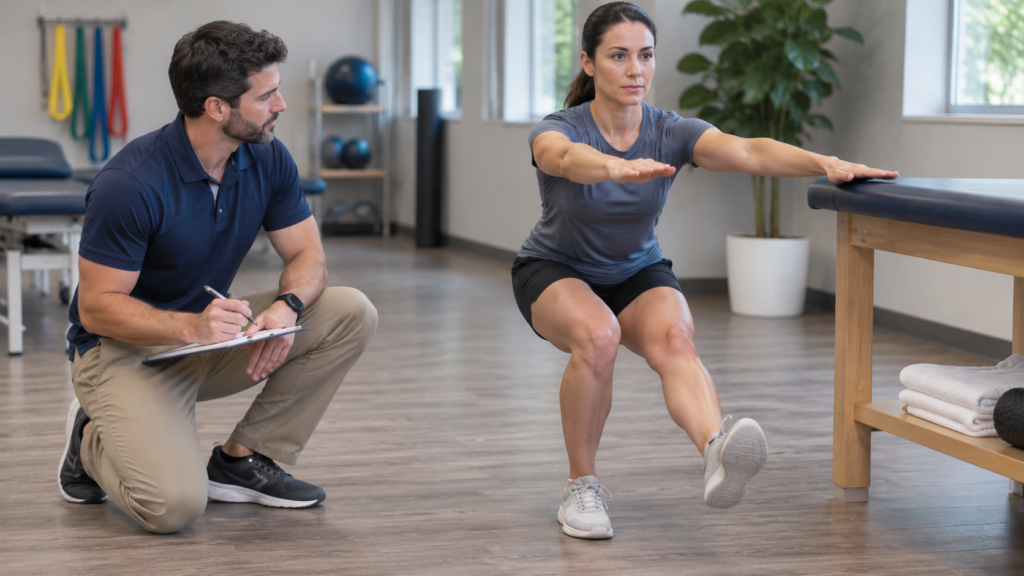
The Single-Leg Squat Test is a practical way to observe how a person organizes the trunk, pelvis, hip, knee, ankle, and foot during a controlled one-leg task. It describes movement performance under a defined setup; it does not diagnose one condition or prove that one muscle is weak.
What Is the Single-Leg Squat Test?
The Single-Leg Squat Test is a functional movement test performed while standing on one limb. The examiner observes alignment, balance, depth, speed, symptoms, and the ability to return to upright control.
- Classification: functional performance test
- Primary task: controlled unilateral squat
- Assessment area: multi-segment lower-limb control
- Result: descriptive observations or a standardized movement-quality score
Purpose and Indications
The task challenges balance, strength, mobility, and motor control at the same time. It is useful for identifying movement features that require more specific testing or rehabilitation.
- Observe trunk, pelvic, hip, knee, ankle, and foot coordination.
- Compare limbs when bilateral testing is safe and appropriate.
- Monitor movement strategy during rehabilitation.
- Explore symptoms during a single-leg loading task.
- Guide follow-up assessment of strength, mobility, and balance.
Contraindications and Precautions
Do not perform the test when single-leg loading is prohibited or unsafe. A stable support and close guarding may be used for safety, but any assistance must be documented because it changes the task.
- Current non-weight-bearing or protected-weight-bearing restriction
- Suspected fracture, acute instability, or significant new trauma
- Severe pain, dizziness, or inability to stand safely
- Recent surgery without clearance for squat loading
- Rapidly increasing swelling or new neurological symptoms
Patient and Examiner Positions
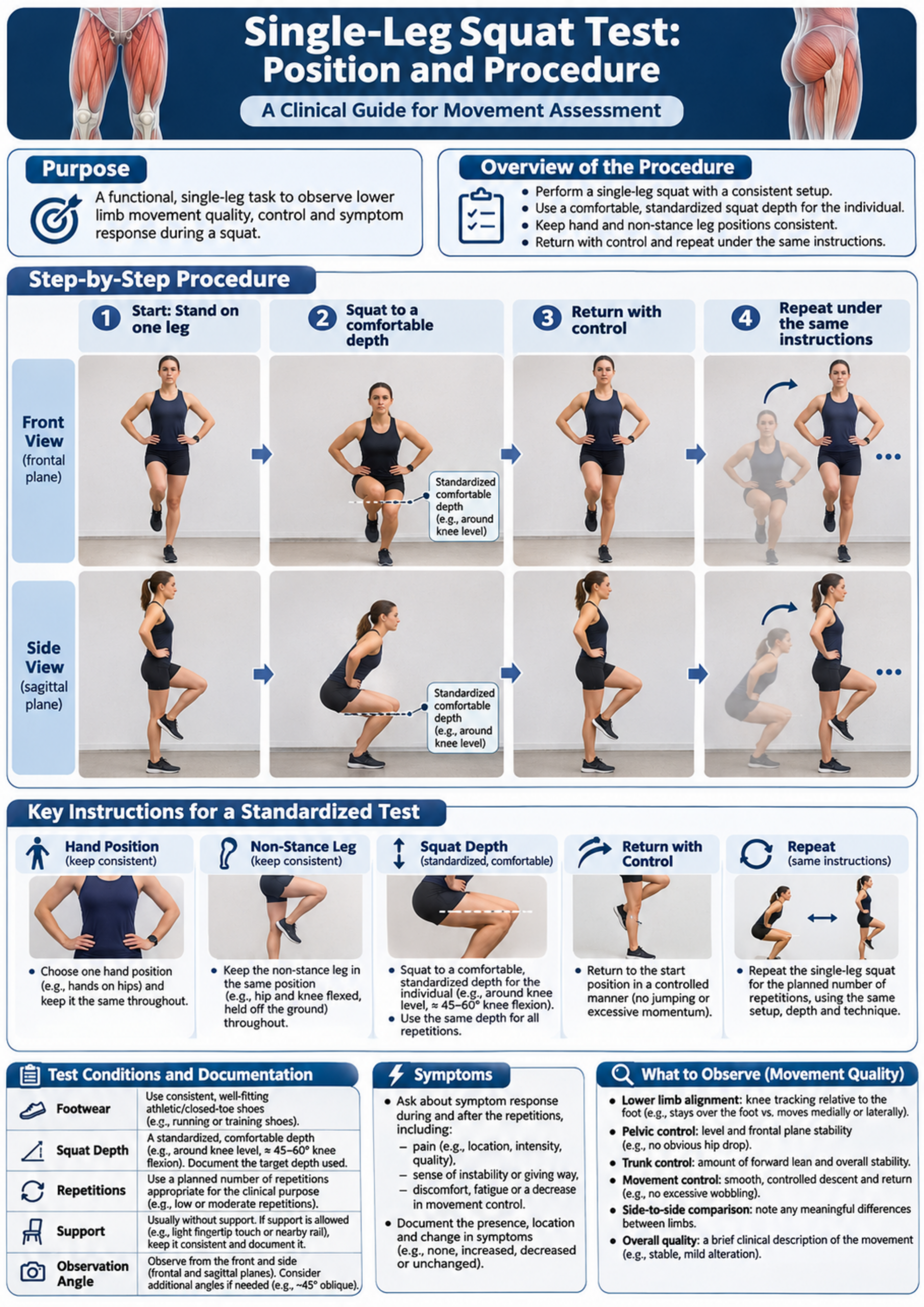
The setup should be consistent across limbs and follow-up sessions. Footwear, stance-foot orientation, free-leg position, hand position, target depth, and camera or examiner view can all affect the result.
- Patient stands on the test limb on a level, nonslip surface.
- Non-stance leg is held in a consistent position.
- Hands are kept on the hips or in another standardized position.
- Examiner observes from the front and, when useful, the side.
- A support is placed nearby but used only if needed.
How to Perform the Single-Leg Squat Test
- Explain and demonstrate the task.
- Record footwear, stance-foot position, hand position, and target depth.
- Ask the patient to balance on one leg.
- Have the patient squat slowly to a comfortable, standardized depth.
- Ask the patient to return to upright with control.
- Repeat under the same instructions while observing from selected views.
- Record symptoms, assistance, depth, repetitions completed, and movement observations.
Test Findings and Interpretation
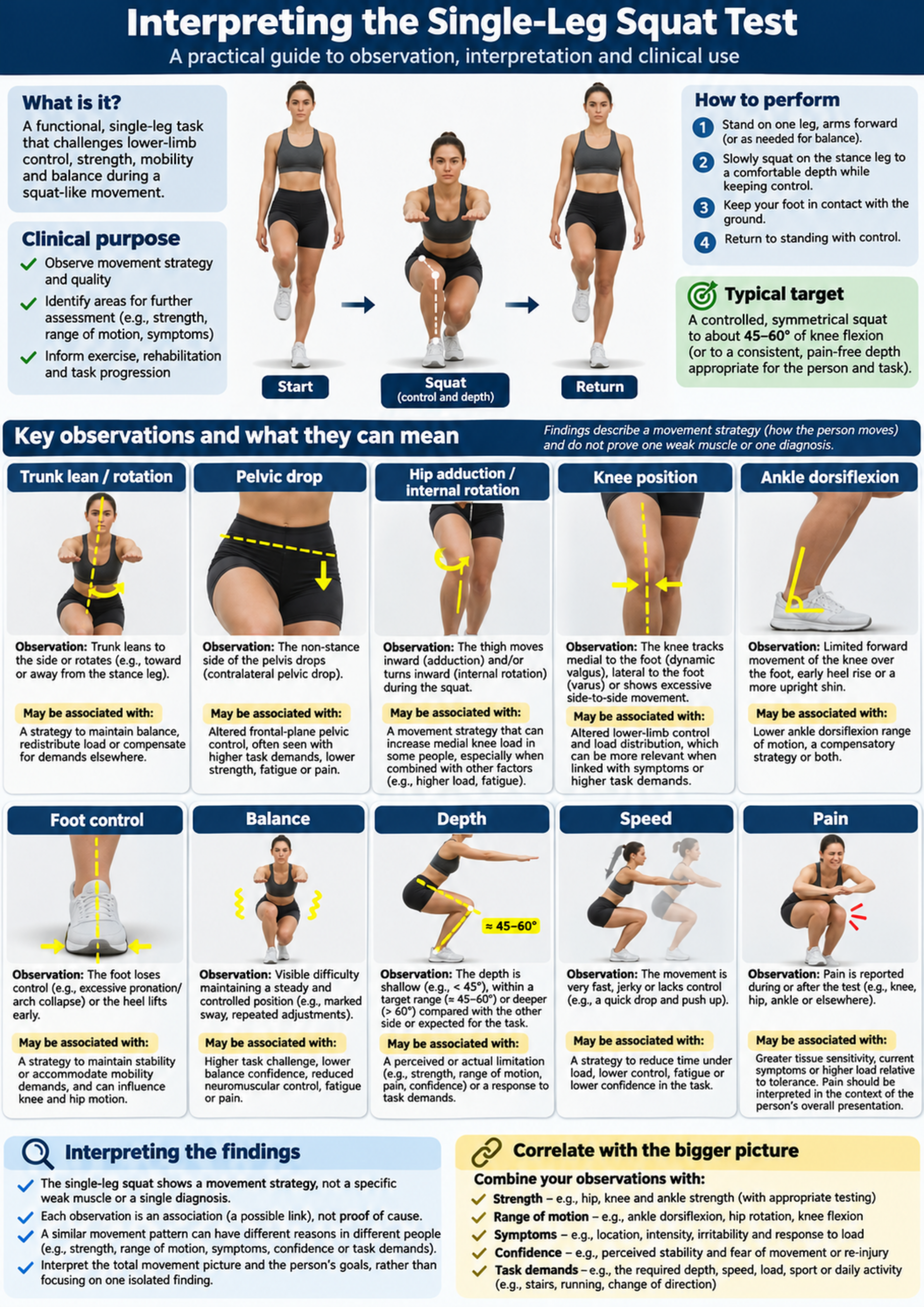
A universal positive or negative result is not appropriate for this functional test. Describe the observed strategy and symptom response rather than reducing the performance to a diagnostic pass or fail.
- Trunk lean, rotation, or loss of upright control
- Contralateral pelvic drop
- Hip adduction or rotation strategy
- Knee position relative to the foot
- Ankle dorsiflexion and heel control
- Foot pronation, supination, or loss of contact
- Balance corrections, depth, speed, confidence, and pain
Relevant Anatomy
The test distributes demand across the entire kinetic chain. No single visual deviation can isolate one muscle, joint, or anatomical lesion without additional examination.
- Trunk muscles controlling the center of mass
- Gluteal and other hip muscles controlling the pelvis and femur
- Quadriceps and hamstrings controlling the knee
- Calf complex and ankle dorsiflexion range
- Foot muscles and joints supporting the base of contact
Associated Conditions and Clinical Contexts
The test is used across lower-extremity rehabilitation, but a movement pattern is associated with performance rather than a specific diagnosis. Interpret it alongside the history, symptoms, and other physical tests.
- Patellofemoral pain
- Anterior cruciate ligament rehabilitation
- Hip, knee, or ankle injury recovery
- Running and jumping rehabilitation
- Return-to-activity or sport assessment
Clinical Significance
The Single-Leg Squat Test provides a repeatable task for linking visual observations with targeted follow-up tests. A study of clinical single-leg squat ratings found that measurement method influenced reliability and agreement with motion analysis, reinforcing the need for a defined protocol.
- Use observations to generate assessment questions.
- Measure strength rather than inferring weakness from appearance.
- Check ankle mobility when squat depth or forward progression is limited.
- Compare symptom behavior with stairs, running, and jumping.
- Retest under the same conditions to judge change.
Reliability and Measurement Limits
Reliability depends on the scoring system, instructions, examiner training, and population. In a standardized multi-segment protocol, a measurement study involving novice and experienced physiotherapists reported moderate overall interrater reliability and stronger intrarater reliability, with agreement varying by segment.
More recent research in people with lower-extremity injuries found good-to-excellent reliability for selected visual-analog ratings and moderate-to-good correlations with two-dimensional measures. These population- and method-specific findings should not be treated as universal diagnostic accuracy.
Common Mistakes and Tips
A neat-looking squat is only comparable when the task itself is standardized. Changing depth, arm position, free-leg position, or instruction between trials can produce a difference that belongs to the setup.
- Do not compare sides at different squat depths.
- Do not focus only on the knee and ignore the trunk, pelvis, ankle, and foot.
- Do not assume visible knee motion proves hip weakness.
- Do not count a balance touch as an unassisted repetition.
- Use video only with consent and a consistent camera angle.
- Document pain and confidence as well as alignment.
Summary
- The Single-Leg Squat Test is a functional assessment of unilateral control.
- Standardize footwear, foot position, free-leg position, hands, depth, and instructions.
- Describe movement and symptoms instead of using a universal pass/fail label.
- Correlate observations with strength, mobility, balance, and patient goals.
- Use the same protocol when monitoring progress.
Used carefully, the Single-Leg Squat Test adds useful information about task performance. Its findings should guide the next examination step, not replace a diagnosis or isolate one anatomical cause.