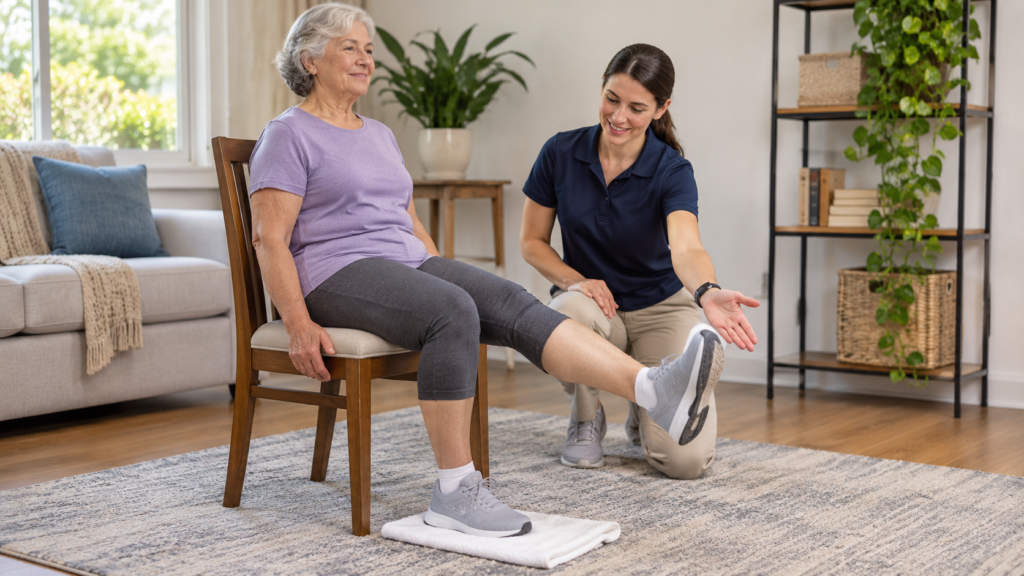
If your knees feel stiff after sitting or first thing in the morning, a chair can provide a stable place to restore motion before you walk farther. These three moves progress from gentle bending to muscle work and then a practical standing task.
Why Knees Often Feel Stiff
Stiffness can reflect reduced movement, joint irritation, osteoarthritis, swelling, muscle guarding, or recovery after injury. The feeling alone does not identify one structure, so pay attention to swelling, locking, giving way, and how quickly movement becomes easier.
- Notice whether stiffness improves after a few comfortable movements.
- Compare symptoms before and after longer sitting periods.
- Track swelling and walking tolerance.
- Seek assessment when stiffness is progressive or repeatedly limits function.
Check Safety Before You Begin
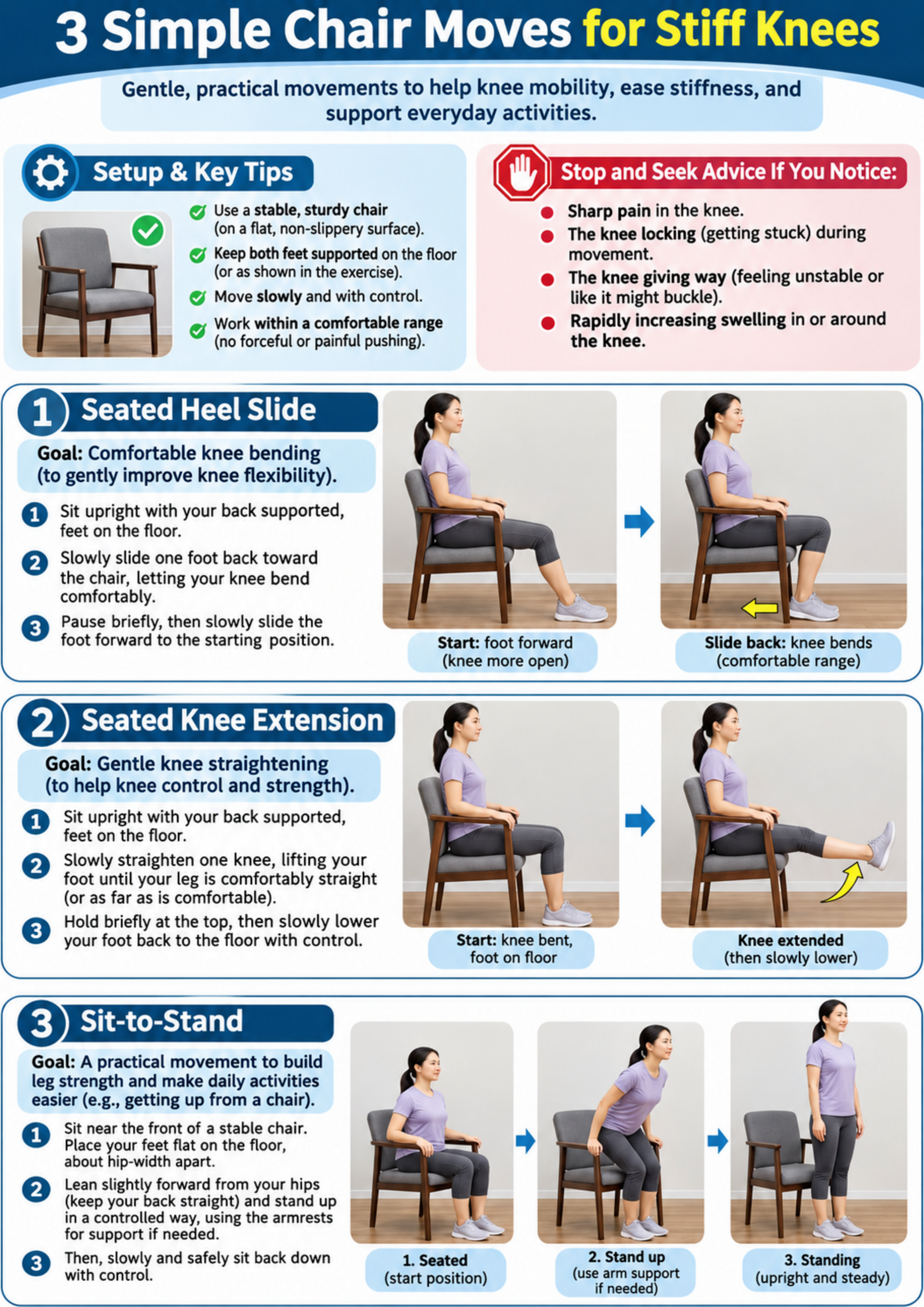
Chair exercises should feel controlled, not sharp or unstable. New inability to bear weight, a visibly deformed knee, a hot swollen joint with fever, or major swelling after trauma needs prompt medical assessment.
- Stop for locking, giving way, or rapidly increasing swelling.
- Do not force through sharp or catching pain.
- Follow post-operative weight-bearing and range restrictions.
- Ask for advice if dizziness or balance makes standing unsafe.
Set Up the Chair Correctly
Use a solid chair on a nonslip surface rather than a rolling office chair. The NHS sitting-exercise guidance also recommends a stable chair and gradual progression.
- Place both feet flat on the floor.
- Sit far enough forward to move without the seat edge pressing behind the knees.
- Keep a counter or rail nearby for standing work.
- Wear supportive footwear for sit-to-stand practice.
Move 1: Seated Heel Slides
Heel slides introduce knee bending without requiring full body weight. A towel under the foot can make the movement smoother on a hard floor.
- Start with the foot comfortably in front of the chair.
- Slide the heel back to bend the knee within an easy range.
- Pause without forcing the heel farther.
- Slide forward again and keep the foot in contact with the floor.
Move 2: Seated Knee Extensions
This movement combines knee motion with quadriceps work. The Leeds Teaching Hospitals knee-exercise guidance includes seated knee extension and advises letting pain guide how much you do.
- Sit upright with the thigh supported.
- Straighten one knee as far as comfortable.
- Briefly tighten the thigh without locking or bouncing.
- Lower the foot slowly rather than letting it drop.
Move 3: Sit-to-Stand
Sit-to-stand trains the same pattern used for chairs, toilets, and getting out of a car. Use the armrests or a higher seat when the knee cannot yet manage the full load comfortably.
- Bring the feet under or slightly behind the knees.
- Lean the trunk forward from the hips.
- Press through both feet and stand with control.
- Reach back for the chair and lower slowly.
Compare the Three Chair Moves
Choose the movement that matches your current goal. Mobility work can prepare the knee, while sit-to-stand adds more load and should be modified when symptoms are irritable.
| Movement | Main goal | Useful modification | Watch for |
|---|---|---|---|
| Heel slide | Comfortable knee bending | Use a towel and smaller range | Pinching or catching |
| Knee extension | Motion plus quadriceps control | Shorten the range | Sharp anterior knee pain |
| Sit-to-stand | Functional strength | Higher chair or arm support | Giving way or uncontrolled drop |
- Begin with heel slides when the knee feels reluctant to bend.
- Use knee extensions to add controlled thigh work.
- Choose a higher seat when standing is difficult.
- Progress only one variable at a time.
Let Symptoms Guide the Range
Mild discomfort can occur when a stiff joint starts moving, but the response should remain manageable and settle afterward. The NICE osteoarthritis guideline explains that exercise may initially increase discomfort while regular tailored exercise improves pain and function over time.
- Use a smaller range on more sensitive days.
- Slow the lowering phase before adding repetitions.
- Recheck swelling and walking later the same day.
- Reduce the next session if symptoms remain clearly aggravated.
Progress Without Rushing
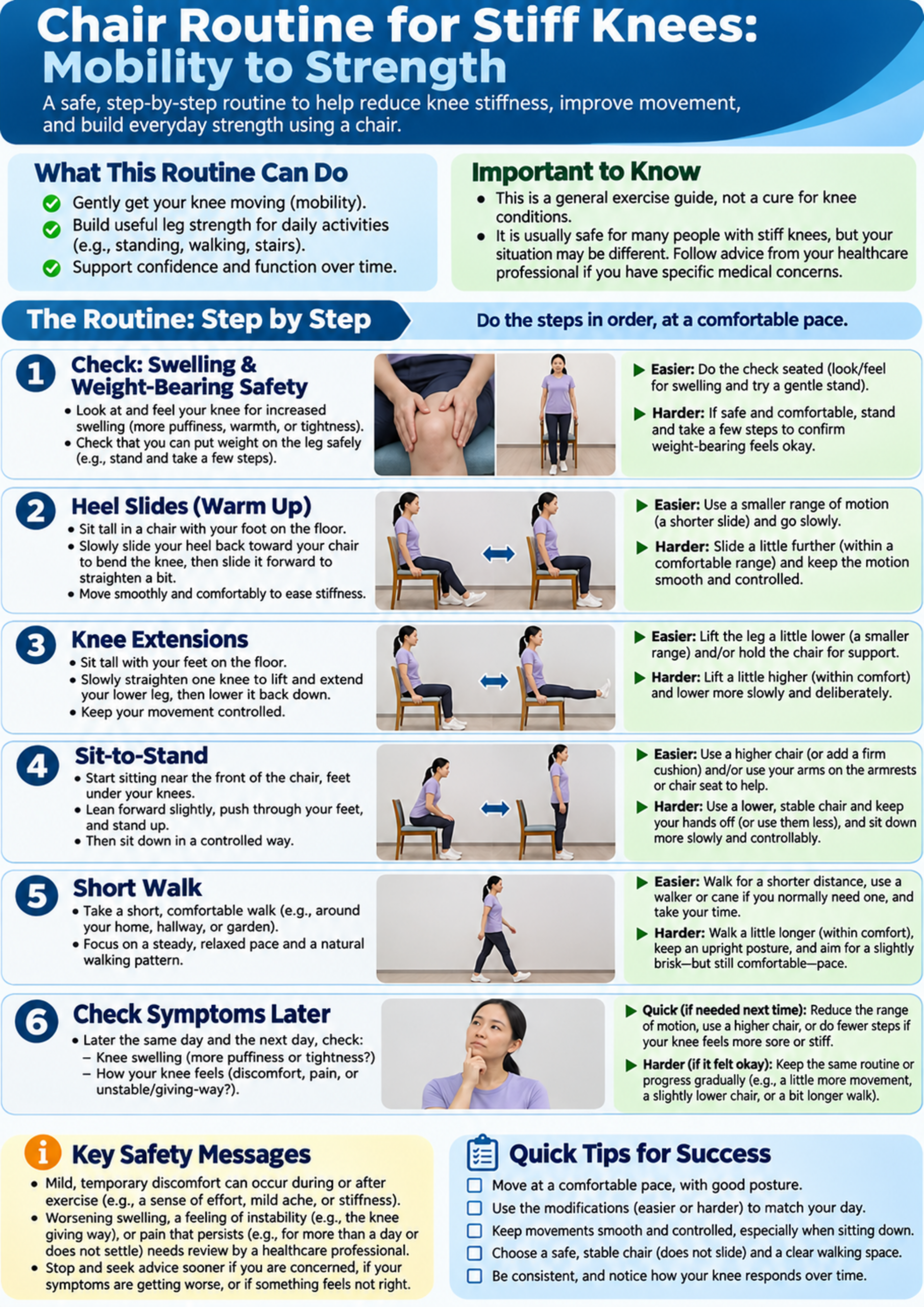
Progress comes from gradually increasing demand, not chasing a large stretch. Change depth, resistance, repetitions, or support one at a time so you can identify what the knee tolerates.
- Increase the movement range before adding external weight.
- Use less arm support only when balance is reliable.
- Try a slightly lower chair after higher-chair control improves.
- Add a short walk to connect exercise with daily function.
Connect Chair Exercise to Daily Activity
Chair movements work best as a bridge into normal activity. Use them after prolonged sitting, before a planned walk, or as part of a broader strengthening programme.
- Stand and move at regular intervals during long sitting.
- Practice calm stair or walking tasks when ready.
- Include hip and calf strength in a complete programme.
- Discuss persistent limitations with a physical therapist.
Conclusion
Heel slides, seated knee extensions, and sit-to-stand provide a simple progression for stiff knees. Keep the range comfortable, use support when needed, and judge the routine by how the knee moves and functions afterward.
Frequently Asked Questions
Should I do all three chair moves?
No. Choose the moves that match your current mobility, strength, balance, and symptom response.
How many repetitions should I perform?
Start with a small manageable amount and build gradually. Individual capacity matters more than a universal number.
Is knee discomfort during exercise normal?
Mild temporary discomfort can occur, but sharp pain, locking, giving way, or worsening swelling is a reason to stop and seek advice.
Can these moves help knee osteoarthritis?
They may support motion and strength, but osteoarthritis care usually also includes broader strengthening, aerobic activity, education, and weight management when relevant.
What if my knee will not bend far?
Use a shorter heel-slide range and avoid forcing. Significant or worsening loss of motion needs assessment.
Can I use a rolling office chair?
No. Use a stable chair that will not slide or roll during movement.
Why does my knee crack during extensions?
Noise alone is common and does not necessarily mean damage. Painful catching, swelling, or loss of function is more important to assess.
How can I make sit-to-stand easier?
Use a higher chair, push from the armrests, reduce depth, and keep a stable support nearby.
When can I add resistance?
Add resistance only after comfortable range and control are consistent. Increase one variable at a time and monitor the later response.
When should I see a physical therapist?
Seek help when stiffness persists, walking or stairs remain limited, the knee repeatedly gives way or locks, or you need a tailored progression.