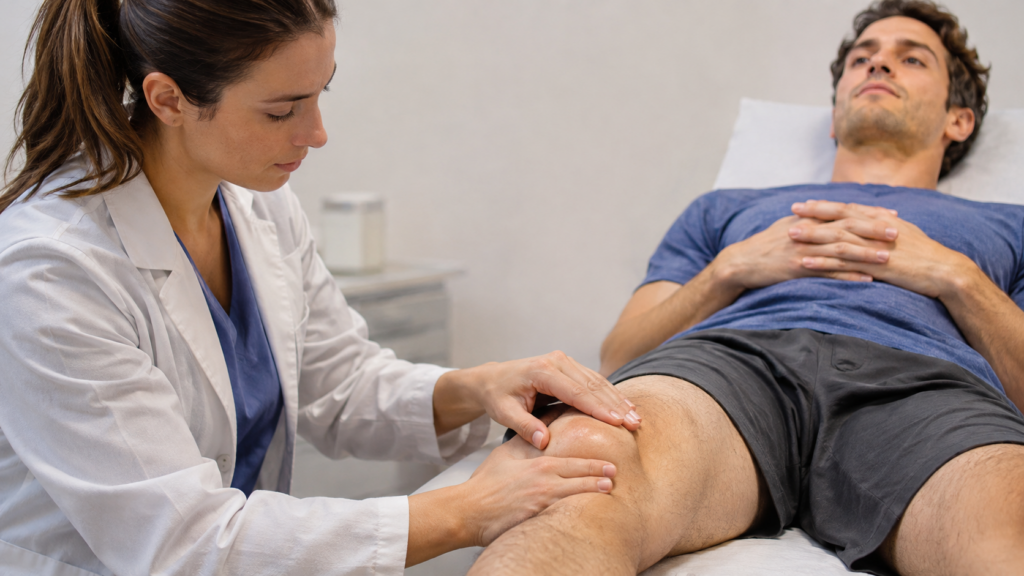
The Patellar Compression Test is an anterior-knee pain provocation maneuver, but its name is used for several related techniques. The exact method must be documented because gentle passive compression and the quadriceps-contraction Clarke variant are not interchangeable.
What Is the Patellar Compression Test?
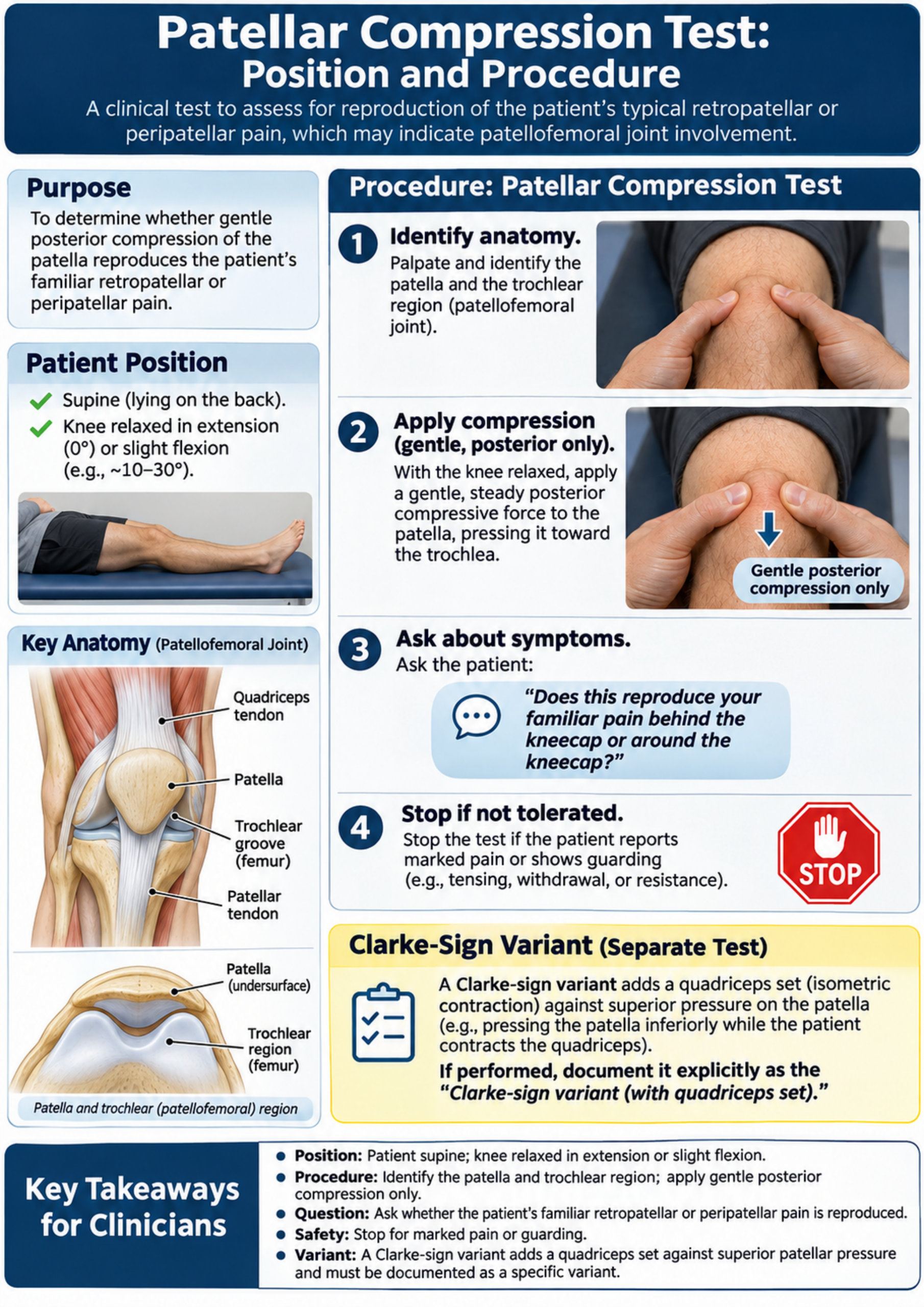
The Patellar Compression Test is an orthopedic provocative test that applies controlled pressure between the patella and femoral trochlea. The examiner asks whether the maneuver reproduces the patient’s familiar retropatellar or peripatellar pain.
- Classification: orthopedic pain-provocation test
- Region: patellofemoral joint
- Primary finding: reproduction of familiar anterior knee pain
- Limitation: a positive response does not identify one tissue or prove cartilage damage
Purpose and Indications
The test may be used as one component of an anterior-knee pain examination. Its role is symptom provocation rather than structural diagnosis.
- Explore familiar pain around or behind the patella.
- Compare the response with squatting, stairs, and prolonged sitting.
- Assess patellofemoral irritability before selecting other tests.
- Contribute to a broader differential diagnosis of anterior knee pain.
Contraindications and Precautions
Do not force compression through marked pain or guarding. Acute trauma, fracture concern, dislocation, infection, or a large tense effusion requires appropriate assessment before provocative testing.
- Suspected patellar fracture or acute dislocation
- Recent surgery without clearance for patellofemoral loading
- Severe acute pain or inability to relax the quadriceps
- Hot swollen joint with systemic illness
- Stop immediately if gentle pressure produces marked pain or apprehension
Patient and Examiner Positions
The patient is usually supine with the knee relaxed in extension or slight flexion. A small towel under the knee may reduce guarding, while the examiner stays beside the test limb and identifies the patellar borders before applying pressure.
- Patient supine with the thigh supported
- Knee relaxed in the chosen test angle
- Quadriceps relaxed for passive compression
- Examiner hand centered over or around the patella without excessive force
- Opposite knee may be compared only with the same technique
How to Perform the Patellar Compression Test
- Explain that the goal is to reproduce familiar symptoms, not tolerate maximum pressure.
- Position the patient supine and allow the quadriceps to relax.
- Identify the patella and note resting mobility and tenderness.
- Apply gentle posterior pressure toward the trochlea without grinding.
- Ask whether the sensation matches the patient’s usual retropatellar or peripatellar pain.
- Release immediately if pain or guarding rises sharply.
- If using a Clarke-sign variant, separately document superior patellar resistance and the requested quadriceps contraction.
Test Findings and Interpretation
Positive Finding
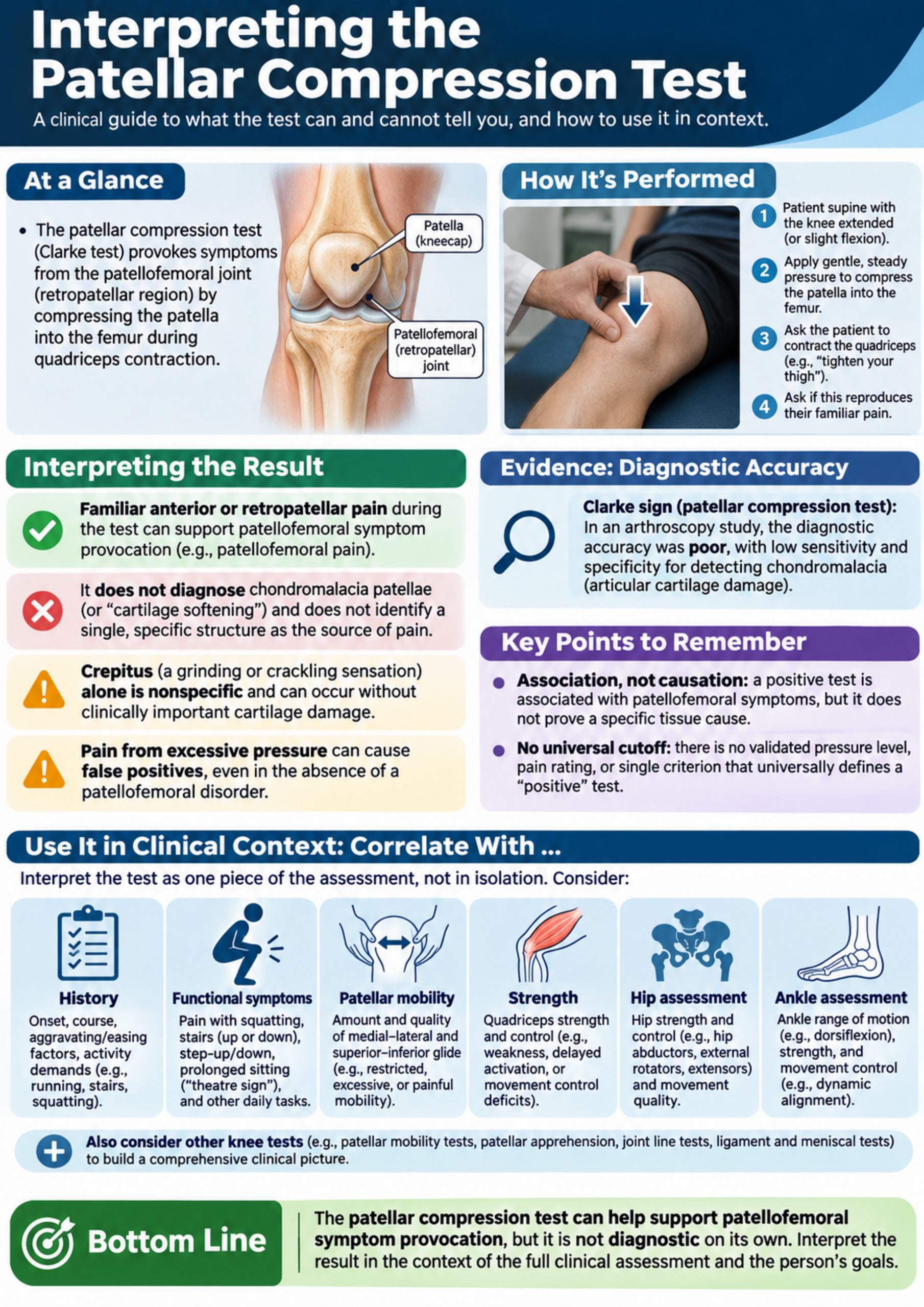
Reproduction of the patient’s familiar anterior, retropatellar, or peripatellar pain may support patellofemoral symptom provocation. Pain caused only by excessive examiner pressure is not a meaningful positive result.
Negative Finding
No familiar pain with gentle, controlled compression is a negative response for that specific maneuver. It does not exclude patellofemoral pain because the test has limited diagnostic accuracy.
Relevant Anatomy
The patella articulates with the femoral trochlea and is embedded within the quadriceps mechanism. Pressure, contact area, and joint force change with knee angle and quadriceps activity.
- Patella and patellar facets
- Femoral trochlea
- Articular cartilage and subchondral bone
- Medial and lateral retinacular tissues
- Quadriceps tendon and patellar tendon
Associated Conditions
A painful test is associated with patellofemoral symptom provocation, not a unique diagnosis. Similar pain can occur with several anterior-knee conditions and with excessive test pressure in otherwise asymptomatic people.
- Patellofemoral pain
- Patellofemoral osteoarthritis
- Patellar chondral irritation
- Post-traumatic or post-operative patellofemoral sensitivity
- Other anterior-knee pain sources requiring differential examination
Clinical Significance
Compression should be interpreted with the history and more functional symptom tests. A diagnostic-accuracy study of patellofemoral pain findings found that clusters involving resisted contraction, squatting pain, and palpation were more informative than isolated findings.
- Ask whether squatting or stair descent reproduces familiar pain.
- Assess patellar mobility and local tenderness gently.
- Evaluate knee and hip strength without assuming causation.
- Consider ankle mobility and lower-limb task mechanics.
- Use imaging only when clinically indicated, not because one test is painful.
Sensitivity, Specificity, and Diagnostic Accuracy
Accuracy depends on the exact maneuver and reference diagnosis. In 106 surgical patients without a history of patellofemoral pain, a Clarke-sign validation study using arthroscopy reported sensitivity 0.39, specificity 0.67, positive likelihood ratio 1.18, and negative likelihood ratio 0.91 for chondromalacia patella.
Those results apply to that Clarke-sign protocol and study population, not every maneuver called the Patellar Compression Test. The poor likelihood ratios mean the result did not meaningfully confirm or exclude chondromalacia in that setting.
Common Mistakes and Tips
The most common error is using too much force and then labeling any pain as diagnostic. Another is failing to document whether the examiner used passive compression, a glide, or a quadriceps-contraction variant.
- Do not grind the patella against the trochlea.
- Do not treat crepitus alone as a positive test.
- Do not use unfamiliar pressure pain as proof of disease.
- Document knee angle, pressure direction, and muscle activity.
- Compare the result with functional tasks and the full knee examination.
Summary
- The Patellar Compression Test is a provocative orthopedic maneuver.
- Use gentle controlled pressure and ask about familiar anterior-knee pain.
- Document the exact technique because test variants differ.
- A painful result does not diagnose chondromalacia or isolate one structure.
- Interpret the finding with history, functional tasks, and other tests.
The Patellar Compression Test can contribute limited symptom information when performed gently. It should not be used alone to diagnose patellofemoral pain or cartilage damage.