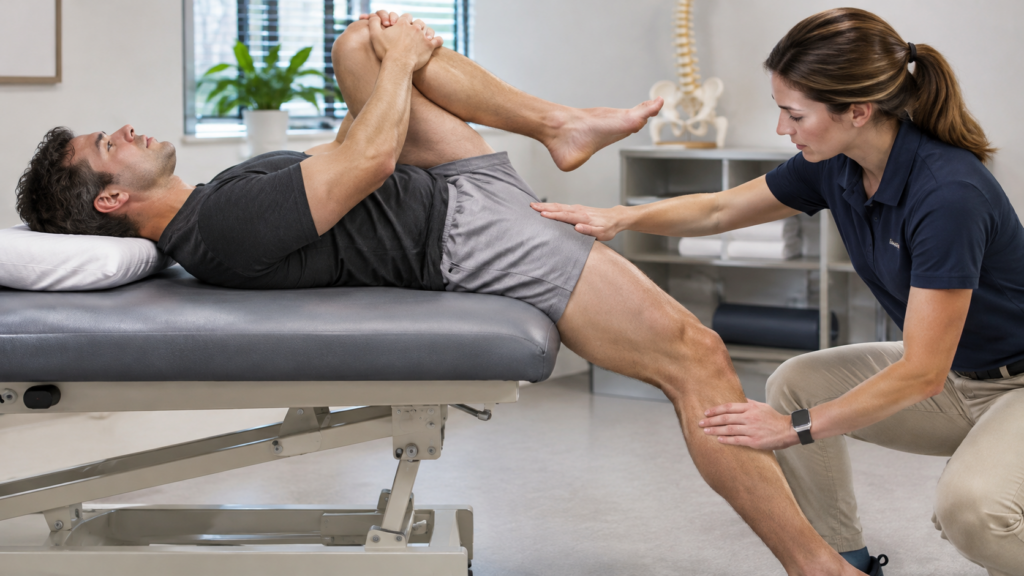
The Modified Thomas Test is commonly used to examine hip-extension flexibility while observing the knee and thigh position. Its value depends heavily on controlling the pelvis; an uncontrolled anterior pelvic tilt can make the hip appear to extend farther than it actually does.
What Is the Modified Thomas Test?
The Modified Thomas Test is an orthopedic flexibility test performed near the edge of a treatment table. It assesses hip-extension range and related thigh or knee positions, but it does not isolate one muscle or diagnose the cause of pain.
- Classification: orthopedic flexibility and range-of-motion test
- Primary measure: hip extension relative to a controlled pelvis
- Additional observations: knee angle, hip abduction, and rotation
- Role: one component of a broader hip and lower-limb examination
Purpose and Indications
The test helps quantify hip-extension flexibility and observe whether knee or thigh position changes during the maneuver. It can guide further assessment when hip mobility may affect gait, running, posture, or rehabilitation tasks.
- Assess limited hip-extension range.
- Compare sides using the same pelvic position.
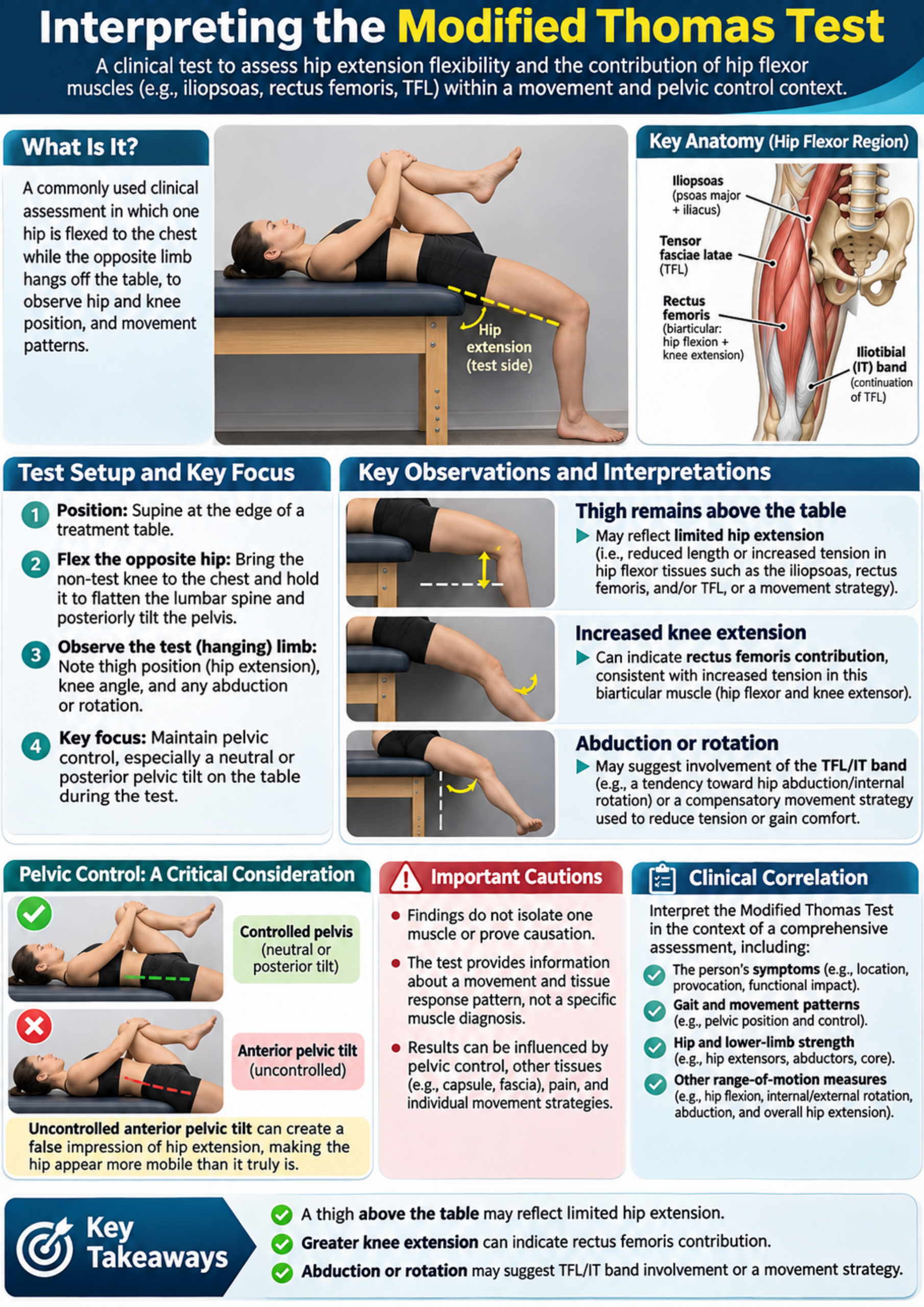
- Observe knee extension that may reflect rectus femoris contribution.
- Observe hip abduction or rotation during the test.
- Monitor flexibility under a standardized protocol.
Contraindications and Precautions
Do not force the test when hip, groin, back, or knee symptoms are acute. The table-edge position also requires balance, secure support, and enough assistance to prevent a fall.
- Recent hip surgery without clearance for the position
- Suspected fracture, acute instability, or severe pain
- Inability to lie supine or bring the opposite hip toward the chest safely
- Marked low-back symptoms aggravated by flexion or extension
- Stop for sharp pain, neurological symptoms, or guarding
Patient and Examiner Positions
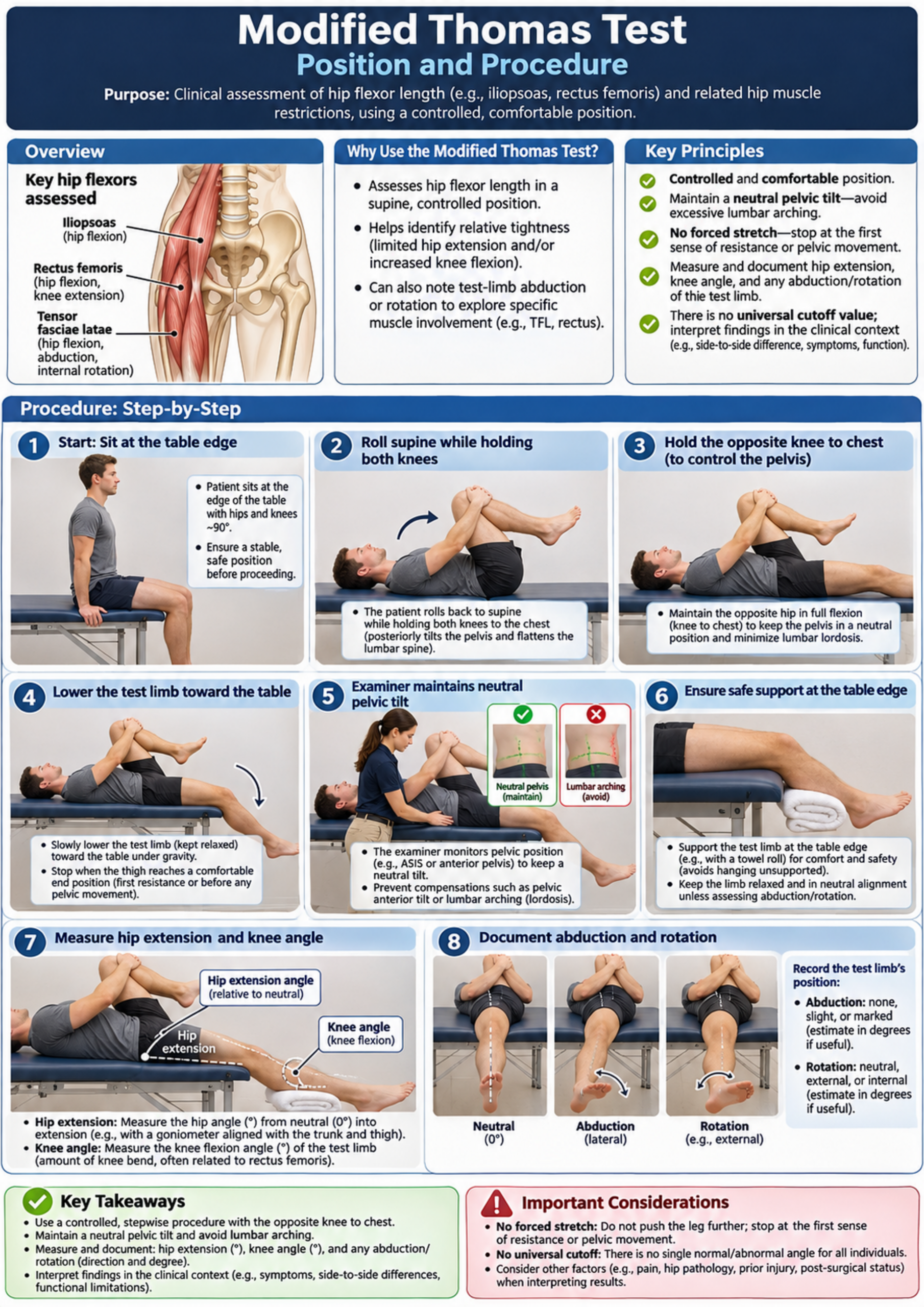
The patient begins seated near the table edge and rolls back while holding the knees. The examiner supports the test limb as needed and monitors the pelvis and lumbar spine throughout.
- Patient close enough to the edge for the test thigh to lower freely
- Opposite hip held toward the chest to help control pelvic position
- Test thigh supported initially, then lowered without forcing
- Pelvis maintained near neutral rather than allowing lumbar arching
- Examiner aligned to view the thigh and lower leg accurately
How to Perform the Modified Thomas Test
- Explain the test and position the patient seated near the table edge.
- Ask the patient to hold both knees while rolling to supine.
- Maintain the non-test knee toward the chest.
- Stabilize or monitor the pelvis to prevent anterior tilt and lumbar extension.
- Slowly lower the test limb toward the table without pushing.
- Measure the hip angle and knee angle with the chosen instrument.
- Record thigh abduction, rotation, symptoms, and any loss of pelvic control.
Test Findings and Interpretation
Positive Finding
A thigh that remains above neutral with pelvic position controlled indicates limited hip-extension range in that test position. Increased knee extension or thigh abduction can suggest contributions from multi-joint tissues or movement strategy, but it does not isolate one muscle.
Negative Finding
The thigh reaches the chosen neutral reference without loss of pelvic control and without relevant symptoms. A negative result does not exclude other sources of hip, groin, knee, or low-back symptoms.
Relevant Anatomy
The test lengthens several anterior hip and thigh structures while changing pelvic and lumbar position. Interpretation should therefore reflect a linked system rather than a single-muscle test.
- Iliopsoas crossing the anterior hip
- Rectus femoris crossing both hip and knee
- Tensor fasciae latae and iliotibial tract
- Anterior hip capsule and surrounding connective tissues
- Lumbopelvic structures that influence apparent hip extension
Associated Conditions and Clinical Contexts
Limited test range may be present in several clinical populations, but association does not establish causation. The result should be related to symptoms and functional demands.
- Reduced hip extension during gait or running
- Hip flexor stiffness after prolonged sitting
- Low-back pain assessment
- Anterior hip or thigh symptoms
- Post-injury or sport rehabilitation
Clinical Significance
The test can provide a repeatable hip-extension measure when setup and pelvic control are standardized. Use the result to decide whether further range-of-motion, strength, gait, or symptom testing is needed.
- Compare findings with walking and running mechanics.
- Measure rather than relying on a visual pass or fail.
- Assess active hip extension and functional tasks separately.
- Do not infer that limited range caused pain.
- Retest with the same table position and measurement method.
Reliability, Validity, and Measurement Limits
In 29 healthy college students, a criterion-validity study of the Modified Thomas Test found poor validity for hip-extension measurement when pelvic tilt was not controlled; the pelvic-tilt–controlled analysis accounted for much of the variance. The uncorrected test had sensitivity 31.82% and specificity 57.14% for an extension deficit defined as failure to reach neutral in that specific sample.
A goniometric reliability study in 64 healthy participants reported high intrarater and interrater reliability when neutral pelvic tilt was enforced. Earlier research in 42 healthy participants also reported high reliability for inclinometer and goniometer measurements, showing that standardized measurement can be repeatable even though interpretation remains context dependent.
Common Mistakes and Tips
The most important error is allowing the pelvis to tilt forward and the low back to arch as the thigh lowers. This substitutes lumbopelvic motion for true hip extension.
- Do not push the test thigh toward the table.
- Do not let the opposite knee drift away from the chest.
- Do not measure after pelvic position has been lost.
- Do not label one muscle as short from appearance alone.
- Record the instrument, landmarks, symptoms, and test side.
Summary
- The Modified Thomas Test assesses hip-extension flexibility in a controlled position.
- Pelvic stabilization is essential for valid interpretation.
- Thigh, knee, and rotation findings do not isolate one muscle.
- Use standardized measurements when monitoring change.
- Correlate the result with symptoms, gait, strength, and other mobility tests.
Performed carefully, the Modified Thomas Test can add useful information about hip-extension flexibility. Its result is most meaningful when pelvic position is controlled and the findings are integrated with the rest of the examination.