
Backpack ergonomics for students and professionals carrying heavy loads is not simply about choosing a lighter bag.
How the backpack fits, where the load sits, how long it is carried, the walking environment, physical capacity, and how the contents are distributed can all influence comfort, fatigue, balance, and movement.
In clinical practice, the most useful approach is to reduce unnecessary load, keep the pack close to the body, distribute the weight symmetrically, and adjust the carrying system to the individual rather than relying on one universal weight rule.
Why Backpack Ergonomics Matters
A backpack is designed to carry a load close to the trunk while leaving the hands free.
When properly fitted, this can be more practical than carrying the same load in one hand or over one shoulder.
Problems often begin when the backpack becomes unnecessarily heavy, hangs too far from the body, sits very low, or is carried for long periods without adequate recovery.
From a physical therapy perspective, I would not judge a backpack only by its weight.
I would also look at the person’s posture while walking, shoulder-strap position, trunk movement, symptoms, carrying duration, terrain, stairs, footwear, and physical demands during the rest of the day.
Important variables include:
- Total backpack weight.
- Duration of continuous carrying.
- Walking distance.
- Walking speed.
- Hills and stairs.
- Shoulder-strap adjustment.
- Hip-belt use.
- Position of heavier objects.
- Individual strength and endurance.
- Previous or current musculoskeletal symptoms.
Backpack use can be associated with discomfort around the shoulders, neck, thoracic region and lower back, although research does not support reducing the issue to backpack weight alone.
A systematic review of load-carriage systems found that weight, design and placement may influence pain and discomfort, while also emphasizing substantial variability in the evidence.
What Happens to the Body When a Backpack Gets Heavier?
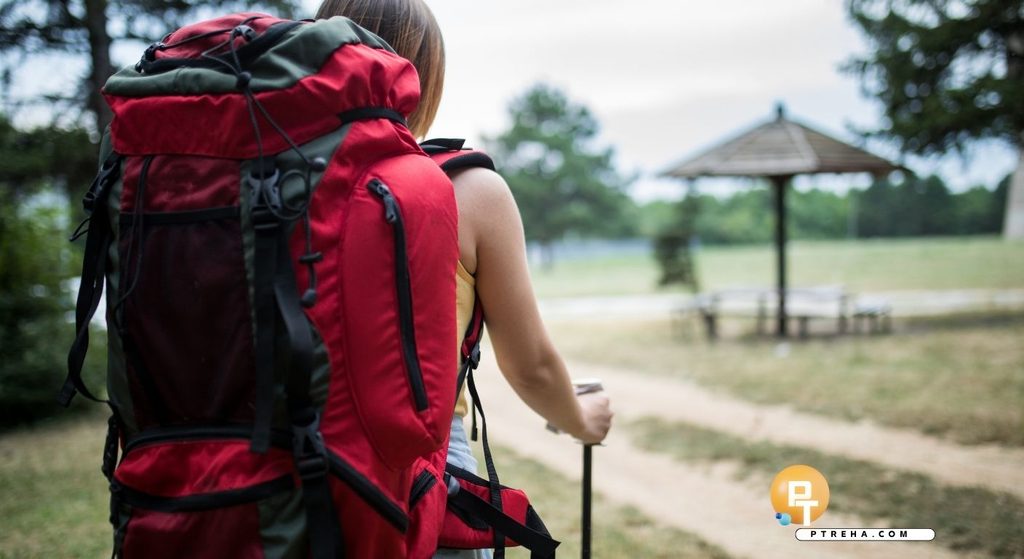
The body has to keep its combined center of mass controlled over the feet while carrying a backpack.
When additional weight is positioned behind the trunk, a person may compensate by changing trunk position, head position, stride characteristics or muscular activity.
The exact response varies according to the person and the load.
With increasing load or prolonged carrying, you may notice:
- Greater forward trunk inclination.
- Increased effort from trunk and hip muscles.
- Shoulder pressure from the straps.
- Earlier muscular fatigue.
- Changes in walking rhythm.
- Shorter or altered steps in some people.
- More effort when climbing stairs.
- Greater perceived exertion.
- Local discomfort under the shoulder straps.
- More frequent posture adjustments.
A forward lean while carrying a heavy backpack does not automatically mean that the spine has been injured or that the person has developed a permanent postural problem.
It can simply be an immediate strategy for controlling the load.
What matters clinically is whether the load produces excessive fatigue, pain, neurological symptoms, loss of balance or movement changes that persist after the backpack has been removed.
How Heavy Should a Backpack Be?
This is one of the most common questions I hear when discussing backpack ergonomics.
There is no single percentage of body weight that can safely define an appropriate backpack for every student or adult.
Recommendations around keeping school backpacks relatively light are useful as practical guidance, but they should not be presented as a precise injury threshold.
A large systematic review and meta-analysis of schoolbag weight and low-back pain did not find evidence that simply carrying a schoolbag above the commonly cited percentage of body weight was associated with a higher prevalence of low-back pain in schoolchildren.
The certainty of the evidence was limited.
This is important because it means that statements such as “a backpack above a certain percentage causes back injury” are too simplistic.
Instead, consider:
- The person’s body size.
- Current physical capacity.
- Backpack design.
- Duration of carrying.
- Distance covered.
- Frequency of carrying.
- Whether symptoms develop.
- Whether the load can be reduced.
- Whether the bag moves excessively.
- Whether the person can walk normally with it.
For example, two people of identical body weight may respond very differently to the same backpack.
One may carry it comfortably for a short commute, while another may develop substantial shoulder fatigue because of a longer walking distance, poor strap adjustment or lower conditioning.
For students, parents should still actively minimize unnecessary load rather than trying to reach a particular percentage.
For professionals carrying tools, electronics or field equipment, the same principle applies: remove equipment that is not needed for the task whenever possible.
How to Choose an Ergonomic Backpack
A good backpack should allow the load to remain relatively stable and close to the body.
For everyday school or professional use, I generally prefer a backpack with two adjustable shoulder straps rather than a single-strap bag for substantial loads.
Useful features include:
- Two adjustable shoulder straps.
- Adequately wide straps.
- Comfortable shoulder padding.
- A stable back panel.
- Several internal compartments.
- Compression straps when appropriate.
- A sternum strap for stabilization.
- A functional hip belt for larger loads.
- A size appropriate for the user’s torso.
- Durable construction that prevents sagging.
The American Academy of Pediatrics’ backpack safety guidance similarly recommends features such as two broad adjustable shoulder straps, a padded back, compartments, and appropriate waist or chest straps.
More padding is not automatically better.
Excessively thick padding cannot compensate for poor backpack sizing or poor load placement.
Backpack feature and its practical purpose
| Backpack feature | Ergonomic purpose | Practical check |
|---|---|---|
| Two shoulder straps | Shares the load between both sides | Both straps should be used |
| Adjustable straps | Positions the backpack close to the trunk | Bag should not hang loosely behind you |
| Hip belt | Can transfer part of the load toward the pelvis | Particularly useful for substantial loads |
| Sternum strap | Helps control shoulder-strap position and pack movement | Should feel supportive, not restrictive |
| Compartments | Improve organization and load positioning | Heavy items should not migrate outward |
| Compression straps | Reduce movement of partially filled packs | Tighten after packing |
| Structured back panel | Improves stability and protects against hard objects | Check for uncomfortable pressure points |
| Appropriate pack size | Prevents excessive sagging or oversized loading | Match pack dimensions to the user |
How to Fit a Backpack Correctly
An expensive backpack can still be uncomfortable if it is badly adjusted.
When assessing backpack fit clinically, I first look at whether the pack is stable against the person’s back rather than hanging away from the trunk.
A useful fitting sequence is:
- Loosen the straps before putting the backpack on.
- Put both shoulder straps on.
- Position the backpack against the back.
- Tighten the shoulder straps gradually.
- Keep the pack relatively close to the trunk.
- Adjust the hip belt if the backpack has one.
- Position the sternum strap comfortably.
- Tighten compression straps if available.
- Walk several meters.
- Re-adjust anything that pinches or allows excessive movement.
Avoid aggressively pulling the shoulder straps until the backpack is uncomfortably high.
The goal is stability and comfort rather than maximum tightness.
The shoulder straps should generally have similar adjustment on both sides unless an individual anatomical or equipment-related reason requires otherwise.
Check the fit while moving
Do not assess the backpack only while standing in front of a mirror.
Walk with it.
Try:
- Normal walking.
- Faster walking.
- Turning.
- Stairs.
- Sitting down.
- Standing back up.
- Reaching for a door.
- Bending slightly.
- Getting on and off public transportation.
A backpack that feels acceptable while standing may become uncomfortable as soon as it starts bouncing during walking.
How to Pack a Heavy Backpack
Load placement can be just as important as total load.
As a general ergonomic principle, dense items should usually remain relatively close to the trunk rather than being placed at the outermost part of the backpack.
For a student, this may mean positioning a heavy laptop or large textbook near the back panel rather than placing it in the front pocket.
For a professional, batteries, tools or equipment cases should not be allowed to shift freely inside the backpack.
Pack strategically:
- Place dense items close to the back panel.
- Use dedicated laptop compartments when available.
- Prevent heavy objects from moving.
- Distribute smaller objects between compartments.
- Remove unnecessary books or equipment.
- Carry only the supplies needed that day.
- Tighten compression straps.
- Avoid filling outer pockets with dense objects.
- Balance left-to-right loading.
- Repack when the contents change.
Why keeping weight close matters
Imagine holding a weight directly against your chest and then holding the same weight farther away.
The object has not become heavier, but the mechanical demand changes because of its distance from the body.
The same general principle applies to backpacks.
A load positioned far behind the trunk can require different compensatory strategies compared with one held closer.
For everyday packing:
- Laptop: close to the back.
- Large books: near the back.
- Smaller notebooks: farther outward.
- Light clothing: outer area.
- Water bottle: secure it so it does not swing.
- Small accessories: use compartments.
- Frequently used lightweight objects: outer pockets.
There is no need to obsess over millimeters of placement.
The practical objective is simply to keep the densest objects stable and reasonably close to the body.
Backpack Ergonomics for Students

Students have a particular problem: backpack contents may accumulate during the day without anyone noticing.
Textbooks, laptops, chargers, notebooks, sports equipment, food and water can quickly create a substantial load.
A student may then carry that backpack while walking to school, climbing several flights of stairs and commuting home.
A useful routine is:
- Check the timetable before leaving home.
- Take only required books.
- Remove completed worksheets.
- Use school storage when available.
- Avoid carrying duplicate supplies.
- Use digital materials when practical.
- Empty the backpack regularly.
- Organize papers into lightweight folders.
- Carry sports equipment separately when appropriate.
- Adjust straps as clothing thickness changes.
Children and adolescents should also know how to put the backpack on rather than repeatedly swinging a heavy bag onto one shoulder.
A practical technique is to place the backpack on a table, chair or other stable raised surface when possible, insert both arms into the straps, and then stand upright.
When lifting it from a lower position:
- Stand close to the backpack.
- Use a stable stance.
- Bend through the hips and knees as needed.
- Keep the backpack close.
- Avoid forcefully twisting while lifting.
- Put on both straps rather than throwing the bag over one shoulder.
Occasionally carrying a light backpack over one shoulder is different from routinely carrying a substantial load asymmetrically for long distances.
For heavier everyday loads, I prefer both straps.
Backpack Ergonomics for Professionals Carrying Equipment
Professionals may face a different load-carriage problem.
Photographers, healthcare workers, technicians, engineers, commuters, field workers and other professionals may carry laptops, tools, batteries, documents or specialized equipment for prolonged periods.
Here I pay particular attention to cumulative exposure.
A backpack may feel manageable for five minutes but become demanding after repeated walking, stairs and prolonged standing.
Professionals should consider:
- Total walking distance.
- Number of stair climbs.
- Time spent standing.
- Frequency of removing the pack.
- Equipment required for each assignment.
- Availability of lockers or storage.
- Whether a wheeled option is practical.
- Whether equipment can be divided between bags.
- Whether rarely used equipment can stay on site.
- Whether the load changes through the workday.
For genuinely heavy professional loads, a basic school-style backpack may not be the best system.
A properly designed pack with a substantial hip belt, load-control features and an appropriate torso fit may provide better load management.
Use the hip belt when the load becomes substantial
Many people leave the hip belt hanging unused.
On appropriately designed load-carrying packs, the hip belt can help transfer some load toward the pelvic region rather than relying predominantly on the shoulder straps.
Set it up so that:
- It sits comfortably around the pelvic region.
- It does not restrict breathing.
- The backpack remains stable.
- Shoulder straps are not doing all the work.
- The buckle does not create a painful pressure point.
- Clothing is not trapped uncomfortably underneath.
The sternum strap has a different role.
It primarily helps stabilize the shoulder straps and control pack movement; it should not be tightened aggressively in an attempt to “unload” the entire backpack.
Common Backpack Mistakes I See in Practice
Backpack problems are often caused by several small issues rather than one dramatic error.
The first thing I usually check is whether the person is carrying items they simply do not need.
Common mistakes include:
- Carrying the backpack on one shoulder.
- Allowing it to hang far behind the body.
- Using very loose shoulder straps.
- Packing the heaviest item in the outer pocket.
- Carrying unnecessary equipment every day.
- Ignoring a usable hip belt.
- Allowing objects to move inside the bag.
- Using a backpack that is too large for the user.
- Continuing despite progressively worsening symptoms.
- Never readjusting the backpack after changing its contents.
Another common mistake is trying to maintain a rigidly “perfect” posture.
You do not need to walk with the chest artificially lifted and the shoulder blades forcibly squeezed together.
Movement should remain natural.
An ergonomic backpack should make normal movement easier rather than requiring constant muscular bracing.
Managing Fatigue During Long Periods of Load Carriage
Duration matters.
Even an appropriately fitted backpack can become uncomfortable when carried long enough.
When circumstances allow, break long periods of load carriage into shorter exposures.
Useful strategies include:
- Put the backpack down during longer waits.
- Use a locker between classes.
- Remove the pack while sitting.
- Change unnecessary contents before long walks.
- Take short carrying breaks.
- Use elevators when fatigue makes stairs difficult.
- Avoid standing with the backpack on unnecessarily.
- Alternate demanding and lighter tasks.
- Maintain regular general physical activity.
- Build carrying tolerance progressively when required for work.
If your occupation requires load carriage, physical conditioning may improve your ability to tolerate the task, but exercise is not a justification for carrying unnecessary weight.
The first intervention should still be rational load management.
Strength and conditioning can support load tolerance
No particular exercise can make poor backpack ergonomics harmless.
However, general strength, aerobic fitness and task-specific conditioning can contribute to better tolerance of physical work.
Depending on the individual, useful exercise categories may include:
- Squat variations.
- Hip-hinge exercises.
- Step-ups.
- Rowing movements.
- Loaded carries.
- Trunk-control exercises.
- Calf strengthening.
- General walking.
- Aerobic conditioning.
- Progressive work-specific training.
Exercise selection should match the person’s ability, symptoms and job or study demands.
For someone returning from an injury or dealing with persistent pain, the loading program may need individual assessment rather than simply adding more weight.
When Backpack Discomfort Needs More Attention
Temporary shoulder pressure or muscular fatigue after carrying a demanding load is not the same thing as diagnosing an injury.
However, symptoms should not automatically be dismissed as “just the backpack.”
Reduce or remove the load and seek appropriate assessment if symptoms are persistent, progressive or concerning.
Pay particular attention to:
- Persistent pain despite reducing the load.
- Recurrent numbness or tingling.
- Noticeable weakness.
- Symptoms extending into an arm or leg.
- Significant balance difficulty.
- Increasing pain during normal activities.
- Pain following a substantial injury.
- Symptoms that interfere with sleep or daily function.
- Unexplained systemic symptoms.
- Difficulty carrying even light everyday loads.
A physical therapist can assess movement, load tolerance, functional strength, backpack fit and relevant musculoskeletal factors.
Symptoms suggesting another medical problem should be assessed by the appropriate healthcare professional rather than being attributed automatically to backpack use.
Practical Backpack Ergonomics Checklist
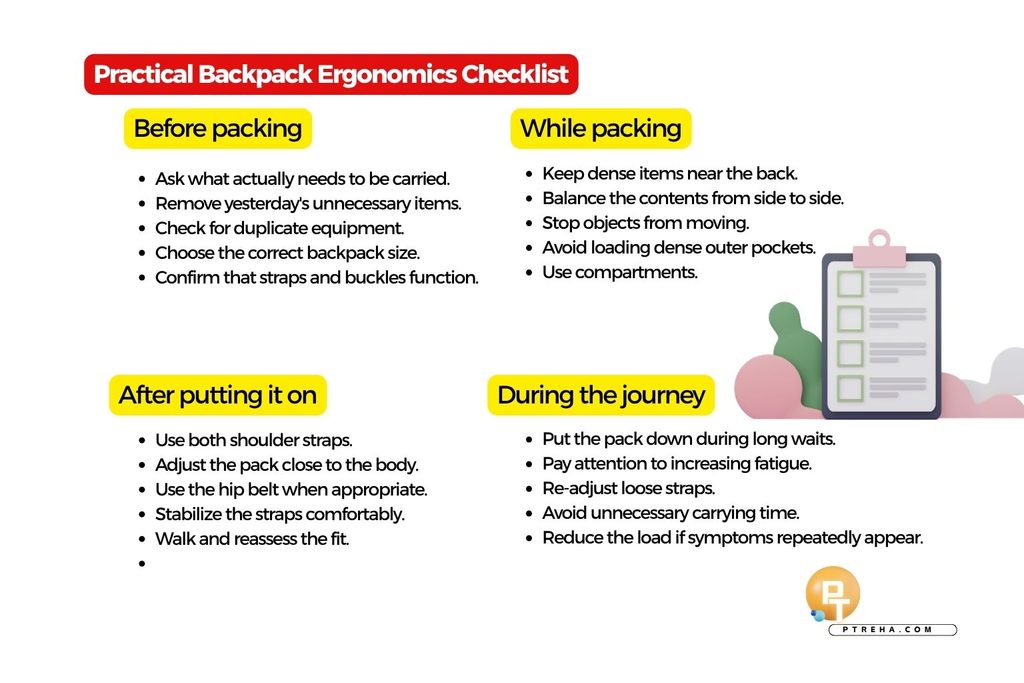
Before leaving home, school or work, perform a quick check.
Before packing
- Ask what actually needs to be carried.
- Remove yesterday’s unnecessary items.
- Check for duplicate equipment.
- Choose the correct backpack size.
- Confirm that straps and buckles function.
While packing
- Keep dense items near the back.
- Balance the contents from side to side.
- Stop objects from moving.
- Avoid loading dense outer pockets.
- Use compartments.
After putting it on
- Use both shoulder straps.
- Adjust the pack close to the body.
- Use the hip belt when appropriate.
- Stabilize the straps comfortably.
- Walk and reassess the fit.
During the journey
- Put the pack down during long waits.
- Pay attention to increasing fatigue.
- Re-adjust loose straps.
- Avoid unnecessary carrying time.
- Reduce the load if symptoms repeatedly appear.
The objective is not to create a perfect posture throughout the day.
It is to make the load manageable enough that the person can move normally and perform the required task without unnecessary strain.
Conclusion
Good backpack ergonomics for students and professionals carrying heavy loads depends on more than a single weight limit.
Reduce unnecessary contents, select an appropriately sized backpack, use both shoulder straps, keep dense items stable and close to the body, use the hip belt when the pack is designed for it, and consider carrying duration as well as weight.
From a physical therapy perspective, the best backpack setup is one that allows efficient, comfortable movement with a manageable level of effort.
Persistent pain, neurological symptoms, substantial weakness or difficulty tolerating ordinary loads should prompt further assessment rather than simply tightening the straps or trying to “improve posture.”
Frequently Asked Questions
How heavy is too heavy for a backpack?
There is no precise weight that becomes unsafe for every person.
Body size, conditioning, duration, distance, backpack design, terrain and symptoms all influence tolerance.
For students and professionals, unnecessary load should be removed regardless of whether the backpack falls below a particular percentage of body weight.
Should a backpack be limited to a percentage of body weight?
Percentage-based recommendations can be useful as simple practical guidance, particularly for children, but they should not be treated as scientifically proven injury thresholds.
Research examining schoolbag weight and low-back pain has not established a universal percentage at which injury suddenly occurs.
Is carrying a backpack on one shoulder bad?
Occasionally carrying a very light backpack on one shoulder is unlikely to be a major concern for most people.
For substantial loads or longer distances, using both shoulder straps generally provides a more symmetrical and stable carrying method.
Should a backpack sit high or low on the back?
The backpack should generally remain reasonably close to the trunk and should not sag far below the torso.
Exact positioning depends on backpack design and body dimensions.
Stability and comfort are more useful goals than trying to reproduce one exact position.
Where should the heaviest items go?
Dense items should usually be positioned close to the back panel rather than in an outer pocket.
Keeping heavy objects close to the trunk and preventing them from shifting can improve load control.
Does a hip belt really help?
A functional hip belt on an appropriately designed backpack can help transfer part of the load toward the pelvis and improve pack stability.
This becomes increasingly useful with substantial loads, although a thin decorative waist strap may not provide the same function as a structured load-bearing hip belt.
Can backpacks cause poor posture?
A backpack can produce temporary changes in trunk, head or shoulder position while it is being carried.
That does not mean backpack use inevitably causes a permanent postural abnormality.
Posture is influenced by many factors, and temporary movement adaptations should not automatically be labeled as structural problems.
Can a backpack cause back pain?
Backpack carrying may contribute to discomfort or aggravate symptoms in some individuals, but back pain is multifactorial.
It is therefore inappropriate to assume that backpack weight alone is the cause of someone’s pain without considering carrying duration, physical capacity, activity, previous symptoms and other relevant factors.
Are wheeled backpacks better?
A wheeled bag may be useful when a person needs to transport substantial material over suitable surfaces and wants to reduce carrying time.
However, stairs, crowded areas, uneven ground and repeated lifting of the wheeled bag can reduce its practical advantage.
The best solution depends on the environment.
What should I do if my shoulders or back hurt every time I carry my backpack?
Start by removing unnecessary contents, checking the fit, using both straps, placing dense items close to your back, and reducing continuous carrying time.
If pain repeatedly returns despite these changes, becomes progressively worse, or is associated with numbness, weakness or other concerning symptoms, seek an appropriate clinical assessment.