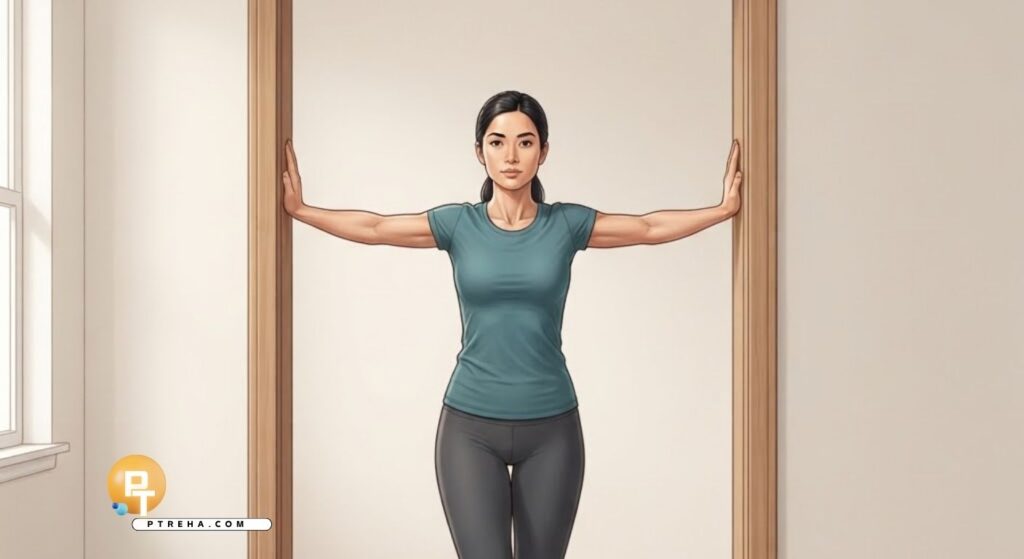
An upper body posture reset using a doorway stretch can be a simple way to reduce the feeling of chest tightness after prolonged sitting, computer work, driving, or repeated forward-reaching tasks.
The goal is not to force the shoulders backward or create a permanently “perfect” posture, but to restore comfortable movement through the chest and shoulders, then reinforce that mobility with active shoulder-blade control and regular position changes.
What a Doorway Stretch Can Do for Upper Body Posture
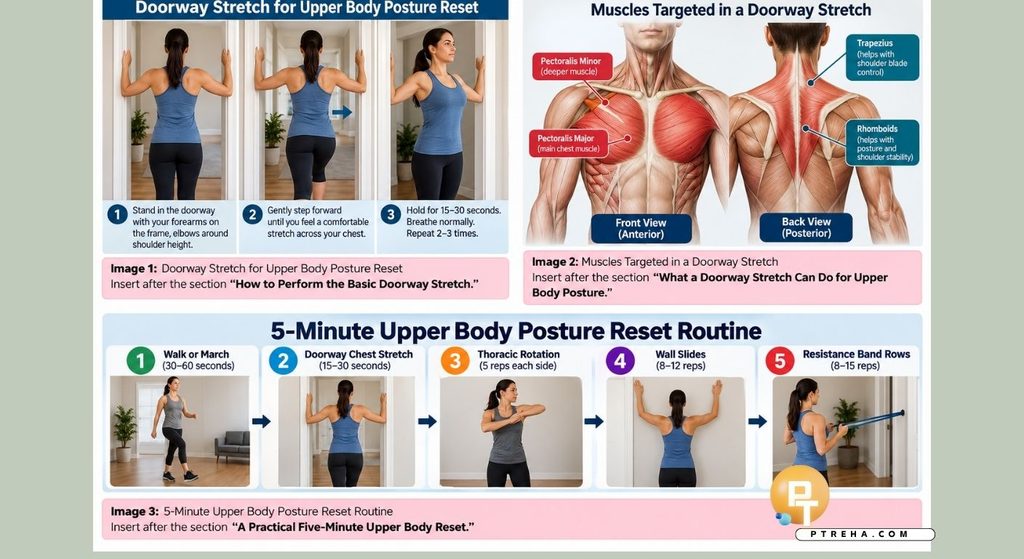
A doorway stretch primarily places the anterior chest tissues, including the pectoral muscles, into a lengthened position.
This can be useful when prolonged sitting or repetitive activities leave the front of the chest feeling restricted.
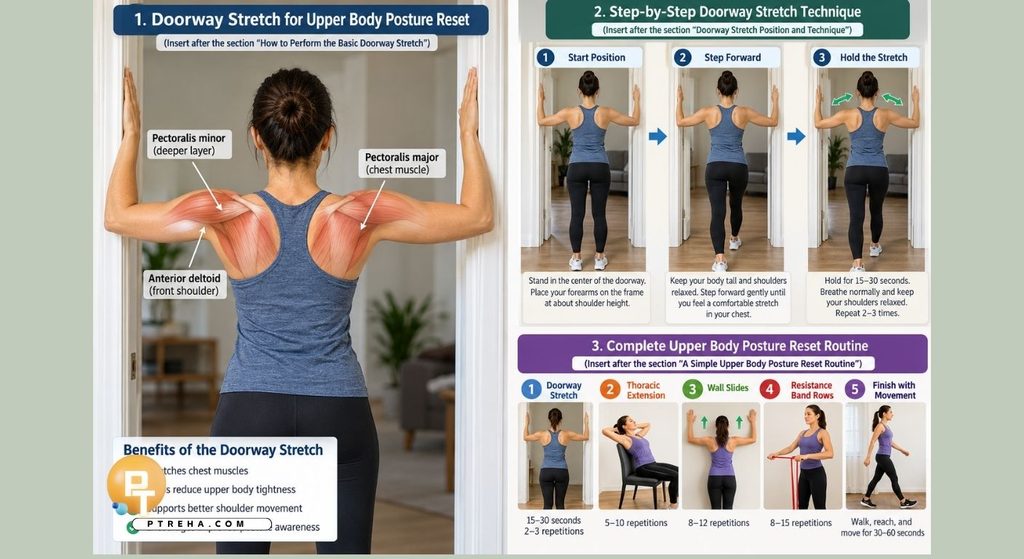
The stretch may help temporarily improve how easily you can move the shoulders backward or overhead, particularly when chest stiffness is one factor limiting movement.
Potential benefits include:
- Reducing the sensation of tightness across the chest.
- Encouraging comfortable shoulder extension.
- Improving awareness of shoulder position.
- Providing movement after prolonged desk work.
- Preparing the upper body for strengthening exercises.
- Breaking up long periods spent in one position.
However, stretching alone should not be expected to permanently change posture.
Research examining pectoralis minor stretching shows that stretching may influence symptoms or mobility in some people, but changes in muscle length and posture are not always consistent.
A systematic review available through PubMed’s review of pectoralis minor stretching research found that the effects depend partly on the stretching method used.
This is why a posture routine should usually include both mobility and active exercise.
Why the Upper Body Can Feel Stiff After Sitting
The body adapts to the positions and activities it performs repeatedly.
A person who spends several hours using a laptop may remain in relatively little thoracic extension while the arms stay in front of the body.
That does not automatically mean the person has damaged their posture.
Common contributors to upper-body stiffness include:
- Long periods without changing position.
- Repetitive keyboard or mouse use.
- Frequent smartphone use.
- Limited thoracic spine movement.
- Reduced shoulder movement during the day.
- Chest muscle stiffness.
- Fatigue of the upper-back and shoulder muscles.
- Repeated forward-reaching tasks.
- Stress-related muscle tension.
- Lack of general physical activity.
A useful posture reset therefore focuses on movement variability rather than holding one rigid position all day.
For example, someone working at a computer may benefit more from standing up, moving the shoulders, performing a brief doorway stretch, and walking for a minute than from constantly trying to pull the shoulder blades backward.
How to Perform the Basic Doorway Stretch
The standard doorway stretch should create a gentle stretch through the front of the chest without causing shoulder pain, numbness, tingling, or a pinching sensation.
Use a stable doorway with enough space to step forward safely.
To perform it:
- Stand in the center of the doorway.
- Place one forearm against each side of the frame.
- Keep the shoulders relaxed rather than shrugged.
- Position the elbows approximately around shoulder height or slightly below.
- Place one foot slightly forward.
- Keep the trunk tall.
- Gently shift your body forward.
- Stop when you feel a comfortable chest stretch.
- Breathe normally.
- Return slowly to the starting position.
The movement should come from stepping or shifting the body forward rather than aggressively pushing the shoulders backward.
A practical starting point is a gentle 15- to 30-second stretch for two or three repetitions, provided the position is comfortable.
The American Physical Therapy Association’s consumer resource ChoosePT home stretching guidance also describes doorway-based upper-body stretching and emphasizes performing stretching movements slowly and steadily.
Doorway Stretch Position and Technique
Small changes in arm position alter where the stretch is felt.
There is no need to place the arms as high as possible.
A comfortable middle position is often preferable when beginning.
| Doorway position | Primary purpose | What you should feel | Key precaution |
|---|---|---|---|
| Elbows below shoulder level | Gentle chest mobility | Mild stretch across chest | Do not force shoulder extension |
| Elbows near shoulder level | General pectoral stretch | Stretch across front chest/shoulder | Avoid anterior shoulder pain |
| One arm at a time | More controlled stretch | Stretch on one side | Keep trunk rotation minimal |
| Hands higher on frame | Greater overhead emphasis | Chest and anterior shoulder stretch | Avoid if it causes pinching |
| Staggered stance | Better balance and control | Comfortable chest opening | Keep the ribs controlled |
The exact position should be adjusted according to shoulder mobility, comfort, and symptoms.
During the stretch:
- Keep the neck relaxed.
- Avoid pushing the chin forward.
- Do not excessively arch the lower back.
- Keep the ribs relatively quiet.
- Avoid aggressively squeezing the shoulder blades.
- Maintain gentle abdominal control.
- Move gradually into the stretch.
- Keep breathing throughout the hold.
You do not need an intense stretch to obtain a useful mobility stimulus.
A Simple Upper Body Posture Reset Routine
A doorway stretch becomes more useful when followed by active movements.
The following routine can be performed after working at a desk, studying, driving, or spending a long period in one position.
Step 1: Relax and Reset Your Starting Position
Stand comfortably rather than trying to assume a military-style posture.
Focus on:
- Feet comfortably apart.
- Knees relaxed.
- Rib cage stacked comfortably over the pelvis.
- Arms hanging naturally.
- Neck relaxed.
- Shoulders away from the ears.
Take two or three slow breaths.
Step 2: Perform the Doorway Stretch
Move into the doorway position and gently step forward.
Try:
- 15–30 seconds per stretch.
- Two or three comfortable repetitions.
- Slow breathing.
- Mild to moderate stretch intensity.
Do not bounce or repeatedly push deeper into the stretch.
Step 3: Add Thoracic Extension
After prolonged sitting, restoring movement through the thoracic spine can complement the chest stretch.
Using the back of a firm chair:
- Sit upright.
- Place the hands behind the head.
- Support the upper back against the chair.
- Gently extend the upper back over the chair.
- Keep the movement comfortable.
- Return slowly.
Perform several controlled repetitions rather than forcing a large range.
Step 4: Add Shoulder-Blade Control
Next, reinforce the newly explored range with active movement.
Try a gentle standing row using an exercise band:
- Hold the band in both hands.
- Keep the elbows near the sides.
- Pull the elbows backward.
- Allow the shoulder blades to move toward each other naturally.
- Avoid shrugging.
- Return slowly.
Perform approximately 8–15 controlled repetitions according to your tolerance.
Step 5: Move Out of the Position
Finish with normal movement rather than immediately returning to a rigid seated posture.
For example:
- Walk around the room.
- Reach the arms overhead.
- Roll the shoulders gently.
- Rotate the trunk.
- Take several relaxed breaths.
The purpose of the routine is to restore movement options.
Why Strengthening Should Follow Stretching
A doorway stretch may make a restricted position temporarily feel easier, but the nervous and musculoskeletal systems also need active control through the available range.
This is particularly relevant around the scapula.
Muscles contributing to scapular control include:
- Middle trapezius.
- Lower trapezius.
- Serratus anterior.
- Rhomboids.
- Rotator cuff muscles.
- Posterior shoulder musculature.
That does not mean everyone with rounded shoulders has “weak back muscles.” Posture is influenced by anatomy, habits, activity, fatigue, comfort, movement strategies, and many other factors.
Research comparing pectoral stretching with scapular-retraction strengthening found greater improvement in forward shoulder position in the strengthening group, which reinforces the importance of active exercise rather than relying exclusively on stretching.
The study can be reviewed through PubMed’s comparison of pectoral stretching and scapular strengthening.
Useful exercises that may accompany a doorway stretch include:
- Resistance-band rows.
- Wall slides.
- Serratus wall slides.
- Band external rotation.
- Prone arm raises when appropriate.
- Controlled shoulder flexion.
- Thoracic rotation exercises.
Exercise selection should match the individual’s symptoms, mobility, strength, and functional goals.
How Often Should You Use the Doorway Posture Reset?
There is no universal schedule that everyone must follow.
For someone who becomes stiff during desk work, short movement breaks distributed throughout the day are usually more practical than one long stretching session.
A simple approach might be:
- Change sitting position regularly.
- Stand periodically.
- Perform the doorway stretch when the chest feels stiff.
- Move the shoulders through comfortable ranges.
- Include strengthening several times during the week.
- Avoid staying in any single posture for unnecessarily long periods.
The doorway stretch itself may only require a few minutes.
For example, a desk worker could use this sequence during a break:
- Stand and walk briefly.
- Perform two doorway stretches.
- Complete eight controlled wall slides.
- Perform ten band rows.
- Move the neck gently.
- Return to work in a comfortable position.
The routine does not need to be exhausting to be useful.
Common Doorway Stretch Mistakes
Poor technique can move stress away from the chest and toward the anterior shoulder, neck, or lower back.
Forcing the Shoulders Too Far Forward
Stepping deeply through the doorway can produce excessive shoulder extension.
Instead:
- Use a smaller step.
- Keep the stretch gentle.
- Stop before shoulder discomfort.
- Increase range gradually if appropriate.
Arching the Lower Back
Some people create the appearance of greater chest opening by extending the lumbar spine.
Instead:
- Keep the ribs controlled.
- Avoid pushing the abdomen forward.
- Maintain a comfortable neutral trunk.
- Think about moving the whole body forward.
Elevating the Shoulders
Shoulder shrugging may create unnecessary neck tension.
Instead:
- Relax the upper trapezius.
- Keep the neck comfortable.
- Use a lower arm position if necessary.
Stretching Into Pain
A doorway stretch should not reproduce sharp or significant shoulder pain.
Stop or modify the exercise if you develop:
- Sharp pain.
- Increasing shoulder pain.
- Numbness.
- Tingling.
- Burning sensations.
- Arm weakness.
- Dizziness.
- Symptoms extending down the arm.
Pain is not required for an effective stretch.
One-Arm Doorway Stretch for Better Control
Some people tolerate a unilateral doorway stretch better than the two-arm version.
It allows each shoulder to be positioned independently.
To perform it:
- Stand next to the doorway.
- Place one forearm against the frame.
- Keep the shoulder relaxed.
- Step forward slightly.
- Rotate the chest gently away from the arm if comfortable.
- Stop when a chest stretch is felt.
- Hold without bouncing.
- Repeat on the opposite side.
This variation may be useful when:
- One side feels tighter.
- Shoulder mobility differs between sides.
- The bilateral version feels uncomfortable.
- Better control is needed.
- The person tends to arch the back during the two-arm stretch.
Side-to-side differences are common and do not automatically indicate pathology.
Make the Posture Reset More Effective at a Desk
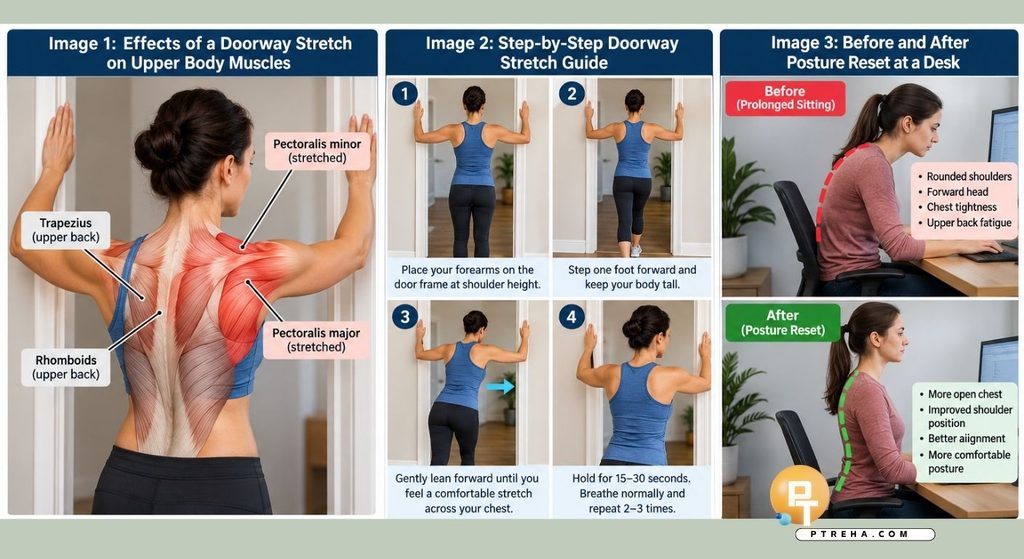
Stretching can be helpful, but the rest of the work environment still matters.
A workstation does not need to create one perfect posture.
It should make it easy to move between comfortable positions.
Consider these adjustments:
- Keep frequently used items within comfortable reach.
- Position the keyboard so the shoulders can remain relaxed.
- Keep the mouse close to the body.
- Adjust the screen to reduce unnecessary neck bending.
- Support the forearms when useful.
- Change position regularly.
- Alternate between tasks when possible.
- Stand or walk during some breaks.
- Avoid consciously pulling the shoulders backward all day.
- Continue regular exercise outside work.
An ergonomic setup should support movement rather than lock the body into one position.
A useful rule is simple: your next posture is often more important than your supposedly perfect posture.
When the Doorway Stretch May Need Modification
Not everyone should use the same arm position or stretch intensity.
Be particularly cautious when there is:
- Recent shoulder injury.
- Recent surgery.
- Shoulder instability.
- History of dislocation.
- Significant joint hypermobility.
- Acute neck or shoulder pain.
- Symptoms extending into the arm.
- Neurological symptoms.
- Significant pain with shoulder extension.
- A medical restriction on upper-limb activity.
Someone with anterior shoulder instability, for example, may not tolerate a deep doorway position because the exercise places the shoulder into extension and horizontal abduction.
A physical therapist can modify:
- Arm height.
- Shoulder rotation.
- Stretch intensity.
- Hold duration.
- Number of repetitions.
- Exercise selection.
The exercise should fit the patient rather than forcing the patient to fit a standard stretch.
Doorway Stretch vs. Trying to “Fix” Rounded Shoulders
Rounded shoulder appearance is not a diagnosis by itself.
People naturally differ in:
- Thoracic curvature.
- Shoulder position.
- Scapular orientation.
- Muscle length.
- Skeletal structure.
- Habitual posture.
- Preferred movement patterns.
A person can have visibly rounded shoulders without pain, while another person with apparently upright posture may still have shoulder or neck symptoms.
Therefore, an upper body posture reset should not be based solely on appearance.
A better goal is to improve:
- Comfortable movement.
- Shoulder function.
- Strength.
- Movement tolerance.
- Work tolerance.
- Exercise capacity.
- Position variability.
If the doorway stretch helps someone move more comfortably, it can be included.
If it repeatedly aggravates symptoms, a different exercise may be more appropriate.
A Practical Five-Minute Upper Body Reset
For many healthy adults, the following sequence provides a practical framework.
1.
Walk or march gently
- About 30–60 seconds.
- Let the arms swing naturally.
- Relax the shoulders.
2.
Doorway chest stretch
- Two comfortable repetitions.
- Hold approximately 15–30 seconds.
- Avoid forcing the end range.
3.
Thoracic rotation
- Five gentle repetitions each direction.
- Keep the movement smooth.
- Breathe normally.
4.
Wall slides
- Perform 8–12 controlled repetitions.
- Keep the shoulders comfortable.
- Do not force overhead range.
5.
Band rows
- Perform 8–15 repetitions.
- Move slowly.
- Avoid shrugging.
6.
Finish with relaxed movement
- Walk briefly.
- Reach comfortably overhead.
- Shake out the arms.
This routine can be shortened or expanded depending on available time.
The important principle is the sequence:
move → stretch → actively control the range → return to normal activity.
When to See a Physical Therapist
Postural stiffness that responds to ordinary movement usually does not require extensive treatment.
Assessment becomes more useful when symptoms are persistent, recurrent, progressively worsening, or limiting normal activity.
Consider physical therapy assessment when you experience:
- Persistent shoulder pain.
- Significant neck pain.
- Recurrent headaches associated with neck symptoms.
- Loss of shoulder movement.
- Difficulty reaching overhead.
- Noticeable weakness.
- Persistent numbness or tingling.
- Symptoms radiating into the arm.
- Pain that repeatedly interrupts sleep.
- Difficulty performing work or daily activities.
Seek appropriate medical assessment promptly for significant trauma, sudden major weakness, chest pain, breathing difficulty, or other concerning symptoms rather than assuming they are caused by posture.
Conclusion
An upper body posture reset using a doorway stretch is most useful as a brief movement strategy rather than a method for forcing the body into one ideal posture.
A comfortable doorway stretch can help address chest stiffness, but combining mobility with thoracic movement, scapular control, strengthening, regular activity, and frequent position changes provides a more complete approach.
Use a gentle range, avoid painful shoulder positions, and adjust the exercise to your individual mobility.
The goal is not to hold your shoulders back all day—it is to help your upper body move comfortably through the positions required for work, exercise, and daily life.
Frequently Asked Questions
Can a doorway stretch fix rounded shoulders?
A doorway stretch alone is unlikely to permanently change rounded shoulder posture.
It may improve the feeling of chest flexibility, but active exercise, movement habits, shoulder strength, thoracic mobility, and individual anatomy also influence shoulder position.
How long should I hold a doorway stretch?
A practical starting range is approximately 15–30 seconds when the stretch is comfortable.
Longer holds are not automatically better, and the stretch should not produce pain or neurological symptoms.
How many times should I repeat the stretch?
Two or three gentle repetitions are sufficient for many people during a short mobility session.
The appropriate amount depends on comfort, mobility, symptoms, and the rest of the exercise program.
Should I feel the doorway stretch in my shoulder?
You may feel some stretching near the front of the shoulder, but the main sensation should generally be across the chest or anterior shoulder region.
Sharp pain, pinching, numbness, or tingling is a reason to stop and modify the position.
Is it better to place my elbows high or low?
Neither position is universally better.
Lowering the elbows usually creates a gentler shoulder position, while higher positions increase the overhead component.
Choose the position that creates a comfortable chest stretch without shoulder irritation.
Can I perform the doorway stretch every day?
Many healthy people can perform gentle chest mobility regularly if it remains comfortable.
Daily stretching is not mandatory, however, and the routine should also include general movement and appropriate strengthening.
Should I squeeze my shoulder blades together during the stretch?
Aggressive scapular squeezing is unnecessary.
Keep the shoulders relaxed and allow the chest tissues to lengthen naturally while maintaining comfortable trunk control.
Can a doorway stretch help neck posture?
It may indirectly help some people move more comfortably through the upper chest and shoulder region, but it is not a specific treatment for neck posture.
Neck symptoms may require assessment of cervical movement, thoracic mobility, shoulder function, workload, and other factors.
Why does my lower back arch during the doorway stretch?
You may be compensating for limited chest or shoulder mobility by extending the lumbar spine.
Reduce the step forward, lower the arms if necessary, keep the ribs controlled, and use a gentler range.
What should I do after the doorway stretch?
Follow the stretch with active movement whenever possible.
Wall slides, band rows, shoulder rotation exercises, thoracic movement, or simply walking and moving the arms can help integrate the available range into normal movement.