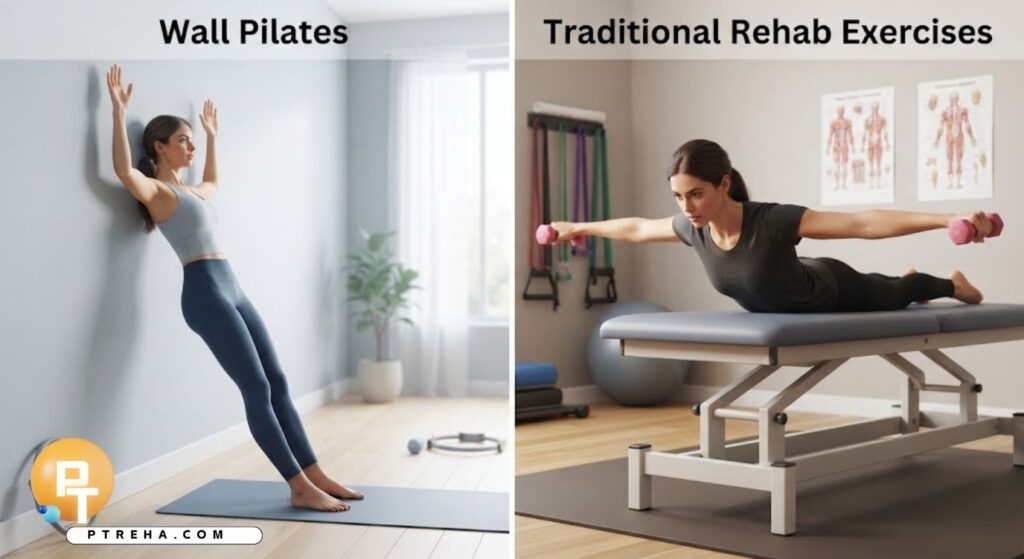
Wall Pilates and traditional rehabilitation exercises can both support better posture, but they are not interchangeable.
Wall Pilates offers accessible, controlled movement using the wall for feedback and support, while traditional rehabilitation is usually more individualized and can target specific mobility, strength, endurance, balance, and movement-control deficits identified during assessment.
Understanding Posture Before Comparing the Exercises
Posture is not simply whether the shoulders are perfectly level or the spine appears completely straight.
It is the way the body organizes itself during sitting, standing, walking, lifting, and other activities.
There is also no single posture that every person must maintain throughout the day.
Human bodies naturally vary in spinal curves, pelvic position, shoulder height, and resting alignment.
For rehabilitation, the more useful questions are often:
- Can the person move comfortably between different positions?
- Can they tolerate sitting or standing for the required time?
- Do they have enough strength and endurance for daily activities?
- Can they change position without excessive pain?
- Are certain postures repeatedly aggravating symptoms?
This distinction matters when comparing wall Pilates vs.
traditional rehab exercises for posture.
Improving posture should usually mean improving movement options, strength, control, endurance, and comfort rather than forcing the body into one rigid position.
Exercise can influence postural alignment, although the response varies according to the population, exercise program, body region, and outcome being measured.
A systematic review of exercise interventions found that exercise can improve several measures of postural alignment, while also showing that programs and research methods vary considerably.
What Is Wall Pilates for Posture?
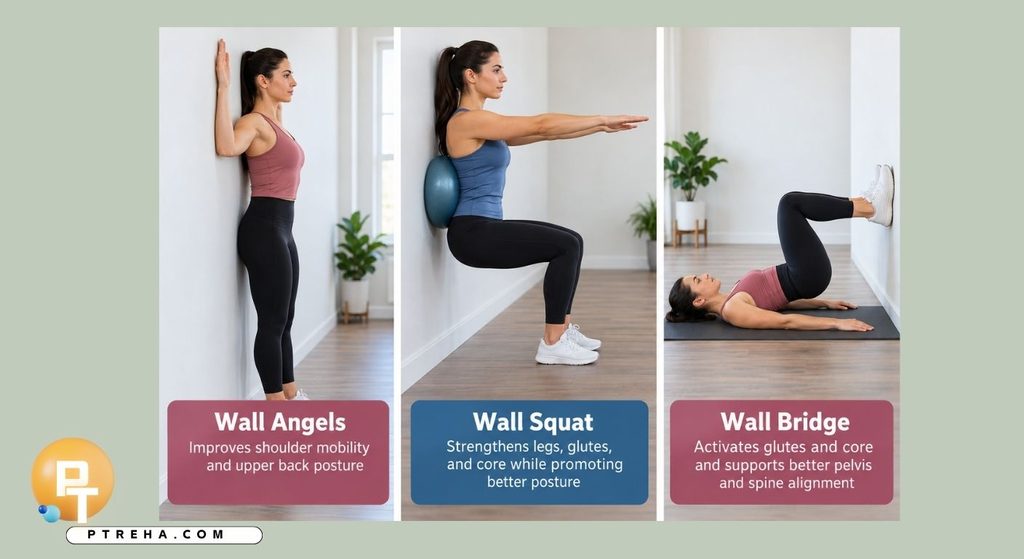
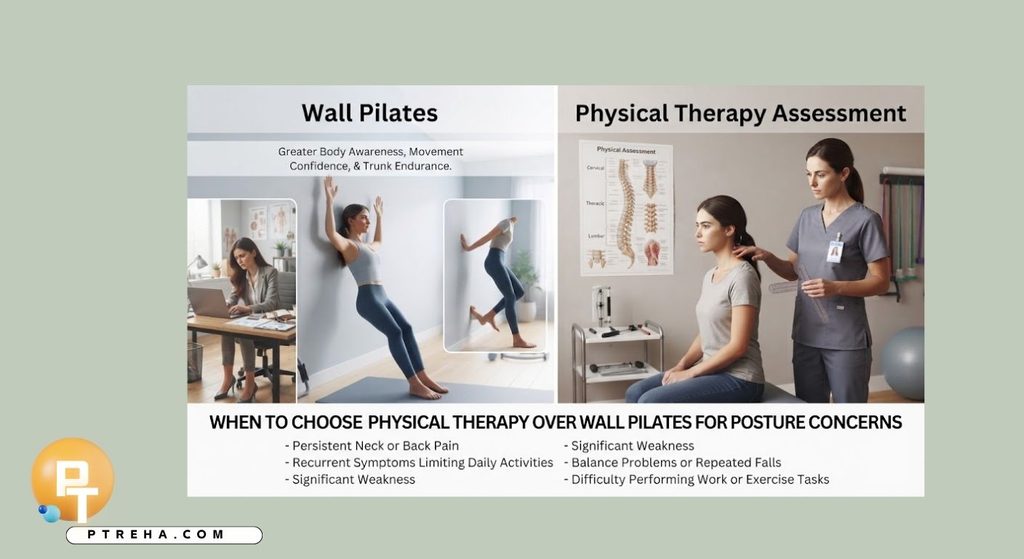
Wall Pilates is a variation of Pilates-style exercise in which a wall is used as a support surface, resistance point, or source of movement feedback.
The wall may help a person understand where the head, upper back, pelvis, hands, or feet are positioned during an exercise.
Common wall Pilates exercises may include:
- Wall-supported standing alignment drills.
- Wall squats or supported squat variations.
- Wall bridges with the feet elevated.
- Wall-assisted leg movements.
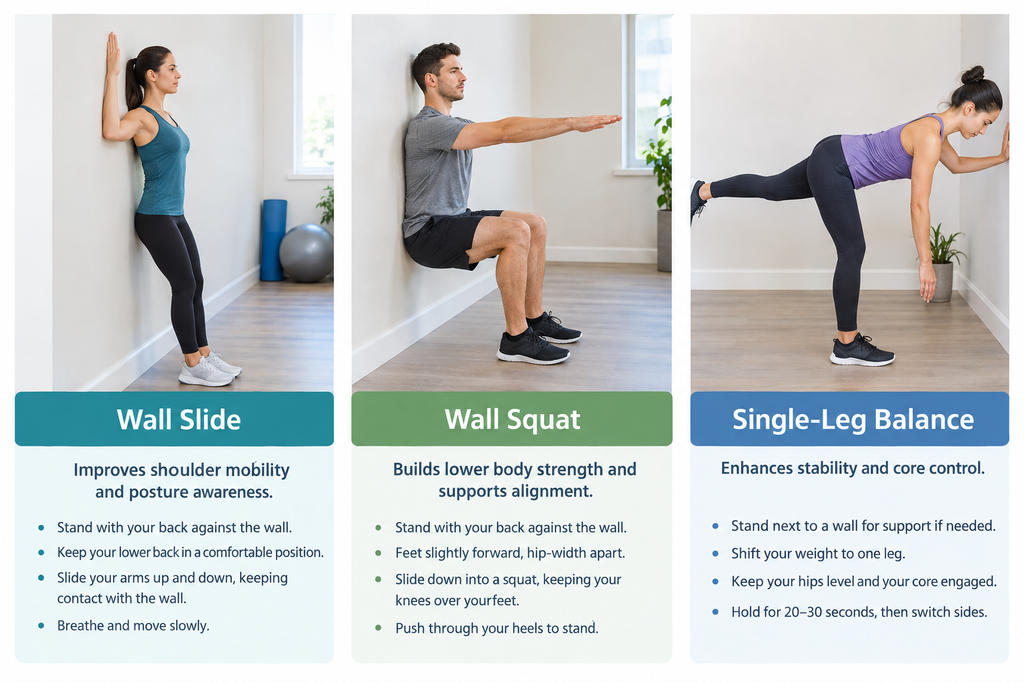
- Standing arm slides or wall angels.
Pilates generally emphasizes controlled movement, breathing, trunk control, concentration, and coordinated movement.
Wall-based variations may make some exercises easier to learn because the wall provides an external reference.
For example, someone who tends to lose balance during a standing hip exercise may feel more confident performing the movement with one hand against a wall.
The wall can also provide useful feedback during upper-body movements.
A person performing a wall slide may become more aware of:
- Rib position.
- Shoulder movement.
- Head position.
- Trunk control.
- Range of comfortable arm elevation.
However, touching the wall does not automatically create “correct posture.” Body proportions, spinal curves, mobility, and symptoms differ considerably between individuals.
The wall should therefore be treated as an exercise tool rather than a template into which every body must fit.
What Are Traditional Rehab Exercises for Posture?
Traditional rehabilitation exercises are not one standardized routine.
In physical therapy, exercises are selected according to the person’s symptoms, functional limitations, examination findings, goals, and response to treatment.
A posture-related rehabilitation program might address several different impairments.
These may include:
- Limited thoracic or shoulder mobility.
- Reduced trunk or hip strength.
- Poor muscular endurance.
- Difficulty controlling movement.
- Reduced balance or physical capacity.
For one patient, treatment might emphasize thoracic mobility and shoulder strengthening.
For another, the main issue may be prolonged sitting tolerance and insufficient variation during the workday.
Common rehabilitation exercise categories include:
- Progressive resistance exercises.
- Mobility exercises.
- Motor-control exercises.
- Balance and coordination work.
- Functional movement practice.
Traditional rehabilitation therefore has an important advantage: exercises can be modified according to the actual problem rather than according to a predefined exercise style.
A person with neck discomfort during computer work, for example, may benefit from a program combining upper-back endurance exercises, shoulder strengthening, movement breaks, ergonomic modification, and gradual improvement in sitting tolerance.
Someone with low-back discomfort may require a different approach involving hip strength, trunk endurance, aerobic activity, lifting practice, and confidence with movement.
This individualization is one reason rehabilitation should not be reduced to a generic “posture correction” routine.
Wall Pilates vs. Traditional Rehab Exercises for Posture
Neither approach is automatically superior for every person.
The appropriate choice depends on what needs to improve.
| Feature | Wall Pilates | Traditional Rehab Exercises |
|---|---|---|
| Main approach | Pilates-style controlled movement using a wall | Exercise selected according to assessment and functional goals |
| External feedback | Often high because the wall provides a reference | Can use walls, mirrors, resistance bands, weights, cues, or no equipment |
| Exercise variety | Usually based on Pilates movement patterns | Very broad, including strength, mobility, endurance, balance, and functional training |
| Individualization | Depends heavily on instructor or program | Typically central to physical therapy |
| Strength progression | Possible but may become limited without additional resistance | Easily progressed with resistance, load, range, speed, and task complexity |
| Balance support | Wall can provide useful assistance | Support can be adjusted according to the patient’s needs |
| Posture awareness | Often emphasized | Used when clinically useful rather than as the sole goal |
| Functional training | May be included | Can directly reproduce work, sport, lifting, walking, or daily tasks |
| Best role | Exercise option or component of a program | Comprehensive rehabilitation framework |
Research on Pilates suggests that it may improve some measurements of postural alignment.
A systematic review and meta-analysis found potential benefits for several postural measures, although certainty ranged from moderate for some findings to low or very low for others.
Importantly, most research evaluates Pilates as a broader exercise method.
It should not automatically be interpreted as proof that a particular social-media “wall Pilates posture routine” has been clinically validated.
Traditional rehabilitation also does not rely on one special group of exercises.
Its strength lies in selecting and progressing exercise according to the person’s presentation.
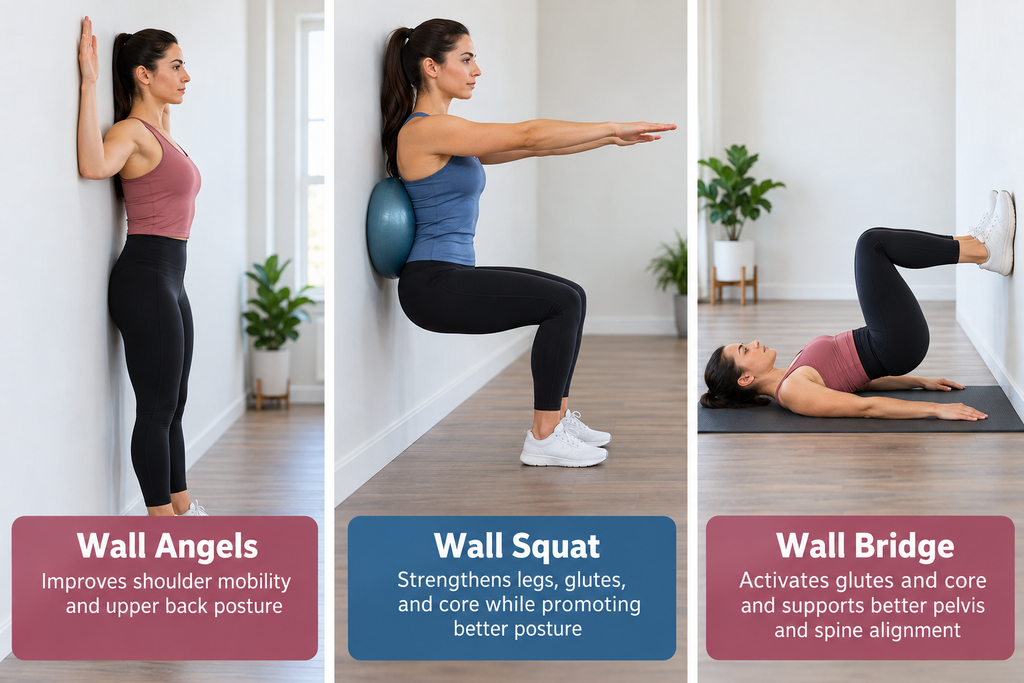
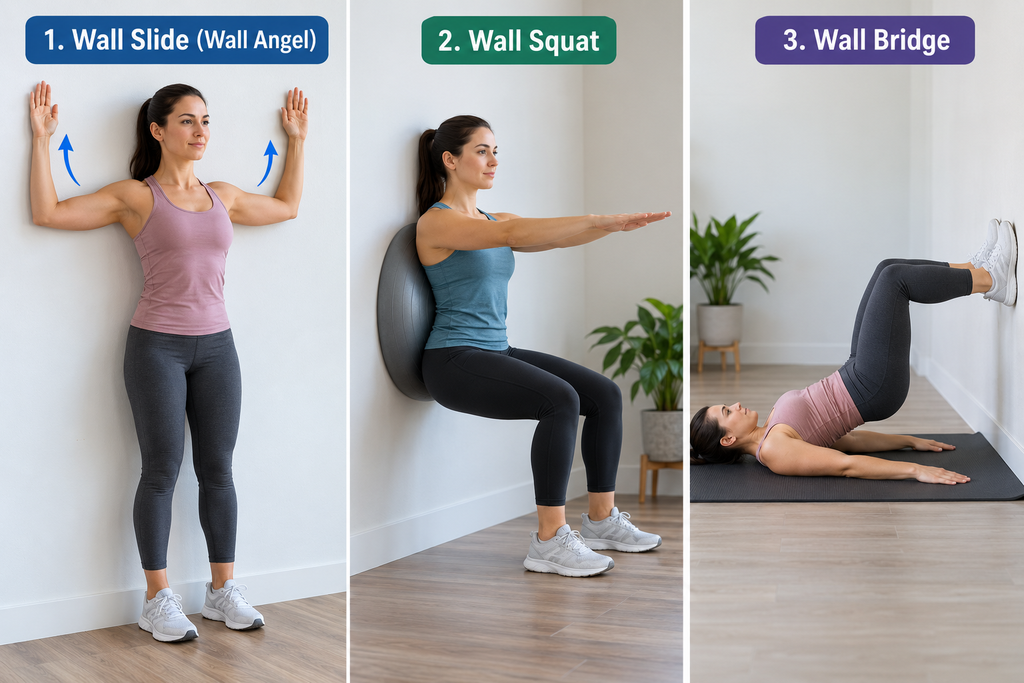
How Wall Pilates May Help Posture
Wall Pilates can be useful when the goal is to improve body awareness while introducing low-to-moderate difficulty movements.
The wall provides tactile feedback that can make movement easier to understand.
Potential benefits include:
- Greater awareness of trunk and pelvic movement.
- Practice controlling the ribs during arm or leg movements.
- Improved confidence with standing exercise.
- Development of trunk and hip endurance.
- Increased movement variety during sedentary days.
Consider a person who spends much of the day at a desk and feels stiff when standing upright.
A short wall-based sequence could include gentle wall-supported squats, wall slides, standing hip extension, controlled heel raises, and trunk rotation away from the wall.
The objective would not be to hold a rigid posture afterward.
It would be to move the body through different positions and gradually improve capacity.
Wall Pilates may also work well for people who prefer structured, flowing exercise instead of isolated strengthening drills.
An exercise program that someone enjoys and performs consistently may be more useful than a technically excellent program they rarely perform.
Why Traditional Rehab Exercises May Offer More Precision
Traditional rehabilitation becomes particularly valuable when symptoms or functional limitations are present.
A physical therapist can examine whether a person’s problem is primarily related to mobility, strength, endurance, movement sensitivity, balance, workload, or another factor.
Exercise selection can then reflect those findings.
For example, a rehabilitation program for prolonged desk-work discomfort could include:
- Thoracic rotation exercises.
- Progressive rowing or pulling exercises.
- Shoulder external-rotation strengthening.
- Trunk and hip strengthening.
- Regular changes between sitting, standing, and walking.
A person whose posture changes because of muscular fatigue may benefit more from endurance training than from repeatedly practicing a “corrected” standing position.
Similarly, someone struggling with overhead work might require progressive shoulder loading instead of simply performing wall alignment exercises.
Traditional rehabilitation is also easier to progress systematically.
Progression may involve:
- Increasing resistance.
- Increasing repetitions or duration.
- Expanding the range of movement.
- Reducing external support.
- Adding task-specific demands.
This flexibility becomes important as the patient improves.
A wall-supported squat might initially be appropriate, for example.
Later rehabilitation could progress toward an unsupported squat, loaded squat, lifting task, stair activity, or another movement relevant to the patient’s goals.
Posture Improvement Requires More Than Holding Yourself Straight
One of the most common mistakes in posture training is attempting to maintain a deliberately corrected posture all day.
This can create unnecessary muscular effort and sometimes make the person more conscious or fearful of normal movement.
Instead, rehabilitation should encourage movement variability.
Useful habits include:
- Changing sitting positions regularly.
- Alternating between sitting and standing when practical.
- Walking periodically during prolonged desk work.
- Exercising major muscle groups regularly.
- Gradually increasing tolerance to necessary positions.
For people with low-back pain, major clinical guidance emphasizes self-management, remaining active, and selecting exercise according to individual needs and capabilities rather than relying on one specific exercise category.
The same general rehabilitation principle is useful when discussing posture: exercise should improve function, not create fear of ordinary positions.
Someone can sit with a rounded upper back temporarily without causing damage simply because the posture looks less upright.
The issue is more likely to arise when a position becomes uncomfortable, is maintained for too long, or exceeds the person’s current tolerance.
Therefore, consider posture as a dynamic behavior rather than a fixed alignment.
A Practical Combined Posture Routine
Wall Pilates and conventional rehabilitation exercises do not have to compete with each other.
They can be combined when their purposes are clear.
A simple starting program might begin with movement preparation.
Examples include:
- Gentle thoracic rotations.
- Shoulder circles.
- Comfortable neck movements.
- Hip mobility movements.
A wall-based portion could then include controlled exercises such as:
- Wall slides.
- Wall-supported squats.
- Standing wall push-ups.
- Supported single-leg balance.
These exercises can improve movement awareness while giving the person an external reference.
The program could then progress to conventional strengthening exercises.
Examples include:
- Resistance-band rows.
- Hip-hinge practice.
- Split squats.
- Loaded carries.
- Trunk endurance exercises.
Finally, rehabilitation should include movement that resembles everyday demands.
For an office worker, that could mean practicing comfortable sitting variation and incorporating frequent walking.
For someone who lifts objects at work, the program should eventually include progressively loaded lifting.
For an older adult concerned about upright function, walking, sit-to-stand exercises, balance training, and lower-limb strengthening may become more important than achieving a specific photographic posture.
How to Progress Posture Exercises Safely
Posture exercise should become more challenging as capacity improves.
Repeating the easiest wall exercise indefinitely may maintain activity, but it may not provide enough stimulus for continued strength or endurance gains.
Progress one variable at a time when possible.
Possible progression strategies include:
- Add repetitions gradually.
- Increase resistance when appropriate.
- Increase time under muscular tension.
- Reduce wall support.
- Add functional movement.
For example, a person could progress from a wall push-up to an incline push-up and eventually toward a lower supporting surface if appropriate.
Similarly, a wall-supported squat could progress toward an unsupported sit-to-stand or squat.
Exercise quality also matters.
Watch for:
- Comfortable breathing.
- Controlled movement.
- Appropriate muscular effort.
- A tolerable symptom response.
- Ability to recover after the session.
Minor muscular fatigue after exercise may be expected.
Sharp pain, progressively worsening symptoms, or neurological symptoms should not simply be ignored in pursuit of “better posture.”
A useful program should challenge the body without requiring perfect movement on every repetition.
Common Mistakes With Wall Pilates and Posture Training
Wall Pilates becomes less useful when the wall is treated as proof of ideal anatomical alignment.
For example, some people cannot comfortably touch the back of the head, upper back, pelvis, and heels to the wall simultaneously because of normal anatomical differences.
Trying to force every body into the same position may create unnecessary tension.
Common mistakes include:
- Forcing the lower back completely flat against the wall.
- Pulling the shoulders backward throughout the day.
- Holding the abdomen rigidly during every exercise.
- Assuming discomfort is always caused by “bad posture.”
- Performing the same routine despite worsening symptoms.
Another mistake is focusing only on the upper body.
Postural control during standing and movement involves the entire kinetic chain.
Hips, legs, trunk, feet, vision, balance, and the task itself can all influence how someone organizes their body.
It is also important not to confuse posture with structural spinal conditions.
Wall exercises are not substitutes for appropriate evaluation or condition-specific rehabilitation when someone has a diagnosed spinal disorder or significant deformity.
When a Physical Therapy Assessment Is More Appropriate
A general wall Pilates routine may be reasonable for a healthy person who wants to move more and improve general body awareness.
Persistent or significant symptoms deserve a more individualized approach.
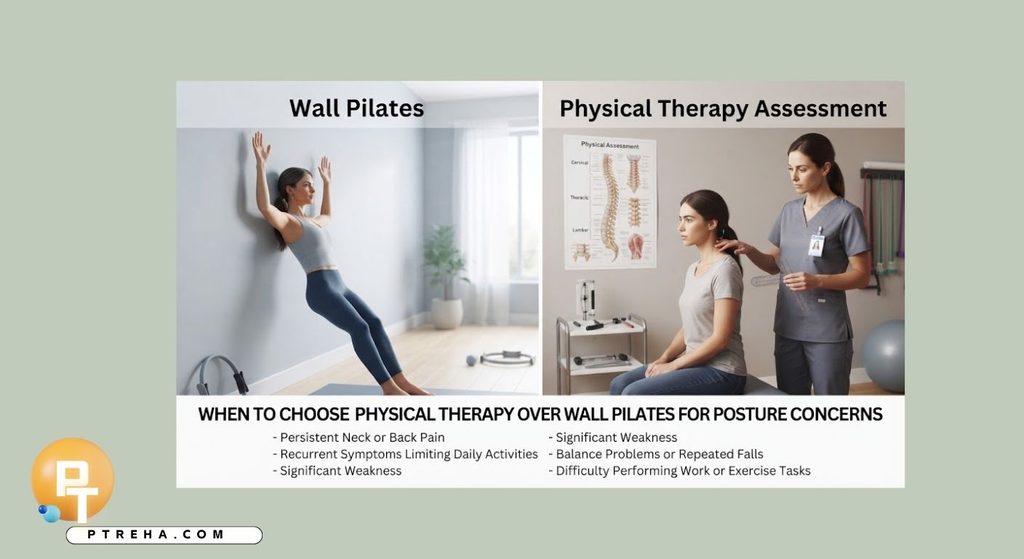
Consider a physical therapy assessment when posture concerns are accompanied by:
- Persistent neck or back pain.
- Recurrent symptoms that limit daily activities.
- Significant weakness.
- Balance problems or repeated falls.
- Difficulty performing work or exercise tasks.
Medical assessment may be needed more urgently when symptoms include major trauma, rapidly progressive neurological changes, major unexplained systemic symptoms, or changes in bowel or bladder control associated with neurological symptoms.
A physical therapist can determine whether posture itself appears clinically relevant or whether other factors are more important.
Treatment may then focus on strength, mobility, workload, activity tolerance, movement confidence, balance, or functional tasks rather than simply changing appearance.
Conclusion
When comparing wall Pilates vs.
traditional rehab exercises for posture, wall Pilates can be a useful form of controlled exercise that provides external feedback, support, and an accessible way to practice movement.
Evidence suggests Pilates may improve some postural measures, but it should not be viewed as a universal posture correction method.
Traditional rehabilitation offers broader individualization and easier progression when pain, weakness, mobility limitations, reduced endurance, or functional problems are present.
In many cases, the most practical approach is not choosing one method exclusively but combining enjoyable wall-based exercises with progressive strengthening, mobility, aerobic activity, and functional training according to individual needs.
Frequently Asked Questions
Is wall Pilates good for posture?
Wall Pilates can help some people improve movement awareness, trunk control, flexibility, muscular endurance, and confidence with exercise.
These factors may influence posture.
It should not be expected to permanently place the body into one ideal alignment, however.
Posture naturally changes throughout the day.
Is wall Pilates better than physical therapy exercises?
Not necessarily.
Wall Pilates is an exercise method, while physical therapy rehabilitation can incorporate many exercise methods depending on the person’s clinical needs.
A therapist may even include Pilates-style or wall-supported exercises when they are appropriate.
Can wall Pilates fix rounded shoulders?
Exercise may influence shoulder and upper-back positioning in some people, particularly when mobility, strength, and movement habits contribute to the appearance.
However, rounded shoulders are not a single diagnosis, and anatomical variation is normal.
The goal should usually be comfortable movement and sufficient functional capacity rather than forcing the shoulders backward.
How often should I perform posture exercises?
Frequency depends on exercise intensity, training experience, symptoms, recovery, and the type of exercise.
Light mobility or movement-break exercises may be performed relatively often, while demanding strengthening sessions generally need appropriate recovery between sessions.
Can wall Pilates strengthen the core?
Yes.
Many Pilates-style exercises challenge abdominal, back, pelvic, and hip muscles through controlled movement.
As strength improves, additional resistance or more demanding variations may eventually be required to continue progressing.
Does poor posture always cause back or neck pain?
No.
Pain is influenced by multiple factors, and the relationship between posture and pain is not simple.
Some positions may aggravate symptoms for certain people, but appearance alone cannot reliably identify the cause of pain.
Should my lower back touch the wall during posture exercises?
Not necessarily.
The lumbar spine normally has a curve, and the amount of that curve varies between individuals.
Do not force the lower back flat simply because an exercise graphic suggests that every part of the spine must contact the wall.
Are wall exercises suitable for beginners?
Many are.
The wall can provide balance assistance, feedback, and a stable surface that makes some movements easier to learn.
Difficulty should still match the person’s strength, mobility, balance, and health status.
How long does it take to improve posture?
There is no universal timetable because the goal may involve strength, endurance, mobility, symptoms, habits, or functional tolerance.
Progress should be judged by meaningful outcomes such as easier movement, improved exercise capacity, better sitting or standing tolerance, and fewer activity limitations rather than appearance alone.
Can I combine wall Pilates with regular strengthening exercises?
Yes.
This is often a practical approach.
Wall Pilates can provide movement practice and body awareness, while progressive resistance exercises can develop the strength and capacity needed for work, recreation, and everyday activity.