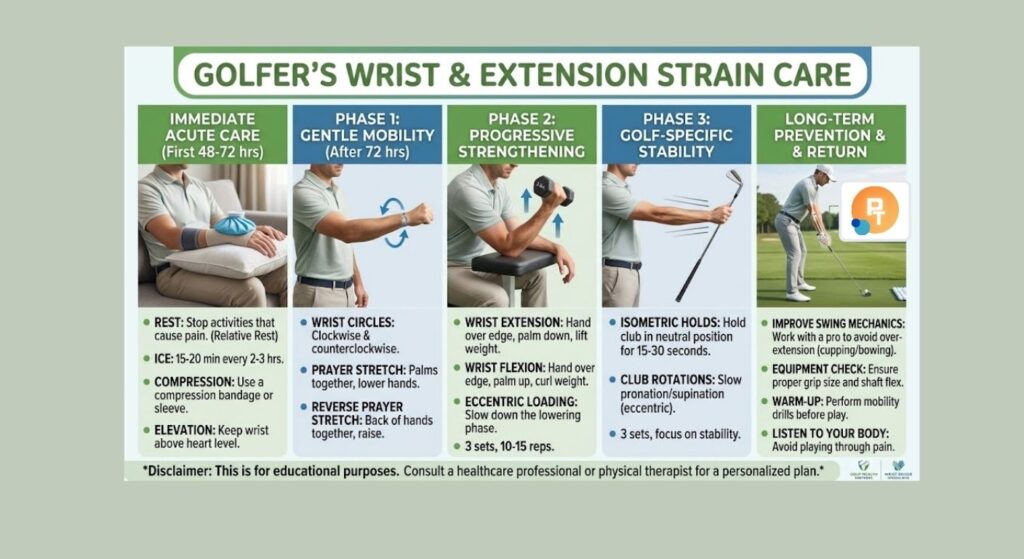
Golfer’s wrist pain and wrist extension strain can develop when repeated swings, forceful gripping, or excessive wrist loading irritate the muscles, tendons, or ligaments around the wrist.
Effective care starts with identifying the painful structure, temporarily adjusting aggravating activities, restoring comfortable movement, and gradually rebuilding strength before returning to golf.
Understanding Golfer’s Wrist and Wrist Extension Strain
The wrist is a complex joint system that transfers force between the forearm, hand, and golf club.
During a golf swing, it must tolerate changing combinations of extension, flexion, rotation, and gripping force.
Golfer’s wrist is a descriptive term rather than a single medical diagnosis.
It may refer to several conditions affecting golfers, including tendon overload, muscle strain, ligament sprain, or irritation of structures on either side of the wrist.
Wrist extension occurs when the back of the hand moves toward the forearm.
This movement is controlled primarily by the wrist extensor muscles located along the back of the forearm.
A wrist extension strain generally involves overstretching or overloading muscle tissue involved in wrist extension.
However, pain provoked by wrist extension does not automatically mean the extensor muscles are strained.
Structures that may contribute to golf-related wrist pain include:
- Wrist extensor muscles: Help stabilize and extend the wrist during gripping and swinging.
- Wrist flexor muscles: Assist with gripping and bending the wrist toward the palm.
- Extensor tendons: Transmit force from the forearm muscles to the hand.
- Wrist ligaments: Support joint stability during rotational and loaded movements.
- Triangular fibrocartilage complex (TFCC): Supports the little-finger side of the wrist and helps stabilize the distal radioulnar joint.
- Joint capsules: Can become irritated by forceful or repeated end-range loading.
It is also essential to distinguish golfer’s wrist from golfer’s elbow, medically known as medial epicondylitis or medial elbow tendinopathy.
Golfer’s elbow primarily affects the common flexor-pronator tendon attachment on the inside of the elbow, although symptoms can extend into the forearm.
Wrist-related symptoms require separate assessment rather than assuming that every golf injury involves the same tendon.
The American Academy of Orthopaedic Surgeons’ explanation of golfer’s elbow provides additional information about the forearm tendons involved in that condition.
Common Causes of Wrist Extension Strain in Golfers
Golf requires repeated coordination of the wrist, elbow, shoulder, and trunk.
When training loads increase faster than the tissues can tolerate, discomfort may develop.
Several mechanical and training factors may contribute.
- Excessive practice volume: Increasing the number of swings or practice sessions without adequate recovery.
- Striking the ground: Hitting the turf forcefully before contacting the ball may transmit a sudden load through the wrist.
- Excessive grip pressure: Holding the club too tightly increases forearm muscle demand.
- Repeated wrist extension: Frequent or prolonged loading with the wrist bent backward.
- Poor swing coordination: Excessive dependence on wrist motion rather than coordinated movement across the body.
- Muscle fatigue: Reduced muscular control toward the end of long practice sessions.
- Abrupt training changes: Switching equipment, increasing swing intensity, or returning after a long break.
- Previous wrist injuries: Persistent mobility or strength limitations may influence how loads are distributed.
A single painful swing can also cause an acute injury.
Sudden pain after striking a tree root, hard ground, or another obstruction should not automatically be treated as a simple muscle strain.
In clinical assessment, the mechanism of injury is often as important as the location of the pain.
Symptoms of Golfer’s Wrist and Extension Strain
Symptoms depend on which anatomical structures are affected and whether the problem developed gradually or during a specific incident.
A mild wrist extensor muscle strain may produce discomfort along the back of the wrist or forearm, particularly during resisted wrist extension.
Common symptoms include:
- Pain when bending the wrist backward.
- Discomfort while gripping or lifting objects.
- Tenderness over the affected wrist or forearm muscles.
- Reduced tolerance for repeated golf swings.
- Stiffness after periods of inactivity.
- Pain when using the hand to push against a surface.
- Reduced grip strength because gripping provokes pain.
- Mild swelling following an acute injury.
Pain from a muscle strain may increase when the affected muscle contracts against resistance or is gently stretched.
However, these findings are not specific enough to establish a diagnosis without further examination.
What the Location of Wrist Pain Can Suggest
| Pain location | Possible contributing structures | Activities that may aggravate symptoms |
|---|---|---|
| Back of wrist | Extensor tendons, dorsal capsule, or joint structures | Wrist extension and pushing through the hand |
| Thumb side of wrist | Radial wrist tendons, ligaments, or nearby joint structures | Gripping, lifting, and thumb movements |
| Little-finger side | TFCC, extensor carpi ulnaris tendon, or other ulnar-sided structures | Rotational loading, gripping, and golf swings |
| Palm side of wrist | Flexor tendons or other volar wrist structures | Forceful gripping and wrist flexion |
| Inner elbow extending into forearm | Common flexor-pronator tendon or other medial elbow structures | Resisted wrist flexion, pronation, and gripping |
This table is intended to guide symptom awareness, not provide a definitive diagnosis.
Pain location alone cannot reliably distinguish a muscle strain from a ligament injury, tendon disorder, joint irritation, or fracture.
For a broader review, the NHS guidance on wrist pain describes common symptoms and when further medical assessment may be needed.
Initial Care for an Irritated or Strained Wrist
During the early stage, the objective is to reduce excessive mechanical stress while maintaining safe movement.
Complete inactivity is rarely necessary for a mild uncomplicated strain, but painful golf swings and heavy wrist loading should be temporarily reduced.
Reduce Painful Loading
For the first few days after an uncomplicated acute strain:
- Stop golf swings that reproduce significant pain.
- Avoid forceful gripping, lifting, and pushing through the injured wrist.
- Continue comfortable finger, elbow, and shoulder movements.
- Use the hand for light daily tasks if these do not substantially increase symptoms.
- Avoid repeatedly testing the painful movement at maximum force.
- Monitor swelling, movement, and functional ability.
If a wrist injury followed a fall, strong impact, or sudden twisting event, an appropriate medical examination may be necessary before starting rehabilitation exercises.
Cold Therapy and Support
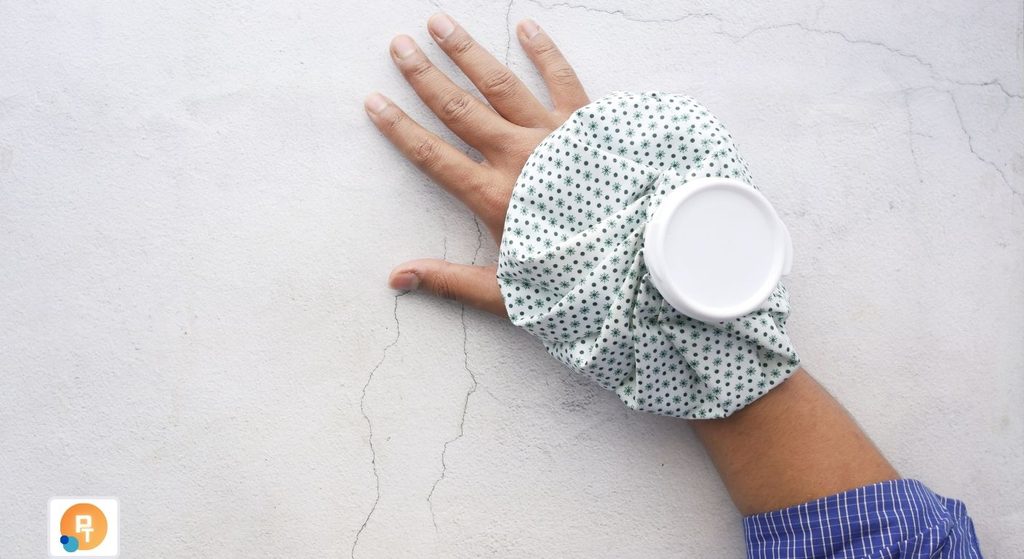
A cold pack may temporarily relieve pain and help manage swelling.
Apply a cold pack wrapped in a towel for approximately 10–15 minutes, checking the skin regularly.
Avoid direct ice contact and discontinue if there is unusual numbness or skin irritation.
A removable wrist support may make selected daily activities more comfortable.
However, prolonged immobilization without a clinical indication can contribute to stiffness and should not replace progressive rehabilitation.
The Guy’s and St Thomas’ NHS wrist sprain and strain guidance recommends gentle movement, light functional use, and avoiding heavy lifting or gripping during early recovery.
Physical Therapy Assessment of Golfer’s Wrist
A physical therapy assessment should identify the source of symptoms, evaluate functional limitations, and determine which movements and loading patterns are appropriate.
The evaluation begins with the injury history.
Important questions include:
- Did pain begin suddenly or gradually?
- Was there a particular swing, impact, or twisting movement?
- Where exactly is the pain located?
- Does wrist extension, flexion, or rotation reproduce symptoms?
- Is the pain present only during golf or also during ordinary activities?
- Has there been swelling, bruising, clicking, or a sense of instability?
- Are numbness, tingling, or significant weakness present?
- Have similar symptoms occurred previously?
The physical examination may include active and passive wrist movement, resisted muscle testing, grip strength assessment, palpation, and evaluation of appropriate neighboring joints.
A therapist may also assess the way the golfer grips the club and distributes movement across the upper extremity.
Clinical interpretation matters: Pain during resisted wrist extension suggests sensitivity to that movement or load, but it does not isolate one tendon or confirm a muscle strain.
If examination findings suggest a fracture, significant ligament injury, neurological problem, or another condition requiring medical investigation, referral is appropriate.
Rehabilitation Exercises for Wrist Extension Strain
Exercise selection should reflect the actual diagnosis, symptom irritability, and stage of recovery.
For a mild uncomplicated wrist extensor strain, rehabilitation generally progresses from comfortable mobility to controlled resistance and then sport-specific loading.
These exercises are examples, not a universal protocol.
Do not perform them after an unassessed significant injury or when there is suspected fracture or instability.
1. Active Wrist Flexion and Extension
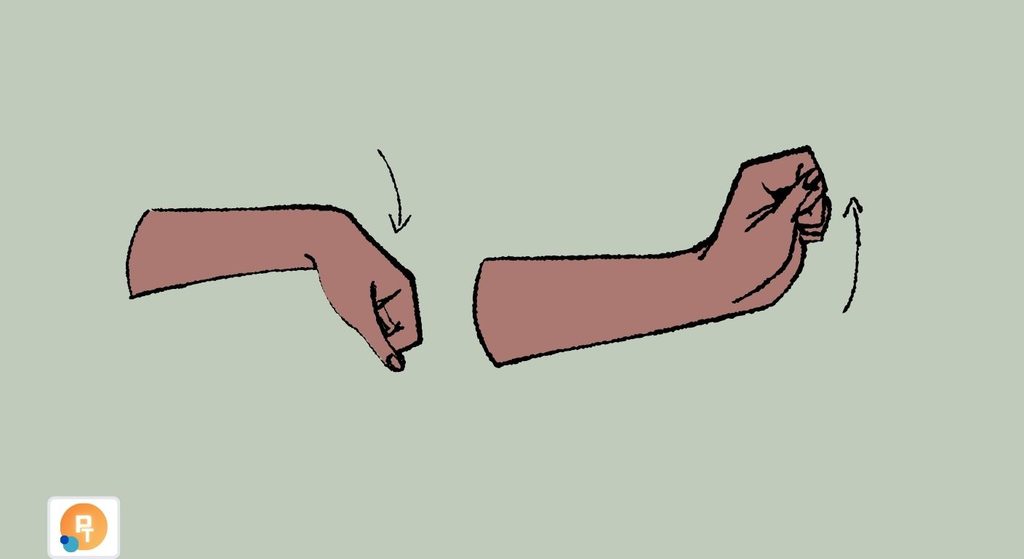
Purpose: Maintain wrist mobility without excessive resistance.
- Rest your forearm on a table with the hand extending beyond its edge.
- Slowly move the wrist upward into comfortable extension.
- Reverse the movement into gentle flexion.
- Stay within a tolerable range.
- Perform approximately 10 slow repetitions, adjusting the amount to your symptoms.
The movement should feel controlled rather than forced.
If discomfort increases with every repetition, reduce the range or stop.
2. Gentle Wrist Extensor Stretch
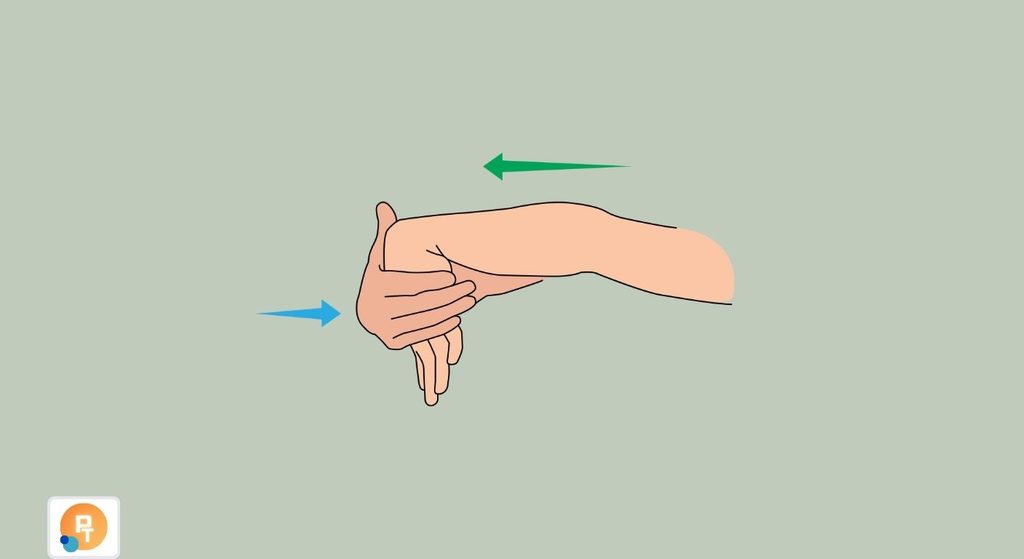
Purpose: Restore comfortable flexibility when the acute symptoms have settled.
- Extend your elbow comfortably in front of you.
- Turn the palm downward.
- Use the opposite hand to gently bend the wrist toward the palm.
- Stop when a mild stretch is felt along the back of the forearm.
- Hold for approximately 15–20 seconds.
Repeat two or three times if comfortable.
Avoid strong stretching when the wrist is swollen, acutely injured, or painful during passive movement.
3. Isometric Wrist Extension
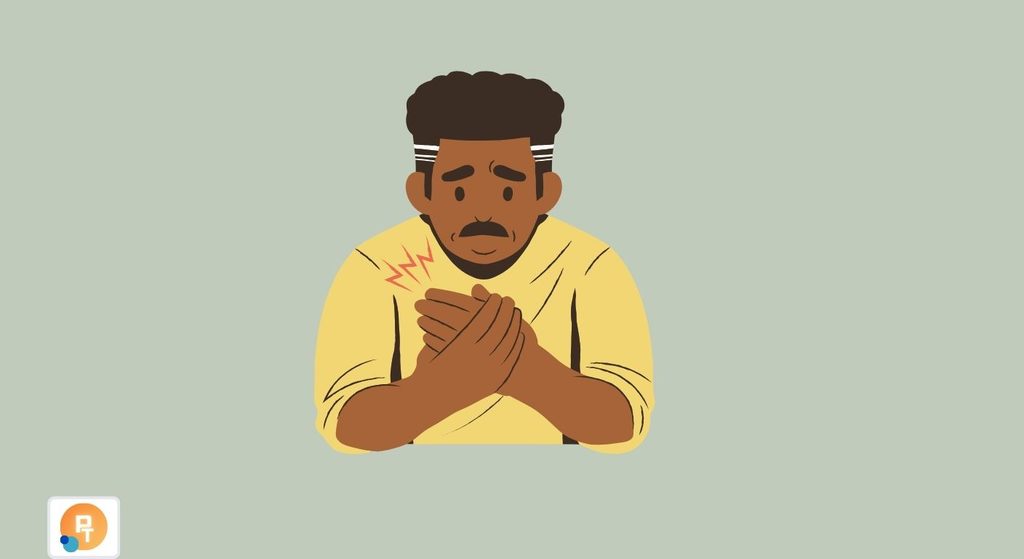
Purpose: Introduce muscle activation without repeatedly moving the wrist.
- Place the forearm on a table with the palm facing downward.
- Keep the wrist in a comfortable neutral position.
- Place the other hand over the back of the affected hand.
- Gently try to lift the affected hand while the other hand prevents movement.
- Hold for approximately five seconds, then relax.
Begin with five comfortable repetitions.
Use light effort initially.
There is no benefit in producing a maximal contraction if it aggravates symptoms.
4. Light Resisted Wrist Extension

Purpose: Gradually restore the strength of the wrist extensor muscles.
- Support the forearm on a table with the palm facing downward.
- Hold a very light dumbbell or other manageable resistance.
- Slowly raise the back of the hand.
- Pause briefly.
- Lower the hand under control.
A reasonable starting trial is one set of 8–12 repetitions using a resistance that is comfortably manageable.
Progression may include:
- Increasing repetitions before increasing resistance.
- Adding another set if recovery between sessions is satisfactory.
- Slowing the lowering phase when appropriate.
- Increasing resistance in small increments.
- Monitoring how the wrist responds later that day and the following morning.
Avoid progressing simultaneously in weight, volume, and exercise frequency.
5. Forearm Pronation and Supination
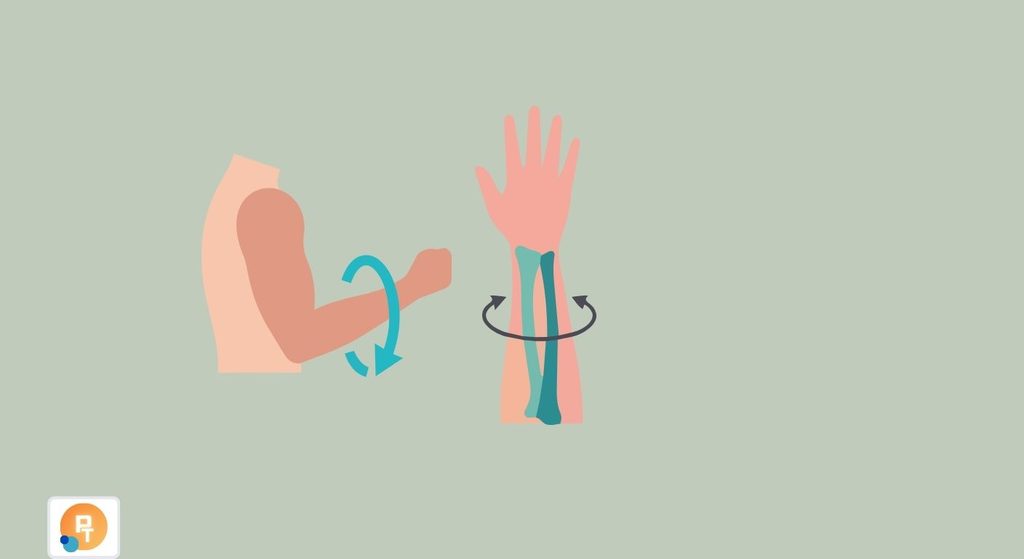
Purpose: Improve tolerance to rotational movements used in gripping and swinging.
- Bend the elbow to approximately 90 degrees.
- Keep the upper arm near your body.
- Slowly turn the palm upward.
- Rotate back until the palm faces downward.
- Repeat within a comfortable range.
Start with approximately 10 repetitions.
When rotation becomes comfortable, a therapist may introduce carefully graded resistance using a light object.
6. Progressive Grip Strengthening
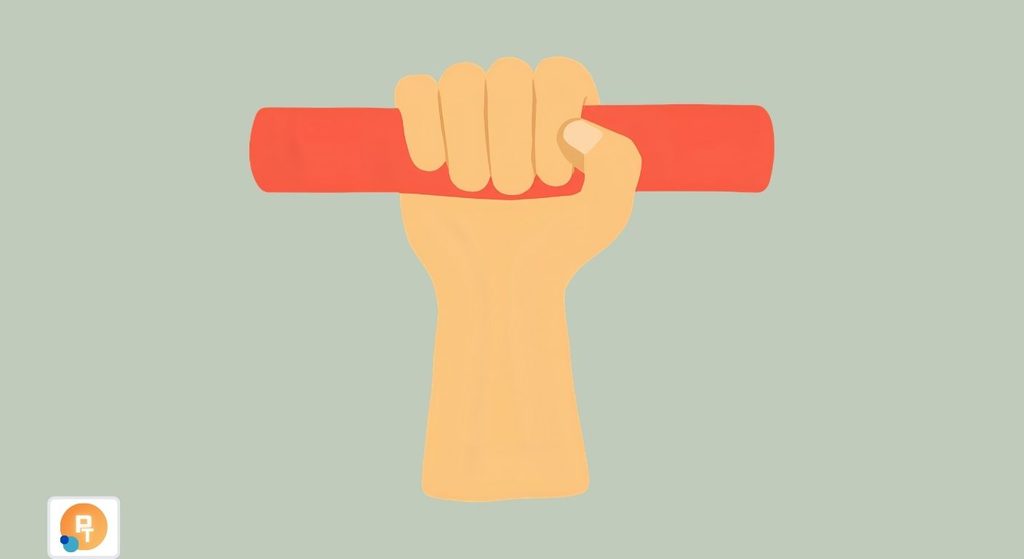
Purpose: Restore hand and forearm endurance for club control.
Hold a soft foam ball or rolled towel and squeeze gently for a few seconds before releasing.
Begin with a small number of repetitions and increase gradually.
Useful progression options include:
- Light gripping with the wrist neutral.
- Longer comfortable holds.
- Repeated gentle squeezes.
- Gripping combined with controlled wrist positioning.
- Functional object handling.
- Gradual exposure to holding the golf club.
Aggressive squeezing should be avoided if it produces persistent wrist or elbow pain.
The AAOS therapeutic exercise program for epicondylitis also explains stretching and progressive forearm strengthening for golfer’s elbow.
Its exercises are specific to elbow tendinopathy and should not automatically be applied to every wrist injury.
How to Progress Exercises Without Aggravating the Wrist
Successful rehabilitation depends on applying enough load to improve strength without repeatedly provoking an excessive symptom response.
A practical approach is to monitor how the wrist behaves during activity, immediately afterward, and the next morning.
Signs that an exercise level is being tolerated include:
- Movement remains smooth and controlled.
- Symptoms are mild or absent.
- Pain does not increase steadily during the set.
- Wrist function remains comfortable afterward.
- There is no new swelling.
- The next morning is not noticeably worse.
- Daily activities are becoming easier.
Mild, short-lived discomfort may be acceptable in some rehabilitation programs, but this depends on the diagnosis.
Pain should never be used as a reason to continue an exercise when a significant injury has not been excluded.
If symptoms flare after strengthening, consider reducing resistance, repetitions, or frequency.
Persistent worsening despite appropriate modification suggests that the exercise program or working diagnosis needs reassessment.
Returning to Golf After Wrist Extension Strain
Returning to golf should depend on functional recovery rather than a fixed number of days.
Before reintroducing swings, the golfer should have comfortable everyday hand use, adequate wrist movement, improving grip strength, and tolerance to relevant rehabilitation exercises.
A gradual return may follow this sequence:
- Club handling: Hold the club and practice grip positioning without swinging.
- Slow movement rehearsal: Perform controlled golf motions without striking a ball.
- Short practice swings: Introduce low-intensity swings within a comfortable range.
- Light ball contact: Begin with short, controlled shots.
- Progressive swing loading: Increase swing range, intensity, and practice volume gradually.
- Full practice: Return to normal play when the wrist consistently tolerates increased demands.
The number of sessions at each level depends on symptom response and the underlying injury.
Do not advance simply because the wrist feels comfortable while resting.
Golf requires tolerance to repeated gripping, rotation, acceleration, and impact.
Technique and Equipment Considerations
A golf instructor may help identify swing characteristics that unnecessarily increase loading through the wrist.
Useful considerations include:
- Avoiding excessively tight grip pressure.
- Reviewing grip size and club suitability.
- Reducing repeated contact with hard practice surfaces.
- Avoiding large increases in practice volume.
- Building rest periods into longer sessions.
- Improving coordination between the trunk, shoulders, arms, and wrists.
- Reintroducing high-force swings only after sufficient loading tolerance returns.
A technically efficient golf swing can help manage load, but no single grip or swing adjustment guarantees injury prevention.
The AAOS golf injury prevention guidance provides further information about conditioning and avoiding common golf-related overuse problems.
Preventing Recurrent Wrist Pain
Rehabilitation should address more than the symptoms present during the initial injury.
Once the wrist is comfortable, continuing a manageable strengthening program may help preserve capacity for repetitive hand use and golf practice.
Prevention strategies include:
- Maintaining forearm strength and endurance.
- Practicing wrist movements through comfortable ranges.
- Increasing swing volume gradually.
- Allowing recovery following unusually demanding practice sessions.
- Paying attention to early symptoms rather than repeatedly playing through worsening pain.
- Reviewing technique when wrist discomfort occurs consistently during a particular swing phase.
- Including shoulder and trunk conditioning in the overall training program.
- Reassessing equipment when grip or club characteristics appear to contribute to symptoms.
Exercises should be chosen according to individual needs.
Someone recovering from a dorsal wrist muscle strain may require a different program from someone managing TFCC-related symptoms or medial elbow tendinopathy.
Recovery Time and When to Seek Medical Assessment
Recovery varies considerably according to injury severity, affected tissue, general health, and the demands of returning to sport.
A mild uncomplicated muscle strain may improve substantially within a few weeks.
More substantial sprains, tendon problems, and ligament injuries can require much longer rehabilitation.
The North Bristol NHS Trust guidance on injured wrists explains that wrist sprain recovery may take several weeks and that return to sport should follow restoration of comfortable movement and strength.
Seek prompt medical assessment when symptoms include:
- Severe pain following an impact or fall.
- Significant swelling or rapidly developing bruising.
- Inability to move the wrist or grip objects.
- An obvious deformity.
- New numbness or loss of sensation.
- Marked weakness or loss of hand function.
- A wrist that becomes unusually hot, red, or swollen, particularly with fever.
- Pain that becomes progressively worse rather than improving.
Pain on the thumb side after a fall deserves particular attention because some wrist fractures may initially be mistaken for sprains.
For milder symptoms, arrange clinical assessment if pain interferes with normal activities, repeatedly returns, or fails to improve after approximately two weeks of appropriate self-care.
Return-to-play decisions should be individualized. Severe structural injuries should not be managed using a general muscle-strain exercise program without medical clearance.
Conclusion
Golfer’s wrist and extension strain care involves identifying the affected structures, modifying painful loading, restoring comfortable movement, and progressively rebuilding grip and forearm strength.
The goal of physical therapy is not simply to eliminate pain at rest.
It is to restore the wrist’s ability to tolerate the repetitive forces of golfing and everyday activities without recurring symptoms.
Frequently Asked Questions
1. What is golfer’s wrist?
Golfer’s wrist is a general description of wrist pain associated with golfing activities.
It is not a single diagnosis and can involve muscles, tendons, ligaments, or joint structures.
The location of pain, injury mechanism, and physical examination help determine the likely cause.
2. Can golf cause a wrist extension strain?
Yes.
Repeated or forceful loading of the wrist extensor muscles can contribute to a strain, particularly when practice intensity increases suddenly.
However, pain during extension can also result from tendon irritation, joint problems, or ligament injuries, so it should not automatically be attributed to a muscle strain.
3. Should I stop playing golf if my wrist hurts?
Temporarily reducing or stopping painful swings is appropriate when wrist symptoms are increasing.
Light activities that do not significantly aggravate the wrist can often continue.
Returning to golf should be gradual and based on comfortable movement, adequate strength, and tolerance to progressively greater loads.
4. Is stretching helpful for golfer’s wrist?
Gentle stretching may help restore comfortable movement when stiffness is present and acute symptoms have settled.
However, aggressive stretching can aggravate certain injuries, particularly when ligaments or joint structures are involved.
Stretching should match the identified impairment rather than being prescribed automatically.
5. How long does a wrist extension strain take to heal?
A mild muscle strain may improve within several weeks, but recovery depends on severity and the demands placed on the wrist.
Persistent tendon symptoms or ligament injuries may require longer treatment.
Recovery should be assessed through functional improvement rather than time alone.
6. Can I perform wrist strengthening exercises every day?
Gentle mobility activities may be appropriate daily, but strengthening frequency depends on exercise intensity and symptom response.
Higher-resistance exercises generally require recovery between demanding sessions.
A physical therapist can help determine the appropriate combination of loading, frequency, and progression.
7. Does a wrist brace help with golfer’s wrist pain?
A wrist brace may temporarily reduce symptoms during selected activities by limiting irritating movements.
It does not directly correct weakness, impaired loading tolerance, or problematic movement patterns.
The type and duration of support should reflect the condition being treated.
8. What is the difference between golfer’s wrist and golfer’s elbow?
Golfer’s wrist describes symptoms localized around the wrist and potentially involving several different structures.
Golfer’s elbow is specifically associated with the common flexor-pronator tendon attachment on the inner elbow.
Both may be aggravated by gripping, but their assessment and rehabilitation requirements can differ.
9. Can poor golf technique contribute to wrist injuries?
Yes.
Swing mechanics, excessive grip pressure, repeated ground impact, and poor load distribution may contribute to excessive wrist stress.
Technique analysis may be useful when pain repeatedly occurs during a particular movement.
However, training volume, tissue capacity, and previous injury history should also be considered.
10. When should I see a physical therapist for golfer’s wrist pain?
A physical therapy assessment is appropriate when wrist pain persists, recurs during golf, limits everyday activities, or prevents a comfortable return to practice.
Evaluation can help identify movement limitations, strength deficits, and appropriate rehabilitation progressions.
Severe pain, deformity, significant swelling, sensory loss, or suspected fracture requires prompt medical assessment before routine exercise-based rehabilitation.