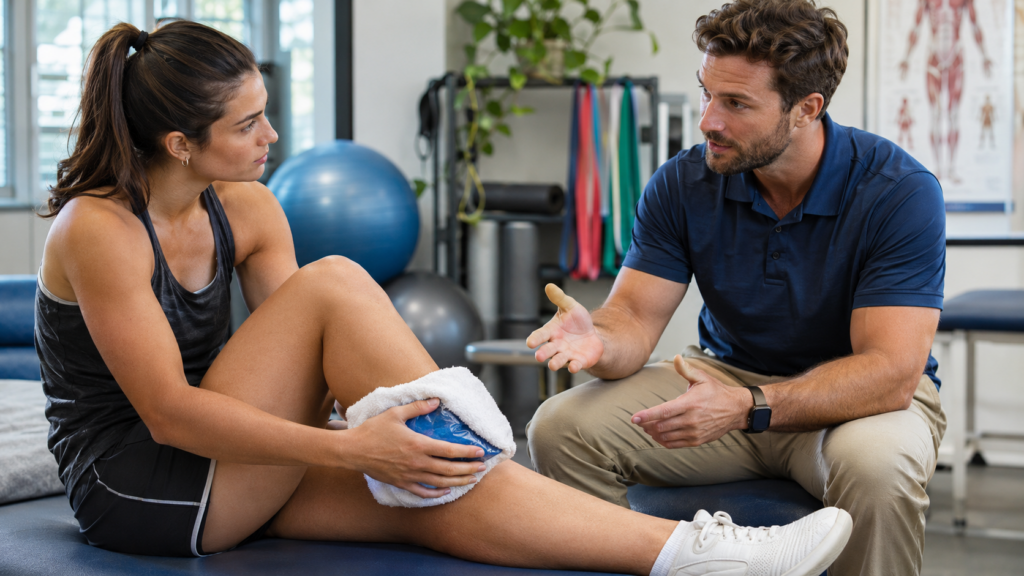
Ice can make a fresh sprain or muscle injury feel better, but less pain does not automatically mean faster tissue repair. The concern about delayed healing comes mainly from laboratory and animal research, while direct evidence in injured people remains limited and mixed.
What Ice Actually Does to Injured Tissue
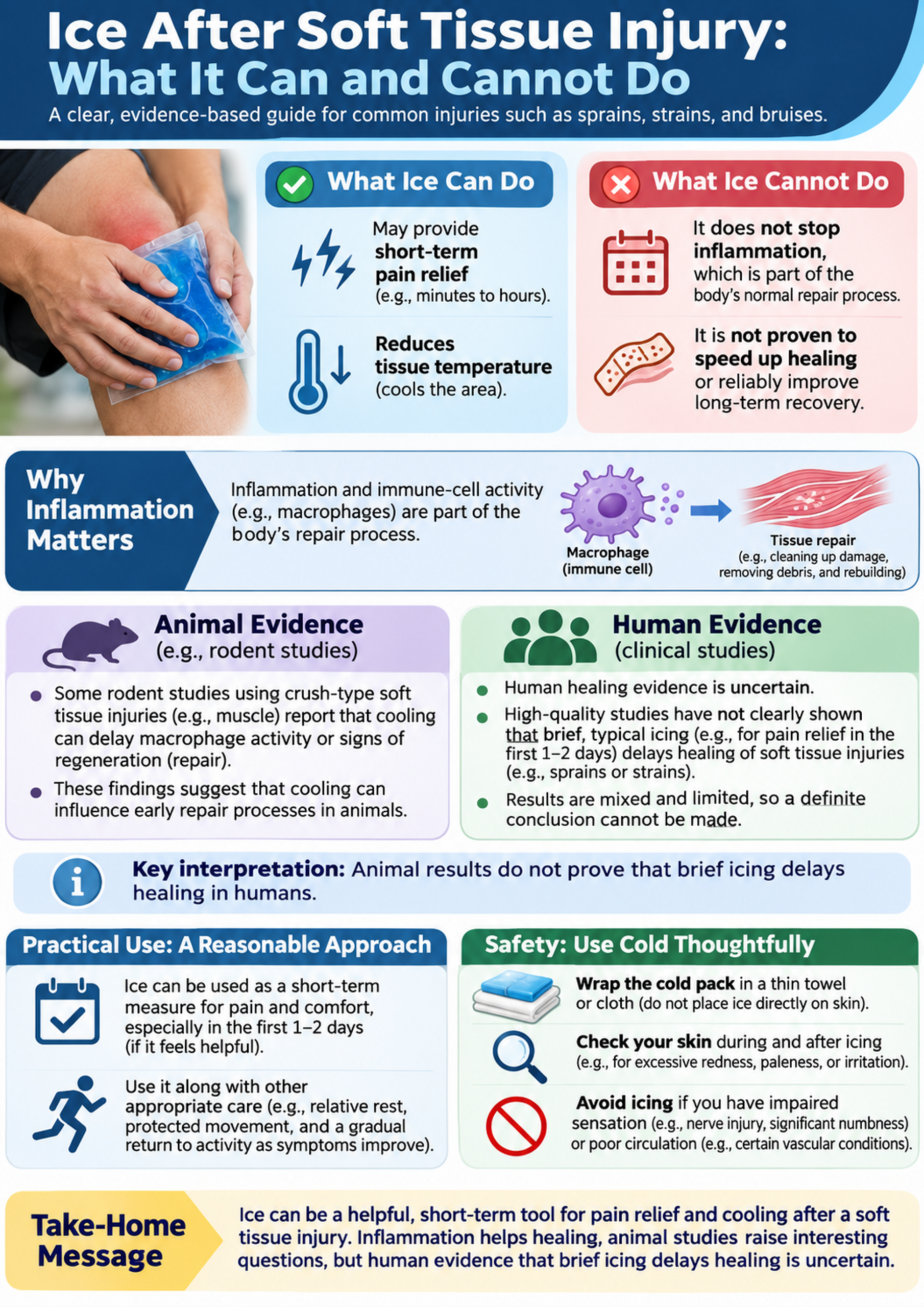
Cooling lowers skin and superficial tissue temperature and can temporarily reduce pain sensitivity. The depth and duration of cooling depend on the cold source, wrapping, body area, circulation, and application time.
- Provides short-term analgesia for some people.
- Reduces local tissue temperature.
- May temporarily change blood flow and nerve conduction.
- Does not mechanically repair torn fibers or ligaments.
Inflammation Is Part of Repair
After tissue injury, immune cells help remove damaged material and coordinate later repair. Excessive or prolonged inflammation can be harmful, but eliminating the early response is not a realistic or necessarily helpful treatment goal.
- Blood vessels and immune cells respond soon after injury.
- Macrophages participate in cleanup and regeneration signaling.
- New vessels support the recovering tissue.
- Repair then progresses toward remodeling and load tolerance.
Why Laboratory Studies Raise Concern
Cooling can alter cellular signaling, immune-cell movement, and vascular responses in experimental models. Those mechanisms make a delay biologically plausible, but plausibility is not the same as a proven clinical effect.
- Cooling may slow selected cellular reactions.
- Immediate icing can change early immune-cell recruitment in animal models.
- Some models show altered collagen or muscle-fiber regeneration.
- The response depends on injury severity, timing, and tissue type.
What Animal Studies Show—and Do Not Show
In a rat crush-injury model, research on skeletal muscle regeneration found delayed early degeneration and regeneration after a 20-minute icing exposure. A different rat model with much smaller muscle necrosis found features consistent with facilitated regeneration, showing that injury model matters.
- Rodent crush injuries are not the same as a typical human sprain.
- Muscle findings cannot automatically be applied to tendons or ligaments.
- Experimental temperature and injury severity may differ from clinical care.
- Conflicting models argue against a blanket conclusion.
Human Healing Evidence Remains Uncertain
High-quality human studies directly measuring tissue regeneration after clinically realistic icing are scarce. It is therefore more accurate to say ice might influence healing biology than to claim that brief icing definitely delays recovery in people.
- Pain outcomes are studied more often than tissue repair.
- Protocols vary in temperature, duration, and frequency.
- Different injuries heal through different biological pathways.
- Return-to-sport time is affected by rehabilitation, severity, and diagnosis.
Pain Relief Is Not the Same as Faster Healing
An intervention can be useful for comfort without accelerating repair. Conversely, reducing pain too aggressively before loading may hide the feedback a person needs to protect a significant injury.
- Use symptom relief to support safe movement, not to force activity.
- Recheck function after the numbing effect fades.
- Do not use pain reduction to rule out fracture or severe injury.
- Match activity to tissue tolerance and clinical advice.
When Ice May Still Be Reasonable
Brief, wrapped cold application can be a reasonable comfort option when swelling or throbbing makes rest difficult. The current NHS sprain and strain guidance still includes protected ice use during the first few days, alongside protection, compression, elevation, and a gradual return to movement.
- Choose it when it meaningfully reduces pain.
- Keep the goal comfort rather than “stopping inflammation.”
- Combine it with an appropriate rehabilitation plan.
- Stop if the skin becomes painful, blotchy, or excessively numb.
How to Use Cold Safely
Cold injury is preventable. People with impaired sensation, poor circulation, Raynaud’s phenomenon, or certain medical conditions should seek professional advice before using a cold pack.
- Wrap the cold source in a damp towel or cloth.
- Check the skin regularly.
- Do not fall asleep with the pack in place.
- Never apply extreme cold directly to bare skin.
What Supports Recovery Beyond Ice
Accurate diagnosis and progressive loading matter more to long-term recovery than any single passive treatment. Early protection may be necessary, but prolonged complete rest can reduce capacity and confidence.
- Protect the area from repeated injury.
- Use compression or elevation when appropriate.
- Begin comfortable movement when it is safe.
- Progress strength, balance, and sport-specific loading gradually.
Compare Early Injury Options
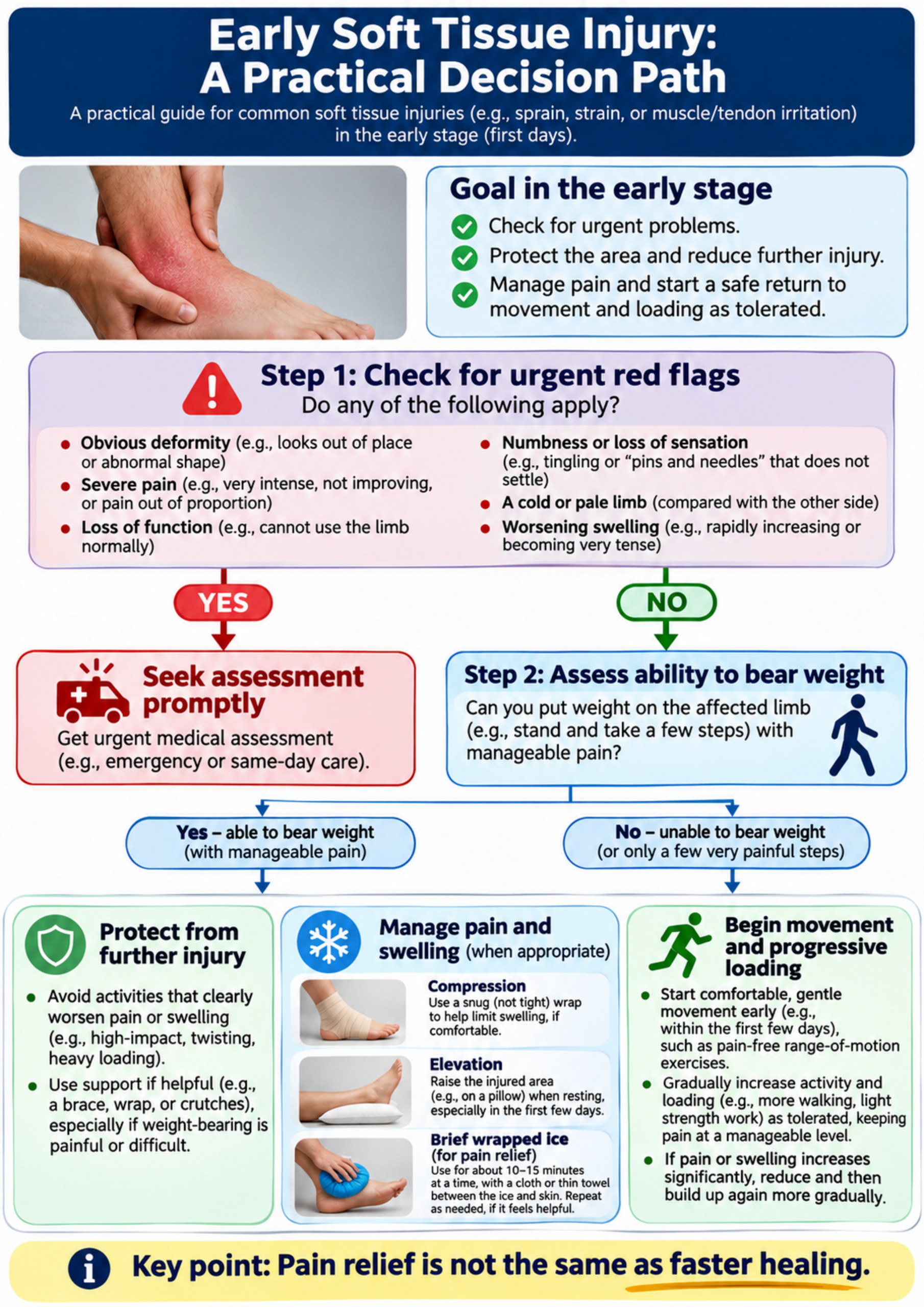
The best early plan depends on injury severity, diagnosis, symptoms, and function. No single column below replaces an examination when weight bearing, movement, or circulation is significantly affected.
| Option | Primary goal | Potential benefit | Main limitation |
|---|---|---|---|
| Wrapped cold pack | Short-term comfort | May reduce pain | Human healing effect is uncertain |
| Compression | Manage swelling and support | May improve comfort | Must not impair circulation |
| Elevation | Assist fluid movement | May reduce dependent swelling | Effect varies by injury and position |
| Progressive movement | Restore function and capacity | Supports mobility and loading tolerance | Must match tissue safety and symptoms |
- Seek urgent assessment for deformity, a cold or pale limb, or major numbness.
- Arrange review when weight bearing is impossible or symptoms rapidly worsen.
- Use passive treatments to support, not replace, active rehabilitation.
- Monitor function over time rather than swelling alone.
Conclusion
Ice might alter soft tissue healing because cooling can modify early repair processes, and some animal studies show delayed regeneration. In people, the clinical effect remains uncertain, so use ice selectively for comfort, apply it safely, and keep diagnosis and progressive rehabilitation at the center of recovery.
Frequently Asked Questions
Does ice definitely delay healing in humans?
No. The strongest delay findings come from animal models, and direct human tissue-healing evidence is insufficient for a definite claim.
Can ice still help after a sprain?
Yes, it may provide short-term pain relief. That benefit should be separated from claims that it speeds tissue repair.
Should I avoid ice completely?
Not necessarily. Brief, wrapped use can be reasonable for comfort when it is safe and does not replace appropriate assessment or rehabilitation.
Is swelling always harmful?
No. Swelling is part of the injury response, although excessive swelling can limit comfort and movement and may need management.
Can I exercise after icing?
Wait until sensation and control are normal, then follow the loading plan appropriate for the injury. Reduced pain is not proof that tissue is ready for heavy activity.
How long should I apply ice?
Use brief applications consistent with local clinical guidance and check the skin. Individual factors and the cold source change how quickly tissue cools.
Who should avoid cold packs?
People with impaired sensation or circulation, cold hypersensitivity, or conditions such as Raynaud’s phenomenon should seek advice first.
Is heat better than ice?
Neither is universally better. Heat may feel helpful for stiffness, while cold may reduce acute pain; both are symptom tools rather than complete healing plans.
What matters most for soft tissue recovery?
Correct diagnosis, protection when needed, progressive movement and loading, sleep, nutrition, and a rehabilitation plan matched to the injured tissue.
When should I seek urgent care?
Seek urgent assessment for severe deformity, loss of circulation, major numbness or weakness, an open injury, or rapidly worsening pain and swelling.