
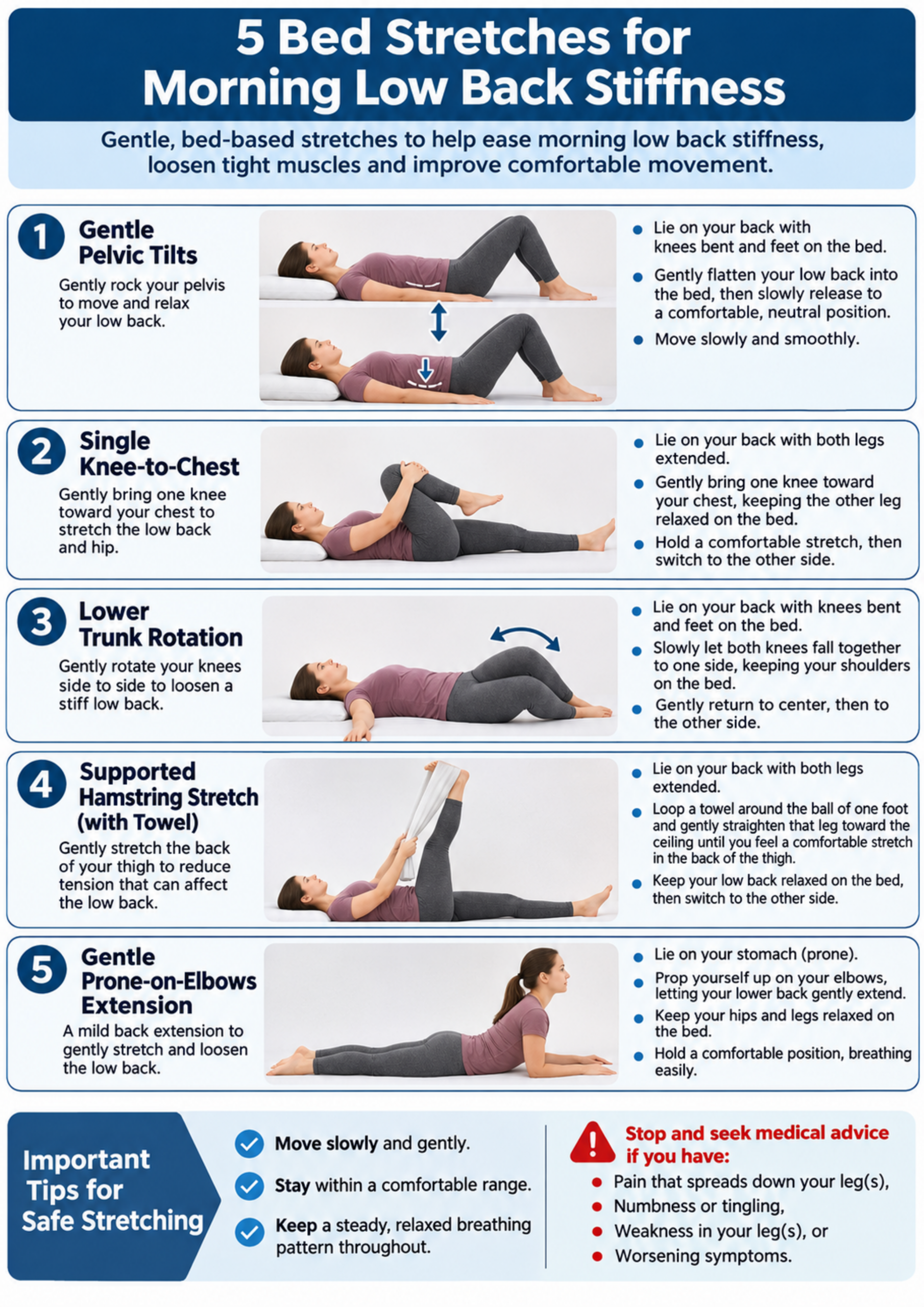
If your lower back feels stiff before your feet even reach the floor, the first few movements should feel like a gentle warm-up, not a flexibility test. These five bed stretches use small, controlled ranges to help you find a more comfortable start to the morning.
Why Morning Low Back Stiffness Happens
Several hours in one position can make the back and hips feel temporarily less mobile. Sleep position, yesterday’s activity, osteoarthritis, muscle sensitivity, and an irritated disc or joint can all contribute, so the sensation alone does not identify one cause.
- Notice whether stiffness eases after a few minutes of movement.
- Track any symptoms that travel into the buttock or leg.
- Compare how you feel after active and less-active days.
- Look for a trend rather than judging one morning.
Check Safety Before You Start
General exercises are not a substitute for assessment when symptoms are new, severe, or changing. The NHS back pain guidance advises urgent help for serious warning signs and recommends stopping exercises that make pain worse.
- Seek urgent care for new bladder or bowel changes or numbness around the saddle area.
- Arrange prompt assessment for major leg weakness, fever, significant trauma, or unexplained weight loss.
- Do not force a movement that sends pain farther down the leg.
- Ask for individual advice after recent surgery, fracture, or during pregnancy.
Set Up a Comfortable Starting Position
A soft mattress may let the pelvis sink and make control harder, so use smaller ranges if needed. A pillow under the head and bent knees can reduce the effort required to relax.
- Start on your back with both knees bent and feet supported.
- Breathe normally instead of bracing hard.
- Move slowly enough to notice the response.
- Use comfort, not maximum range, as the limit.
1. Gentle Pelvic Tilts
Pelvic tilts introduce a small rocking motion through the pelvis and lumbar spine. The movement should be subtle; pressing the back forcefully into the mattress is unnecessary.
- Lie on your back with knees bent.
- Gently roll the pelvis to flatten the low-back curve slightly.
- Reverse the motion to restore a comfortable arch.
- Keep the ribs and shoulders relaxed.
2. Single Knee-to-Chest
This movement flexes the hip and may feel comfortable across the lower back or buttock. If it increases leg symptoms or pinches the front of the hip, reduce the range or skip it.
- Keep one foot on the bed.
- Bring the other knee toward the chest using your hands behind the thigh.
- Pause in an easy position without pulling hard.
- Lower the leg and compare sides.
3. Lower Trunk Rotation
Small side-to-side knee movements can introduce gentle rotation through the hips and lower trunk. The goal is smooth motion, not getting both knees to the mattress.
- Keep the knees bent and together.
- Let both knees drift a short distance to one side.
- Return through the middle, then move the other way.
- Keep both shoulders comfortably supported.
4. Supported Hamstring Stretch
A towel or strap lets you adjust the position without reaching for the foot. A mild pull behind the thigh is acceptable, but nerve-like tingling, burning, or spreading pain is a reason to stop.
- Loop a towel behind one thigh or around the foot.
- Raise the thigh only as far as the back remains comfortable.
- Slowly straighten the knee until a mild stretch appears.
- Keep the opposite leg bent if that feels better.
5. Prone-on-Elbows Extension
Some people feel better with gentle extension after sleeping in a flexed position, while others do not. Treat this as an optional direction-specific movement, not a stretch everyone must perform.
- Roll onto your stomach if that position is comfortable.
- Place the elbows beneath or slightly in front of the shoulders.
- Let the chest rise while the pelvis stays supported.
- Stop if back or leg symptoms worsen or spread.
Compare the Five Bed Movements
Use the movement that leaves you the same or better afterward. A stretch that looks small can still be the correct dose when the back is sensitive.
| Movement | Main direction | Useful cue | Modify or stop when |
|---|---|---|---|
| Pelvic tilt | Small flexion and extension | Rock, do not press | Bracing or pain increases |
| Knee-to-chest | Hip and lumbar flexion | Hold behind the thigh | Hip pinching or leg pain appears |
| Trunk rotation | Gentle rotation | Use a small arc | Symptoms travel farther |
| Hamstring stretch | Knee extension with hip flexion | Keep tension mild | Tingling or burning appears |
| Prone on elbows | Lumbar extension | Relax the pelvis | Back or leg symptoms worsen |
- Choose two or three movements that suit your response.
- Repeat slowly rather than holding your breath.
- Use a smaller range on more sensitive mornings.
- Record which direction helps you move more easily.
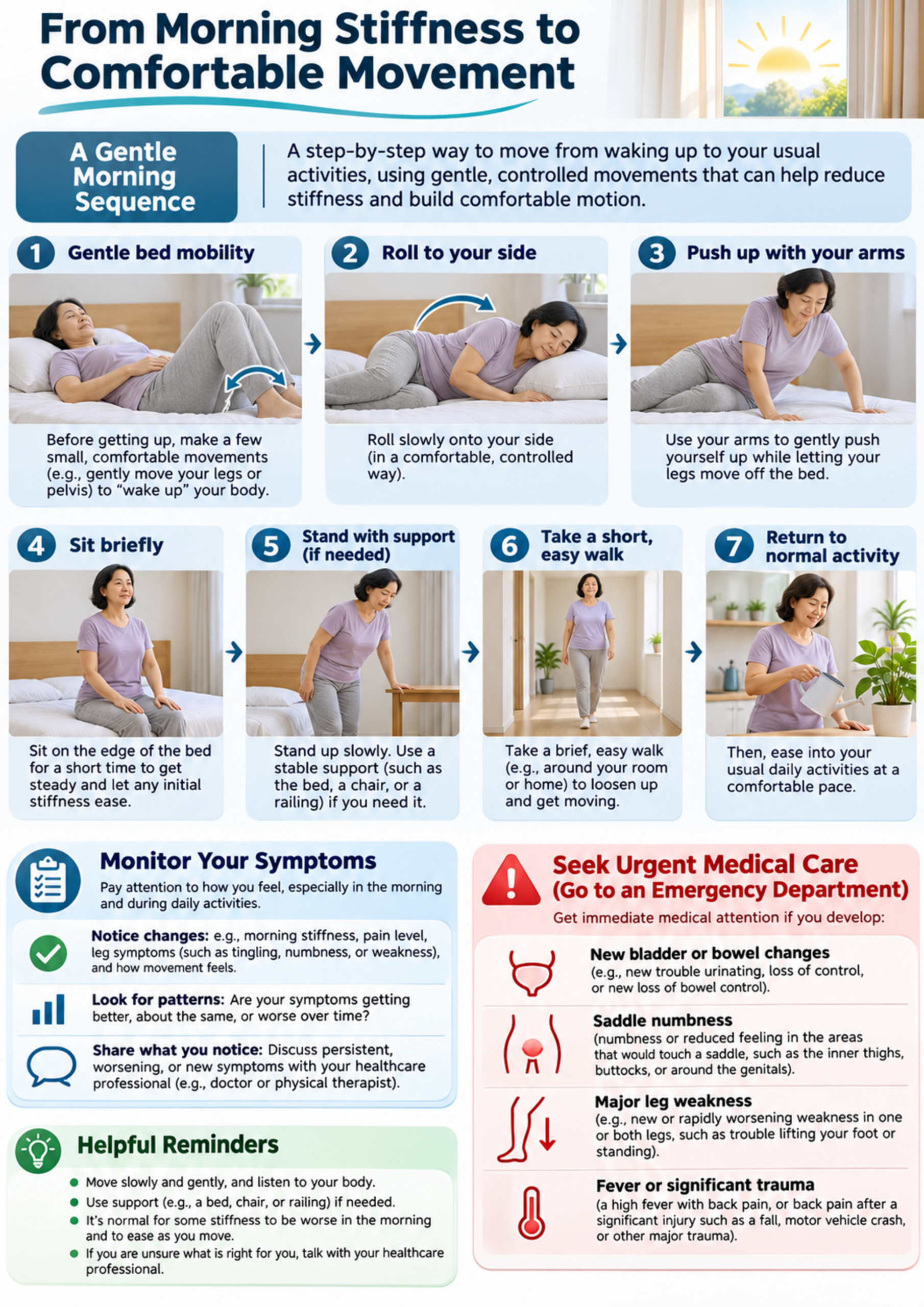
Move From the Bed Into Normal Activity
Stretching is most useful when it helps you resume activity rather than keeping you in bed. The NICE low back pain guideline emphasizes self-management and continuing normal activities, while exercise choice should match individual needs and capabilities.
- Roll to your side before pushing up with your arms.
- Sit briefly if changing position makes you light-headed.
- Stand with support available if balance is uncertain.
- Follow with a short, easy walk around the room or home.
Conclusion
Morning low back stiffness often responds better to calm, repeatable movement than to aggressive stretching. Choose the directions that feel comfortable, monitor the response after you get up, and seek assessment when symptoms persist, progress, or include warning signs.
Frequently Asked Questions
How long should morning back stiffness last?
There is no universal time limit. Stiffness that consistently lasts a long time, is worsening, or comes with other symptoms deserves clinical review.
Should I do all five stretches every morning?
No. Start with the movements that feel comfortable and leave you moving the same or better afterward.
How many repetitions should I perform?
Begin with a small number of slow repetitions and assess the response. Your clinician can individualize volume if symptoms are persistent or complex.
Is a firm mattress required?
No. Use smaller ranges on a soft mattress, or perform the routine on another safe surface if bed support is inadequate.
Can I stretch when pain travels into my leg?
Be cautious. Stop a movement that makes symptoms spread farther down the leg, or adds numbness, tingling, or weakness.
Is heat useful before stretching?
Some people find brief, safely applied warmth comfortable for stiffness. Protect the skin and avoid sleeping on a heating device.
What if extension feels worse?
Skip the prone-on-elbows movement. Directional responses differ, and an exercise is not mandatory simply because it helps someone else.
Can these stretches prevent back pain?
They may help morning mobility, but no short routine can guarantee prevention. Regular activity, strength, sleep, and load management also matter.
Should I rest in bed when my back is sore?
Prolonged bed rest is generally discouraged. Use comfortable movement and gradually return to normal activity unless a clinician has given different instructions.
When should I see a physical therapist?
Seek assessment when symptoms repeatedly limit sleep or activity, fail to improve, recur frequently, or include leg symptoms that need a tailored examination.