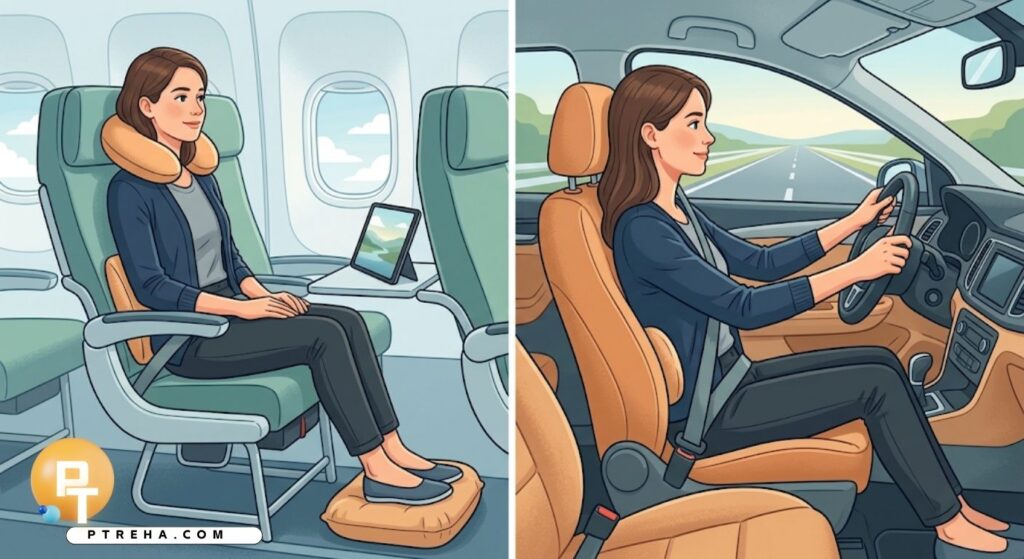
Long flights and extended car rides can leave your neck, back, hips, and legs feeling stiff, especially when you remain in one position for hours.
Travel ergonomics is about making your seat work for your body, changing positions regularly, moving your legs, and planning practical movement breaks so you can arrive with less stiffness and discomfort.
Why long journeys make your body stiff
Travel-related stiffness is usually influenced by prolonged sitting, restricted movement, limited space, and sustained postures rather than one single “bad” position.
Your body does not need to remain perfectly upright throughout an entire journey.
In fact, trying to hold one rigid posture for hours can be just as impractical as continuously slouching.
The more useful goal is to find a comfortable, supported position and change it regularly.
Common areas that may become stiff during long-distance travel include:
- Lower back
- Neck
- Upper back
- Shoulders
- Hips
- Hamstrings
- Calves
- Ankles
- Feet
The problem is particularly noticeable when you stand after several hours of sitting.
You may feel temporarily restricted when you first walk, but this does not automatically mean that you have injured your muscles, joints, or spine.
A practical approach is therefore to reduce the amount of uninterrupted sitting rather than searching for one perfect posture.
This principle is consistent with general ergonomic guidance from OSHA’s guidance on changing sitting positions, which emphasizes that even a good sitting posture should not be maintained without regular changes in position.
Set up your seat before the journey
Good travel ergonomics starts before the journey begins.
Whether you are sitting on an airplane or preparing to drive several hours, spend a few minutes arranging the available space around you.
For a car, seat adjustment is particularly important because the driver needs to maintain the same basic position while controlling the vehicle.
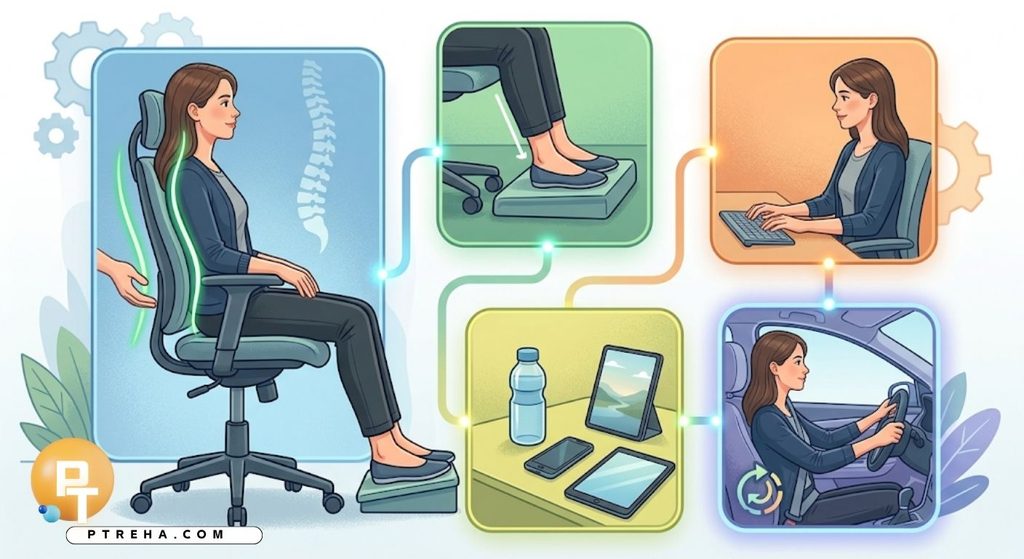
Before starting a long journey:
- Sit back against the backrest.
- Avoid sliding forward so your lower back loses support.
- Keep your feet comfortably supported.
- Avoid excessive pressure behind the knees.
- Position the seat so you can reach the controls without stretching.
- Keep the steering wheel close enough to avoid excessive shoulder reaching.
- Adjust the mirrors after establishing your normal driving position.
- Keep frequently used items within comfortable reach.
- Remove bulky objects from your back pocket.
- Recheck your position after driving for a while.
A small rolled towel can be useful when the available seat does not provide enough lower-back support.
OSHA’s guidance on chair and lumbar support describes a rolled towel or removable support cushion as a temporary way to provide additional lumbar support when appropriate.
The important point is that lumbar support should make the position more comfortable.
It should not force your lower back into an exaggerated arch.
Long-flight ergonomics: make limited space work better
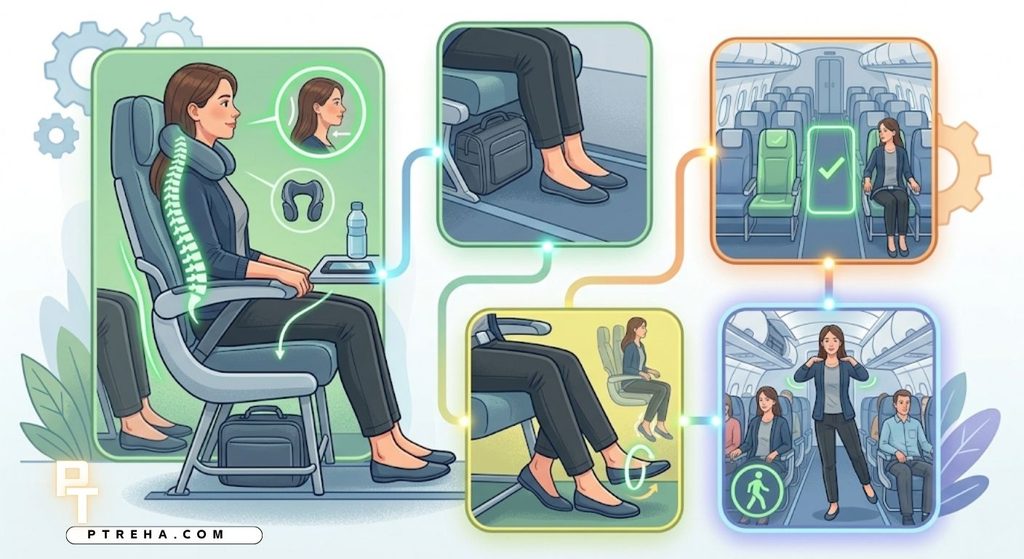
Airplane seats create several ergonomic challenges.
You have restricted legroom, limited seat adjustment, a narrow personal space, and fewer opportunities to move compared with normal daily activities.
Before boarding, consider whether your seat location makes movement easier.
An aisle seat can make it more convenient to stand and walk without disturbing another passenger, although personal needs and travel circumstances should determine your choice.
Once seated:
- Keep your shoulders relaxed.
- Avoid continuously pushing your head forward.
- Change your sitting position periodically.
- Move your ankles while seated.
- Avoid keeping your legs crossed for the entire flight.
- Keep the area around your feet as clear as possible.
- Use the headrest if it provides comfortable support.
- Avoid prolonged extreme neck rotation.
- Stand and walk when permitted and safe.
- Use natural breaks in the journey as opportunities to move.
You do not need to perform a complicated exercise routine in the airplane aisle.
Small movements performed repeatedly are usually more practical than waiting until you feel extremely stiff and then trying to compensate with aggressive stretching.
For long-distance travel, the CDC recommends moving the legs frequently and walking periodically.
Its guidance on reducing blood-clot risk during travel also describes simple calf and ankle movements that can be performed while seated.
Car-ride ergonomics: adjust the driver’s position
Long car journeys require additional attention because the driver must maintain control of the vehicle.
The driver should never perform stretches, mobility exercises, or other movements that interfere with safe vehicle operation.
Instead, movement should be incorporated into planned stops.
Before driving, check:
- Seat distance from the pedals
- Seat height
- Backrest position
- Headrest position
- Steering-wheel distance
- Steering-wheel height
- Lower-back support
- Mirror position
You should be able to operate the pedals without excessive reaching or stretching.
Likewise, the steering wheel should be positioned so you do not have to continuously reach forward with your arms.
If your shoulders gradually become tense during driving, check whether you are reaching too far toward the steering wheel or gripping it unnecessarily hard.
Passengers have more freedom to move, but they can still develop stiffness if they remain in exactly the same position for hours.
Do not wait for stiffness before moving
One of the most useful principles of travel ergonomics is to move before stiffness becomes severe.
During a road trip, plan regular stops where you can safely exit the vehicle and walk.
During a flight, use appropriate opportunities to stand or walk.
Useful movements include:
- Walking
- Ankle pumps
- Heel raises
- Toe raises
- Gentle knee movements
- Shoulder rolls
- Comfortable neck movements
- Gentle hip movements
- Calf stretching
- Easy trunk movements
The movements should remain comfortable.
You do not need to force a stiff joint or muscle into a large range of motion.
If a movement causes increasing pain, numbness, dizziness, or another concerning symptom, stop that particular movement.
For people who cannot leave their seat easily, simple ankle and calf movements can still provide an opportunity to move the legs.
The CDC specifically recommends frequent leg movement and calf-muscle exercises during long journeys.
A simple movement routine for travel stops
You do not need a gym or exercise equipment to make a useful movement break.
When you stop at a service station, rest area, airport lounge, or other suitable location, try a short sequence.
Five-minute travel reset
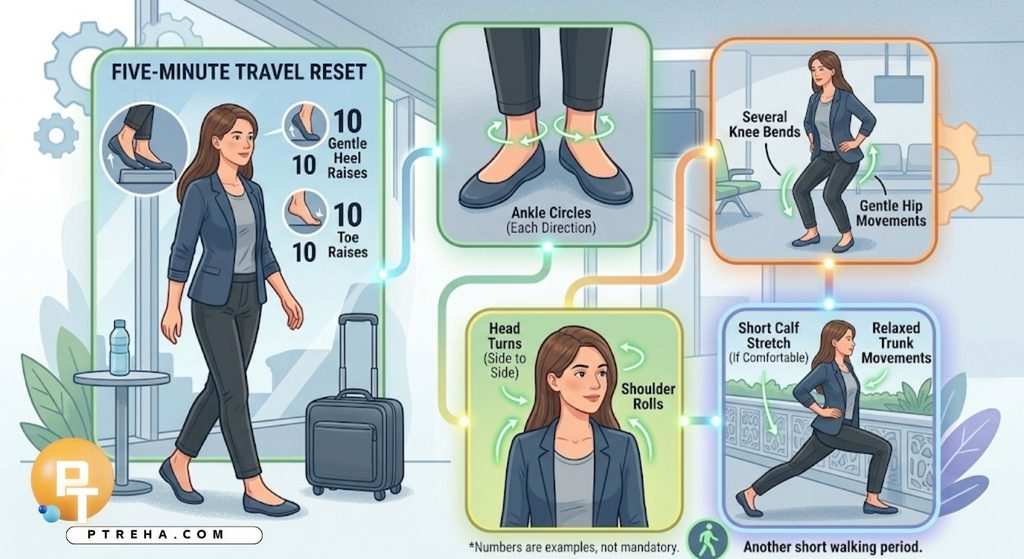
Start with comfortable walking.
Then perform:
- 10 gentle heel raises.
- 10 toe raises.
- Several ankle circles in each direction.
- Several gentle knee bends.
- Several shoulder rolls.
- Comfortable head turns from side to side.
- Gentle hip movements.
- A short calf stretch if comfortable.
- A few relaxed trunk movements.
- Another short period of walking.
The numbers are simply a practical example, not a mandatory prescription.
Your movement needs may vary depending on your fitness level, symptoms, age, and existing conditions.
The objective is to restore movement gradually rather than turn every travel break into a workout.
How to manage neck stiffness during flights
Neck stiffness can become noticeable when you spend hours looking at a phone, tablet, laptop, book, or entertainment screen.
It can also develop when you sleep with the head falling repeatedly to one side.
During travel:
- Bring your screen closer to eye level when practical.
- Avoid looking downward continuously.
- Change your viewing position.
- Relax your shoulders.
- Use a travel pillow if it provides useful support.
- Avoid sleeping with the neck held in an extreme position.
- Perform gentle neck movements during appropriate breaks.
- Avoid forcefully stretching the neck.
- Avoid repeatedly manipulating your neck to produce a cracking sensation.
A useful strategy is to alternate activities.
For example, instead of spending two uninterrupted hours looking down at a phone, you could watch something at a more comfortable height, look forward, rest your eyes, move your shoulders, and walk when appropriate.
This reduces the amount of time your neck spends in one restricted position.
How to reduce lower-back and hip stiffness
Lower-back and hip stiffness are common complaints after long periods of sitting.
The solution is not necessarily to stretch aggressively.
Start by restoring comfortable movement.
After leaving a vehicle or airplane:
- Stand slowly.
- Walk for a few minutes.
- Allow your hips and knees to move naturally.
- Avoid immediately lifting heavy luggage.
- Keep bags close to your body when lifting.
- Avoid twisting while carrying heavy luggage.
- Use luggage wheels when available.
- Divide heavy loads when possible.
- Avoid repeatedly bending forward immediately after prolonged sitting.
- Gradually return to normal activity.
If your back feels stiff after a long journey, walking may be more comfortable initially than performing an intense hamstring or back stretch.
After several minutes of movement, you can reassess how your body feels and choose gentle mobility exercises if needed.
Travel ergonomics and leg circulation
Long-distance travel is not only a musculoskeletal issue.
Prolonged immobility can also increase the risk of venous blood clots in some travelers.
This applies to journeys by airplane, car, bus, and train.
The risk is generally small for most travelers, but it can be higher when additional risk factors are present.
Relevant risk factors can include:
- Previous blood clot
- Recent surgery
- Recent significant injury
- Pregnancy or recent childbirth
- Certain hormone treatments
- Active cancer
- Some inherited clotting disorders
- Limited mobility
- Certain chronic medical conditions
- Increasing age
- Obesity
If you have one or more significant risk factors, discuss travel precautions with your healthcare professional before a long journey.
During travel, practical measures include:
- Move your legs frequently.
- Flex and extend your ankles.
- Raise and lower your heels.
- Raise and lower your toes.
- Tighten and relax your leg muscles.
- Walk when appropriate.
- Take planned breaks during road trips.
- Avoid unnecessary prolonged immobility.
- Follow individualized medical advice if you have increased risk.
The CDC notes that travelers should speak with a healthcare professional if they believe they have an increased risk of blood clots.
It also explains that aspirin should not be started specifically to prevent travel-related blood clots without appropriate medical advice.
Choosing travel accessories
Travel accessories can improve comfort, but they should not replace movement.
A useful accessory should make it easier to maintain a comfortable position without restricting your ability to change positions.
| Problem | Possible solution | Practical use |
|---|---|---|
| Poor lower-back support | Small lumbar cushion or rolled towel | Provide gentle support without forcing excessive arching |
| Unsupported feet | Compact footrest when appropriate | Support the feet while maintaining comfortable movement |
| Neck discomfort | Travel pillow | Support the head during rest without forcing the neck |
| Limited legroom | Organize personal items | Keep the foot area as clear as possible |
| Long sitting periods | Phone reminder | Remind you to move at suitable opportunities |
| Long car journey | Planned rest stops | Get out, walk, and change position |
| Shoulder tension | Appropriate arm support | Allow the shoulders to relax |
| Heavy luggage | Wheeled suitcase | Reduce unnecessary carrying demands |
Do not assume that a product is automatically ergonomic because the packaging uses the word “ergonomic.”
The best accessory is the one that fits your body, improves comfort, and allows you to change position.
What to do after a long journey
The transition from prolonged sitting to normal activity should be gradual.
When you arrive, avoid immediately going from several hours of sitting to lifting multiple heavy bags or performing demanding exercise.
Instead:
- Stand up gradually.
- Walk for a few minutes.
- Move your ankles.
- Move your knees.
- Move your hips comfortably.
- Gently move your spine.
- Carry luggage in manageable loads.
- Use luggage wheels when possible.
- Avoid twisting while lifting.
- Resume normal activity progressively.
If you have been sitting in a car for several hours, even a short walk around the parking area can be a useful first movement break.
You do not need to perform an extensive stretching session simply because you feel stiff.
Common travel ergonomics mistakes
Many travel-related discomfort problems come from simple habits.
Watch for these common mistakes:
- Staying completely still because the posture initially feels comfortable.
- Waiting until stiffness becomes severe before moving.
- Looking down at a phone for hours.
- Carrying a heavy bag on one shoulder for a prolonged period.
- Keeping a wallet or bulky object under one side of the pelvis.
- Driving with the seat positioned too far away.
- Reaching excessively toward the steering wheel.
- Sleeping without adequate head support.
- Performing aggressive stretches immediately after sitting.
- Ignoring persistent numbness.
- Ignoring new weakness.
- Lifting heavy luggage while twisting.
- Skipping planned breaks during long road journeys.
- Treating one posture as the “perfect” posture.
- Relying entirely on an ergonomic accessory instead of moving.
A better strategy is to combine comfortable support with regular changes in position.
When travel stiffness needs professional assessment
Ordinary stiffness after a long journey usually improves as you begin moving again.
However, symptoms that are severe, persistent, progressively worsening, or substantially different from your usual symptoms deserve appropriate assessment.
Particular attention is warranted when symptoms involve neurological changes or significant changes in function.
Seek medical assessment for concerning symptoms such as:
- New significant weakness
- Progressive loss of strength
- New persistent numbness
- Major difficulty walking
- Severe or rapidly worsening pain
- New loss of bladder or bowel control
- New numbness around the groin or saddle region
Leg swelling, unexplained leg pain or tenderness, warmth, or discoloration can be symptoms of deep vein thrombosis.
Sudden difficulty breathing, chest pain, coughing up blood, lightheadedness, or fainting can indicate a potentially serious pulmonary embolism and require immediate medical attention.
The CDC provides a detailed overview of these blood-clot symptoms during travel.
A practical travel checklist
Before leaving home, think beyond the destination.
A few simple preparations can make a long journey easier to manage.
Before a flight
- Choose a practical seat when possible.
- Keep essential items accessible.
- Avoid filling the foot area with unnecessary luggage.
- Consider whether you need lumbar or neck support.
- Wear comfortable clothing.
- Plan opportunities to move.
- Know whether you have individual blood-clot risk factors.
- Avoid starting medication specifically for travel without medical advice.
Before a long car journey
- Adjust the driver’s seat.
- Adjust the steering wheel.
- Adjust the mirrors.
- Check that your feet reach the pedals comfortably.
- Plan rest stops.
- Keep heavy objects secure.
- Keep frequently needed items accessible.
- Avoid relying on a single sitting position for the entire journey.
During the journey
- Move your legs frequently.
- Change your sitting position.
- Relax your shoulders.
- Avoid prolonged phone use with the head bent forward.
- Walk when appropriate.
- Use planned stops.
- Do not perform distracting movements while driving.
After arrival
- Walk before sitting again for another long period.
- Move your hips and ankles.
- Handle luggage carefully.
- Avoid immediately performing demanding physical activity if you feel very stiff.
- Monitor unusual or worsening symptoms.
Conclusion
Effective travel ergonomics is not about maintaining one perfect posture from departure to arrival.
It is about combining comfortable support, sensible seat adjustment, frequent position changes, leg movement, planned walking breaks, and safe luggage handling.
Whether you are spending hours in an airplane seat or behind the wheel, small movement opportunities throughout the journey can help reduce the amount of uninterrupted sitting and make the transition back to normal activity more comfortable.
FAQ
Is sitting upright the best position during a long flight?
Not necessarily.
A comfortable supported position is more practical than trying to remain rigidly upright for the entire journey.
Changing your position regularly is an important part of managing prolonged sitting.
How often should I move during a long flight?
Move your legs frequently while seated and take opportunities to stand or walk when it is safe and permitted.
For blood-clot prevention, the CDC recommends getting up and walking periodically during long travel and performing simple leg exercises while seated.
Should I use a lumbar support on an airplane?
A small lumbar cushion or rolled towel can be useful if the seat provides insufficient lower-back support.
It should improve comfort without forcing your lower back into an exaggerated position.
Is crossing my legs during a flight harmful?
Occasionally crossing your legs is not automatically a problem.
The more important issue during a long journey is avoiding prolonged immobility and changing position regularly.
What is the best stretch for back stiffness after a long car ride?
There is no single stretch that is best for everyone.
Start with comfortable walking and gentle movement, then consider appropriate mobility or stretching based on your symptoms and individual needs.
Can a neck pillow prevent neck stiffness during a flight?
A neck pillow may improve comfort while resting or sleeping if it provides appropriate support.
It should not force your neck into an extreme position or prevent you from changing position.
Can long travel cause back pain without an injury?
Yes.
Prolonged sitting, restricted movement, sustained loading, and uncomfortable positioning can contribute to temporary back discomfort or stiffness without necessarily indicating a new injury.
Do I need compression stockings for every long flight?
No.
Compression stockings are not automatically necessary for every traveler.
People with additional blood-clot risk factors should discuss appropriate preventive measures with a healthcare professional.
What should I do if my legs feel stiff after a long journey?
Begin with comfortable walking and gentle ankle and knee movements.
Avoid immediately forcing an intense stretch, particularly if the stiffness is significant.
When should I seek medical help after traveling?
Seek assessment for severe, persistent, or worsening symptoms, particularly new weakness, significant neurological changes, or major difficulty walking.
Sudden breathing difficulty, chest pain, coughing up blood, fainting, or concerning unilateral leg swelling or pain requires prompt medical attention.