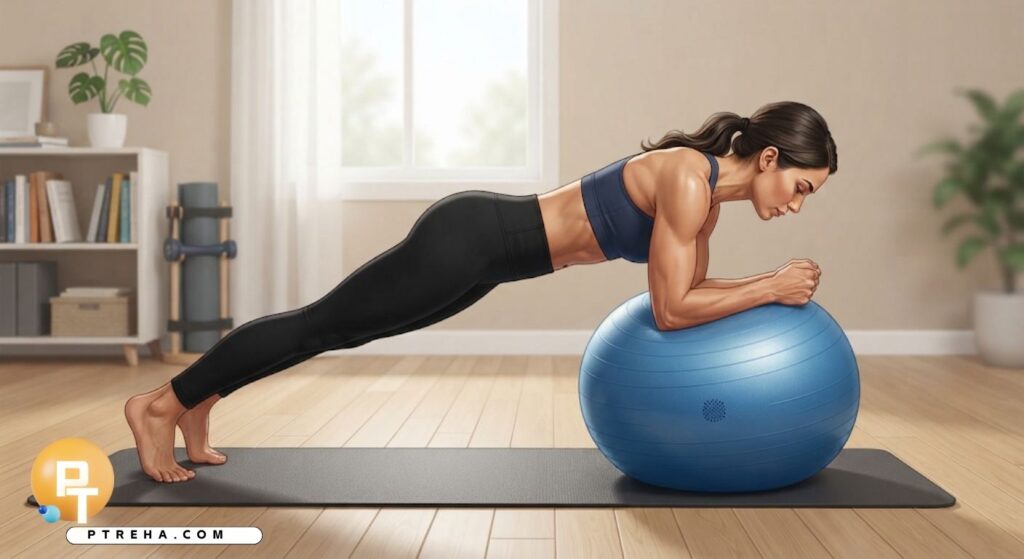
A Swiss ball can turn a simple home core routine into a controlled stability challenge by adding an unstable surface that requires the trunk, hips, and shoulders to coordinate while you maintain alignment.
This Swiss ball core and stability workout at home focuses on practical exercises that can be progressed gradually, with an emphasis on control, breathing, and movement quality rather than simply making the exercises harder.
What Swiss Ball Training Adds to Core Exercise
A Swiss ball, also called a stability or exercise ball, creates a moving support surface.
Instead of resting on a completely stable floor, your trunk and limbs must make small adjustments to maintain position.
This can make familiar exercises more demanding without adding external weights.
The main training goals can include trunk stabilization, abdominal strengthening, hip control, balance, and coordination between the upper and lower body.
Swiss ball exercises can be useful for:
- Trunk stabilization
- Abdominal muscle strengthening
- Hip control
- Balance training
- Shoulder and trunk coordination
- Anti-extension control
- Anti-rotation control
- Whole-body stability
- Movement coordination
- Progressing familiar exercises
The goal is not to remain completely motionless.
The goal is to control the movement required by the exercise without excessive shifting, collapsing, or unnecessary spinal movement.
How to Set Up Your Swiss Ball Safely
Before starting, make sure the ball is appropriate for your body size and properly inflated.
A ball that is excessively soft or positioned poorly can significantly change the exercise.
Choose an open area where the ball cannot easily roll into furniture, walls, sharp objects, or other obstacles.
When learning a new exercise, a wider foot position usually provides more stability than keeping the feet close together.
Use these setup principles:
- Place the ball on a non-slip surface.
- Remove sharp objects from the exercise area.
- Check the ball for visible damage.
- Follow the manufacturer’s inflation recommendations.
- Keep enough space around the ball.
- Use footwear with adequate grip when appropriate.
- Begin with a wide base of support.
- Keep a stable support nearby when learning balance exercises.
- Start with slow movements.
- Stop if you repeatedly lose control of the ball.
A safe environment is especially important because losing balance on a Swiss ball can happen quickly when the exercise becomes too difficult.
Warm Up Before the Workout
You do not necessarily need a long warm-up before a short home session, but several minutes of progressive movement can help you become familiar with the ball.
The warm-up should prepare the movements you are about to perform rather than fatigue you before the main exercises.
You can begin with:
- Marching in place.
- Walking around the room.
- Gentle bodyweight squats.
- Seated marching on the ball.
- Gentle pelvic movements while seated.
- Shoulder circles.
- Controlled hip hinges.
- Easy trunk movements within a comfortable range.
If sitting on the ball feels unstable, perform the initial movements beside a stable support instead of trying to maintain balance throughout every exercise.
Swiss Ball Core and Stability Workout
The following routine combines relatively accessible exercises with progressively more demanding stability challenges.
You do not need to perform every exercise during your first session.
Start with exercises that you can control and progress when your technique remains consistent.
Seated Swiss Ball March
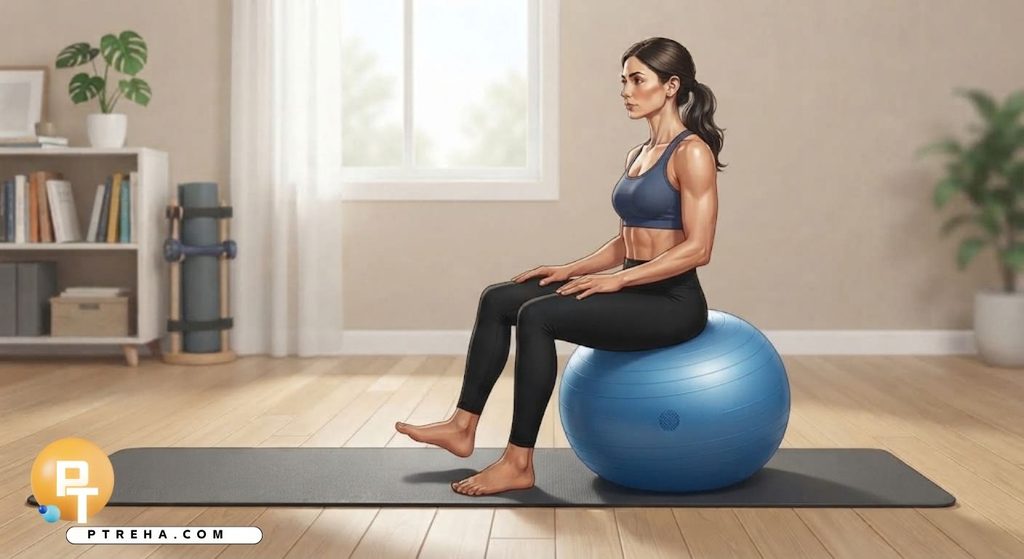
Sit near the center of the ball with your feet approximately hip-width apart and your trunk upright.
Slowly lift one foot a small distance from the floor while attempting to keep the pelvis relatively level.
Lower the foot and repeat on the opposite side.
The movement should be controlled rather than performed by rapidly lifting the knees.
Try:
- 6–10 repetitions per side.
- Slow lifting and lowering.
- Comfortable breathing.
- Minimal side-to-side trunk movement.
- A comfortable knee-lifting range.
This is a useful starting exercise because the feet remain available as a support when balance becomes difficult.
Swiss Ball Dead Bug
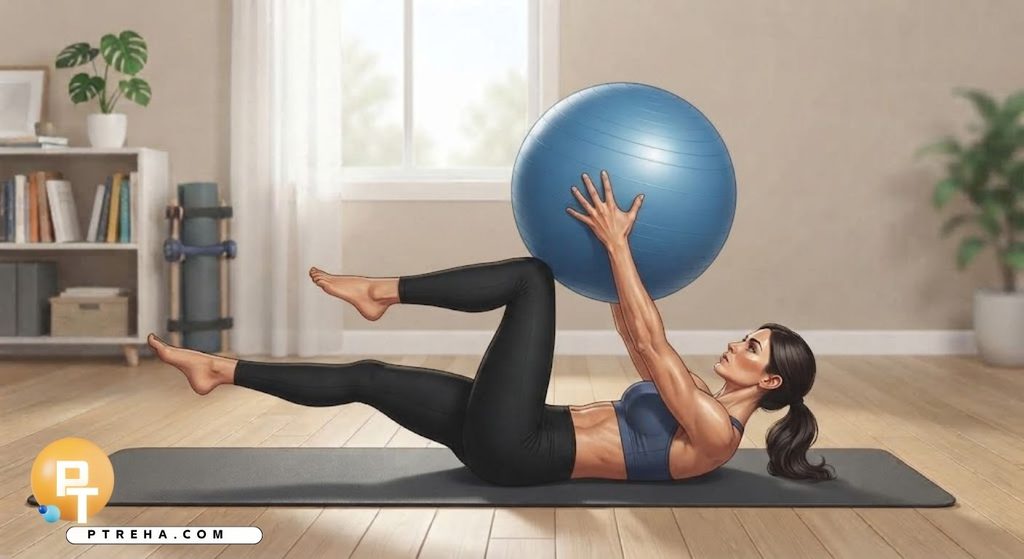
Lie on your back with the ball held between your hands and thighs.
Position yourself comfortably and maintain controlled breathing throughout the exercise.
Slowly lower one arm and the opposite leg while maintaining control of the ball.
Return to the starting position and alternate sides.
If the full movement is difficult, move only one limb at a time.
Focus on:
- Maintaining steady breathing.
- Controlling the rib cage.
- Moving slowly.
- Avoiding excessive lumbar extension.
- Keeping the ball controlled.
- Using a smaller movement range when necessary.
The objective is coordinated trunk and limb control rather than moving the arms and legs as far as possible.
Swiss Ball Bridge
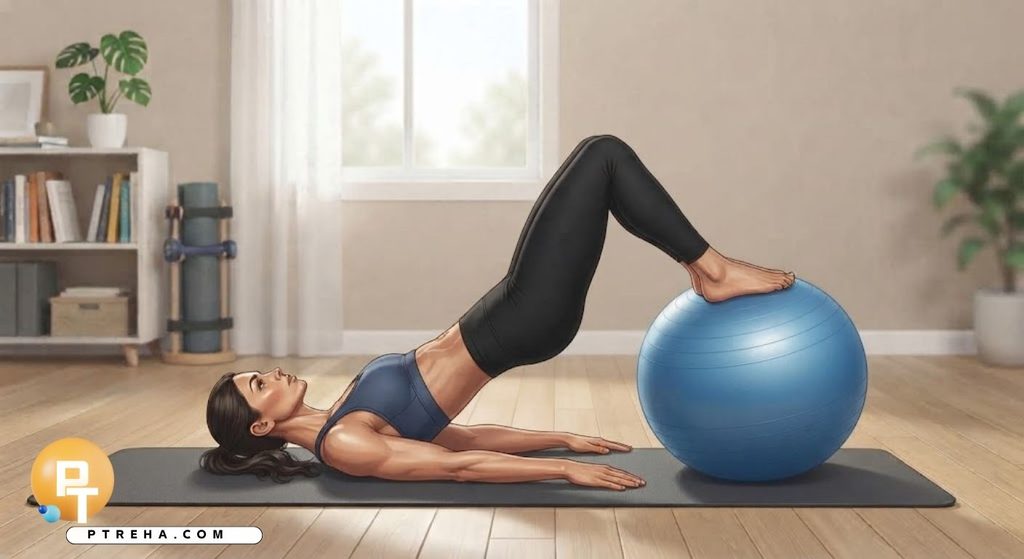
Place your lower legs on the ball while lying on your back.
Begin with the knees comfortably bent and the arms resting beside your body.
Press through your feet and lift your pelvis in a controlled manner.
Pause briefly, then lower the pelvis while preventing the ball from rolling excessively.
This exercise combines hip extension with trunk and lower-limb control.
Useful cues include:
- Keep the pelvis controlled.
- Avoid excessive arching of the lower back.
- Keep the ball under control.
- Move smoothly.
- Avoid pushing through pain.
- Lower the pelvis slowly.
- Maintain even pressure through both legs.
If the exercise is too difficult, perform a conventional bridge with your feet on the floor before returning to the ball variation.
Swiss Ball Wall Squat
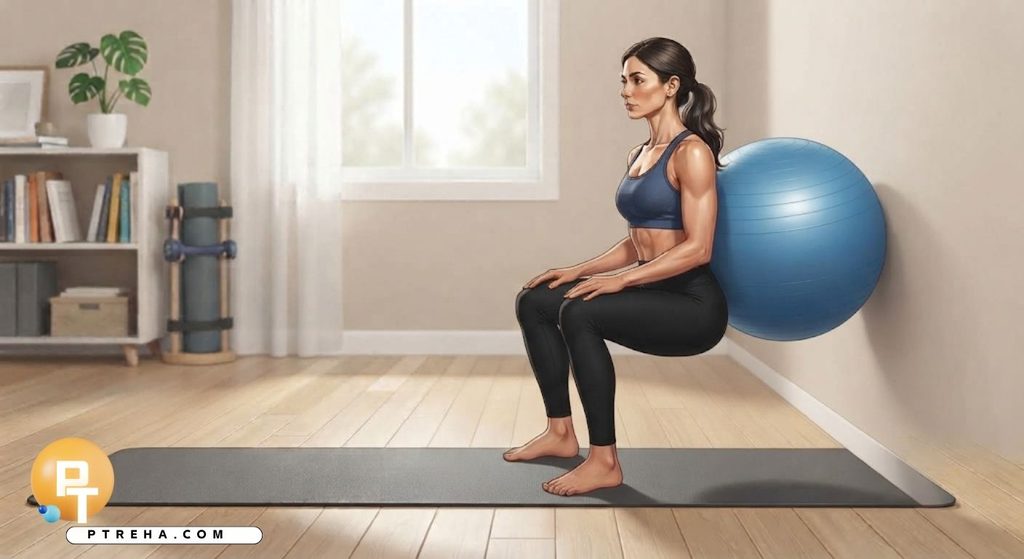
Place the ball between your back and a wall.
Position your feet far enough forward to allow a comfortable squat.
Bend your hips and knees while allowing the ball to roll along the wall.
Return to standing by pushing through your feet.
Although this is primarily a lower-limb strengthening exercise, maintaining a controlled trunk position adds a stability component.
Try:
- 8–12 repetitions.
- A comfortable squat depth.
- Even pressure through both feet.
- Controlled lowering.
- Smooth standing.
- No bouncing at the bottom.
If your knees, hips, or back become uncomfortable, reduce the depth or discontinue the exercise.
Swiss Ball Plank
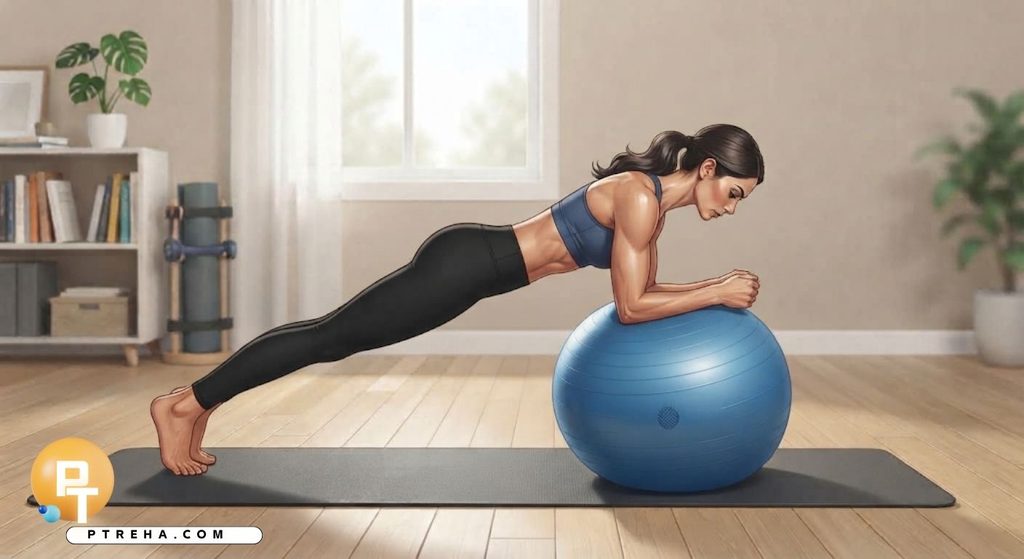
Place your forearms on the ball and extend your legs behind you into a plank position.
The unstable support requires you to control your trunk while maintaining the position.
Start with a short hold rather than immediately attempting a prolonged plank.
Prioritize:
- Controlled breathing.
- Stable shoulder positioning.
- Trunk alignment.
- Active abdominal control.
- Appropriate hip positioning.
- Minimal unnecessary movement.
If this variation is too difficult, begin with a plank using your forearms on the floor.
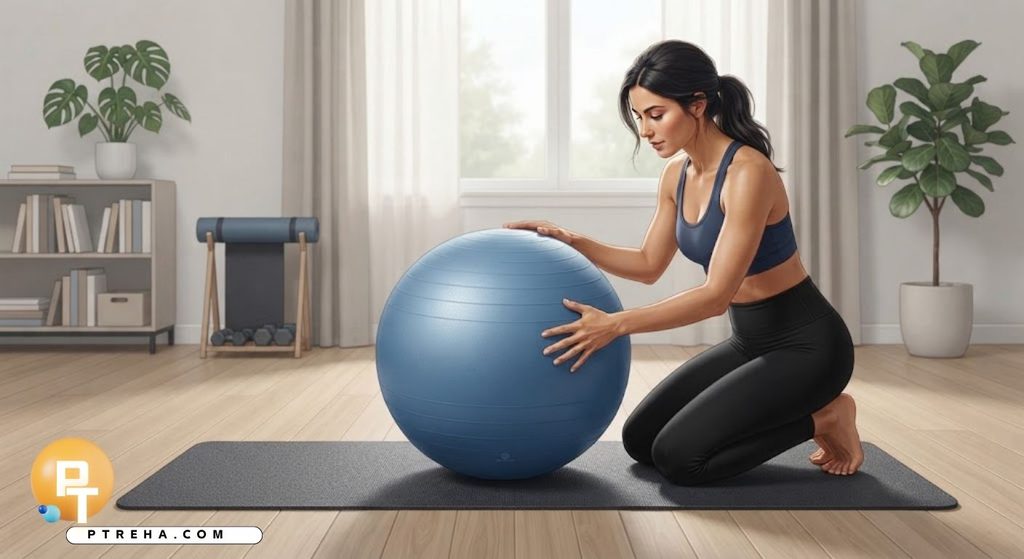
Swiss Ball Roll-Out
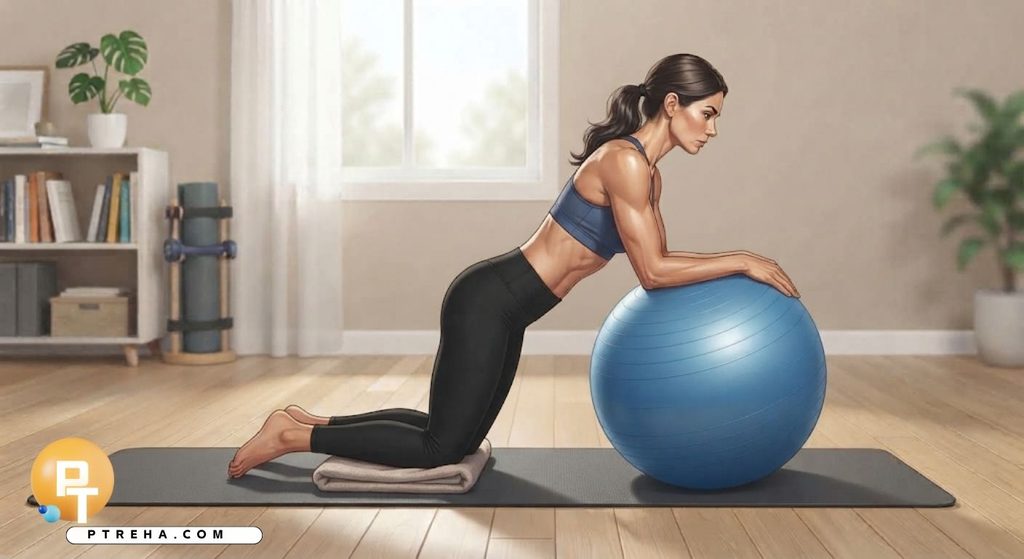
Kneel in front of the ball with your forearms or hands supported on it.
Slowly move the ball forward while maintaining control of your trunk.
Only travel as far as you can without losing your desired alignment, then bring the ball back.
The roll-out is considerably more demanding than simply sitting or lying on the ball because the trunk must resist excessive extension as the ball moves away from the body.
For beginners:
- Use a short range.
- Move slowly.
- Avoid excessive lumbar extension.
- Keep the hips controlled.
- Return before technique deteriorates.
- Use a comfortable surface underneath your knees.
Increasing the distance gradually is usually more appropriate than immediately attempting a large range of motion.
Swiss Ball Bird Dog
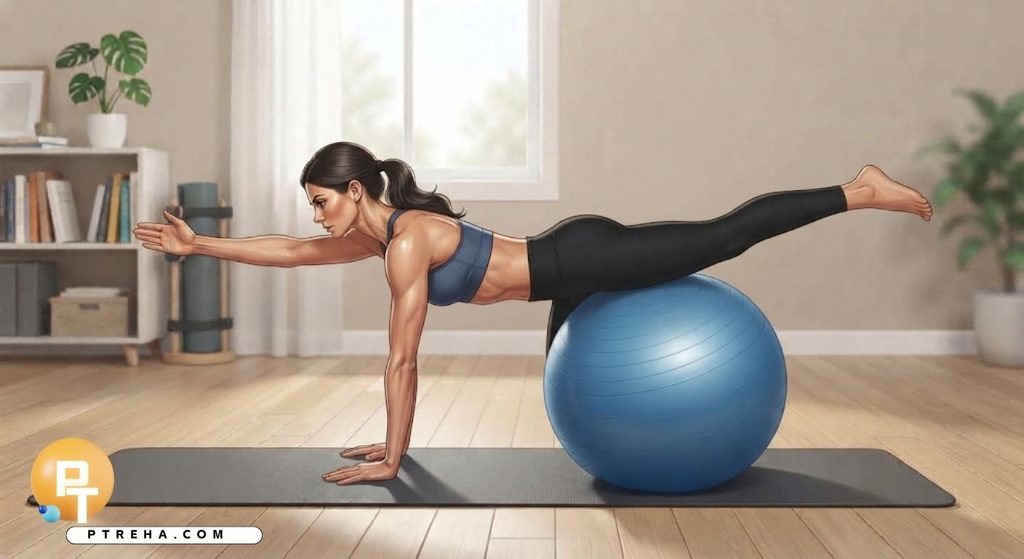
Position your trunk over the ball while supporting yourself with your hands and feet, or use a modified position in which the ball provides support to your trunk.
From a stable starting position, gradually remove one point of support by lifting one arm or one leg.
Progress to opposite arm and leg movements only when the easier variation is controlled.
This exercise emphasizes coordination between the trunk, shoulders, and hips.
Useful progression steps include:
- Weight shifting.
- One-arm lifting.
- One-leg lifting.
- Opposite arm and leg movement.
- Longer controlled holds.
- Smaller bases of support.
Do not progress simply because the exercise feels easy.
Progress when you can maintain control throughout the complete movement.
A Simple Home Workout Structure
You can organize these exercises as a circuit or perform them individually with appropriate rest.
| Exercise | Starting volume | Main focus | Easier modification |
|---|---|---|---|
| Seated ball march | 6–10/side | Balance and trunk control | Keep both feet down between repetitions |
| Dead bug with ball | 6–8/side | Trunk-limb coordination | Move one limb at a time |
| Swiss ball bridge | 8–12 | Hip and trunk control | Perform bridge with feet on floor |
| Wall squat | 8–12 | Lower-limb control | Reduce squat depth |
| Ball plank | 10–20 sec | Trunk stability | Perform plank on the floor |
| Ball roll-out | 5–8 | Anti-extension control | Use a shorter range |
| Ball bird dog | 5–8/side | Whole-body stability | Lift one limb at a time |
A practical session can include four to six exercises performed for one or two rounds.
Rest as needed between exercises, especially when balance or technique begins to deteriorate.
You do not need to train to muscular failure.
For stability-focused exercises, losing control is usually a useful indication that the set should end or the exercise should be modified.
How to Progress the Exercises
Progression should increase the training challenge without sacrificing movement quality.
With a Swiss ball, even a relatively small change can substantially alter the difficulty because the amount of available support changes.
You can progress by:
- Increasing repetitions gradually.
- Increasing hold duration.
- Increasing movement range.
- Reducing the base of support.
- Moving more slowly.
- Adding controlled limb movement.
- Progressing from bilateral to unilateral loading.
- Increasing roll-out distance.
- Reducing external support.
- Moving to a more demanding exercise variation.
For example, someone who can comfortably perform seated marching does not necessarily need to immediately attempt an advanced balance exercise.
A more appropriate progression could involve longer controlled marches followed by coordinated arm movements.
This approach also makes it easier to identify which progression caused difficulty.
How Often Should You Perform a Swiss Ball Workout?
The appropriate frequency depends on your overall exercise program, training experience, recovery, and goals.
A Swiss ball routine can be incorporated into a broader strengthening program rather than being treated as the only form of core exercise.
Remember that the ball is a training tool rather than a requirement for developing trunk strength.
Unstable exercises can increase the stability demands of certain movements, but they also change the way force is produced.
A balanced exercise program can include:
- Swiss ball exercises.
- Stable-surface core exercises.
- Lower-limb strengthening.
- Upper-limb strengthening.
- Aerobic activity.
- Balance exercises when appropriate.
- Mobility exercises when indicated.
- Task-specific movement.
This provides more training options than relying exclusively on unstable exercise.
Common Mistakes During Swiss Ball Training
One of the most common problems with home stability-ball exercise is selecting an exercise that is too difficult too soon.
An exercise should challenge your control without forcing you to compensate through other parts of your body.
Watch for:
- Holding your breath.
- Moving too quickly.
- Excessive lumbar arching.
- Uncontrolled pelvic rotation.
- Knees moving inward during squatting.
- Using momentum during roll-outs.
- Using a poorly inflated ball.
- Exercising on a slippery surface.
- Progressing before mastering the previous variation.
- Continuing despite significant or unfamiliar pain.
A more difficult exercise is not automatically a more effective exercise.
The appropriate exercise is one that provides the intended training challenge while remaining controllable.
Making the Workout Appropriate for Beginners
Beginners should spend more time learning positioning than chasing repetitions.
For example, seated ball marching can initially be performed with both feet close to the floor.
As control improves, the leg can be lifted farther while the trunk remains stable.
Similarly, a conventional floor bridge can prepare you for a bridge with the feet supported on the ball.
A useful progression may look like this:
- Seated Swiss ball posture.
- Seated Swiss ball march.
- Stable-surface dead bug.
- Swiss ball dead bug.
- Stable bridge.
- Swiss ball bridge.
- Supported plank.
- Swiss ball plank.
Keep a stable chair, wall, or other appropriate support nearby when learning balance-dependent movements.
The purpose of progression is to develop control gradually rather than making the first workout unnecessarily difficult.
When to Modify or Stop an Exercise
Swiss ball training should not be used to push through significant pain or repeated loss of balance.
Stop the exercise if you experience:
- New severe pain.
- Dizziness.
- Faintness.
- Loss of coordination.
- Significant shortness of breath unrelated to normal exercise effort.
- New numbness.
- New weakness.
- Repeated inability to control the ball safely.
If you have an injury, neurological condition, substantial balance impairment, recent surgery, or another health concern affecting exercise safety, individualized assessment by an appropriate healthcare professional is preferable to selecting advanced Swiss ball exercises independently.
The exercises described in this article are general exercise examples and should not be considered an individualized rehabilitation prescription.
How to Build a 15-Minute Home Routine
If you have limited time, organize the workout into three simple sections.
Block 1: Preparation
- Seated Swiss ball march: 8 repetitions per side.
- Easy bodyweight squat: 8–10 repetitions.
- Gentle hip and shoulder movements.
Block 2: Core and stability
- Swiss ball dead bug: 6 repetitions per side.
- Swiss ball bridge: 8–10 repetitions.
- Swiss ball plank: 10–20 seconds.
- Swiss ball roll-out: 5–8 repetitions.
Block 3: Movement control
- Swiss ball wall squat: 8–12 repetitions.
- Bird dog variation: 5–8 repetitions per side.
- Easy walking afterward.
Adjust the number of exercises and repetitions according to your current ability.
Completing fewer exercises with good control is generally more useful than rushing through the entire routine with poor technique.
Conclusion
A Swiss ball core and stability workout at home can provide a practical way to train trunk control, balance, coordination, and hip stability using a single piece of equipment.
The key is to begin with manageable exercises and gradually increase the challenge while maintaining controlled movement and comfortable breathing.
The Swiss ball should be considered one training tool within a broader exercise program.
Stable-surface strengthening remains valuable, and the most appropriate exercise is the one that matches your current ability, training goal, and safety needs.
FAQ
Is a Swiss ball good for core training?
Yes.
Swiss ball exercises can provide an instability challenge that requires the trunk muscles to contribute to maintaining body position during movement.
However, the ball is not automatically better than stable-surface exercises, and the appropriate choice depends on the exercise and training goal.
Can beginners use a Swiss ball for core exercises?
Yes.
Beginners can use a Swiss ball when the exercise is appropriately modified.
Seated movements, supported positions, and exercises with a wider base of support are useful starting points before progressing to more demanding variations.
How long should a Swiss ball core workout take?
A short session can be useful when the exercises are appropriately selected and performed with good technique.
A focused routine can be completed in approximately 15 minutes, although the appropriate duration depends on the person’s overall exercise program and goals.
How many Swiss ball exercises should I do in one workout?
There is no universal number.
Four to six appropriately selected exercises can provide a practical session while allowing you to focus on different movement demands, such as trunk control, hip stability, balance, and anti-extension control.
Should I use a Swiss ball every day?
Daily use is not necessary for most people.
The appropriate frequency depends on exercise intensity, training experience, recovery, and the rest of your physical activity.
Swiss ball exercises can be included regularly without making them the sole component of your exercise routine.
Is a Swiss ball better than floor exercises?
Not universally.
A Swiss ball changes the stability demands of an exercise and can increase the challenge to trunk control, but stable exercises remain important for developing strength and movement capacity.
The best choice depends on the exercise objective and the person’s ability.
Can Swiss ball exercises improve balance?
They can challenge balance because the ball provides a less stable support surface.
However, the difficulty should match the person’s balance ability.
Someone with substantial balance limitations may require individualized exercise selection and supervision rather than advanced Swiss ball exercises.
Why do I shake during Swiss ball exercises?
Shaking can occur when muscles are working to control a demanding position, particularly when an exercise is new or the support surface is unstable.
If shaking is accompanied by pain, dizziness, weakness, or loss of control, stop the exercise and reassess the movement.
What should I do if the Swiss ball feels too difficult?
Reduce the difficulty rather than forcing the movement.
You can widen your base of support, shorten the movement range, decrease the hold duration, use a stable surface, or return to an easier exercise variation.
Can I use Swiss ball exercises for rehabilitation?
Swiss balls can be incorporated into some rehabilitation programs, but rehabilitation exercises should be selected according to the individual’s condition, impairments, goals, and stage of recovery.
A general home exercise article should not replace an individualized clinical assessment when rehabilitation is required.
Resources
- PubMed — Effects of unstable training on muscle activation: systematic review and meta-analysis: PubMed research article
- PubMed — Core muscle activation during Swiss ball and traditional abdominal exercises: PubMed research article
- PubMed — Comparison of EMG activity during stable and unstable exercise: PubMed research article
- ACE Fitness — Stability Ball Sit-Ups and Crunches: ACE exercise guide
- ACE Fitness — Core-Strengthening Stability Ball Workout: ACE Fitness resource