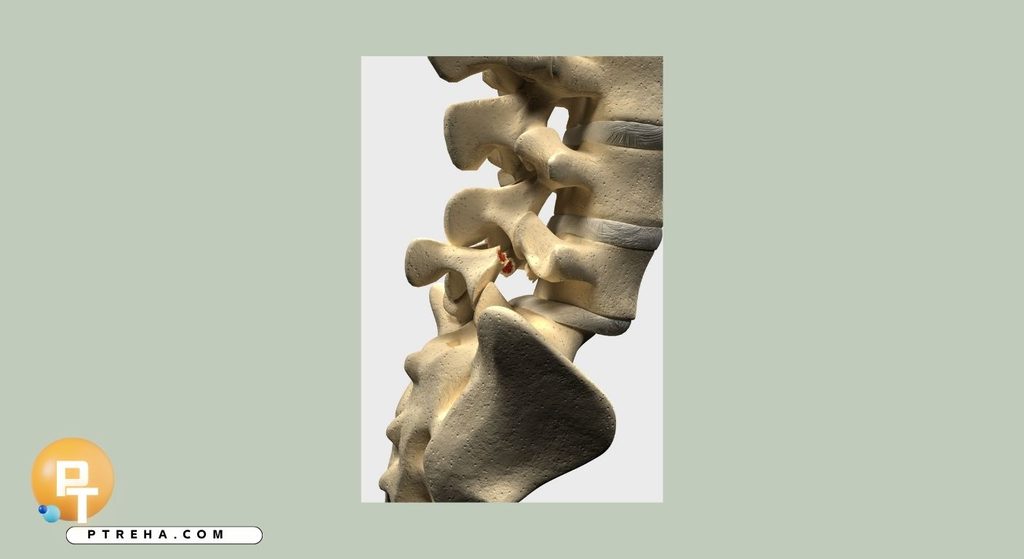
Spondylolisthesis is a spinal condition in which one vertebra shifts relative to the vertebra below it, most commonly in the lumbar spine.
Symptoms range from no pain at all to low-back pain, buttock or leg symptoms, stiffness, and activity limitations; exercise-based rehabilitation can help improve strength, movement tolerance, and function when appropriately matched to the individual’s presentation.
What Is Spondylolisthesis?
Spondylolisthesis describes abnormal displacement of one vertebra in relation to another.
It is different from a herniated or “slipped” disc, although both conditions can produce back or leg symptoms.
The condition can have different causes, including degenerative changes, a defect or stress injury involving the pars interarticularis, developmental factors, trauma, or other less common causes.
The underlying type matters because rehabilitation should be based on the person’s symptoms, examination findings, age, activity demands, and clinical diagnosis.
Some people have a radiographic slip without significant symptoms.
Others may experience mechanical low-back pain, buttock or thigh pain, hamstring tightness, or symptoms associated with irritation or compression of a lumbar nerve.
Common Symptoms
Symptoms are variable, but commonly reported features include:
- Localized low-back pain
- Pain that increases with prolonged standing or walking
- Buttock or thigh discomfort
- Leg pain with possible neural involvement
- Numbness or tingling in a leg
- Perceived stiffness in the lumbar region
- Hamstring tightness
- Reduced tolerance for lifting
- Reduced walking or standing tolerance
- Difficulty returning to sport or higher-level activity
The presence of a vertebral slip on imaging does not automatically explain every symptom.
A physical therapist should consider the complete clinical presentation rather than treating the imaging finding in isolation.
Why Exercise Can Help
Exercise is generally used to improve physical capacity rather than to “push the vertebra back into place.” The practical goals are to reduce activity-related symptoms, improve trunk and hip capacity, restore confidence with movement, and increase tolerance for everyday and recreational activities.
Conservative management commonly includes physiotherapy, activity modification, and an individualized strengthening and mobility program.
Evidence concerning specific exercise protocols for spondylolisthesis remains heterogeneous, so there is no single exercise routine that is appropriate for every patient.
A useful rehabilitation program may target:
- Trunk motor control
- Abdominal and lumbar muscle endurance
- Hip strength
- Lower-extremity strength
- Functional movement capacity
- Aerobic fitness
- Movement confidence
- Flexibility where clinically appropriate
- Gradual exposure to previously aggravating activities
- Sport-specific physical capacity
The emphasis should be on progressive loading rather than permanent avoidance of movement.
Clinical Assessment Before Starting Exercise
A diagnosis of spondylolisthesis should not be treated as a generic low-back-pain diagnosis.
The therapist should establish what activities reproduce symptoms, whether symptoms extend into the leg, and whether there are neurological findings requiring additional assessment.
Assessment may include lumbar and hip movement, strength, functional tasks, gait, neural symptoms, activity tolerance, and relevant medical history.
Imaging can be useful when clinically indicated, but the scan should be interpreted alongside the examination rather than used as the sole determinant of treatment.
Important assessment questions include:
- Where is the pain located?
- Does pain travel below the buttock or into the leg?
- Is there numbness or tingling?
- Is there measurable weakness?
- Which positions increase symptoms?
- Which positions reduce symptoms?
- Is standing more difficult than sitting?
- How well can the person walk?
- What lifting activities are limited?
- What sport or occupational demands must be restored?
A patient with localized mechanical back pain may require a different program from someone with progressive leg weakness or significant neural symptoms.
Exercise Selection and Progression
There is no universal “spondylolisthesis exercise.” Exercise selection should be based on irritability, movement response, physical capacity, and the underlying presentation.
For many patients, early rehabilitation focuses on movements that can be performed comfortably while developing trunk and hip capacity.
Examples may include abdominal bracing, controlled bridging, hip strengthening, supported squatting, walking, and other low-impact activities.
Example Exercise Categories
Depending on the individual assessment, a program may include:
- Diaphragmatic breathing with relaxed trunk control
- Abdominal bracing
- Supine marching with trunk control
- Bridge variations
- Side-lying hip abduction
- Resistance-band hip exercises
- Sit-to-stand practice
- Supported squats
- Step-up exercises
- Walking or another tolerated aerobic activity
The exercise should be technically controlled rather than performed simply to reach a particular repetition target.
Progression Should Be Gradual
A practical progression can move from low-load control toward functional strengthening:
- Establish a tolerable starting position.
- Learn controlled trunk and pelvic movement.
- Increase repetitions or exercise duration.
- Introduce resistance.
- Progress toward unilateral or more demanding movements.
- Add functional lifting or carrying.
- Gradually reintroduce sport-specific or occupational demands.
The appropriate progression depends on the individual’s response.
Increasing exercise difficulty is useful only when the previous level is tolerated.
Trunk and Core Strengthening
Trunk strengthening is commonly incorporated into rehabilitation because adequate trunk muscle endurance and motor control can support functional movement and reduce excessive reliance on passive structures.
A simple starting exercise is abdominal bracing.
In a comfortable position, the patient gently activates the abdominal musculature while continuing to breathe normally, avoiding excessive abdominal gripping or breath holding.
Progressions can include controlled marching, heel slides, bridge variations, and eventually loaded functional movements.
Useful trunk-training principles include:
- Maintain comfortable breathing.
- Avoid unnecessary breath holding.
- Start with low-load control.
- Prioritize movement quality.
- Progress resistance gradually.
- Use functional movements as capacity improves.
- Stop or modify an exercise if symptoms become clearly worse.
Core exercises should not be presented as a way to “stabilize” the vertebra permanently.
Their clinical purpose is to improve physical capacity and movement control.
Hip and Lower-Extremity Strengthening

The hips and lower extremities contribute substantially to walking, stair climbing, squatting, lifting, and athletic movement.
Improving their capacity can help distribute physical demands across the kinetic chain.
For example, a patient who finds repeated sit-to-stand movements difficult might begin with a higher chair and controlled repetitions.
As strength and confidence improve, the chair height can be reduced or external resistance introduced.
Potential exercises include:
- Sit-to-stand
- Supported squat
- Step-up
- Hip abduction
- Hip extension
- Bridge
- Split-stance strengthening
- Calf raises
- Hamstring strengthening
- Functional carrying tasks
Exercise selection should remain symptom-guided.
A technically correct exercise is not necessarily appropriate if it repeatedly aggravates the patient’s symptoms.
Mobility, Walking, and Aerobic Exercise
Exercise for spondylolisthesis should not consist exclusively of isolated strengthening.
General physical activity is also important for maintaining conditioning and reducing deconditioning.
Walking is often a practical starting point when it is tolerated.
Other low-impact activities, such as cycling or aquatic exercise, may be useful alternatives depending on symptoms and individual preference.
Mobility work should also be individualized.
A patient may benefit from gentle hip mobility or targeted muscle flexibility, but aggressive stretching is not automatically required simply because hamstring tightness is present.
Helpful activity principles include:
- Choose an activity that can be performed consistently.
- Begin below the person’s current symptom threshold.
- Increase duration before adding substantial intensity when appropriate.
- Monitor symptoms during and after activity.
- Avoid sudden increases in training volume.
- Use low-impact options during more irritable periods.
- Gradually return to higher-impact activities when capacity permits.
What Exercises Should Be Modified or Avoided?
There is no universally prohibited exercise for every person with spondylolisthesis.
However, movements that repeatedly reproduce or substantially aggravate symptoms should be modified while the underlying problem is assessed.
Particular caution may be appropriate with repeated or loaded lumbar extension and rotation in patients whose symptoms are provoked by those movements.
This is especially relevant in some presentations involving pars-related pathology, where extension and rotation can increase mechanical stress.
Examples that may require modification include:
- Heavy back extensions
- Repeated loaded lumbar hyperextension
- High-volume twisting movements
- Heavy lifting performed with poor control
- High-impact exercise during an irritable phase
- Sport drills that repeatedly reproduce symptoms
- Exercises that cause increasing leg symptoms
- Movements associated with new neurological symptoms
Avoidance should not become unnecessarily restrictive.
The objective is usually to modify the provoking load and progressively rebuild tolerance rather than permanently eliminate movement.
Example Exercise Plan for Symptom Management
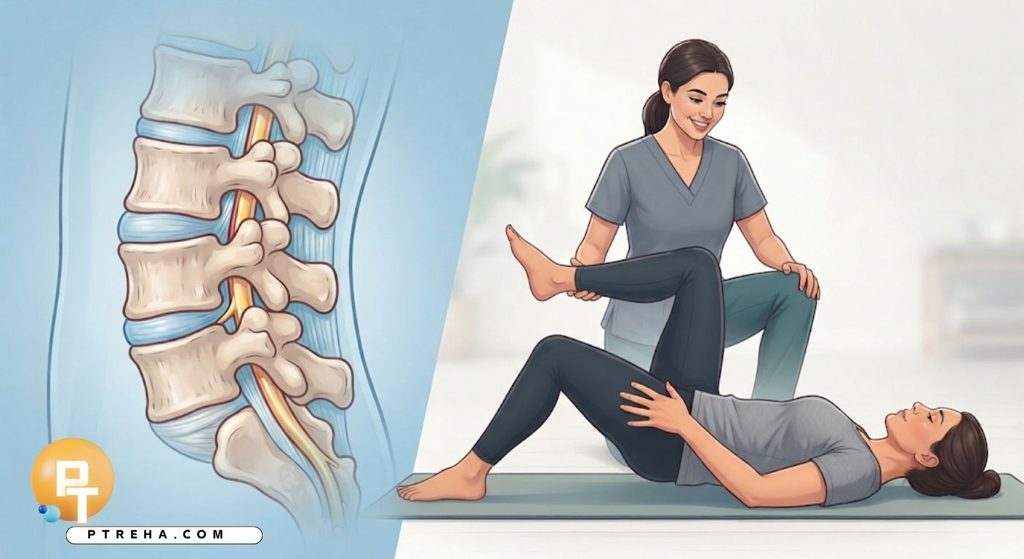
The following example illustrates how a clinician might organize exercise categories.
It is not a universal prescription and should be adapted after individual assessment.
| Rehabilitation focus | Example exercise | Main purpose | Possible progression |
|---|---|---|---|
| Trunk control | Abdominal bracing | Develop trunk control | Supine marching |
| Trunk endurance | Bridge | Posterior-chain endurance | Resistance or unilateral progression |
| Hip strength | Side-lying hip abduction | Hip abductor capacity | Band resistance |
| Functional strength | Sit-to-stand | Transfer capacity | Squat or loaded sit-to-stand |
| Lower-limb strength | Step-up | Leg strength and control | Higher step or resistance |
| Aerobic capacity | Walking | General conditioning | Longer duration or faster pace |
| Functional lifting | Hip-hinge practice | Movement coordination | Light external load |
| Return to activity | Activity-specific drills | Restore participation | Gradual intensity increase |
A patient might begin with two or three exercises that are well tolerated rather than attempting a long routine.
As control and tolerance improve, additional resistance or functional complexity can be introduced.
For example, someone who develops back discomfort after ten minutes of walking may begin with shorter, tolerable walking intervals rather than stopping physical activity altogether.
The duration can then be increased progressively according to symptoms and recovery.
Managing Symptoms During Rehabilitation
Pain does not always mean that tissue damage is occurring, but a significant or progressive change in symptoms should not simply be ignored.
The response to exercise should be monitored across the session and afterward.
A useful clinical approach is to consider:
- Pain intensity
- Pain location
- Whether symptoms spread farther down the leg
- Whether symptoms remain elevated after exercise
- Changes in walking tolerance
- Changes in strength
- Changes in neurological symptoms
- Ability to perform daily activities
- Overall recovery between sessions
If a movement consistently causes increasing leg pain, numbness, tingling, or weakness, the exercise should be stopped or modified and the patient reassessed.
Exercise progression should therefore be based on response, not on a predetermined schedule.
When Medical Review Is Important
Most people with uncomplicated symptoms can be managed conservatively, but some presentations require medical assessment.
Persistent or worsening neurological symptoms should not be treated as an ordinary exercise-training problem.
Seek prompt medical evaluation for symptoms such as:
- New or progressive leg weakness
- Significant or worsening numbness
- Severe or progressive leg symptoms
- Difficulty walking that is worsening
- New bowel or bladder dysfunction
- Numbness around the saddle or genital region
- Severe symptoms following significant trauma
- Systemic symptoms accompanying back pain
Urgent assessment is particularly important when symptoms suggest possible significant neurological compromise.
Returning to Sport and Higher-Level Activity
Athletes require more than symptom reduction before returning to full participation.
Rehabilitation should restore the physical capacities demanded by the specific sport.
A runner, for example, may need progressive exposure to running volume, acceleration, deceleration, and eventually sport-specific training.
A weight-training athlete may need a graded return to squatting, hinging, lifting, and loaded spinal positions rather than an immediate return to previous loads.
Return-to-activity planning can include:
- Establishing acceptable baseline symptoms
- Restoring lower-limb strength
- Improving trunk endurance
- Building aerobic capacity
- Practicing sport-specific movements
- Increasing training volume gradually
- Monitoring symptoms between sessions
- Reintroducing higher loads progressively
- Addressing technique where relevant
- Coordinating progression with the treating clinician
The goal is not simply to achieve a pain-free exercise session.
The goal is to demonstrate sufficient capacity for the demands of the desired activity.
Conclusion
Spondylolisthesis management through exercise should be individualized rather than based on a fixed list of “good” and “bad” exercises.
A well-designed program can address trunk control, hip and lower-limb strength, aerobic conditioning, movement tolerance, and gradual return to meaningful activities while respecting the person’s symptoms and clinical findings.
Exercise does not need to be complicated to be useful.
Consistent, progressive strengthening and physical activity, combined with appropriate clinical monitoring and modification of aggravating loads, can form an important part of conservative rehabilitation.
Frequently Asked Questions
1. Can exercise help spondylolisthesis?
Exercise can help manage symptoms and improve physical function in appropriately selected patients.
Rehabilitation commonly focuses on strengthening, motor control, conditioning, and gradual restoration of activity rather than attempting to mechanically reverse the vertebral displacement.
2. Should I stop exercising if I have spondylolisthesis?
A diagnosis does not automatically mean that all exercise should stop.
Activity may need to be temporarily modified when particular movements aggravate symptoms, followed by gradual reloading as tolerance improves.
3. Is walking good for spondylolisthesis?
Walking can be a useful low-impact aerobic activity when it is tolerated.
The appropriate duration depends on the person’s symptoms and functional capacity, and walking can be progressed gradually rather than increased abruptly.
4. Are core exercises useful for spondylolisthesis?
Core exercises are commonly incorporated to improve trunk muscle capacity and movement control.
They should be selected according to the person’s symptoms and progressed gradually rather than treated as a universal cure.
5. Should I avoid bending forward?
Not necessarily.
The effect of flexion varies between individuals and between types of spondylolisthesis, so the appropriate movement strategy should be based on the clinical presentation rather than a blanket rule.
6. Should lumbar extension exercises be avoided?
Lumbar extension is not automatically contraindicated for everyone.
However, repeated or loaded extension may aggravate symptoms in some people, particularly when extension-related loading is relevant to the underlying pathology, so exercise selection should be individualized.
7. Can spondylolisthesis cause leg pain?
Yes.
Spondylolisthesis can be associated with symptoms extending into the buttock or leg, including pain, numbness, or tingling when neural structures are involved.
8. Does everyone with spondylolisthesis need surgery?
No.
Treatment depends on symptoms, neurological findings, functional limitations, underlying cause, and response to conservative management.
Physiotherapy and exercise are commonly included in nonoperative care, while surgery may be considered for selected patients when conservative management is unsuccessful or significant neurological problems are present.
9. How long should a spondylolisthesis exercise program continue?
There is no single appropriate duration for every patient.
Rehabilitation should progress according to symptoms, strength, function, and activity goals, with the longer-term aim of maintaining physical capacity rather than simply completing a fixed number of treatment sessions.
10. When should I stop an exercise and seek professional advice?
Stop and seek reassessment if an exercise causes substantial worsening, new or progressive weakness, significant numbness, worsening neurological symptoms, or other concerning changes.
New bowel or bladder dysfunction or saddle-region numbness requires urgent medical evaluation.
Resources
- NHS – Spondylolisthesis
- Nonoperative Treatment in Lumbar Spondylolysis and Spondylolisthesis – Systematic Review
- Surgical and Non-Surgical Management of Spondylolisthesis – Comprehensive Review
- Management for Degenerative Lumbar Spondylolisthesis – Systematic Review and Network Meta-analysis
- Rehabilitation After Lumbar Spine Surgery in Adults – Systematic Review and Meta-analysis
- American College of Physicians – Noninvasive Treatments for Low Back Pain