The Unterberger Test, also called the Fukuda–Unterberger or Fukuda stepping test, is a vestibular and neurological clinical performance assessment in which a person steps in place, usually with the eyes closed, while the clinician observes rotation and displacement.
It is intended to explore how well orientation and stepping are maintained when visual reference is removed, but an abnormal turning response is not specific enough to establish a vestibular diagnosis on its own.
What Is the Unterberger Test?
The Unterberger Test is a bedside stepping assessment traditionally used in vestibular and neurological examination.
The patient repeatedly steps in place without visual input, and the clinician observes whether the person rotates or drifts away from the starting position.
The test is based on the idea that removing vision places greater reliance on vestibular, proprioceptive, and motor information for maintaining orientation.
However, the response reflects the interaction of several sensory and motor systems rather than selectively testing one vestibular structure or one side of the labyrinth.
Different versions of the test exist.
Variations include the number or duration of steps, arm position, stepping cadence, and how rotation or displacement is recorded, so the protocol should always be documented when the test is used.
Importantly, current evidence does not support treating the Unterberger Test as a dependable standalone screening test for peripheral vestibular dysfunction.
A turning response should therefore be interpreted as one clinical observation rather than as a diagnostic result.
Purpose of the Unterberger Test
- Observe stepping behavior when visual orientation is removed.
- Examine rotation and displacement during repeated stepping.
- Contribute descriptive information to a broader vestibular or neurological examination when a standardized protocol is used.
- Document changes in performance when the same protocol is repeated under comparable conditions.
- Help the clinician decide whether further assessment of vestibular, neurological, sensory, or musculoskeletal contributors is appropriate.
The test should not be interpreted as a direct measurement of unilateral vestibular function.
Research has demonstrated substantial variability in healthy individuals and inconsistent relationships between stepping deviation and the side of vestibular dysfunction.
Unterberger Test Indications
Because the test has limited diagnostic and screening value, its use should be selective rather than routine.
- Observation of orientation and stepping behavior in a patient being assessed for dizziness or balance disturbance.
- As an additional clinical observation within a wider vestibular or neurological assessment.
- Documentation of stepping performance when a clinic follows a clearly defined and repeatable protocol.
- Educational or research settings in which stepping deviation and subjective straight-ahead orientation are being examined.
Current clinical guidance has specifically questioned the value of Fukuda stepping as a bedside screening procedure for unilateral peripheral vestibular deficits.
Unterberger Test Contraindications and Precautions
There is no universally established set of test-specific medical contraindications that applies to every patient.
Safety is the main consideration because the test deliberately reduces visual information while the person is stepping.
- Perform the assessment only when the patient can participate safely.
- Clear the surrounding area of obstacles and tripping hazards.
- Stand close enough to provide appropriate guarding.
- Consider having a stable support surface or assistance immediately available when balance is uncertain.
- Stop the test if the patient becomes significantly unstable, symptomatic, frightened, or unable to continue safely.
- Use additional caution in patients with substantial gait instability or other factors that make unsupported stepping unsafe.
Loss of balance during the test should be treated as a safety issue rather than automatically interpreted as evidence of vestibular disease.
Patient Position
A commonly described position includes:
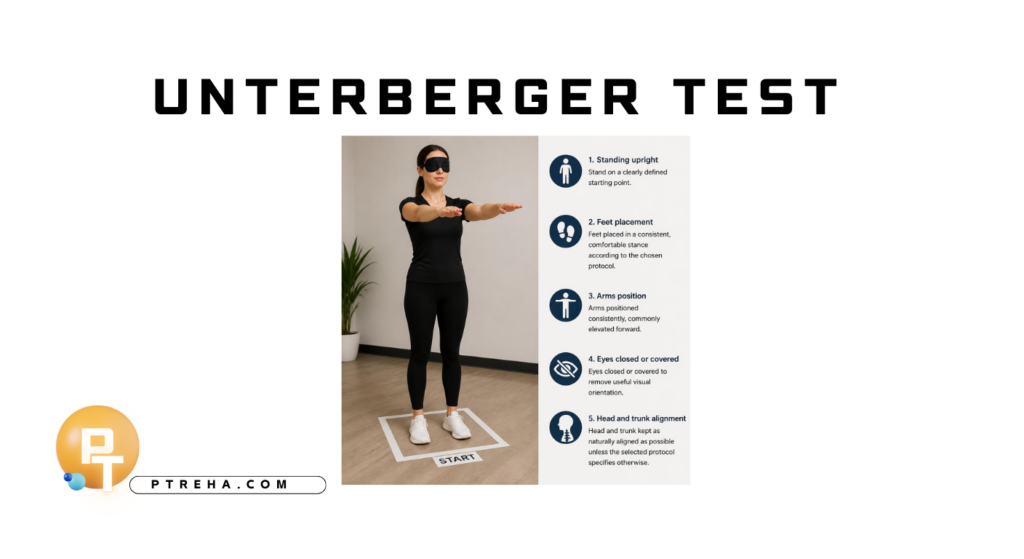
- Standing upright on a clearly defined starting point.
- Feet placed in a consistent, comfortable stance according to the chosen protocol.
- Arms positioned consistently, commonly elevated forward.
- Eyes closed or covered to remove useful visual orientation.
- Head and trunk kept as naturally aligned as possible unless the selected protocol specifies otherwise.
One published research protocol used the subject standing in a neutral position with the arms elevated approximately 90 degrees, followed by stepping in place for 60 seconds at a standardized cadence.
This is one research protocol, not a universal requirement for every clinical version of the test.
Examiner Position
- Stand near the patient, preferably slightly to the side or behind, where balance loss can be detected quickly.
- Maintain an unobstructed view of the feet, trunk, and direction of body rotation.
- Avoid unnecessary conversation or environmental cues that could provide orientation.
- Use consistent instructions between trials.
- Have a clearly defined starting position and method for recording the final position.
A quiet, visually noninformative environment is traditionally used because external sensory cues can influence the performance.
How to Perform the Unterberger Test
Because protocols vary, the following is a representative clinical approach based on commonly described eyes-closed stepping procedures.
- Explain the task and confirm that the patient can perform it safely.
- Place the patient in the standardized starting position.
- Remove visual orientation by asking the patient to close the eyes or use an appropriate blindfold according to the selected protocol.
- Ask the patient to step in place while maintaining the instructed posture and arm position.
- Use the predetermined stepping duration or number of steps consistently.
- Avoid giving feedback about the patient’s direction of movement during the test.
- Observe the direction and amount of body rotation, displacement from the starting position, stepping consistency, and any obvious balance loss.
- At the end of the protocol, record the final position and orientation according to the clinic’s chosen measurement method.
- When repeat testing is clinically appropriate, reproduce the same protocol as closely as possible.
A 2023 experimental study used a 60-second blindfolded stepping protocol with a cadence of approximately 60–80 steps per minute and measured both final position and angular orientation.
Other clinical protocols use different step counts, demonstrating why the exact protocol should be recorded rather than assumed.
Interpretation of the Unterberger Test
The most useful observations are descriptive rather than simply labeling the test “positive” or “negative.”
The examiner may document:
- Direction of rotation.
- Amount of rotation.
- Forward, backward, or lateral displacement.
- Changes in stepping symmetry or consistency.
- Loss of balance or inability to complete the task.
- Whether the finding is reproducible under the same testing conditions.
A visible turn or displacement can indicate an asymmetry in the sensory-motor processes used to maintain orientation without visual input.
However, it does not establish that the vestibular apparatus is the cause of the deviation.
“An observed turning response is a clinical finding, not a diagnosis.”
Healthy individuals can demonstrate measurable rotation or displacement during the test, and the magnitude of the response can vary between individuals and between repeated trials.
What Does a Marked Turning Response Mean?
A marked or clearly reproducible turn may justify closer examination of vestibular, neurological, sensory, and musculoskeletal contributors, particularly when it occurs together with symptoms or other examination findings.
Historically, clinicians have associated turning toward one side with unilateral vestibular dysfunction on that side.
However, this relationship is not sufficiently consistent to use direction of rotation by itself to localize a vestibular lesion.
In a study of patients with unilateral vestibular lesions, deviation toward the lesion side occurred in only a proportion of participants, while others deviated toward the intact side or remained within the study’s reference range.
The result should therefore be integrated with the patient’s history and other examination findings rather than used as a lesion-localization rule.
Anatomy Involved in the Unterberger Test
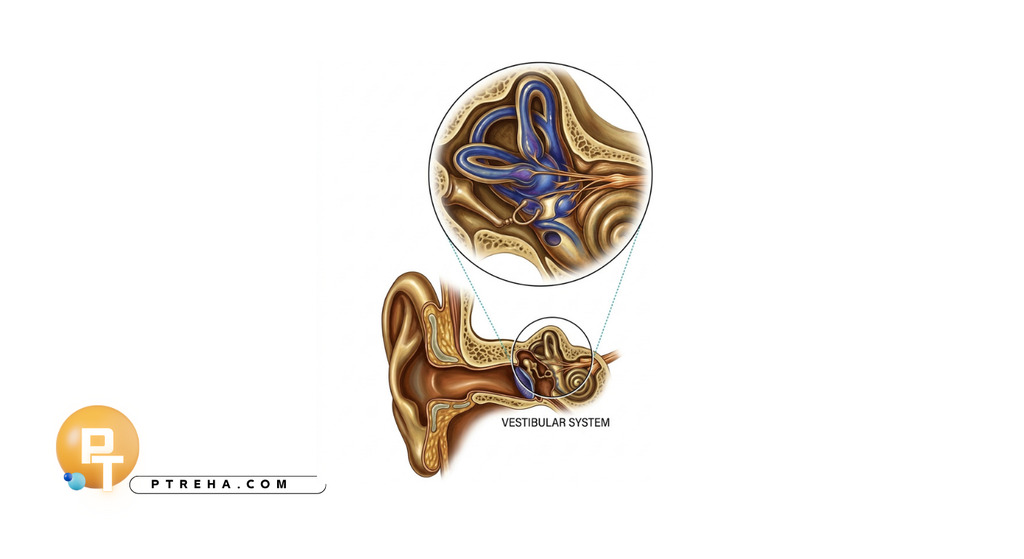
- Vestibular apparatus of the inner ear: provides information related to head motion and orientation.
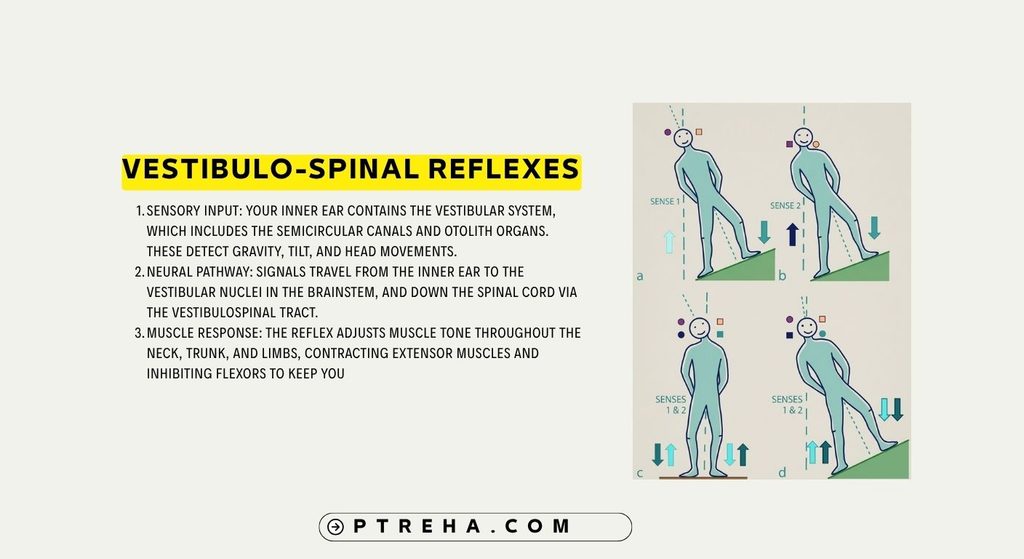
- Vestibular pathways in the central nervous system: transmit and integrate vestibular information involved in postural control.
- Proprioceptive systems: provide information from the feet, ankles, lower limbs, trunk, and other body regions.
- Visual system: is intentionally reduced during the test, changing the sensory information available for orientation.
- Central motor and postural control systems: coordinate the stepping response and maintain the body’s orientation.
- Lower-limb and trunk musculature: contributes to the ability to repeatedly step and maintain upright stability.
The Unterberger Test does not isolate any single muscle, nerve, ligament, vestibular organ, or brain structure.
Its performance represents the combined effect of multiple sensory and motor systems.
Conditions Detected / Associated With the Test
The test should be described as associated with clinical assessment rather than as a diagnostic test.
- Peripheral vestibular disorders may influence performance.
- Unilateral vestibular dysfunction can produce asymmetrical stepping responses in some patients.
- Balance disturbances from other sensory or motor causes can also influence the result.
- Musculoskeletal asymmetry, lower-limb differences, altered proprioception, and habitual movement patterns may affect stepping behavior.
- Normal individuals may also demonstrate measurable rotation or displacement.
For these reasons, an abnormal stepping pattern is not specific for a peripheral vestibular lesion.
Clinical Significance
- It can provide an additional observation of orientation during stepping without visual reference.
- The direction and consistency of a response may be clinically interesting when considered alongside other findings.
- Repeated testing is more meaningful when the protocol and environmental conditions are kept consistent.
- Unexpected findings can prompt a broader examination rather than a direct diagnostic conclusion.
- The test should not replace established vestibular or neurological assessments when those are clinically indicated.
The American Physical Therapy Association’s vestibular clinical practice guideline emphasizes appropriate examination and outcome-measure selection for patients with peripheral vestibular hypofunction, while military vestibular clinical guidance specifically reports that Fukuda stepping has poor utility for detecting unilateral peripheral deficits and should not be used as a screening test.
Sensitivity and Specificity
Reliable universal sensitivity and specificity values for the Unterberger/Fukuda stepping test are not established across populations and protocols.
A study involving 736 patients with chronic dizziness compared Fukuda stepping performance with caloric testing and found poor screening performance for peripheral vestibular asymmetry.
Other studies have also reported inconsistent relationships between stepping deviation and the affected side.
These findings argue against applying a single sensitivity, specificity, or cutoff value to all patients.
Diagnostic Accuracy
The diagnostic accuracy of the Unterberger Test is limited and strongly dependent on the population, protocol, and reference test used.
Evidence has repeatedly questioned its ability to identify or localize unilateral peripheral vestibular dysfunction reliably.
A turning response should therefore be interpreted as one component of clinical assessment, not as confirmation of a vestibular diagnosis.
Common Mistakes in Unterberger Test
- Treating a particular degree of rotation as a universal abnormal cutoff.
- Assuming that turning toward one side automatically identifies the side of vestibular pathology.
- Changing the arm position, stepping cadence, duration, or instructions between examinations.
- Allowing visual, auditory, or environmental cues to influence orientation.
- Failing to guard a patient who may lose balance.
- Interpreting normal variation as evidence of pathology.
- Using the test as a standalone vestibular screening or diagnostic procedure.
- Ignoring musculoskeletal, proprioceptive, neurological, and movement-related contributors to the observed deviation.
- Reporting only “positive” or “negative” without describing the actual behavior observed.
Research has demonstrated variability even among individuals without known vestibular dysfunction, making overly rigid interpretation particularly problematic.
Tips for Performing the Unterberger Test
- Choose one protocol and use it consistently.
- Document the duration or number of steps used.
- Keep arm position and starting stance consistent.
- Minimize external orientation cues.
- Clearly define the starting location.
- Guard the patient closely enough to manage unexpected loss of balance.
- Record both rotation and displacement rather than relying on direction alone.
- Consider whether pain, weakness, joint restriction, sensory impairment, or gait asymmetry could affect the result.
- Interpret the observation together with the patient’s history and other clinical findings.
- Avoid using a single stepping response to make a diagnosis or localize a lesion.
Summary
- The Unterberger Test is a vestibular/neurological clinical performance assessment involving repeated stepping with visual input reduced or removed.
- The clinician observes rotation, displacement, stepping behavior, and balance, rather than testing one anatomical structure in isolation.
- Protocols vary, so the selected procedure should be standardized and documented.
- A turning response can occur in people with vestibular disorders, but it can also occur in individuals without vestibular pathology.
- Current evidence does not support the test as a reliable standalone diagnostic or screening test for unilateral peripheral vestibular dysfunction.
The Unterberger Test can still be useful as a descriptive clinical observation when performed safely and interpreted cautiously.
Its greatest value comes from placing the stepping behavior in the context of the patient’s symptoms, functional presentation, and broader neurological and vestibular examination.
Resources and External References
- PubMed — Test–retest reliability of the Fukuda Stepping Test
- PubMed — Reliability of the Fukuda Stepping Test to Determine the Side of Vestibular Dysfunction
- PubMed — Fukuda Stepping Test: Sensitivity and Specificity
- PMC — Utility of Stepping, Walking and Head Impulses for Screening Patients for Vestibular Impairments
- Frontiers in Neurology — Test–re-test reliability and dynamics of the Fukuda–Unterberger stepping test
- RehabMeasures Database — Fukuda Stepping Test (Unterberger Step Test)
- APTA — Vestibular Rehabilitation for Peripheral Vestibular Hypofunction Clinical Practice Guideline