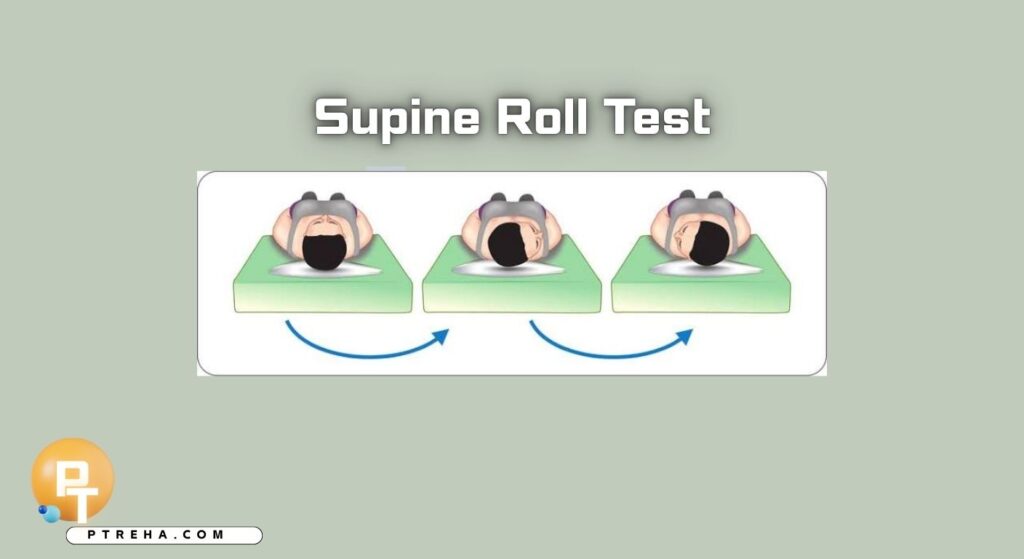
The Supine Roll Test, also called the supine head-roll test or Pagnini–McClure test, is a diagnostic positional maneuver used to assess the horizontal semicircular canals when horizontal-canal BPPV is suspected.
The test is performed with the patient lying supine while the head is turned from side to side and the clinician observes for positional nystagmus and associated vertigo or dizziness.
What Is the Supine Roll Test?
The Supine Roll Test is a clinical positional vestibular assessment, rather than an orthopedic, muscle, strength, or balance performance test.
Its principal clinical use is the assessment of horizontal semicircular canal BPPV.
In this condition, displaced otoconia can alter the normal response of the horizontal canal when the head changes position relative to gravity, producing characteristic positional nystagmus.
The important finding is usually direction-changing horizontal nystagmus when the head is turned to the right and left.
The nystagmus may be geotropic, meaning it beats toward the ground, or apogeotropic, meaning it beats away from the ground.
A patient’s report of dizziness or vertigo alone is not sufficient to interpret the maneuver as a specific horizontal-canal BPPV pattern.
Eye movement characteristics are central to the clinical interpretation.
Purpose of the Supine Roll Test
- Assess for positional nystagmus associated with suspected horizontal-canal BPPV.
- Help distinguish horizontal-canal involvement from posterior-canal presentations.
- Help identify whether the response is geotropic or apogeotropic.
- Assist with determining the more likely involved side when the nystagmus pattern is sufficiently clear.
- Provide information that can help guide subsequent clinical management and repositioning procedures.
The American Academy of Otolaryngology–Head and Neck Surgery recommends a supine roll test when a patient has a history compatible with BPPV and the Dix–Hallpike maneuver produces horizontal or no nystagmus.
Supine Roll Test Indications
The test may be considered when:
- The patient’s history suggests positional vertigo, particularly symptoms triggered by rolling in bed, lying down, or changing head position.
- Horizontal-canal BPPV is suspected clinically.
- The Dix–Hallpike maneuver does not demonstrate the expected posterior-canal pattern and produces horizontal or no nystagmus.
- A clinician needs to investigate the possibility of a lateral or horizontal semicircular canal presentation.
The test should be interpreted as one component of a broader vestibular examination rather than as an isolated diagnostic decision.
Supine Roll Test Contraindications and Precautions
There is not a single universally defined list of contraindications specific to the Supine Roll Test.
Instead, the clinician should consider whether the patient can safely tolerate supine positioning and controlled cervical rotation.
Relevant precautions include:
- Significant neck pain or a marked restriction in cervical rotation that would make the maneuver poorly tolerated.
- A known cervical or other medical condition in which the required head movement or positional change has not been established as safe.
- Severe symptoms during positional testing that create an immediate fall, transfer, or other safety concern.
- Patients who are medically unstable or unable to tolerate the examination position.
The required movement should be modified or the examination deferred when the patient’s medical or musculoskeletal status makes positional testing unsafe.
Clinical judgment and the patient’s individual precautions take precedence over rigid application of a testing protocol.
Patient Position
A commonly used setup places the patient:
- Lying comfortably in a supine position on an examination table.
- With the head supported so that cervical movement can be controlled.
- With the head and upper body positioned according to the selected clinical protocol; published protocols differ somewhat in the amount of head flexion or upper-body elevation used.
- With both sides tested using a comparable head movement so that the nystagmus responses can be meaningfully compared.
Some protocols use slight upper-body elevation or head positioning intended to optimize the orientation of the horizontal canals.
Because protocols vary, clinicians should use a recognized technique consistently rather than mixing components from different procedures.
Examiner Position
The examiner should:
- Stand or sit near the patient’s head.
- Maintain good control of the head during rotation.
- Observe the patient’s eyes carefully throughout the maneuver.
- Monitor the patient’s symptoms and general tolerance.
- Maintain a consistent movement pattern on both sides.
- Use Frenzel lenses or video-oculography when available and appropriate because visual fixation can make positional nystagmus more difficult to observe at the bedside.
The examiner should pay particular attention to direction, timing, and relative intensity of the nystagmus rather than simply documenting whether dizziness occurred.
How to Perform the Supine Roll Test
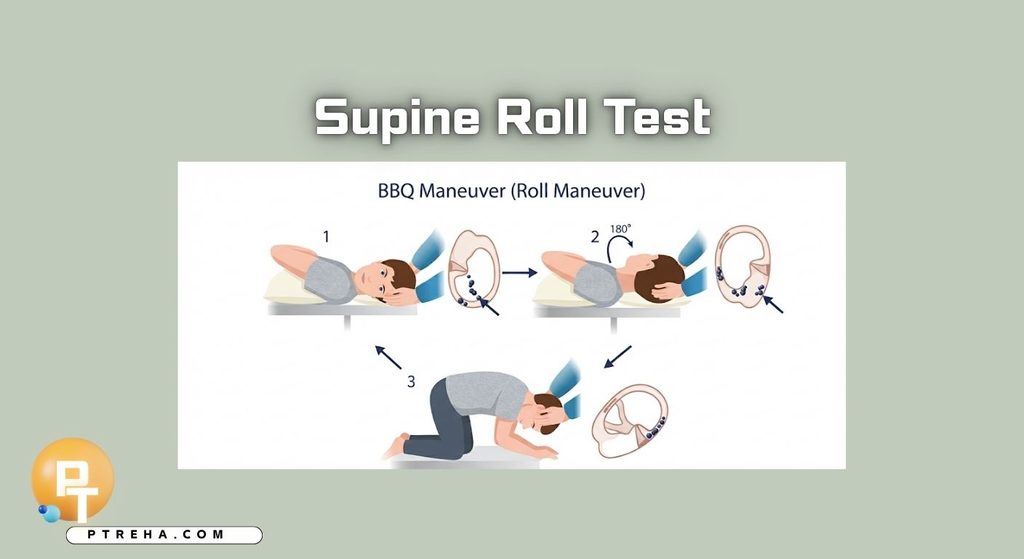
One commonly used bedside approach is:
- Explain that brief dizziness or visual disturbance may occur and that the patient should report significant discomfort.
- Place the patient supine with the head supported in the selected standardized position.
- Observe the eyes in the initial position to establish a baseline.
- Turn the patient’s head briskly but under control toward one side.
- Observe for the onset, direction, and character of horizontal nystagmus and ask whether the patient experiences vertigo or dizziness.
- Return the head toward neutral and allow the response to settle sufficiently for the next comparison.
- Turn the head toward the opposite side using a comparable movement.
- Compare the nystagmus response on the two sides.
- Document the direction of the fast phase, whether the response is geotropic or apogeotropic, the relative strength of the response, and the patient’s symptoms.
The exact head-turn angle and degree of upper-body elevation differ among published protocols, so consistency between sides is more important than presenting one numerical setup as universally required.
“For the Supine Roll Test, the direction of the eyes often tells you more than the patient’s report of dizziness alone.”
What Constitutes a Positive Test?
For horizontal-canal BPPV, a clinically characteristic response is direction-changing horizontal positional nystagmus when the head is turned to either side.
Two major patterns are described:
Geotropic response: the horizontal fast phase beats toward the ground with the head turned to each side.
Apogeotropic response: the horizontal fast phase beats away from the ground with the head turned to each side.
The presence of positional vertigo can support the clinical picture, but the nystagmus pattern is an essential part of interpretation.
The terms “positive” and “negative” should therefore not replace a detailed description of the actual eye movement.
What Does a Positive Supine Roll Test Mean?
A typical geotropic or apogeotropic direction-changing horizontal nystagmus pattern supports a clinical diagnosis of horizontal-canal BPPV when it fits the patient’s history and the rest of the examination.
It does not mean that every horizontal nystagmus response is automatically caused by BPPV.
In the geotropic variant, the more intense response is commonly used to identify the involved side.
The head position producing the stronger geotropic nystagmus is generally interpreted as corresponding to the affected side.
In the apogeotropic variant, the relationship is generally reversed: the weaker response may indicate the affected side, while the stronger response occurs when the head is turned away from the involved side.
However, side localization can be difficult when responses are symmetrical, weak, atypical, or influenced by the location of otoconia within the canal.
Research has shown that the observed response can also be affected by the sequence of testing and the initial position of canaliths.
Negative Supine Roll Test
A Supine Roll Test that does not provoke the characteristic horizontal direction-changing nystagmus does not, by itself, establish that the patient has no vestibular disorder.
The result may be negative despite a compatible history, particularly when symptoms are intermittent, the response is difficult to visualize, or another BPPV canal or another cause of dizziness is involved.
Clinical interpretation should therefore consider the complete examination, including the history and appropriate positional testing of other canals.
Anatomy Involved in Supine Roll Test
Relevant structures and systems include:
- Horizontal semicircular canals, which detect angular head motion.
- Ampullae and cupulae, which are involved in transducing head movement into vestibular neural signals.
- Utricle, from which otoconia may become displaced in BPPV.
- Vestibular nerve pathways, which transmit vestibular information toward the brainstem.
- Vestibulo-ocular reflex pathways, which generate compensatory eye movements that can become visible as positional nystagmus.
- Extraocular motor system, responsible for the observed direction of eye movement.
The test does not mechanically isolate one anatomical structure in the way a tissue-specific orthopedic test might be described.
Its findings reflect the integrated response of the vestibular system to a positional stimulus.
Conditions Detected / Associated With the Test
The Supine Roll Test is principally associated with:
- Horizontal-canal BPPV, geotropic type, commonly associated with canalithiasis.
- Horizontal-canal BPPV, apogeotropic type, commonly associated with cupulolithiasis, although the underlying mechanism is not always this simple.
- Other positional nystagmus patterns that may require further vestibular or neurological assessment.
Importantly, an atypical positional response should not simply be forced into a horizontal-canal BPPV diagnosis.
Central positional nystagmus and other vestibular conditions can produce positional eye movements, making clinical context essential.
Clinical Significance
- The test helps identify horizontal-canal involvement when BPPV is suspected.
- The geotropic or apogeotropic pattern can provide information about the likely BPPV subtype.
- Comparison of responses between sides can assist with lateralization.
- The findings can help the clinician select an appropriate repositioning strategy.
- Repeating the assessment can help determine whether the previously observed positional response persists after management.
- Atypical findings can indicate the need for a broader vestibular or neurological assessment rather than repeated treatment based on an uncertain diagnosis.
“The Supine Roll Test is most useful when the nystagmus pattern is interpreted in context rather than in isolation.”
Common Mistakes in Supine Roll Test
- Testing only one side and assuming the response is sufficient for lateralization.
- Focusing on dizziness while failing to observe the eyes.
- Using substantially different head movements on the two sides.
- Treating every horizontal nystagmus response as evidence of horizontal-canal BPPV.
- Assuming that the stronger response always identifies the affected side regardless of whether the pattern is geotropic or apogeotropic.
- Ignoring an atypical or poorly localized response.
- Presenting one exact head angle or positioning method as the only valid version of the maneuver.
- Immediately interpreting an absent nystagmus response as proof that no BPPV or vestibular problem exists.
Tips for Performing the Supine Roll Test
- Explain the maneuver before moving the head.
- Use a consistent technique from one side to the other.
- Observe the eyes continuously during the positional change and while the head is maintained in the test position.
- Record the direction-changing pattern, not merely “dizzy” or “not dizzy.”
- Distinguish carefully between geotropic and apogeotropic responses.
- Compare the intensity of the nystagmus only when the head movement and testing conditions are reasonably comparable.
- Use video-oculography or other appropriate visual enhancement when the response is subtle.
- When lateralization is uncertain, combine the roll-test findings with other positional tests and the broader clinical examination instead of forcing a side determination.
Sensitivity and Specificity
Published studies have examined the diagnostic and lateralization performance of the Supine Roll Test, but reported estimates depend on the population, reference standard, testing protocol, and the specific outcome being studied.
A single universal sensitivity or specificity value should therefore not be applied to every clinical setting.
Studies of affected-side lateralization have also demonstrated that performance can vary with the clarity and asymmetry of the elicited nystagmus.
Diagnostic Accuracy
Diagnostic accuracy should not be confused with examiner reliability or the usefulness of the test in clinical practice.
The Supine Roll Test is an important component of the assessment of suspected horizontal-canal BPPV, but diagnosis depends on the patient’s history, positional findings, eye-movement pattern, and exclusion of alternative explanations when the presentation is atypical.
Current clinical guidance specifically emphasizes differentiating BPPV from other causes of dizziness, vertigo, and imbalance.
Summary
- The Supine Roll Test is a positional vestibular assessment used primarily to evaluate suspected horizontal-canal BPPV.
- The key observation is direction-changing horizontal positional nystagmus during head rotation to each side.
- Geotropic nystagmus beats toward the ground, while apogeotropic nystagmus beats away from the ground.
- The relative intensity of the response can assist with side localization, but it should not be treated as an infallible rule.
- The test does not independently explain every cause of positional dizziness, and atypical findings require broader clinical reasoning.
The Supine Roll Test is most valuable when performed consistently and interpreted as part of a complete vestibular examination.
Accurate observation of the nystagmus pattern, careful side-to-side comparison, and recognition of the test’s limitations are more important than relying on a simplified “positive versus negative” label.
Resources and External Links
American Academy of Otolaryngology–Head and Neck Surgery — Clinical Practice Guideline: Benign Paroxysmal Positional Vertigo (Update)
Clinical Practice Guideline: Benign Paroxysmal Positional Vertigo (Update)
Bárány Society — Classification of vestibular signs and examination techniques
Bárány Society Consensus on Nystagmus and Vestibular Examination Techniques
American Academy of Otolaryngology–Head and Neck Surgery — BPPV Guideline Summary
AAO-HNS BPPV Guideline Summary
Interdisciplinary guidance paper on diagnosis and treatment of vertigo and dizziness
Diagnosis and treatment of vertigo and dizziness — Interdisciplinary guidance paper
Review of BPPV treatment and horizontal-canal BPPV patterns
Treatment of Benign Paroxysmal Positional Vertigo — Clinical Review
Study of factors affecting bedside lateralization in horizontal-canal BPPV
Determinants for bedside lateralization of horizontal-canal BPPV