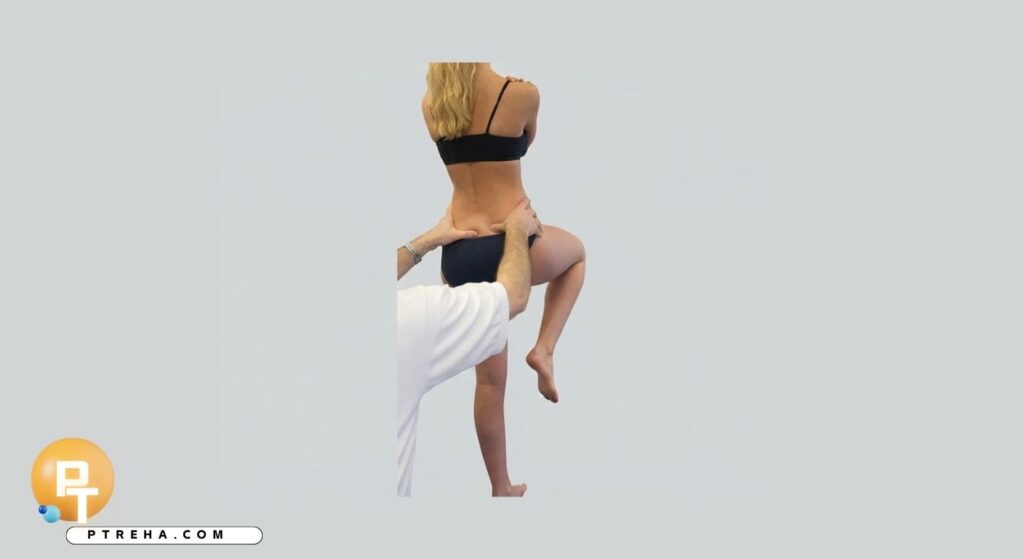
The Stork Test is a standing clinical assessment commonly used to observe relative movement of the pelvis during single-leg hip flexion. It is also known as the Gillet Test or March Test when referring to the sacroiliac joint movement assessment. Because the test depends on palpation of small pelvic movements, its findings should be interpreted cautiously and considered alongside the patient’s symptoms, functional presentation, and other examination findings.
What Is the Stork Test?
In physical therapy, the Stork Test commonly refers to the Gillet Test, a palpatory movement assessment performed in standing. The examiner observes the relative movement of the posterior superior iliac spine (PSIS) and sacral region while the patient flexes one hip.
The test has traditionally been used to assess apparent movement of the innominate bone relative to the sacrum during single-leg stance. However, the sacroiliac joint has relatively small physiological movement, and research has raised important questions about whether clinicians can reliably palpate that movement through the test.
The term Stork Test is also used for a different maneuver involving single-leg standing with spinal extension, historically described in the assessment of possible pars interarticularis stress or spondylolysis. These two procedures should not be treated as interchangeable.
For this article, the Stork Test refers to the Gillet/Stork sacroiliac movement test.
Purpose of the Stork Test
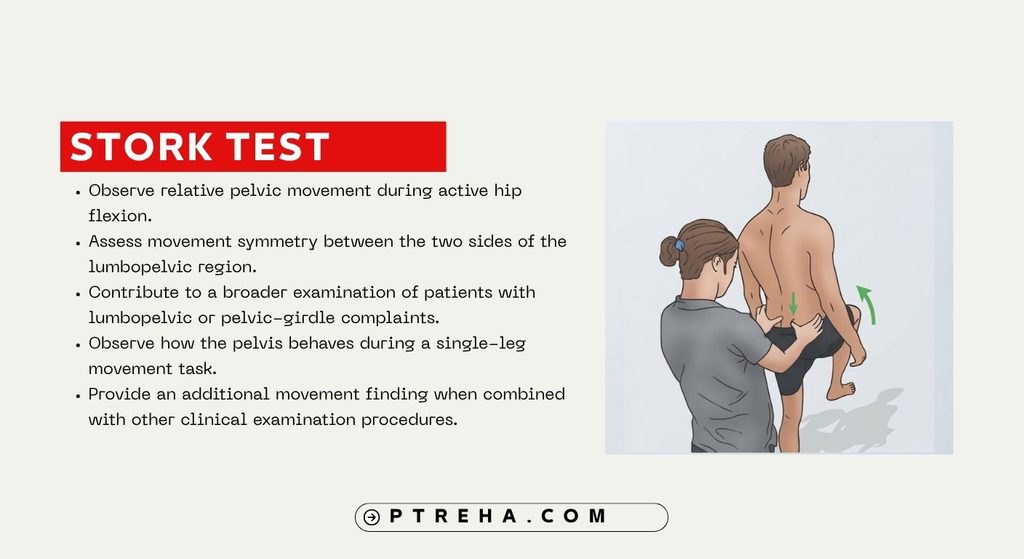
The Stork Test may be used to:
- Observe relative pelvic movement during active hip flexion.
- Assess movement symmetry between the two sides of the lumbopelvic region.
- Contribute to a broader examination of patients with lumbopelvic or pelvic-girdle complaints.
- Observe how the pelvis behaves during a single-leg movement task.
- Provide an additional movement finding when combined with other clinical examination procedures.
It should not be considered a direct measurement of sacroiliac joint mobility.
A palpated difference between sides may reflect several factors, including the patient’s balance strategy, hip movement, trunk movement, pelvic rotation, muscular control, examiner technique, and anatomical variation.
Stork Test Indications
The test may be considered as part of an examination when the clinician is assessing:
- Lumbopelvic movement in a patient with relevant symptoms.
- Pelvic-girdle movement during single-leg loading.
- Movement asymmetry observed during standing or gait-related activities.
- Changes in movement strategy during rehabilitation.
- A broader clinical presentation in which sacroiliac-region assessment is relevant.
The Stork Test should be selected because it contributes useful information to the examination, rather than because a presumed sacroiliac abnormality must be confirmed.
Stork Test Contraindications and Precautions
There is no universally established list of Stork Test-specific contraindications. General clinical safety considerations should guide whether the maneuver is appropriate.
Use appropriate caution when:
- The patient cannot safely maintain standing balance.
- Single-leg loading substantially increases the patient’s symptoms.
- The patient has an acute injury or condition for which unsupported single-leg loading is inappropriate.
- The patient is at increased risk of falling.
- The movement requires a level of hip or spinal motion that the patient cannot comfortably perform.
- The clinician cannot safely position or support the patient.
A stable environment and appropriate guarding are particularly important when balance is impaired.
Patient Position
For the commonly described Gillet/Stork procedure:
- The patient stands upright with the feet positioned comfortably and weight initially distributed between both lower limbs.
- The patient faces forward and attempts to maintain an upright trunk.
- The examiner asks the patient to flex one hip and lift the corresponding knee.
- The movement should be performed in a controlled manner rather than rapidly.
- The examiner may repeat the procedure on the opposite side for comparison.
The exact foot position, amount of hip flexion, and movement instructions can vary between descriptions of the test. The clinician should therefore use a consistent protocol when comparing findings.
Examiner Position
The examiner generally:
- Stands behind the patient.
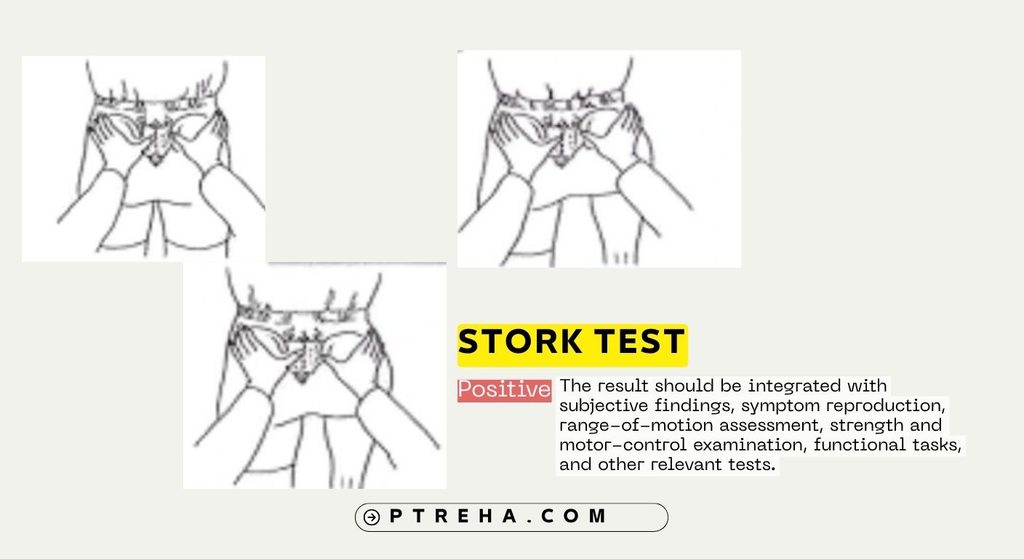
- Places one thumb over the PSIS on the side being examined.
- Places the other thumb over a standardized sacral landmark, commonly described around the sacral base or S2 region.
- Observes the relative movement of the two palpation landmarks while the patient flexes the hip.
- Repeats the assessment on the opposite side when appropriate.
Accurate identification of anatomical landmarks is important because the interpretation depends heavily on what the examiner believes they are palpating.
How to Perform the Stork Test
- Ask the patient to stand comfortably and safely.
- Position yourself behind the patient.
- Identify the PSIS on the side being assessed.
- Identify the corresponding sacral reference point.
- Place the thumbs over the selected landmarks.
- Ask the patient to lift the knee on the side being assessed by flexing the hip.
- Observe the relative movement between the PSIS and sacral reference point.
- Repeat on the opposite side.
- Record the observed movement and any symptom response.
- Interpret the finding in conjunction with the rest of the physical examination.
The traditional interpretation assumes that hip flexion produces a relative posterior/inferior movement of the ipsilateral innominate or PSIS in relation to the sacrum. However, clinicians should avoid treating a palpated difference as proof of restricted sacroiliac motion.
Interpretation
The Stork Test is better understood as a movement-palpation assessment than as a stand-alone diagnostic test.
An apparent asymmetry or reduced movement may indicate that the patient’s lumbopelvic movement strategy differs between sides during the task. It does not establish the presence of sacroiliac joint dysfunction, a positional fault, hypomobility, instability, or a specific pain generator.
Several factors can affect the observed movement, including:
- Hip mobility.
- Trunk position.
- Balance.
- Pelvic rotation.
- Lower-limb loading.
- Muscle coordination.
- Guarding because of pain.
- Examiner palpation technique.
- Difficulty identifying anatomical landmarks.
- Normal anatomical variation.
Research has specifically questioned whether the small amount of sacroiliac movement can be accurately detected through palpation during the Stork/Gillet procedure.
“A palpated movement difference is a clinical finding, not a diagnosis.”
Anatomy Involved in Stork Test
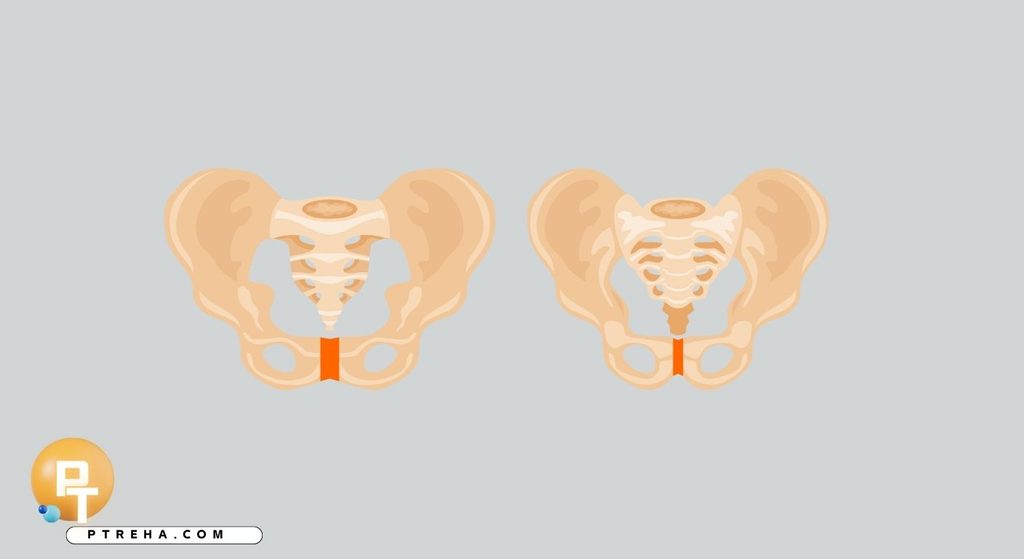
Relevant structures and systems include:
- Posterior superior iliac spine (PSIS): A palpable bony landmark of the ilium used as one of the principal reference points.
- Sacrum: Provides the second reference region for observing relative pelvic movement.
- Sacroiliac joint: The test is traditionally interpreted in relation to relative movement between the innominate and sacrum.
- Hip joint: Active hip flexion is required to perform the maneuver.
- Lumbopelvic musculature: Trunk and pelvic muscles contribute to maintaining posture and controlling movement.
- Lower-limb and postural control systems: Single-leg loading requires coordination of balance and weight transfer.
The test does not isolate the sacroiliac joint or any individual muscle. The observed movement is produced by coordinated movement of multiple body segments and systems.
Conditions Detected / Associated With the Test
The Stork/Gillet Test should not be described as independently detecting a specific disorder.
It may be included in assessment of patients presenting with:
- Pelvic-girdle symptoms.
- Lumbopelvic movement impairments.
- Symptoms in which sacroiliac-region assessment forms part of the differential examination.
- Movement asymmetry during single-leg tasks.
Evidence concerning its ability to identify sacroiliac joint pain or dysfunction is limited. In a study evaluating clinical tests against MRI findings in people with non-radiographic axial spondyloarthritis, functional tests including the Stork Test performed less well than pain-provocation tests for identifying sacroiliac joint inflammation.
This reinforces an important clinical distinction: movement observation is not equivalent to diagnosis of joint pathology.
Clinical Significance
The Stork Test can still have a role in clinical examination when its limitations are understood.
Its findings may help the therapist:
- Compare movement strategies between limbs.
- Identify a movement that warrants further assessment.
- Observe how the patient controls the pelvis during single-leg loading.
- Compare movement before and after an intervention when the same protocol is consistently applied.
- Decide whether additional hip, lumbar, pelvic, balance, or functional testing is appropriate.
The result should be integrated with subjective findings, symptom reproduction, range-of-motion assessment, strength and motor-control examination, functional tasks, and other relevant tests.
Clinical guidelines and contemporary evidence reviews emphasize that motion tests such as the Gillet/Stork Test have limitations when used to identify sacroiliac joint pain or pathology. No single physical examination maneuver should be used in isolation to establish the source of sacroiliac-region pain.
Sensitivity and Specificity
Reported diagnostic values for the Stork/Gillet Test should not be treated as universal.
Different studies have examined different populations, reference standards, protocols, and definitions of an abnormal finding. A systematic review of palpatory sacroiliac mobility tests found substantial variability across studies and concluded that further research is needed to establish validity. Importantly, the review found no concurrent-validity study that adequately established that these palpatory tests accurately measure the movement they are intended to assess.
Consequently, a single sensitivity or specificity figure should not be presented as the general diagnostic performance of the Stork Test.
Diagnostic Accuracy
The Stork/Gillet Test does not have sufficiently established stand-alone diagnostic accuracy to justify using it to diagnose sacroiliac joint dysfunction or to identify a specific pain source.
A systematic review of sacroiliac mobility tests identified limitations in both reliability and validity. More recent clinical guidance also distinguishes motion tests such as the Gillet Test from pain-provocation procedures and notes that physical examination findings alone may not reliably distinguish different sources of sacroiliac-region pain.
Therefore, an abnormal Stork Test should be treated as one clinical observation, not a diagnostic endpoint.
Reliability and Validity
Reliability and validity are particularly important considerations for this assessment.
The Stork/Gillet Test requires the examiner to palpate and interpret relatively small movements. Research has demonstrated variable reliability, and a systematic review and meta-analysis reported moderate pooled intra-examiner agreement for the Gillet Test while emphasizing that further evidence is required to establish validity.
This distinction matters clinically:
- Reliability asks whether the finding can be reproduced consistently.
- Validity asks whether the test actually measures what it claims to measure.
- Good reproducibility, by itself, does not establish diagnostic validity.
The test can therefore be performed consistently without necessarily proving that the palpated movement represents true sacroiliac joint mobility.
Common Mistakes in Stork Test
- Treating the test as a definitive diagnostic test.
- Assuming that asymmetrical movement automatically indicates pathology.
- Assuming that minimal PSIS movement proves sacroiliac hypomobility.
- Using inconsistent palpation landmarks between sides.
- Allowing excessive trunk rotation during the movement.
- Ignoring balance limitations.
- Failing to consider hip mobility or motor-control strategies.
- Using different movement instructions on the two sides.
- Recording an uncertain palpation finding as definitely abnormal.
- Interpreting the result without considering the patient’s symptoms.
One particularly important error is confusing observed pelvic movement with direct measurement of sacroiliac joint motion.
Tips for Performing the Stork Test
- Use clearly identified and consistent anatomical landmarks.
- Give the patient the same movement instructions on both sides.
- Allow the patient to perform the movement in a controlled manner.
- Minimize unnecessary trunk movement.
- Provide appropriate guarding if balance is limited.
- Observe the whole movement rather than relying exclusively on thumb displacement.
- Record the patient’s symptom response separately from the movement finding.
- Repeat the assessment only when repetition is clinically useful.
- Use the same protocol when comparing findings over time.
- Combine the test with other appropriate clinical findings rather than interpreting it in isolation.
“The value of the Stork Test is greatest when it adds context to the examination—not when it is used to replace clinical reasoning.”
Stork Test and the Other “Stork Test”
The terminology deserves special attention because Stork Test can describe more than one clinical maneuver.
The Gillet/Stork Test described in this article involves standing and active hip flexion while the examiner palpates pelvic landmarks. It is primarily discussed as a sacroiliac or lumbopelvic movement assessment.
A different single-leg hyperextension maneuver has also been called the Stork Test and has historically been associated with assessment for possible pars interarticularis stress or spondylolysis.
These procedures have different purposes and should not be combined when documenting an examination. If the term “Stork Test” is used in clinical documentation or teaching, specifying Gillet/Stork Test or describing the actual maneuver helps avoid ambiguity.
Summary
- The Stork Test commonly refers to the Gillet Test, a standing palpatory assessment of relative pelvic movement during active hip flexion.
- It is a clinical movement assessment, not a stand-alone diagnostic test for sacroiliac joint dysfunction.
- The procedure involves palpating the PSIS and a sacral reference point while the patient lifts the corresponding knee.
- An apparent asymmetry or reduced movement does not establish a pathological sacroiliac joint or identify the source of pain.
- Reliability and validity limitations mean that the result should be interpreted cautiously and combined with the broader clinical examination.
The Stork Test can provide a useful movement observation when performed consistently and interpreted within context. For physiotherapists and students, its most important lesson is to distinguish what the test observes from what it can legitimately prove.
Resources
- Validity and Reliability of Palpatory Clinical Tests of Sacroiliac Joint Mobility — Systematic Review and Meta-analysis: Systematic review and meta-analysis
- Does the Gillet Test Assess Sacroiliac Motion or Asymmetric One-Legged Stance Strategies? Full-text research article
- Evaluation of the Ability of Physical Therapists to Palpate Intrapelvic Motion With the Stork Test: PubMed record
- Assessing Construct Validity of Clinical Tests for Sacroiliac Joint Inflammation: PubMed research record
- Consensus Practice Guidelines on Sacroiliac Joint Complex Pain: Clinical practice guideline
- Clinical Examination of the Sacroiliac Joint: Journal article