
functional outcome measures physical therapy and clinical outcome measures are related, but they are not interchangeable terms.
A functional test asks a patient to perform a task under defined conditions, while a clinical outcome measure is a standardized way of quantifying an outcome that matters to care – and it may be patient-reported, performance-based, or clinician-reported.
The important clinical point is that a single functional test, such as the Timed Up and Go, can also serve as a clinical outcome measure when it is standardized, scored, and repeated to track change.
What Do These Terms Actually Mean?
The phrase functional test usually describes the nature of the assessment: the patient performs a meaningful movement or activity and the clinician observes or measures the performance.
The task might involve walking, standing from a chair, stepping, reaching, changing direction, or maintaining balance.
A clinical outcome measure describes the purpose of measurement.
A measure is an instrument or procedure used to quantify an outcome or construct, such as physical function, mobility, pain interference, activity limitation, or participation-related difficulty.
APTA describes standardized outcome measures as tools that can quantify patient status before, during, and after an episode of care, and notes that measures may be self-report or performance-based.
- Functional test = task-oriented performance assessment.
- Clinical outcome measure = standardized measurement used to quantify an outcome.
- A functional test can be an outcome measure when it has defined administration, scoring, and interpretation.
- Not every clinical test is an outcome measure; some are used mainly to identify impairments or inform examination.
Why the Terms Are Often Confused
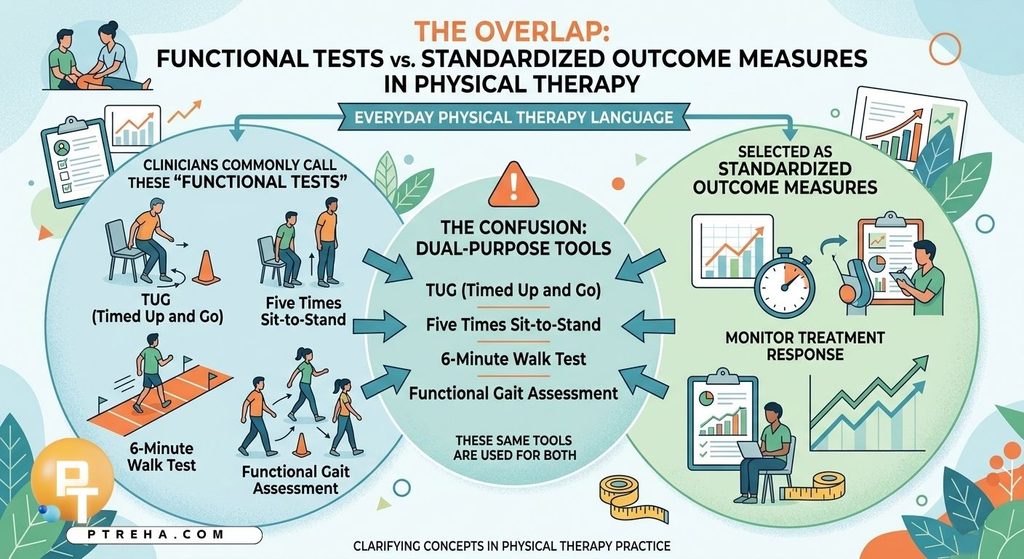
The confusion comes from overlap in everyday physical therapy language.
Clinicians commonly call tools such as the TUG, Five Times Sit-to-Stand, 6-Minute Walk Test, or Functional Gait Assessment “functional tests,” yet these same tools may be selected as standardized outcome measures to monitor treatment response.
COSMIN methodology explicitly includes performance-based outcome measurement instruments alongside patient-reported and clinician-reported instruments.
In other words, performance-based measurement is one type of outcome measurement rather than a completely separate category.
- The same instrument can be a test during an examination and an outcome measure during follow-up.
- The label depends partly on what the clinician is trying to measure and document.
- A test can provide useful clinical information without being a validated outcome instrument.
- Calling something a “functional test” does not automatically prove that it is a good outcome measure for every population.
Functional Tests: What Do They Capture?
Functional tests focus on observable performance.
They can show how efficiently, safely, or successfully a patient performs a specified task under the test conditions, often using time, distance, repetitions, an ordinal score, or task completion as the outcome.
For example, the TUG asks the patient to stand from a chair, walk, turn, return, and sit.
Its score is a time, but the test also requires the clinician to pay attention to the movement task and the patient’s ability to complete it safely.
APTA places the TUG within the activity domain of the ICF and describes it as a functional assessment of mobility, balance, and fall-risk-related factors.
- TUG: time to complete a standardized mobility task.
- 6-Minute Walk Test: distance walked during a standardized walking test.
- Five Times Sit-to-Stand: time needed to complete repeated sit-to-stand performance.
- Functional Gait Assessment: structured observation of postural stability during walking tasks.
- Step-down or squat tasks: movement performance that may help describe functional capacity or movement behavior, but should not automatically be treated as an isolated diagnostic test.
Clinical Outcome Measures: What Do They Capture?
Clinical outcome measures are broader because they are defined by the outcome or construct being quantified, not simply by whether the patient performs a task.
A patient-reported measure may quantify pain interference or perceived physical function without a physical performance task, while a performance-based measure can quantify walking or transfer ability.
PROMIS Physical Function, for example, is a patient-reported outcome system that asks people to report how difficult or easy physical activities are.
The patient is describing perceived function rather than demonstrating the activity to an examiner.
- Patient-reported measures: symptoms, disability, perceived function, quality of life, or participation impact.
- Performance-based measures: observed task performance such as walking or transfers.
- Clinician-reported measures: structured ratings based on professional observation or examination.
- Device-based or instrumented measures: objective data collected through equipment when appropriate.
Functional Tests vs Clinical Outcome Measures: A Practical Comparison
The most useful distinction is therefore not “test versus measure” as if they were competing categories.
Instead, ask what the tool measures, who provides the information, how the result is scored, and how the result will be used in clinical decision-making.
| Feature | Functional test | Clinical outcome measure |
| Primary emphasis | Observed performance of a defined task | Quantification of a defined clinical outcome or construct |
| Typical respondent | Patient performs; clinician observes/measures | Patient, clinician, or patient performing a standardized task |
| Common outputs | Time, distance, repetitions, task score | Score, rating, time, distance, change score, or other standardized result |
| Examples | TUG, 6MWT, 5×STS, FGA | PROMIS PF, PSFS, TUG, 6MWT, other standardized instruments |
| Best use | Describe performance under test conditions | Track status, change, and outcomes using a defined measurement method |
| Key caution | Performance in the test setting is not identical to real-world activity | A valid instrument must fit the construct, population, setting, and purpose |
- Ask what construct the tool was designed to measure.
- Check whether the administration and scoring are standardized.
- Check whether the evidence matches the patient population and setting.
- Decide how the result will change your clinical reasoning or documentation.
How the Same Test Can Be Both
Consider the TUG.
During the initial examination, you may use it to characterize functional mobility and observe how the person rises, turns, walks, and sits.
When the same standardized procedure is repeated at planned follow-up points and the score is used to quantify change, it functions as a performance-based outcome measure.
The same principle applies to walking tests.
A 6-Minute Walk Test can be a performance assessment of walking capacity and, when standardized and repeated appropriately, an outcome measure for change in exercise or mobility-related function.
RehabMeasures describes the test as an objective measure of submaximal aerobic and functional walking capacity.
- Define the construct before choosing the test.
- Use the same administration method when comparing time points.
- Document relevant assistive devices, supervision, and test conditions.
- Interpret change in the context of measurement error and the population studied.
How to Choose the Right Measure in Practice
Start with the clinical question rather than the name of a familiar test.
COSMIN recommends first defining exactly what outcome or construct is being measured and then selecting an instrument whose content is relevant and comprehensive for that construct.
- Construct: Are you measuring pain, physical function, mobility, balance, endurance, disability, or participation?
- Population: Does evidence support use in the patient group and clinical context?
- Standardization: Are instructions, equipment, scoring, and timing clearly defined?
- Measurement properties: What is known about validity, reliability, measurement error, and responsiveness for the intended use?
- Feasibility: Is the tool practical for the setting, available time, staff, equipment, and patient tolerance?
- Interpretability: Can the result be understood in a clinically meaningful way for this patient?
APTA also emphasizes selecting standardized outcome measures that are relevant to the individual or population and have sound psychometric properties.
A measure should be useful for the clinical decision you are making, not simply easy to administer.
Why Using Both Types Can Be Valuable
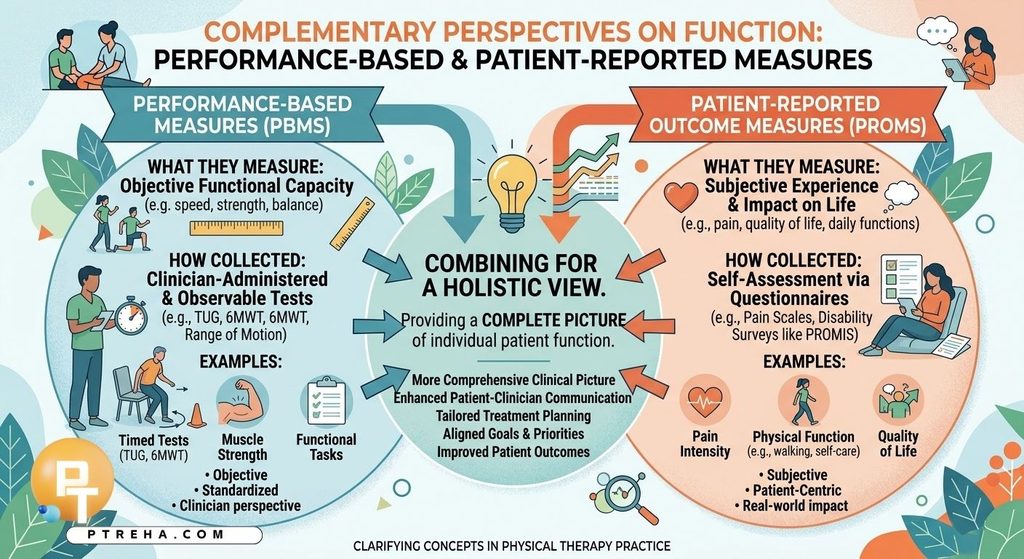
A patient’s demonstrated performance and the patient’s perception of function are related, but they are not identical.
Recent rehabilitation research comparing PROMIS Physical Function with common performance-based tests found associations between the two domains while also showing that each type provided complementary information.
- Performance-based results can show what happened during a standardized task.
- Patient-reported results can show difficulty, symptoms, and perceived impact in daily life.
- A mismatch between the two can be clinically informative rather than automatically indicating error.
- Using more than one measure can help avoid reducing a complex outcome to a single score.
For example, a person may improve on a walking test while continuing to report major difficulty with community mobility.
That pattern does not mean one measure is “wrong”; the measures may be addressing different aspects of function or different contexts of performance.
Common Clinical Mistakes to Avoid
Good measurement can be undermined by inconsistent administration or by using a score for a purpose it was not designed to answer.
The following errors are common reasons why a number can look precise while still being clinically misleading.
- Treating a functional test as a diagnosis by itself.
- Using an isolated performance score to infer the cause of a movement problem without sufficient examination.
- Changing instructions, equipment, assistance, or assistive devices between assessments without documenting the change.
- Applying a cutoff from one population to a different population as if it were universal.
- Assuming that improvement in a task automatically means improved participation or quality of life.
APTA’s TUG guidance, for instance, specifically notes that the TUG should not be used in isolation as a measure of fall risk in community-dwelling adults.
This illustrates a broader principle: a measurement result must be interpreted within the purpose, population, and context for which evidence exists.
Documentation and Interpretation: What Should You Record?
A useful note allows another clinician to understand exactly what was tested and whether the result is comparable with previous or future measurements.
Documentation is part of measurement quality, not an administrative afterthought.
- Name of the instrument and version when relevant.
- Purpose or construct being measured.
- Patient position and essential setup details.
- Assistive device, footwear, brace, orthosis, or level of assistance.
- Instructions and standardized procedure used.
- Score and units, such as seconds, meters, repetitions, or questionnaire points.
- Factors that could have influenced performance, such as pain, fatigue, cognition, or environmental constraints.
The WHO ICF framework is useful here because it separates body functions and structures from activities and participation while also recognizing environmental factors.
A standardized clinic task can inform activity-level assessment, but it should not automatically be documented as equivalent to the person’s performance in their usual environment.
The difference between functional tests and clinical outcome measures is mainly a difference in emphasis.
Functional tests are task-based assessments of observed performance, whereas clinical outcome measures are standardized instruments or procedures used to quantify a defined outcome; many functional tests belong to this second category when they are selected and administered as performance-based outcome measures.
In practice, the most defensible approach is to define the construct first, choose a measure supported for the patient and purpose, standardize its administration, and interpret it alongside the patient’s symptoms, goals, examination findings, and real-world function.
FAQ: Functional Tests vs Clinical Outcome Measures
Is every functional test a clinical outcome measure?
No.
A functional test can be used simply to observe or characterize performance during an examination.
It becomes an outcome measure when it is used as a standardized method for quantifying a defined outcome, particularly when the result is recorded and compared over time.
Is the Timed Up and Go a functional test or an outcome measure?
It can be both.
The TUG is a performance-based functional assessment of mobility, and it can also be selected as a standardized outcome measure for monitoring change when the same procedure is repeated appropriately.
Are patient-reported outcome measures better than functional tests?
They answer different questions.
A patient-reported measure captures the patient’s perspective, while a performance-based measure captures performance during a defined task.
The appropriate choice depends on the construct and clinical question.
Can a functional test diagnose a musculoskeletal condition?
A functional test generally contributes to the examination rather than establishing a diagnosis on its own.
The result should be integrated with history, physical findings, differential considerations, and the broader clinical reasoning process.
Why can a patient improve on a test but report no improvement?
The measures may be capturing different dimensions or contexts of function.
A person can perform a standardized task better while still experiencing pain, difficulty with a broader activity, or limitations in daily participation.
What makes an outcome measure clinically useful?
Useful measures have a clearly defined construct, appropriate evidence for the intended population and setting, acceptable measurement properties, practical administration, and interpretable results.
The measure should also fit the clinical decision it is intended to support.
Should I use the same functional test at every visit?
Not automatically.
Repeated measurement is useful when the test remains relevant to the clinical question and is administered consistently.
Frequency should reflect the patient, setting, goals, and expected rate of change rather than a universal rule.
Can I compare scores if the patient used a different assistive device?
Caution is needed.
A change in assistive device, level of assistance, environment, or instructions can change performance.
Record such differences clearly and avoid assuming that score differences represent treatment effects alone.
Do functional tests measure real-world function?
They measure performance under the conditions of the test.
Because real-world activity is influenced by environment, task demands, confidence, symptoms, and context, standardized test performance should be interpreted as one source of functional information rather than a complete representation of daily life.
What should I choose first: a functional test or a patient-reported measure?
Choose the measure that best matches the construct you need to quantify.
In many cases, a combination is appropriate because performance-based and patient-reported measures can provide complementary information about the same broad domain of function.
Resources
- APTA – Outcomes Measurement
- APTA – Initial Examination and Evaluation: Selecting Outcome Tools
- APTA – Timed Up and Go Test
- APTA – PROMIS Physical Function
- APTA – Patient Specific Functional Scale
- WHO – International Classification of Functioning, Disability and Health (ICF)
- COSMIN – Outcome Measurement Instruments
- COSMIN – Selecting the Most Suitable Measurement Instrument
- Shirley Ryan AbilityLab – 6 Minute Walk Test
- Recent rehabilitation study comparing PROMIS Physical Function with performance-based measures
Image note: Both figures are original diagrams created for this article; no external image license is required for the illustrations.