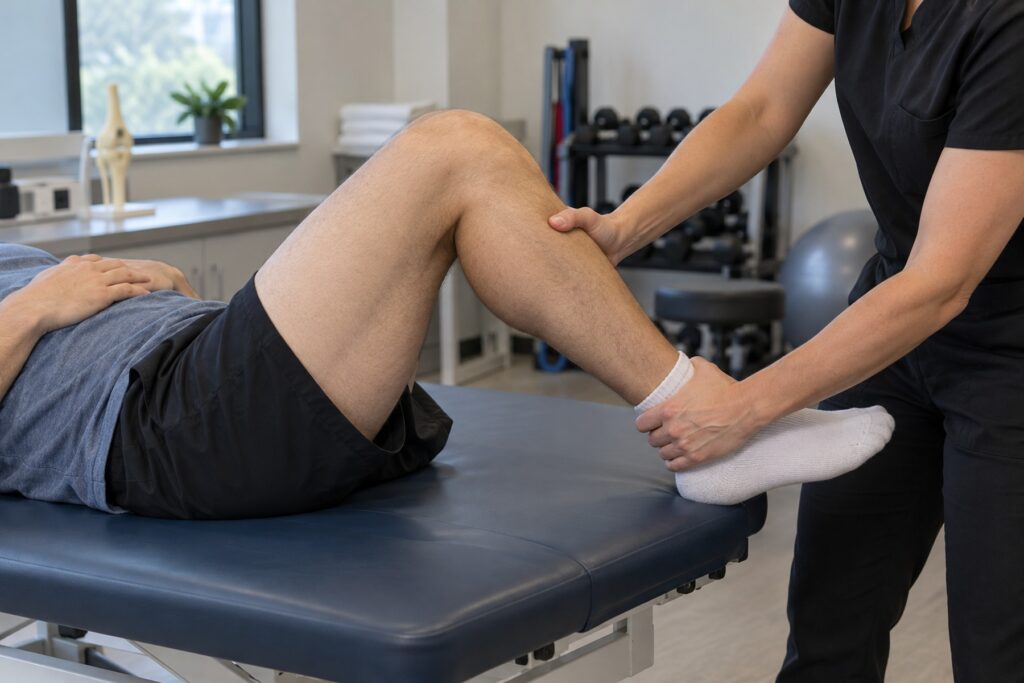
The Slocum Test is a modified anterior drawer examination that adds tibial rotation to assess patterns of anteromedial and anterolateral rotatory knee laxity. It is an orthopedic special test that supports a clinical hypothesis; it does not diagnose a single ligament or instability pattern on its own.
What Is the Slocum Test?
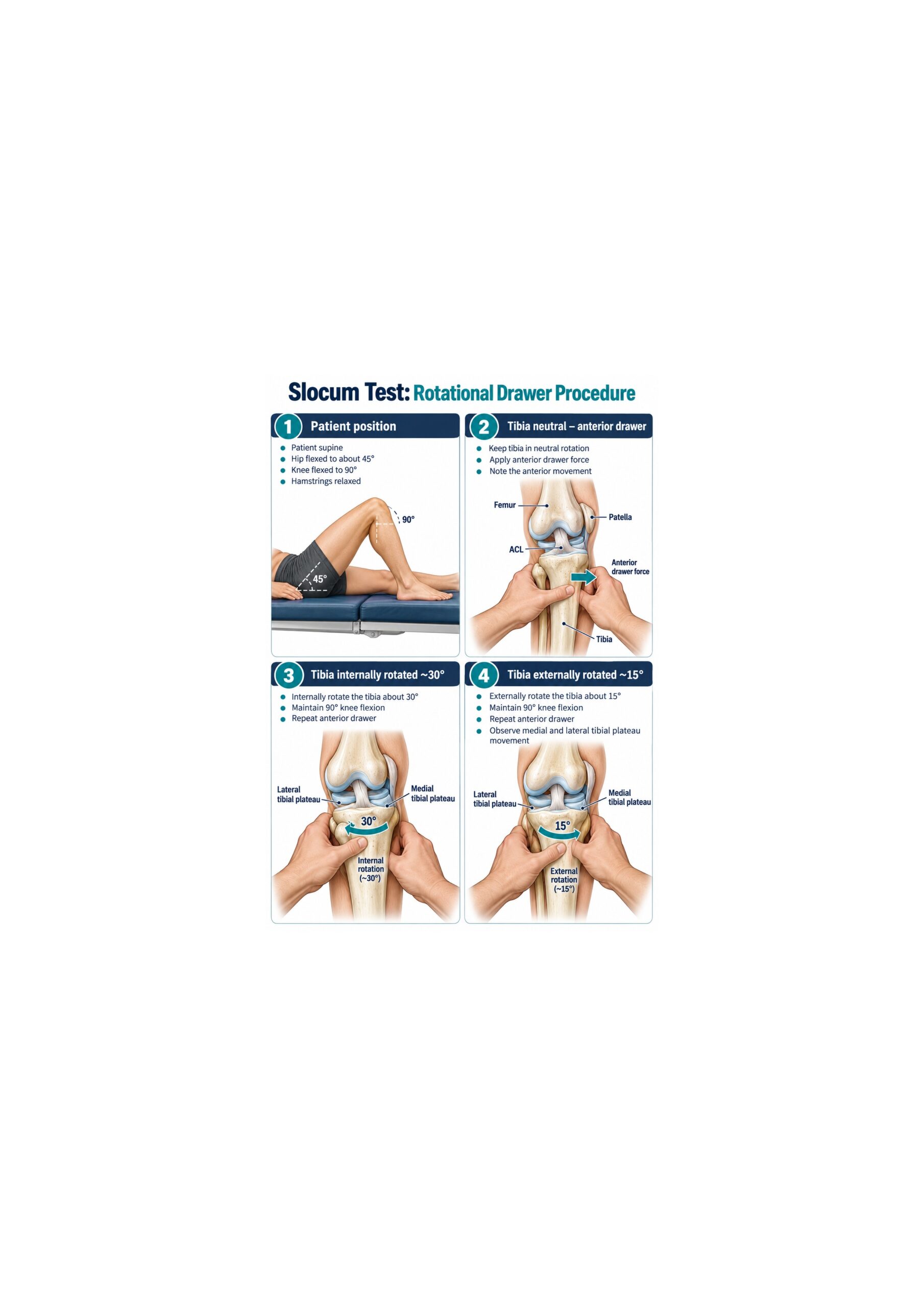
The test compares anterior tibial translation with the tibia in neutral, internal, and external rotation. A commonly described protocol uses the knee near 90° of flexion, internal rotation near 30°, and external rotation near 15°, while the examiner observes how the medial and lateral tibial plateaus move relative to the femur.
Purpose and Indications
- Assess anterior translation with a rotational bias.
- Investigate suspected anteromedial or anterolateral rotatory instability.
- Add information when ACL or collateral ligament injury is suspected.
- Compare plateau movement between the involved and uninvolved knee.
Contraindications and Precautions
The Slocum Test should be gentle and should not be forced through pain or guarding.
- Defer when fracture, dislocation, or another injury needing urgent stabilization is suspected.
- Modify or stop when acute pain, large effusion, or muscle guarding prevents a relaxed test.
- Follow procedure-specific precautions after recent surgery.
- Avoid excessive rotation in a knee with known instability.
Patient and Examiner Positions
- Patient: supine with the hip flexed and the knee near 90°.
- Foot: supported so the tibia can be placed in neutral, internal, or external rotation.
- Examiner: seated or standing at the foot of the table, hands around the proximal tibia.
- Palpation: thumbs monitor the medial and lateral tibial plateaus relative to the femoral condyles.
How to Perform the Slocum Test
- Explain the procedure, obtain consent, and compare the resting position of both knees.
- Flex the hip and knee, support the foot, and ask the patient to relax the hamstrings.
- Perform a gentle anterior drawer in neutral rotation to establish a comparison.
- Internally rotate the tibia near 30° and repeat the anterior drawer while observing the plateaus.
- Externally rotate the tibia near 15° and repeat with the same force and knee position.
- Compare sides and document translation, rotation, endpoint, pain, and guarding.
Test Findings and Interpretation
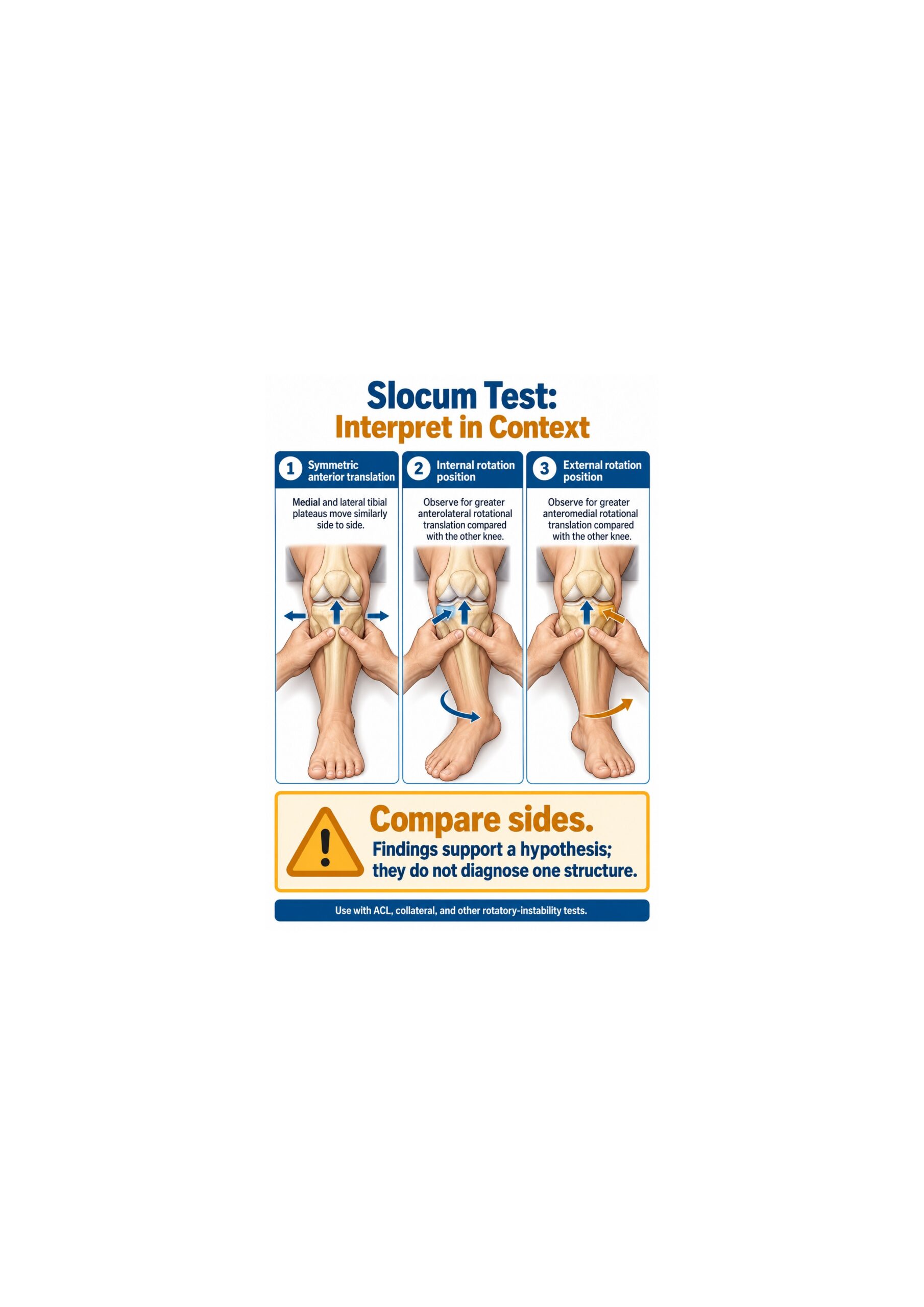
A concerning finding is excessive or asymmetric anterior translation with a rotational component compared with the opposite knee. Greater anterolateral translation during the internally rotated position may support an anterolateral pattern, while greater anteromedial translation during external rotation may support an anteromedial pattern.
These interpretations depend on technique, anatomy, and associated injuries. A normal-appearing test does not exclude ACL or other ligament injury.
What an Abnormal Finding Means
- It supports further assessment of rotatory laxity.
- It does not isolate the ACL, medial structures, or anterolateral structures.
- It does not establish injury grade or treatment need.
- It should be correlated with mechanism, symptoms, other tests, and imaging when indicated.
The original description of rotatory instability by Slocum and Larson framed the maneuver as a modification of anterior drawer testing rather than a stand-alone structural diagnosis.
Relevant Anatomy
- The ACL is a primary restraint to anterior tibial translation.
- The superficial and deep medial collateral structures contribute to medial and rotational stability.
- The anterolateral capsule and lateral structures influence rotational control.
- Menisci, joint shape, and muscle activity affect tibiofemoral motion.
Conditions Associated With an Abnormal Slocum Test
- ACL injury with rotatory laxity
- Anteromedial rotatory instability involving medial structures
- Anterolateral rotatory instability involving ACL and lateral restraint patterns
- Combined ligament injury
These are associations. The test result alone cannot determine which structures are injured.
Clinical Significance
- Adds a rotational comparison to standard anterior drawer assessment.
- Encourages separate observation of medial and lateral plateau motion.
- May guide the choice of additional ACL, collateral, and rotatory-instability tests.
- Supports referral or imaging decisions when combined with the full examination.
Evidence and Diagnostic Accuracy
High-quality sensitivity and specificity values for the exact manual Slocum Test are not well established across defined clinical populations and reference standards. A study of rotational knee laxity measurement describes the rotated anterior drawer positions but also illustrates the challenge of measuring rotational laxity consistently.
A review of rotatory knee instability places the test within a broader evaluation of complex instability patterns. This supports cautious interpretation rather than universal diagnostic thresholds.
Common Mistakes and Practical Tips
- Active hamstrings: support the foot and pause until the patient relaxes.
- Changing knee flexion: maintain the same position across rotation conditions.
- Rotating only the foot: control the tibia and observe the knee, not foot posture alone.
- Unequal drawer force: use a gentle and consistent anterior pull.
- Ignoring the plateaus: palpate medial and lateral movement separately.
- Calling it diagnostic: integrate the finding with the complete examination.
Limitations
Natural asymmetry, tibial torsion, pain, swelling, hamstring activity, examiner force, and imprecise rotation angles can change the result. Bilateral injury also reduces the usefulness of side-to-side comparison.
Summary
- The Slocum Test is a rotated anterior drawer assessment.
- Internal and external tibial rotation bias different rotatory translation patterns.
- Observe medial and lateral plateau motion and compare sides.
- Diagnostic-accuracy evidence for the exact manual test is limited.
- Use the finding with ACL, collateral, rotatory-instability, and imaging assessment.
Used carefully, the Slocum Test can add useful rotational information to a knee examination, but it should remain one part of a broader clinical assessment.