
Yes, a mattress and pillow can work together to support a comfortable spinal position, but there is no single combination that is best for everyone. The useful goal is a surface that supports your body without creating concentrated pressure, paired with a pillow that keeps your head reasonably aligned with your trunk in your usual sleep position.
What spinal alignment during sleep really means
Sleep alignment does not mean forcing the spine into a perfectly straight line. It means avoiding a sustained position in which the head, rib cage, or pelvis is markedly tipped or rotated relative to the rest of the body.
- Your neck should feel supported rather than pushed forward, tilted back, or bent sideways.
- Your shoulders and hips should settle enough to limit pressure, while the trunk remains supported.
- Your position should allow relaxed breathing and easy changes of position.
- Comfort on waking matters more than a marketing label such as “orthopedic.”
A review of pillow-height research found that alignment, body dimensions, contact pressure, and muscle activity all influence pillow selection, while evidence does not establish one ideal height for everyone. The peer-reviewed review of pillow-height determinants explains why an individualized fit is more defensible than a fixed measurement.
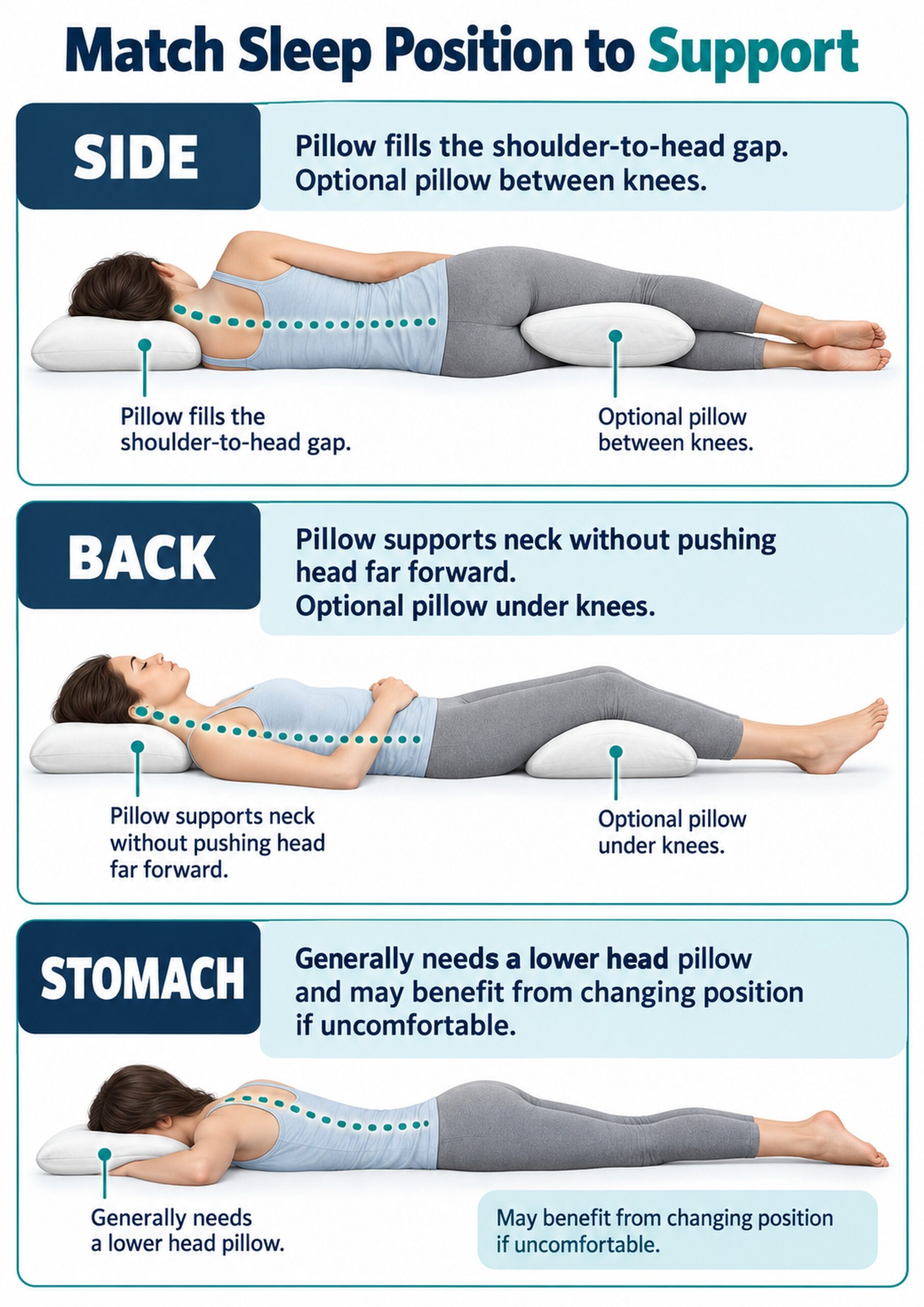
Start with mattress support and pressure comfort
A mattress must do two jobs at once: prevent excessive sinking and spread pressure across the areas that contact the bed. A very firm surface may feel supportive but can be uncomfortable at the shoulder or hip, while a very soft surface can allow the trunk or pelvis to sink more than is comfortable.
- Choose a surface that lets prominent areas settle without leaving the waist or trunk unsupported.
- Judge the mattress after several nights when possible, because a brief showroom test is limited.
- Check your morning symptoms, ease of turning, and sleep interruptions.
- Be cautious with firmness labels because brands do not use one universal scale.
In a randomized trial involving adults with chronic nonspecific low-back pain, a medium-firm mattress produced better pain and disability outcomes than a firm mattress over the study period. That controlled mattress-firmness trial supports considering medium-firm options, but it does not prove that one firmness suits every sleeper or every condition.
Best combination for side sleepers
Side sleeping usually needs more space for the shoulder and hip to settle, plus enough pillow loft to fill the distance between the mattress and the side of the head. The pillow should support the neck without lifting the head toward the ceiling or letting it drop toward the bed.
- Consider a mattress with enough surface cushioning for the shoulder and hip.
- Use a pillow that fills the shoulder-to-head gap after it compresses.
- Keep the nose and breastbone pointing in roughly the same direction.
- Try a pillow between the knees if it improves hip and low-back comfort.
If the shoulder feels compressed, first review both the mattress surface and pillow height. A thicker pillow cannot fully compensate for a mattress that prevents the shoulder from settling, and a softer mattress cannot correct a pillow that bends the neck sideways.
Best combination for back sleepers
Back sleepers often do well with a supportive mattress that allows the pelvis and upper trunk to settle without a deep hollow. The head pillow is commonly lower than a side-sleeping pillow because the shoulder does not create the same lateral gap.
- Look for even support beneath the rib cage and pelvis.
- Choose a pillow that supports the neck without pushing the chin toward the chest.
- Use a small pillow under the knees if that position reduces low-back tension.
- Avoid stacking pillows unless the combined height remains comfortable.
A contoured pillow may feel useful if its raised neck section matches your body, but shape alone does not guarantee a good fit. The pillow must still work with your mattress firmness, head shape, and shoulder position.
Best combination for stomach sleepers
Stomach sleeping holds the neck rotated for long periods and can increase lumbar extension for some people. If you are comfortable and symptom-free, you do not need to force a change, but persistent neck or back discomfort is a reason to test another position.
- Use a low head pillow, or no head pillow if that is comfortable and safe for you.
- A thin pillow under the lower abdomen or pelvis may reduce the feeling of lumbar arching.
- Alternate the direction your head faces rather than always rotating one way.
- Consider gradual practice in side or back sleeping if symptoms persist.
Stomach sleepers should avoid assuming that a very firm mattress will automatically protect the back. Comfort, support distribution, and morning response remain the practical checks.
How to choose the right pillow loft
Pillow loft is the working height after your head settles into it, not the uncompressed height printed on a label. Material, fill amount, body weight, shoulder width, and mattress softness all change the effective height.
- Side sleepers often need more loft because of the shoulder-to-head gap.
- Back sleepers commonly need moderate or lower loft.
- Stomach sleepers generally tolerate the lowest loft.
- Adjustable-fill pillows make small changes easier.
Check the position after lying down for several minutes. If your head is pushed away from the mattress, remove loft; if it drops toward the mattress, add support or review how deeply your shoulder is settling.
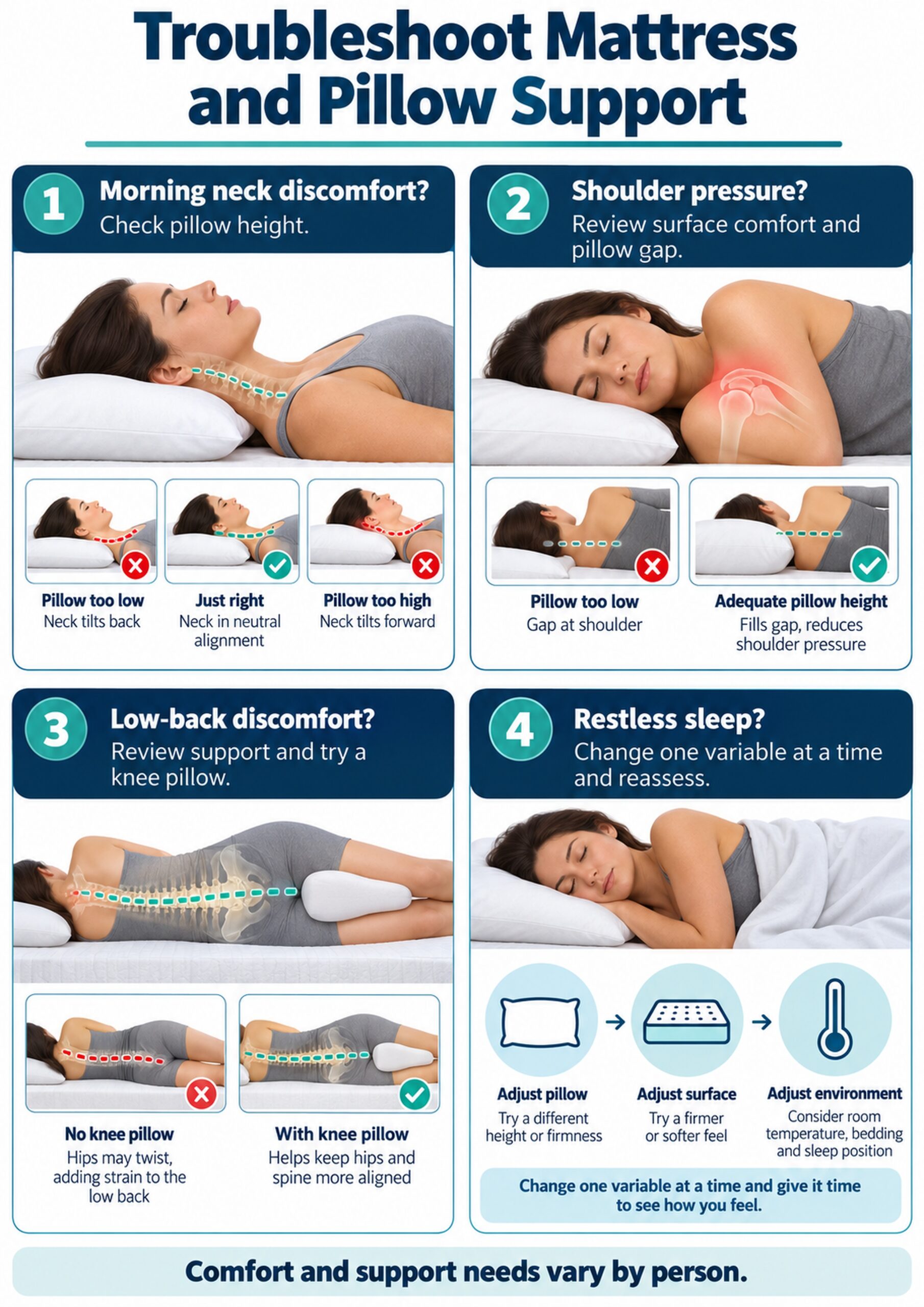
Mattress and pillow combinations by sleep position
This table is a starting framework rather than a prescription. Your body proportions, health conditions, and comfort response may point to a different combination.
| Usual position | Mattress priority | Pillow priority | Optional support |
|---|---|---|---|
| Side | Pressure relief at shoulder and hip with stable trunk support | Enough compressed loft to fill the shoulder-to-head gap | Pillow between knees |
| Back | Even support beneath trunk and pelvis | Supports the neck without pushing the head forward | Pillow under knees |
| Stomach | Limits uncomfortable pelvic sinking | Low loft to reduce neck extension | Thin support under pelvis if comfortable |
| Combination | Balanced pressure comfort and ease of turning | Adjustable or shaped for more than one position | Moveable knee or body pillow |
- Use the row that matches the position in which you spend most of the night.
- For combination sleeping, prioritize easy turning and a pillow that works in both positions.
- Reassess the combination whenever the mattress, topper, or pillow changes.
How body shape and mattress construction change the fit
Two people on the same mattress can experience different alignment and pressure. A broader shoulder, a larger waist-to-hip difference, or greater body mass changes how deeply each region settles.
- Broader shoulders may require more surface contouring and more side-sleeping pillow loft.
- A softer topper changes the effective pillow height because the shoulder may sink farther.
- Partners with different needs may prefer split firmness or separate toppers.
- Heat sensitivity, movement transfer, and edge stability can affect sleep even when alignment looks acceptable.
Material names such as foam, latex, hybrid, or spring do not by themselves predict comfort. Construction, layering, firmness, and condition of the product matter more than the category name.
Test one change at a time
Changing the mattress, pillow, sleep position, and exercise routine together makes it hard to identify what helped. Begin with the least expensive reversible adjustment and keep the rest of the setup stable.
- Record your usual position and morning symptoms for several nights.
- Adjust pillow loft or add one positioning pillow.
- Allow a short adaptation period unless symptoms clearly worsen.
- Then consider a topper or mattress change if pressure or support remains poor.
Use a simple note with sleep interruptions, morning pain location, stiffness duration, and ease of movement. Trends are more useful than one unusually good or bad night.
Movement and exercise still matter
A sleep setup can improve comfort, but it does not replace daytime movement, rehabilitation, or treatment of an underlying condition. Gentle movement after waking often helps distinguish ordinary stiffness from symptoms that need assessment.
- Begin with relaxed breathing and small pelvic tilts or knee movements in bed.
- Walk briefly before judging how your back feels for the day.
- Continue prescribed strengthening or mobility exercises.
- Avoid forcing painful stretches first thing in the morning.
If you already have a rehabilitation plan, discuss sleep-position modifications with your clinician so they complement your program.
When sleep-related pain needs assessment
Persistent or progressive symptoms should not be managed only by buying new bedding. Seek clinical assessment when pain regularly interrupts sleep, continues despite reasonable adjustments, or is accompanied by other concerning symptoms.
- New weakness, numbness, loss of coordination, or changes in bladder or bowel control need prompt medical attention.
- Severe pain after trauma, fever with spinal pain, or unexplained systemic illness also needs assessment.
- Regular loud snoring, choking, or marked daytime sleepiness warrants discussion with a healthcare professional.
- Ongoing morning pain may need a musculoskeletal examination rather than another pillow purchase.
The National Institute of Neurological Disorders and Stroke overview of low-back pain outlines common causes and situations in which medical care is appropriate.
Conclusion
The best mattress and pillow combination is the one that balances pressure comfort, support, and your usual sleep position. Start with a reasonably supportive mattress, match pillow loft to the space beneath your head and neck, change one variable at a time, and judge the result by sleep quality and morning function rather than labels or price.
Frequently asked questions
Is a firm mattress always best for spinal alignment?
No. A surface can be too firm to let the shoulder and hip settle comfortably, and research in chronic nonspecific low-back pain has favored medium-firm over firm mattresses in one controlled trial. Individual comfort and support still vary.
How can I tell whether my pillow is too high?
A pillow may be too high if it pushes your chin toward your chest when you lie on your back or bends your head upward when you lie on your side. Morning neck stiffness or headache can have many causes, so use position and symptom patterns together.
How can I tell whether my pillow is too low?
On your side, a low pillow may let your head fall toward the mattress. On your back, it may leave the neck unsupported or tip the head backward; adding a small amount of fill is a practical test.
Do side sleepers need a soft mattress?
Side sleepers often value surface pressure relief, but “soft” is not automatically better. The mattress should allow the shoulder and hip to settle while still supporting the trunk and pelvis.
Should I place a pillow between my knees?
A pillow between the knees is optional. It can improve comfort by reducing hip rotation for some side sleepers, but it is not required if you already sleep comfortably.
Is memory foam better than latex or springs?
No material is universally superior. Compare the finished mattress for pressure comfort, support, heat, movement, durability, and ease of turning rather than choosing by material name alone.
Can a mattress fix chronic back pain?
A suitable mattress may reduce sleep-related discomfort, but it does not diagnose or treat every cause of back pain. Persistent pain may need exercise, rehabilitation, medical assessment, or other care.
How long should I test a new pillow?
Allow several nights for a modest change when symptoms are mild, but stop if discomfort clearly worsens. An adjustable pillow lets you test smaller changes without replacing the whole product.
What is best for combination sleepers?
Choose a mattress that allows easy turning and a pillow that remains comfortable in your two main positions. Adjustable fill or a shape with different heights can help, provided the design fits your body.
When should I replace my mattress or pillow?
Replace bedding when it no longer provides consistent support or comfort, has visible damage or lasting depressions, or cannot be adjusted to reduce symptoms. Product age alone is less useful than condition and performance.