The Single-Leg Balance Test is a simple performance-based clinical assessment used to examine a person’s ability to maintain postural stability while standing on one lower limb. It is most useful when interpreted as one part of a broader examination because balance depends on interacting sensory, motor, musculoskeletal, and cognitive factors rather than on a single system.
What Is the Single-Leg Balance Test?
The Single-Leg Balance Test, also called the single-leg stance test or one-leg stance test, is primarily a functional performance measure and clinical balance assessment. It evaluates the ability to maintain an upright position with one foot supporting the body while the other foot is lifted from the floor.
A commonly used version is a timed single-leg stance with the eyes open, in which the examiner records how long the person maintains the position according to predefined test-termination criteria. Established clinical resources describe variations involving arm position, lifted-leg position, footwear, vision, and maximum testing time, so the exact protocol should always be documented.
The test primarily challenges static postural control under a reduced base of support. It does not independently measure overall balance, muscle strength, joint stability, mobility, or fall risk.
Postural control depends on the integration of visual, vestibular, and somatosensory information with appropriate motor responses. Therefore, difficulty during single-leg stance may reflect several interacting factors rather than one isolated anatomical impairment.
Purpose of the Single-Leg Balance Test
The Single-Leg Balance Test may be used to:
- Assess static postural control during single-limb support.
- Compare performance between the right and left lower limbs.
- Establish a baseline before rehabilitation and monitor changes over time.
- Observe balance strategies and movement behavior during a relatively simple functional task.
- Contribute to a broader balance assessment in older adults or patients with neurological, vestibular, or musculoskeletal conditions.
- Help determine whether additional assessment of balance, gait, strength, sensory function, or functional mobility is warranted.
The test is especially useful when the clinician wants a quick observation of how a patient controls the body when the support surface is reduced to one foot.
Single-Leg Balance Test Indications
The test may be appropriate when the clinical question involves:
- Reported difficulty with balance during standing or walking.
- Functional problems involving single-limb support.
- Previous falls or concerns about balance in older adults.
- Lower-extremity musculoskeletal complaints when single-leg control is relevant to the patient’s functional goals.
- Neurological conditions affecting postural control or lower-extremity function.
- Vestibular complaints when balance performance is part of the examination.
- Rehabilitation progress where a standardized balance task is useful for repeated assessment.
The indication should come from the patient’s presentation rather than from the presence of a particular diagnosis alone.
Single-Leg Balance Test Contraindications and Precautions
There is no universally established list of test-specific contraindications for the general Single-Leg Balance Test. Safety should be determined from the patient’s clinical status and from the exact protocol being used.
Important precautions include:
- Do not perform the task without appropriate support nearby when there is a meaningful risk of falling.
- Modify, defer, or discontinue testing when the patient cannot safely stand unsupported.
- Respect prescribed weight-bearing restrictions following injury, surgery, or other medical treatment.
- Use caution when standing produces dizziness, near-syncope, marked instability, or other concerning symptoms.
- Consider an assisted or modified balance assessment when the patient requires an assistive device for safe standing.
- Use additional guarding for patients with substantial balance impairment rather than relying on the patient’s ability to recover independently.
The CDC’s balance-testing materials emphasize safe positioning and allow the clinician to stop balance testing when the task cannot be performed safely.
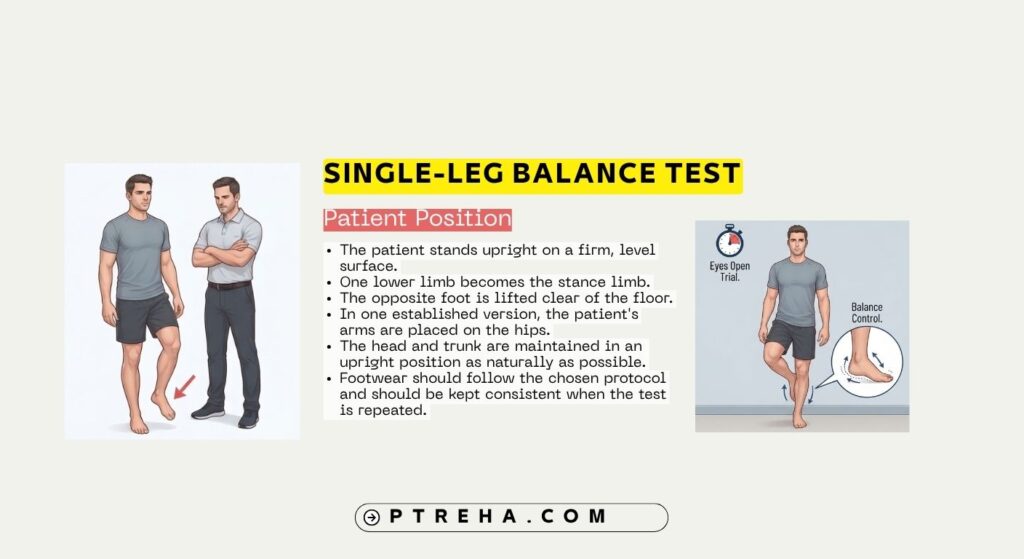
Patient Position
For a commonly used eyes-open, timed single-leg stance protocol:
- The patient stands upright on a firm, level surface.
- One lower limb becomes the stance limb.
- The opposite foot is lifted clear of the floor.
- In one established version, the patient’s arms are placed on the hips.
- The head and trunk are maintained in an upright position as naturally as possible.
- Footwear should follow the chosen protocol and should be kept consistent when the test is repeated.
Because protocols differ, the examiner should document important conditions such as footwear, visual condition, arm position, and the leg tested rather than assuming that all Single-Leg Balance Tests are identical.
Examiner Position
- Stand close enough to protect the patient if balance is lost.
- Position yourself where the stance foot and the lifted foot can be observed clearly.
- Keep the surrounding area free of obstacles.
- Avoid providing physical assistance unless the protocol specifically requires it.
- Use a stopwatch or equivalent timing method when the selected protocol uses timed performance.
- Record the same test conditions on subsequent assessments whenever possible.
For patients with substantial instability, the examiner may need a more protective position or an alternative balance assessment.
How to Perform the Single-Leg Balance Test
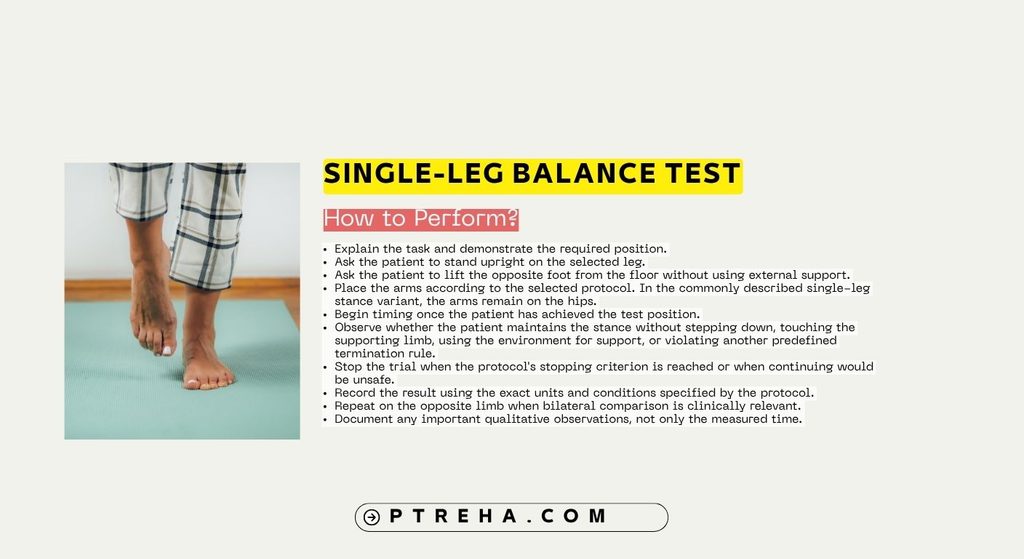
One commonly used timed eyes-open procedure can be performed as follows:
- Explain the task and demonstrate the required position.
- Ask the patient to stand upright on the selected leg.
- Ask the patient to lift the opposite foot from the floor without using external support.
- Place the arms according to the selected protocol. In the commonly described single-leg stance variant, the arms remain on the hips.
- Begin timing once the patient has achieved the test position.
- Observe whether the patient maintains the stance without stepping down, touching the supporting limb, using the environment for support, or violating another predefined termination rule.
- Stop the trial when the protocol’s stopping criterion is reached or when continuing would be unsafe.
- Record the result using the exact units and conditions specified by the protocol.
- Repeat on the opposite limb when bilateral comparison is clinically relevant.
- Document any important qualitative observations, not only the measured time.
The exact starting point and termination criteria vary across published versions. A commonly described single-leg stance measure starts timing when the lifted foot leaves the floor and ends when the foot returns to the floor or another predefined criterion is met.
Interpretation of the Single-Leg Balance Test
The result should be interpreted within the specific protocol, patient population, and clinical context.
For a timed test performed under consistent conditions, maintaining the position for a longer duration generally represents better performance on that particular task. However, a shorter performance does not by itself establish a disease, injury, neurological disorder, or fall-risk diagnosis.
Important factors that may influence performance include age, previous injury, lower-extremity function, sensory input, visual conditions, vestibular function, confidence, fatigue, pain, footwear, medication effects, and the exact instructions used.
For serial rehabilitation testing, consistency is particularly important. Changing from shoes to barefoot, eyes open to eyes closed, arms at the sides to arms on the hips, or one protocol to another may change the result independently of actual clinical improvement.
What Does a Reduced Single-Leg Balance Performance Mean?
A reduced ability to maintain single-leg stance indicates difficulty completing the balance task under the conditions tested.
The finding can help the clinician identify a need to examine contributing factors such as lower-extremity control, sensory function, vestibular symptoms, gait, strength, coordination, or other aspects of postural control.
It does not establish the cause of the impairment. For example, poor single-leg performance should not automatically be interpreted as evidence of ankle instability, hip weakness, vestibular dysfunction, or neurological disease.
This distinction is important because single-leg balance requires coordinated activity across multiple body systems.
Anatomy Involved in Single-Leg Balance Test
Single-leg balance does not isolate one anatomical structure. Maintaining the position requires coordinated contributions from:
- Foot and ankle: provide the immediate base of support and help control the body’s position over the stance foot.
- Knee: contributes to lower-limb alignment and mechanical control during standing.
- Hip: helps control the position of the pelvis and lower limb over the stance leg.
- Trunk and pelvis: contribute to whole-body alignment and control of the center of mass.
- Visual system: provides information about body orientation and the surrounding environment.
- Vestibular system: contributes information relevant to head motion and orientation.
- Somatosensory system: provides information from the feet, joints, muscles, and other tissues about body position and movement.
- Central nervous system: integrates sensory information and generates appropriate motor responses.
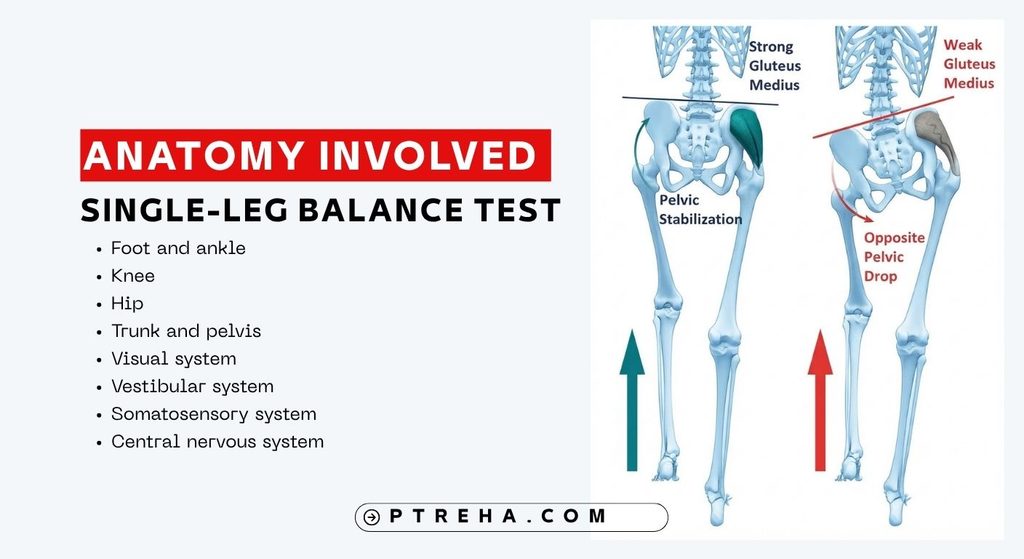
Research on postural control consistently describes balance as a multisystem process rather than an isolated function of one muscle or joint.
Conditions Detected or Associated With the Test
The Single-Leg Balance Test should not be described as a stand-alone diagnostic test for these conditions. Instead, performance may be relevant to clinical assessment in:
- Older adults, particularly when balance and falls are part of the clinical question.
- Neurological disorders, including conditions in which postural control is affected.
- Vestibular disorders, when static balance forms part of the examination.
- Chronic ankle instability, where research has identified differences in postural-control performance during single-leg stance compared with healthy controls.
- Musculoskeletal rehabilitation, when single-limb control is relevant to walking, sport, or functional activities.
- Balance impairment following injury or neurological disease, when the clinician needs a simple performance task to complement other examination findings.
The evidence linking single-leg performance with falls is particularly important to interpret cautiously. A systematic review found differences in one-legged balance performance between fallers and non-fallers, but also reported substantial heterogeneity and generally limited prognostic accuracy across studies.
Clinical Significance
The Single-Leg Balance Test can contribute useful information when it is combined with the patient’s history and other examination findings.
Clinically, it can help with:
- Identifying asymmetry between limbs.
- Monitoring change during rehabilitation.
- Observing whether balance strategies become more controlled over time.
- Determining whether further balance or functional testing is warranted.
- Complementing assessments of gait, lower-extremity function, sensory status, and functional mobility.
- Evaluating a task that resembles the single-limb demands encountered during walking and other activities.
In older adults, single-leg stance has been investigated in relation to falls. However, systematic reviews have found that no single balance assessment should be interpreted in isolation as a definitive predictor of future falls.
“Single-leg stance performance is a task-specific measure of balance, not a complete picture of balance ability.”
A patient’s performance can also be influenced by the task itself. For example, removing visual input creates a different sensory challenge from an eyes-open condition, so results from different sensory conditions should not be treated as interchangeable.
Sensitivity and Specificity
There is no single universally applicable sensitivity or specificity value for the Single-Leg Balance Test.
Published research has used different populations, protocols, definitions of impaired performance, and outcomes. A systematic review specifically examining the Single-Leg Stance Test for prediction of falls in older adults reported variable diagnostic performance and concluded that the clinical tests reviewed had limited overall diagnostic accuracy for identifying fallers.
Therefore, a sensitivity or specificity value from one study should not be transferred to all patients or all versions of the test.
Diagnostic Accuracy
The Single-Leg Balance Test should generally be viewed as a clinical performance assessment rather than a stand-alone diagnostic test.
Evidence relating one-legged balance to falls does not mean that the test can diagnose an underlying disorder or determine whether an individual patient will fall. A broader assessment is required when the clinical question involves diagnosis, prognosis, or comprehensive fall-risk evaluation.
Scoring and Documentation
Scoring depends on the selected protocol.
For a timed version, the primary outcome is commonly the duration of successful single-leg stance, recorded according to the predefined stopping criteria. Other versions may introduce different sensory conditions or observational criteria.
A useful clinical record should include:
- Tested limb.
- Visual condition.
- Footwear.
- Arm position.
- Timing method.
- Duration or other protocol-specific score.
- Reason for stopping.
- Relevant qualitative observations.
- Whether the patient required modification or assistance.
Avoid labeling a result simply as “normal” or “abnormal” without considering the relevant population and protocol. There is no universal single-leg balance value that applies equally to every patient.
Common Mistakes in Single-Leg Balance Test
- Using different instructions on different testing sessions.
- Failing to document whether the patient was barefoot or wearing shoes.
- Changing the arm position between trials.
- Allowing the patient to use external support without documenting the modification.
- Ignoring differences between eyes-open and eyes-closed testing.
- Treating a short duration as proof of a specific diagnosis.
- Using a single balance result to estimate overall fall risk.
- Focusing only on the stopwatch and ignoring movement strategy or safety.
- Comparing results obtained with substantially different protocols.
- Continuing the test after the patient becomes unsafe.
Tips for Performing the Single-Leg Balance Test
- Standardize the test conditions as much as clinically appropriate.
- Explain the task clearly before starting the timer.
- Keep a stable support surface or appropriate guarding available.
- Test both limbs when comparison is clinically useful.
- Record qualitative features such as trunk movement, foot strategy, repeated corrections, or use of the arms.
- Use the same protocol when monitoring progress.
- Interpret the result alongside history, symptoms, gait, strength, sensory findings, and other balance assessments.
- Use more comprehensive balance or mobility measures when the clinical question extends beyond single-limb static balance.
Summary
The Single-Leg Balance Test is a simple functional performance assessment of static postural control during single-limb support.
- It is primarily a clinical balance and performance measure, not an orthopedic special test or stand-alone diagnostic test.
- A commonly used version involves timed single-leg stance with the eyes open, but protocols vary and should be clearly documented.
- Performance reflects the interaction of visual, vestibular, somatosensory, neuromuscular, and musculoskeletal systems rather than one isolated structure.
- Reduced performance may support further clinical assessment but does not independently diagnose a condition.
- Evidence concerning falls is mixed and protocol-dependent, so the test should not be used alone to determine an individual’s overall fall risk.
The greatest clinical value of the Single-Leg Balance Test comes from using a consistent protocol, observing how the patient controls the task, and integrating the result with the rest of the physical therapy examination.
Resources and External Links
Shirley Ryan AbilityLab – Single Leg Stance / One-Legged Stance Test
Single Leg Stance or One-Legged Stance Test – RehabMeasures Database
Shirley Ryan AbilityLab – Timed Unipedal Stance Test
Timed Unipedal Stance Test – RehabMeasures Database
Omaña et al. – Systematic Review of Balance Tests and Falls in Older Adults
Functional Reach, Single-Leg Stance, and Tinetti Assessment – PubMed
One-Legged Balance Performance and Falls Risk – Systematic Review
A Systematic Review of One-Legged Balance Performance and Falls Risk – PubMed
Diagnostic Balance Tests for Falls – Systematic Review and Meta-Analysis
Diagnostic Balance Tests for Assessing Risk of Falls – PubMed
CDC STEADI – Clinical Resources for Balance and Fall Prevention
CDC STEADI Clinical Resources
Postural Control and Multisensory Integration – Review
Sensorimotor Control of Standing Balance – PubMed
Single-Leg Stance and Chronic Ankle Instability – Systematic Review and Meta-Analysis
Postural Control Deficits During Static Single-Leg Stance in Chronic Ankle Instability – PubMed