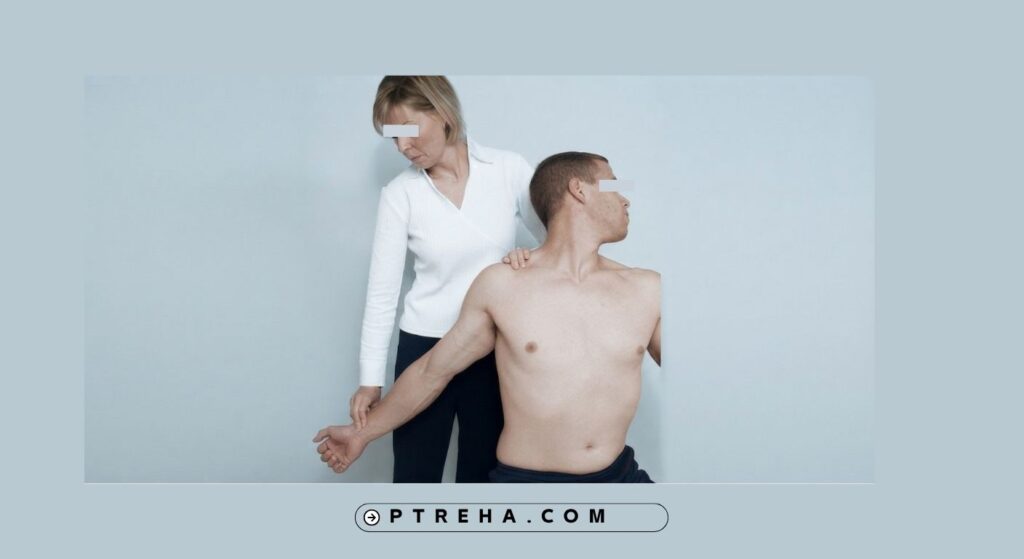
Halstead Maneuver is a provocative clinical assessment traditionally used when evaluating patients with symptoms that may be related to thoracic outlet syndrome. It combines a specific position of the cervical spine and upper limb while the examiner monitors the radial pulse and the patient’s symptoms. Because provocative tests for thoracic outlet syndrome have important limitations, the maneuver should be interpreted as one part of a broader clinical examination rather than as a stand-alone diagnostic test.
What Is the Halstead Maneuver?
Halstead Maneuver is a provocative clinical assessment used in the examination of suspected thoracic outlet syndrome (TOS).
A commonly described version involves palpation of the radial pulse while the examiner applies downward traction to the affected upper limb and the patient extends the cervical spine and rotates the head away from the side being tested.
The maneuver is intended to determine whether this position reproduces the patient’s familiar symptoms and whether a change in the palpable radial pulse occurs.
Thoracic outlet syndrome refers to a group of conditions involving possible compression or irritation of structures passing between the cervical region, first rib, clavicle, and shoulder girdle. Depending on the clinical presentation, the brachial plexus, subclavian artery, or subclavian vein may be involved.
An important point is that the name Halstead Maneuver is not used completely consistently across clinical sources. Some descriptions overlap with techniques referred to as the costoclavicular maneuver, military brace test, or reverse Adson maneuver. The exact technique should therefore be identified when documenting the examination.
Purpose of the Halsteads Maneuver
- To provoke symptoms that may be relevant to suspected thoracic outlet involvement.
- To observe changes in the radial pulse during a provocative position.
- To contribute information to the assessment of upper-extremity neurovascular symptoms.
- To determine whether a particular cervical and shoulder position reproduces familiar symptoms.
- To support clinical reasoning when combined with the history and other examination findings.
The maneuver does not independently establish the presence or type of thoracic outlet syndrome.
Halstead Maneuver Indications
Halstead Maneuver may be considered when a patient presents with symptoms that raise the possibility of thoracic outlet involvement, such as:
- Upper-extremity pain or paresthesia.
- Symptoms that change with cervical or shoulder position.
- A sense of heaviness or discomfort in the upper limb.
- Symptoms suggesting possible neurovascular involvement.
- Clinical findings that warrant further assessment of the thoracic outlet region.
The examination should be selected according to the patient’s history and presentation rather than performed routinely in every patient with arm or neck symptoms.
Halstead Maneuver Contraindications and Precautions
There is not a universally established list of Halstead-specific absolute contraindications. The maneuver should therefore be performed conservatively as a provocative examination rather than as a forceful technique.
Relevant precautions include:
- Avoid excessive downward traction on the upper limb.
- Do not force cervical extension or rotation.
- Stop the maneuver if the patient develops severe or unfamiliar pain.
- Stop when marked neurological symptoms, dizziness, or concerning vascular changes occur.
- Use additional caution in patients with a history suggesting significant vascular pathology or cervical instability.
- Do not repeatedly provoke substantial symptoms simply to reproduce a finding.
- Establish the patient’s baseline symptoms and pulse before testing.
A noticeable change in the radial pulse should be interpreted carefully because positional changes in pulse amplitude can occur without clinically significant thoracic outlet pathology.
Patient Position
A commonly described Halstead protocol uses the following position:
- The patient is seated comfortably.
- The tested upper limb is positioned according to the selected protocol, commonly with the shoulder and elbow extended.
- Downward traction is applied to the tested upper limb.
- The cervical spine is extended.
- The head is rotated away from the side being examined.
Because variations exist in descriptions of the maneuver, clinicians should specify the protocol used rather than assuming that one technique represents a universal standard.
Examiner Position
- Stand beside or slightly behind the patient.
- Palpate the radial pulse of the tested extremity.
- Maintain controlled contact with the patient’s upper limb.
- Apply gentle, consistent downward traction when required by the selected protocol.
- Observe the patient’s facial expression, body response, and reported symptoms throughout the procedure.
- Monitor for any visible changes in skin color or other concerning vascular signs.
The examiner should identify the radial pulse before introducing the provocative position so that the response can be compared with the patient’s baseline.
How to Perform the Halstead Maneuver
- Explain the examination to the patient and ask the patient to report any familiar symptoms.
- Position the patient comfortably in sitting.
- Palpate the radial pulse on the side being tested.
- Establish the patient’s baseline symptoms and pulse.
- Position the tested upper limb according to the selected Halstead protocol.
- Apply controlled downward traction to the upper limb.
- Ask the patient to extend the cervical spine.
- Rotate the patient’s head away from the side being tested.
- Continue monitoring the radial pulse.
- Ask whether the patient’s usual or familiar symptoms are reproduced.
- Stop the maneuver if symptoms become excessive or concerning.
- Release the position and reassess the patient’s symptoms.
The procedure should always be performed smoothly and without unnecessary force.
Interpretation
Interpretation depends on the response produced during the maneuver.
Reproduction of the patient’s familiar symptoms may indicate that the tested position is clinically relevant to the patient’s presentation. However, symptom reproduction alone does not establish thoracic outlet syndrome.
A reduction or disappearance of the radial pulse during the maneuver has traditionally been considered a vascular response. It should not, however, be interpreted as proof of arterial thoracic outlet syndrome.
Provocative positioning can alter pulse findings for reasons unrelated to clinically important vascular compression. For this reason, the examiner should avoid interpreting pulse changes in isolation.
The result should be considered together with:
- The patient’s history.
- Neurological findings.
- Vascular findings when indicated.
- Cervical spine examination.
- Shoulder examination.
- Peripheral nerve assessment.
- Relevant differential diagnoses.
- Additional investigations when clinically appropriate.
What Constitutes a Positive Test?
The terminology of a positive Halstead Maneuver is used in some clinical descriptions, but there is no single universally accepted interpretation applicable to every protocol.
A provocative response may include reproduction of familiar symptoms and/or a change in the radial pulse. These findings should be documented specifically rather than recorded simply as “positive.”
For example, documentation may distinguish between:
- Familiar symptoms reproduced.
- Radial pulse altered during positioning.
- Both symptoms and pulse changes occurred.
- No familiar symptoms reproduced.
This approach provides more clinically useful information than relying on a binary positive/negative label.
What Does a Positive Halstead Maneuver Mean?
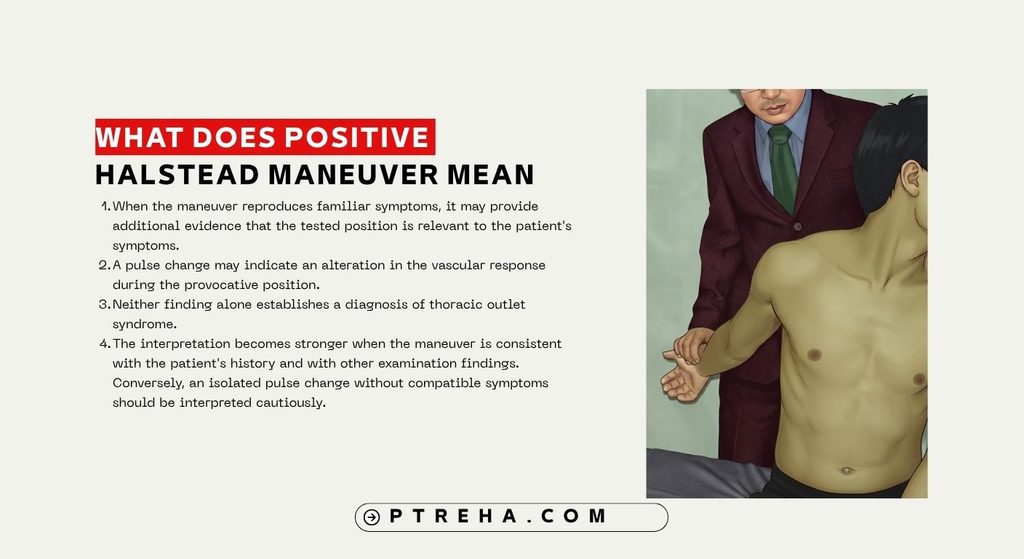
When the maneuver reproduces familiar symptoms, it may provide additional evidence that the tested position is relevant to the patient’s symptoms.
A pulse change may indicate an alteration in the vascular response during the provocative position.
Neither finding alone establishes a diagnosis of thoracic outlet syndrome.
The interpretation becomes stronger when the maneuver is consistent with the patient’s history and with other examination findings. Conversely, an isolated pulse change without compatible symptoms should be interpreted cautiously.
Negative Halstead Maneuver
A maneuver that does not reproduce the patient’s familiar symptoms and does not demonstrate a relevant pulse change provides no provocative finding during that particular examination.
A negative response does not independently exclude thoracic outlet syndrome.
This is particularly important because the clinical presentation of TOS is variable and individual provocative maneuvers have limited diagnostic value when used alone.
Anatomy Involved in Halstead Maneuver
Relevant anatomical and physiological structures include:
- Brachial plexus: provides the major neural pathways supplying the upper limb and may be involved in neurogenic TOS.
- Subclavian artery: may be involved in arterial forms of thoracic outlet pathology.
- Subclavian vein: may be involved in venous forms of thoracic outlet pathology.
- First rib: forms part of the anatomical framework of the thoracic outlet.
- Clavicle: contributes to the boundaries of the costoclavicular region.
- Scalene muscles: form important anatomical relationships with the neurovascular structures passing toward the upper limb.
- Cervical spine and shoulder girdle: their position changes the mechanical environment surrounding the neurovascular structures.
The maneuver should not be interpreted as selectively isolating one anatomical structure unless supported by appropriate evidence.
Conditions Detected / Associated With the Test
Halstead Maneuver is primarily associated with the clinical assessment of possible thoracic outlet syndrome.
It may contribute to assessment when considering:
- Neurogenic thoracic outlet syndrome.
- Arterial thoracic outlet syndrome.
- Venous thoracic outlet syndrome.
- Other causes of upper-extremity neurovascular symptoms in which thoracic outlet involvement is part of the differential diagnosis.
The maneuver does not independently distinguish between these clinical categories.
Clinical Significance
- A familiar symptom response can provide useful information during the clinical examination.
- A pulse alteration may identify a positional vascular response that requires appropriate interpretation.
- The maneuver can contribute to differential diagnosis when combined with other examination findings.
- Findings may help determine whether additional neurological or vascular assessment is appropriate.
- The test can be useful for clinical hypothesis generation but should not replace a complete examination.
- A normal or non-provocative response does not by itself rule out thoracic outlet pathology.
A broader clinical assessment is especially important because symptoms in the neck and upper limb can arise from cervical radiculopathy, peripheral nerve disorders, shoulder pathology, vascular disorders, and other musculoskeletal conditions.
Common Mistakes in Halstead Maneuver
- Interpreting a reduced radial pulse as definitive evidence of thoracic outlet syndrome.
- Ignoring the patient’s familiar symptoms.
- Applying excessive traction to the upper limb.
- Forcing the cervical spine into extension or rotation.
- Failing to check the pulse before performing the maneuver.
- Repeating the test excessively after substantial symptoms have already been reproduced.
- Assuming that every source describes exactly the same Halstead technique.
- Confusing Halstead Maneuver with another thoracic outlet maneuver without documenting the actual protocol.
- Reporting the finding as a confirmed diagnosis.
- Using the maneuver without considering alternative causes of the patient’s symptoms.
Tips for Performing the Halstead Maneuver
- Explain the procedure before beginning.
- Establish a clear baseline for symptoms and pulse.
- Use controlled and gentle positioning.
- Ask the patient specifically whether the symptoms reproduced are familiar.
- Observe both subjective symptoms and objective findings.
- Document the exact technique used.
- Record the specific response rather than only writing “positive.”
- Stop when the maneuver produces excessive or concerning symptoms.
- Interpret the result alongside the rest of the clinical examination.
Sensitivity and Specificity
A single universal sensitivity or specificity value should not be assigned to Halstead Maneuver.
The literature on thoracic outlet provocative testing contains methodological and terminology differences, and individual maneuvers have not been established as sufficiently accurate to diagnose TOS independently.
Published reviews have also highlighted the limited specificity of provocative findings such as radial pulse changes. Consequently, diagnostic performance depends on the population studied, the exact protocol used, the reference standard, and the clinical definition of thoracic outlet syndrome.
Diagnostic Accuracy
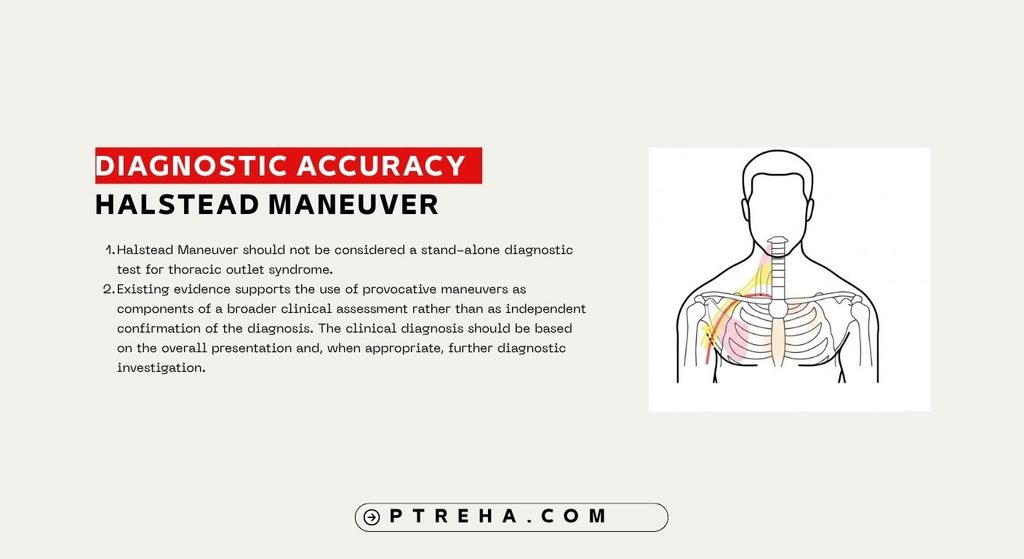
Halstead Maneuver should not be considered a stand-alone diagnostic test for thoracic outlet syndrome.
Existing evidence supports the use of provocative maneuvers as components of a broader clinical assessment rather than as independent confirmation of the diagnosis. The clinical diagnosis should be based on the overall presentation and, when appropriate, further diagnostic investigation.
Summary
- Halstead Maneuver is a provocative clinical assessment used during evaluation of possible thoracic outlet syndrome.
- A commonly described technique combines cervical extension, rotation away from the tested side, upper-limb positioning, downward traction, and radial-pulse palpation.
- Reproduction of familiar symptoms may provide useful clinical information, but it does not independently establish a diagnosis.
- A change in the radial pulse is not specific enough to confirm thoracic outlet syndrome by itself.
- The exact protocol should be documented because descriptions of Halstead Maneuver vary among clinical sources.
Halstead Maneuver is best viewed as one component of a comprehensive examination. Careful history-taking, neurological and vascular assessment, consideration of alternative diagnoses, and appropriate additional investigations remain essential when thoracic outlet syndrome is suspected.
Resources and external links
PubMed — The Diagnostic Accuracy of Clinical Diagnostic Tests for Thoracic Outlet Syndrome
https://pubmed.ncbi.nlm.nih.gov/27632823/
Journal of Vascular Surgery — Reporting Standards of the Society for Vascular Surgery for Thoracic Outlet Syndrome
https://pubmed.ncbi.nlm.nih.gov/27565607/
Current Clinical Concepts: Rehabilitation of Thoracic Outlet Syndrome — PMC
https://pmc.ncbi.nlm.nih.gov/articles/PMC11277273/
Thoracic Outlet Syndrome Clinical Review — PMC
https://pmc.ncbi.nlm.nih.gov/articles/PMC3101069/
American Academy of Physical Medicine and Rehabilitation — Specialized Musculoskeletal Examination Table of Patient Tests
https://now.aapmr.org/wp-content/uploads/2021/09/Specialized-Musculoskeletal-Examination-Table-of-Patient-Tests.pdf