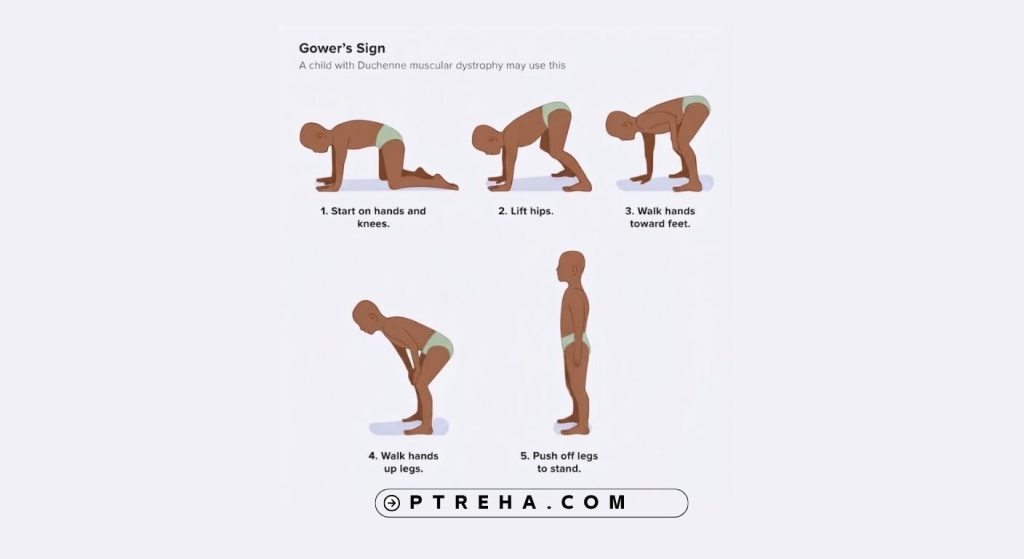
Gower’s Sign is a clinically observable movement pattern that may appear when a person has difficulty rising from the floor because of proximal lower-limb or pelvic-girdle weakness. The characteristic maneuver involves using the upper limbs to push against the floor or “walk” the hands up the thighs while progressing from the floor to standing.
Although Gower’s Sign is classically associated with Duchenne muscular dystrophy, the finding is not specific to Duchenne muscular dystrophy. It can occur in a range of neuromuscular disorders and other conditions associated with proximal weakness. For this reason, it should be interpreted as one component of a broader clinical examination rather than as a diagnosis by itself.
“Gower’s Sign is a clinical finding of movement compensation, not a disease-specific diagnosis.”
What Is Gower’s Sign?
Gower’s Sign is a functional clinical assessment finding observed during the transition from the floor to standing. It reflects difficulty generating sufficient force through the proximal lower limbs and pelvic girdle to rise efficiently without assistance from the upper limbs.
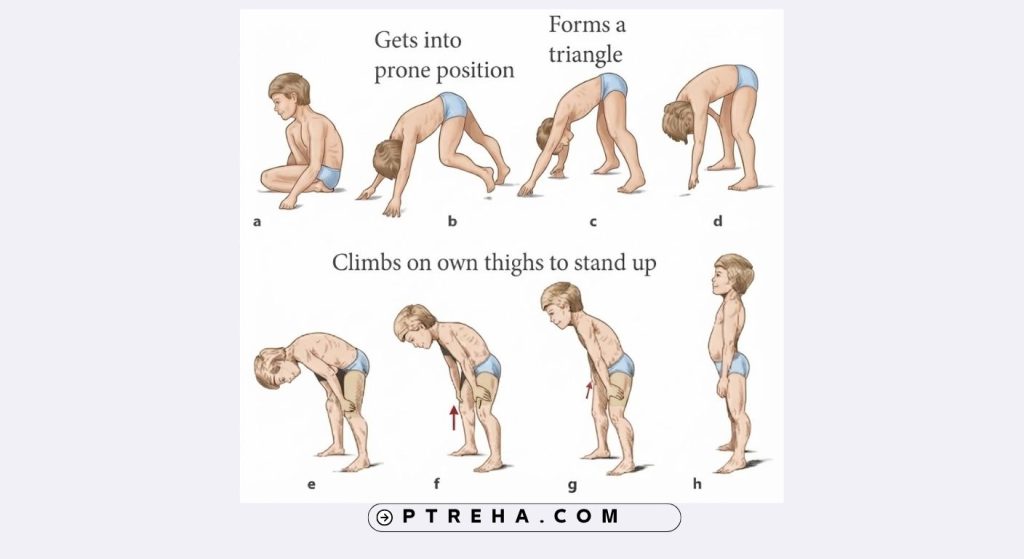
A person demonstrating the classic maneuver may first move into a prone or kneeling position, place the hands on the floor, and then use the arms to assist the lower limbs and trunk. As standing progresses, the hands may move upward along the thighs.
The exact movement pattern varies with the individual’s strength, age, mobility, balance, joint range of motion, pain, body habitus, and underlying condition. Therefore, the maneuver should be observed rather than reduced to a single rigid movement pattern.
Gower’s Sign is particularly well recognized in Duchenne muscular dystrophy, where progressive proximal weakness can interfere with rising from the floor. However, it can also occur in Becker muscular dystrophy, limb-girdle muscular dystrophies, spinal muscular atrophy, inflammatory myopathies, congenital myopathies, and other disorders associated with proximal weakness.
Purpose of the Gower’s Sign
Gower’s Sign can help the clinician:
- Observe how a patient performs a demanding functional transition.
- Identify difficulty associated with proximal lower-limb or pelvic-girdle weakness.
- Observe compensatory use of the upper limbs during rising.
- Support a broader neuromuscular examination.
- Identify functional changes that may warrant further neurological or medical assessment.
- Monitor changes in functional performance when the same assessment is repeated appropriately.
The finding is most useful when considered alongside muscle-strength testing, gait assessment, functional history, neurological examination, developmental history, and other appropriate investigations.
Gower’s Sign Indications
Observation of the maneuver may be appropriate when a patient presents with:
- Difficulty rising from the floor.
- Suspected proximal lower-limb weakness.
- Difficulty climbing stairs, running, jumping, or rising from a squat.
- A waddling or otherwise abnormal gait associated with suspected proximal weakness.
- Delayed or declining gross motor performance.
- Known or suspected neuromuscular disease.
- Functional deterioration that suggests increasing proximal weakness.
In children, the developmental context is particularly important. A hand-assisted strategy for getting up from the floor is not automatically evidence of neuromuscular disease, especially when considered in isolation.
Gower’s Sign Contraindications and Precautions
There is no universally established disease-specific contraindication to observing the Gower maneuver. Instead, clinicians should apply appropriate safety precautions based on the individual’s condition.
- Ensure sufficient space around the patient to reduce injury risk if balance is lost.
- Stay close enough to provide appropriate guarding when the patient has weakness or impaired balance.
- Do not repeatedly fatigue a patient with substantial neuromuscular weakness simply to reproduce the maneuver.
- Stop the assessment if significant pain, distress, dizziness, marked instability, or other concerning symptoms occur.
- Consider contractures, joint limitations, recent injury, or other musculoskeletal problems that may alter the movement.
- Use appropriate assistance when independent floor-to-stand transfer is unsafe.
The assessment should never be performed as a challenge to failure when the patient’s safety is uncertain.
Patient Position
For a commonly described floor-rise observation:
- Begin with the patient on the floor in a position from which they can safely attempt to stand.
- A supine or floor-level starting position may be used depending on the clinical purpose and patient’s abilities.
- The patient should be able to move freely enough for the clinician to observe the complete floor-to-standing transition.
- The starting position should be documented when serial assessments are being compared.
There is no single universal starting position that applies to every clinical situation. The protocol should be consistent when the maneuver is being used to monitor change over time.
Examiner Position
The examiner should:
- Stand or kneel close enough to guard the patient safely.
- Maintain a clear view of the trunk, pelvis, hips, knees, and upper-limb compensation.
- Avoid physically assisting the patient unless assistance is required for safety.
- Observe the entire movement rather than focusing only on whether the hands touch the thighs.
- Note the strategy used to rise, the degree of assistance required, and any obvious compensatory movement.
How to Perform the Gower’s Sign
A practical clinical observation can be performed as follows:
- Explain the task clearly and make sure the patient understands that they are being asked to rise from the floor to standing.
- Position the patient safely on the floor using a starting position appropriate for the patient’s age, ability, and clinical purpose.
- Ask the patient to stand up without unnecessary assistance from the examiner.
- Observe how the patient moves from the floor toward an upright position.
- Look for excessive reliance on the upper limbs, including pushing against the floor or using the hands to move progressively up the thighs.
- Observe the position and movement of the trunk, pelvis, hips, and knees during the transition.
- Note whether the patient can rise smoothly or requires substantial compensatory movement or external assistance.
- If appropriate, document the observed strategy and the level of assistance required.
- Interpret the finding together with the rest of the examination rather than assigning a diagnosis from the maneuver alone.
A classic Gower maneuver involves the hands being used to assist the body upward along the thighs. The underlying movement strategy is a compensation for difficulty producing the force required to extend the hips and knees and bring the trunk upright.
Interpretation
Gower’s Sign should generally be interpreted as an observed functional sign of difficulty with floor-to-standing transfer, often associated with proximal weakness.
The important clinical observation is not simply whether the hands touch the thighs. The clinician should consider the complete movement strategy, including whether the patient needs the upper limbs to compensate for insufficient lower-limb or pelvic-girdle force.
A Gower-type maneuver can occur for reasons other than primary muscle disease. Pain, restricted joint motion, reduced physical conditioning, body habitus, balance limitations, and other functional or neurological factors can influence how a person rises from the floor.
Consequently, the finding does not independently establish the presence of muscular dystrophy or another neuromuscular disorder.
What Does a Gower’s Sign Mean?
When a clear Gower-type maneuver is observed in a patient with other signs of proximal weakness, it can increase clinical concern for a disorder affecting the neuromuscular system.
In Duchenne muscular dystrophy, Gower’s Sign is a well-recognized clinical feature and reflects the functional consequences of progressive proximal weakness. However, the same general movement pattern can occur in several other disorders.
The appropriate clinical response is therefore not to label the patient based solely on the maneuver. Instead, the finding should prompt consideration of the broader pattern of weakness and other examination findings.
“A Gower-type maneuver should trigger clinical reasoning, not diagnostic closure.”
Anatomy Involved in Gower’s Sign
Gower’s Sign does not isolate a single muscle or anatomical structure. Successful rising from the floor requires coordinated force production from multiple regions and systems.
Relevant components include:
- Pelvic girdle and hip extensors: contribute to bringing the pelvis and trunk toward an upright position.
- Hip abductors and other hip musculature: contribute to pelvic and lower-limb control during the transition.
- Knee extensors: contribute to extending the knees as the individual progresses toward standing.
- Trunk musculature: contributes to controlling and extending the trunk.
- Upper limbs: provide compensatory support when lower-limb and pelvic-girdle force is insufficient.
- Central and peripheral nervous systems: coordinate the motor sequence and postural adjustments required for the task.
- Balance and postural-control systems: contribute to maintaining stability during the transition.
The movement therefore represents a coordinated functional task rather than an isolated test of one muscle.
Conditions Associated With Gower’s Sign
Gower’s Sign may be associated with conditions producing clinically important proximal weakness, including:
- Duchenne muscular dystrophy.
- Becker muscular dystrophy.
- Limb-girdle muscular dystrophies.
- Spinal muscular atrophy.
- Some congenital muscular dystrophies and congenital myopathies.
- Inflammatory myopathies.
- Other neuromuscular disorders that produce proximal lower-limb or pelvic-girdle weakness.
It can also be influenced by non-neuromuscular factors that make floor-to-standing more difficult.
Therefore, the presence of the sign should be considered a clinical clue, not confirmation of any particular disease.
Clinical Significance
Gower’s Sign can be particularly valuable during the initial physical examination because it allows the clinician to observe weakness through a functional task rather than relying exclusively on isolated manual muscle testing.
It may help the clinician:
- Recognize a pattern suggestive of proximal weakness.
- Decide whether a more detailed neurological or neuromuscular examination is warranted.
- Compare functional movement strategies over time when the same protocol is used.
- Identify compensatory movement strategies.
- Communicate functional observations to other members of the healthcare team.
In suspected neuromuscular disease, the finding should be integrated with the history, developmental or functional trajectory, gait, strength examination, reflexes, contractures, and other relevant clinical findings.
Sensitivity and Specificity
A universal sensitivity or specificity value for Gower’s Sign should not be presented.
The finding is not specific to Duchenne muscular dystrophy or to one particular neuromuscular diagnosis, and published descriptions use different patient populations and approaches to defining the maneuver. Consequently, a single sensitivity or specificity figure would not appropriately represent the clinical value of Gower’s Sign across populations.
Diagnostic Accuracy
Gower’s Sign should not be treated as a stand-alone diagnostic test.
Its principal value is as a clinical observation that can identify a pattern of functional difficulty associated with proximal weakness. Establishing the cause requires appropriate clinical evaluation and, when indicated, diagnostic investigations.
For example, suspected dystrophinopathy requires more than recognition of Gower’s Sign; diagnosis is based on the overall clinical and laboratory/genetic evaluation.
Common Mistakes in Gower’s Sign
- Treating Gower’s Sign as synonymous with Duchenne muscular dystrophy.
- Assuming that every child who pushes on the thighs has pathological weakness.
- Using a rigid hand-position rule instead of observing the entire movement.
- Ignoring pain or restricted joint mobility as possible contributors.
- Failing to consider body habitus and general functional ability.
- Calling the finding “positive” without describing what was actually observed.
- Using the maneuver as a substitute for formal neurological or strength assessment.
- Repeatedly testing a significantly weak patient until fatigue occurs.
- Providing physical assistance without documenting that assistance.
- Comparing results obtained with substantially different starting positions or procedures.
- Assuming that the maneuver identifies one specific weak muscle.
- Making a diagnosis from Gower’s Sign alone.
Tips for Performing the Gower’s Sign
- Prioritize patient safety over reproducing the maneuver.
- Explain the task before the patient begins.
- Observe the complete floor-to-standing sequence.
- Look for compensatory use of the hands rather than focusing only on whether the hands touch the thighs.
- Compare the movement with the patient’s overall functional presentation.
- Consider age and developmental expectations when assessing children.
- Record the starting position and assistance level when monitoring change.
- Combine the observation with objective strength and neurological assessment.
- Avoid unnecessary repetition in patients with substantial weakness.
- Refer for appropriate medical or neuromuscular evaluation when the finding occurs with other concerning signs.
Summary
- Gower’s Sign is a clinical functional finding associated with difficulty rising from the floor in the presence of proximal lower-limb or pelvic-girdle weakness.
- The characteristic maneuver involves compensatory use of the upper limbs, often with the hands pushing against the floor or moving upward along the thighs.
- It is classically associated with Duchenne muscular dystrophy, but it is not disease-specific and can occur in several other neuromuscular conditions.
- The finding does not isolate one muscle and does not independently establish a diagnosis.
- Safe observation, consistent technique, and integration with the wider neurological and functional examination are essential.
Gower’s Sign remains a useful bedside observation because it turns a demanding functional movement into clinically meaningful information about how a patient generates and compensates for weakness. Its greatest value comes from recognizing the movement pattern early and placing it within the patient’s complete clinical picture rather than treating it as a stand-alone diagnostic test.
Evidence and resources
The clinical interpretation above is supported by established medical references describing Gower’s Sign as a manifestation of proximal weakness and emphasizing that it is not specific to Duchenne muscular dystrophy. The video-analysis literature also describes a spectrum of Gower-type movement strategies rather than a single rigid presentation.
- NCBI GeneReviews – Dystrophinopathies: detailed clinical features and diagnostic approach to Duchenne and Becker muscular dystrophies. NCBI GeneReviews: Dystrophinopathies
- NCBI MedGen – Gowers Sign: clinical definition and classification of the finding as a manifestation of proximal muscle weakness. NCBI MedGen: Gowers Sign
- StatPearls – Gower Sign: clinical description, performance characteristics, and conditions associated with the finding. StatPearls: Gower Sign
- Pathomechanics of Gowers’ Sign: peer-reviewed analysis of the movement pattern and compensatory strategies. Pathomechanics of Gowers’ Sign – PubMed
- Merck Manual Professional – Assessment of Muscle Strength: functional assessment context for rising from the floor and proximal weakness.