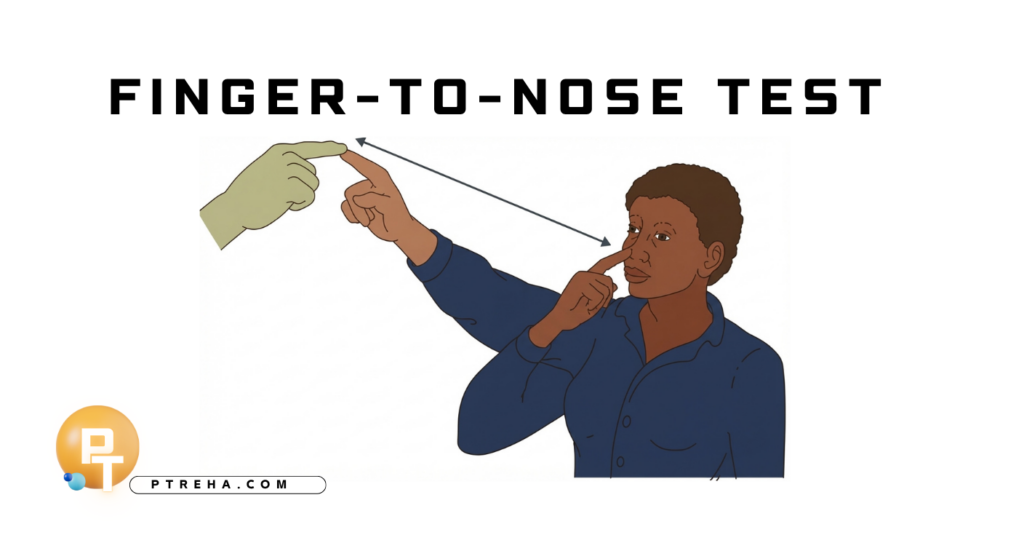
The Finger-to-Nose Test is a bedside neurological assessment used to examine upper-limb coordination during a goal-directed movement. It is commonly used as part of the cerebellar examination to look for findings such as dysmetria, intention tremor, and decomposition of movement, while recognizing that abnormal performance can also reflect sensory, visual, strength, or other neurological factors.
What Is the Finger-to-Nose Test?
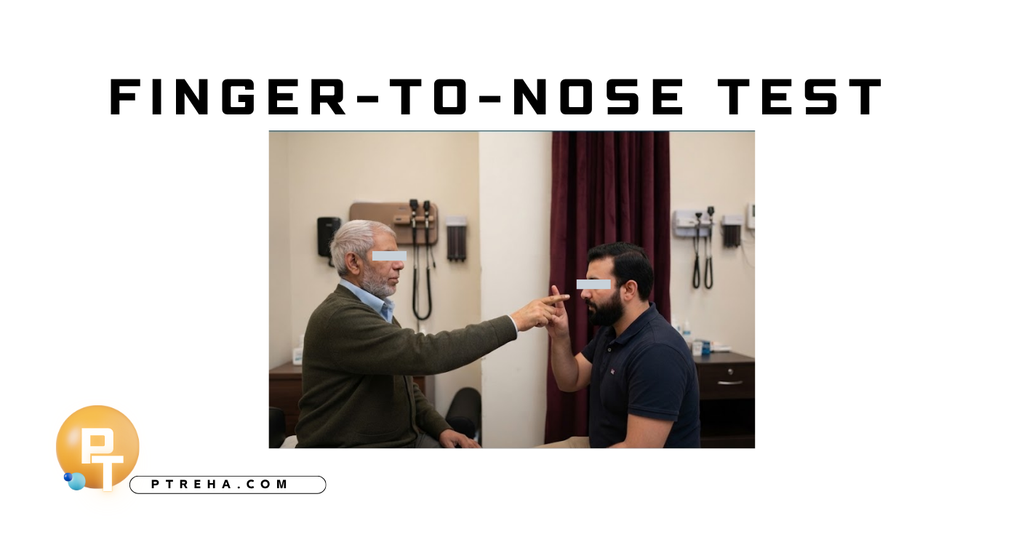
The Finger-to-Nose Test is a neurological clinical assessment of coordination. A commonly used version asks the patient to move the index finger between the examiner’s finger and the patient’s own nose while the examiner observes the accuracy, smoothness, timing, and control of the movement. A related finger-nose-finger version is also widely used in neurological examinations.
The test is particularly useful when assessing possible impairment of cerebellar function. The cerebellum contributes to the timing, scaling, and coordination of voluntary movement, and dysfunction may produce errors in reaching a target or irregular movement as the target is approached.
The maneuver should not be interpreted in isolation. An abnormal result is a clinical finding that may contribute to neurological localization and differential diagnosis; it does not by itself establish the cause of the impairment. Sensory loss, impaired proprioception, weakness, visual problems, pain, or difficulty understanding the instructions can also influence performance.
“Accuracy of movement is more informative than simply completing the task.”
Purpose of the Finger-to-Nose Test
- Assess upper-limb coordination during a goal-directed movement.
- Observe for dysmetria, including overshooting or undershooting the intended target.
- Identify movement irregularity or decomposition.
- Observe for intention or kinetic tremor that becomes more apparent as the hand approaches the target.
- Contribute to the neurological examination when cerebellar dysfunction or ataxia is suspected.
- Compare performance between the right and left upper limbs.
Finger-to-Nose Test Indications
The maneuver may be included when the patient presents with clinical features that raise concern about impaired coordination or ataxia, such as:
- Unsteady or inaccurate upper-limb movements.
- Suspected cerebellar dysfunction.
- New or unexplained problems with coordination.
- Neurological conditions in which limb ataxia is part of the clinical presentation.
- Assessment of neurological status after a condition affecting the central nervous system, when clinically appropriate.
It may also be useful during serial neurological examinations to document whether coordination findings are changing over time. Repeated neurological examinations can contribute to assessment of clinical course and response to treatment.
Finger-to-Nose Test Contraindications and Precautions
There is no universally established absolute contraindication specific to the standard bedside maneuver itself. Safety should instead be guided by the patient’s clinical condition.
- Stop or modify the maneuver if it causes significant pain or aggravates an acute upper-limb injury.
- Consider the patient’s ability to understand and follow the command before interpreting performance.
- Take account of marked weakness, restricted shoulder or elbow movement, severe tremor, visual impairment, or sensory loss that could interfere with the task.
- Position the patient safely, particularly when the test is performed as part of a broader neurological examination in someone with significant balance or mobility impairment.
- Avoid interpreting a single abnormal attempt without considering the patient’s overall neurological examination and relevant contributing factors.
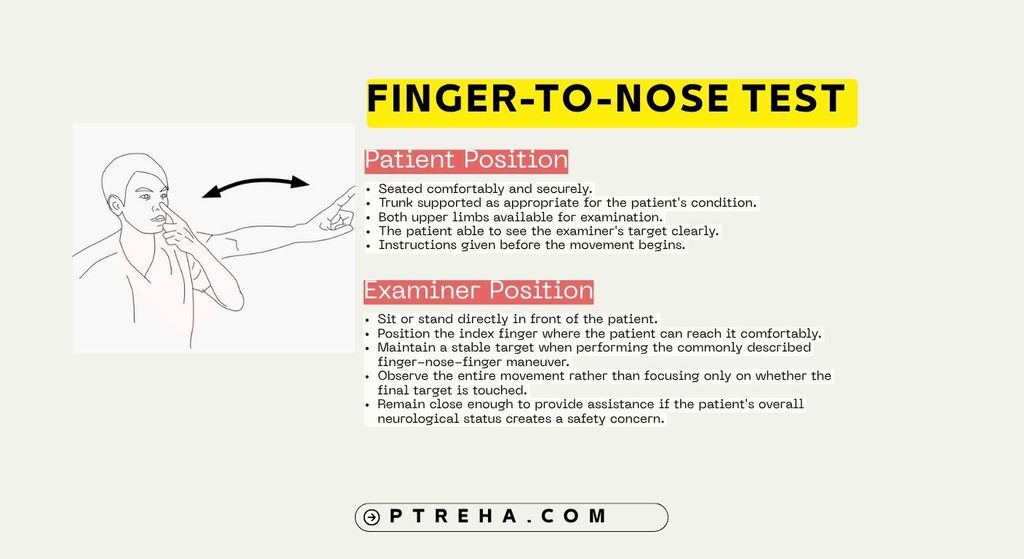
Patient Position
A commonly used bedside position is:
- Seated comfortably and securely.
- Trunk supported as appropriate for the patient’s condition.
- Both upper limbs available for examination.
- The patient able to see the examiner’s target clearly.
- Instructions given before the movement begins.
The exact setup can vary according to the clinical environment and examination protocol. Standardized assessments should follow their specified instructions rather than combining procedures from different protocols.
Examiner Position
- Sit or stand directly in front of the patient.
- Position the index finger where the patient can reach it comfortably.
- Maintain a stable target when performing the commonly described finger-nose-finger maneuver.
- Observe the entire movement rather than focusing only on whether the final target is touched.
- Remain close enough to provide assistance if the patient’s overall neurological status creates a safety concern.
How to Perform the Finger-to-Nose Test
A commonly used finger-to-nose-finger procedure can be performed as follows:
- Explain the task clearly to the patient.
- Ask the patient to extend the index finger.
- Ask the patient to touch the examiner’s index finger.
- Ask the patient to bring the same finger to the tip of their own nose.
- Repeat the movement between the examiner’s finger and the patient’s nose.
- Observe the quality of the movement throughout the task.
- Repeat the examination with the opposite upper limb.
- Compare the two sides and relate the findings to the remainder of the neurological examination.
The examiner should watch for accuracy, smoothness, timing, trajectory, and any corrective movements. Intention tremor may become more noticeable as the finger approaches the target, while dysmetria may appear as overshooting or undershooting.
Some neurological protocols vary in their instructions, speed, target position, or whether the task is performed as finger-to-nose or finger-nose-finger. These differences matter when results are being compared across formal assessments or research protocols.
Test Findings and Interpretation
The Finger-to-Nose Test is better interpreted through observed performance than through a universal positive/negative framework.
Dysmetria
Dysmetria refers to inaccurate control of the distance or force required to reach a target. The patient may consistently overshoot or undershoot the examiner’s finger or their nose, or may require corrective movements to reach the target.
Dysmetria is an important finding in cerebellar examination, but it is not synonymous with a specific diagnosis.
Intention or Kinetic Tremor
A tremor that becomes more prominent as the finger approaches the target may be seen with cerebellar dysfunction. This observation is commonly described during finger-nose-finger examination.
Decomposition of Movement
Instead of moving smoothly toward the target, the patient may divide the movement into separate components. This can be seen with impaired coordination involving cerebellar systems.
Irregular or Inaccurate Movement
The movement may appear poorly timed, inconsistent, or clumsy. The clinical significance becomes stronger when the finding is consistent and occurs together with other neurological abnormalities.
“An abnormal coordination test is a finding to investigate, not a diagnosis by itself.”
What Does an Abnormal Finger-to-Nose Test Mean?
Abnormal performance may indicate impaired coordination, particularly when there is dysmetria, intention tremor, or other features suggesting limb ataxia. Cerebellar dysfunction is an important consideration, especially when the finding is accompanied by other cerebellar signs such as gait ataxia, dysarthria, nystagmus, or impaired rapid alternating movements.
However, the maneuver does not isolate the cerebellum. Accurate performance requires appropriate motor output, sensory information, proprioception, vision, and the ability to understand and execute the task. For this reason, an abnormal result should be interpreted alongside strength, sensory, cranial nerve, eye movement, gait, and other relevant neurological findings.
Negative Finger-to-Nose Test
The terms positive and negative are less useful here than describing the observed performance.
A patient who accurately reaches the target with smooth, well-controlled movements and without clinically meaningful dysmetria or intention tremor has no obvious abnormality on this particular coordination maneuver.
A normal performance does not exclude neurological disease. A patient can have neurological impairment that is not revealed by this maneuver, and coordination findings can vary with the condition being assessed and the sensitivity of the overall examination.
Anatomy Involved in Finger-to-Nose Test
The task depends on the coordinated function of several anatomical and physiological systems:
- Cerebellum: contributes to the timing, scaling, accuracy, and coordination of voluntary movement.
- Cerebellar hemispheres: particularly important for coordination of skilled limb movements.
- Proprioceptive pathways: provide information about limb position and movement.
- Visual system: contributes information about the location of the target.
- Cerebral motor systems: generate and control the voluntary movement required to reach the target.
- Peripheral neuromuscular system: provides the strength and movement needed to execute the task.
Because multiple systems contribute to successful performance, the test should not be described as a direct test of one muscle, nerve, or isolated anatomical structure.
Conditions Associated With Abnormal Finger-to-Nose Performance
Abnormal coordination may occur in conditions involving cerebellar or broader neurological dysfunction. Examples include:
- Cerebellar stroke.
- Multiple sclerosis with cerebellar involvement.
- Hereditary or degenerative cerebellar ataxias.
- Other disorders affecting cerebellar pathways.
- Sensory ataxia associated with impaired proprioceptive input or peripheral neuropathy, which may produce inaccurate movement for a different mechanism.
These conditions should be regarded as clinical possibilities associated with relevant findings, not diagnoses established by the Finger-to-Nose Test alone.
Clinical Significance
The Finger-to-Nose Test can contribute useful information when interpreted as part of a comprehensive neurological assessment.
- It can help identify limb coordination abnormalities.
- It may support recognition of appendicular ataxia.
- Side-to-side comparison can reveal asymmetry that deserves further examination.
- Findings can guide the clinician toward additional sensory, motor, ocular, speech, and gait examination.
- Serial examinations may help document changes in neurological performance over time.
For patients undergoing rehabilitation, the test can also provide qualitative information about coordination, although the bedside maneuver should not be treated as a standalone measure of overall functional ability, balance, or fall risk.
Scoring and Measurement
The basic Finger-to-Nose Test does not have one universal standalone scoring system used across all clinical settings.
Formal ataxia scales may incorporate a standardized nose-finger or finger-nose-finger item within a broader assessment. For example, the Scale for the Assessment and Rating of Ataxia (SARA) includes a nose-finger component as one part of an eight-item assessment of ataxia. Its scoring belongs to the SARA protocol and should not be transferred to an informal bedside version of the test.
When the maneuver is used for routine examination, qualitative documentation is often more appropriate, such as noting accurate versus inaccurate targeting, presence of dysmetria, tremor, decomposition, and side-to-side differences.
Sensitivity and Specificity
Universal sensitivity and specificity values should not be assigned to the Finger-to-Nose Test. Its clinical performance depends on the population, the neurological condition being considered, the exact examination protocol, and what outcome is being used as the reference.
Diagnostic Accuracy
The Finger-to-Nose Test is a clinical neurological examination maneuver rather than a standalone diagnostic test. Its value is primarily in identifying coordination abnormalities and contributing to the broader neurological examination and differential diagnosis.
A diagnosis should be based on the complete clinical picture, including history, examination, and additional investigations when indicated.
Common Mistakes in Finger-to-Nose Test
- Looking only at whether the patient eventually touches the target.
- Ignoring overshooting or undershooting.
- Failing to observe the movement as the finger approaches the target.
- Performing the task so quickly that subtle coordination abnormalities are missed.
- Testing only one arm.
- Changing the procedure between sides without realizing that the protocol has changed.
- Interpreting poor performance as cerebellar disease without considering weakness, pain, vision, or sensory impairment.
- Calling the maneuver simply “positive” without describing the actual finding.
- Treating the result as diagnostic without considering the rest of the neurological examination.
Tips for Performing the Finger-to-Nose Test
- Give a simple demonstration before asking the patient to begin.
- Watch the entire trajectory of the finger.
- Use a consistent examiner target when comparing sides or repeating the test.
- Look for dysmetria, corrective movements, decomposition, and target-related tremor.
- Compare right and left sides.
- Consider sensory and visual contributions before attributing an abnormality to cerebellar dysfunction.
- Keep the patient’s symptoms, age, functional status, and neurological context in mind.
- Document the actual observed finding rather than relying on a generic label.
- When using a formal ataxia scale, follow that scale’s standardized instructions and scoring system exactly.
Summary
The Finger-to-Nose Test is a neurological coordination assessment commonly used to examine upper-limb control and to look for clinical signs of limb ataxia.
Its main observable findings include dysmetria, intention tremor, and decomposition of movement, particularly when these occur in a pattern consistent with impaired cerebellar coordination.
The test should be performed systematically, with attention to the quality and accuracy of movement and comparison between sides.
An abnormal finding does not by itself establish cerebellar disease or another diagnosis. Weakness, sensory impairment, proprioceptive deficits, visual factors, pain, and other neurological problems can also affect performance.
For clinical interpretation, the Finger-to-Nose Test is most useful when integrated with the patient’s history and the rest of the neurological examination rather than used in isolation.
Resources and External Links
NCBI Bookshelf – Neurologic Exam: overview of neurological examination and cerebellar coordination testing. Neurologic Exam – NCBI Bookshelf
NCBI Bookshelf – Cerebellar Dysfunction: discussion of cerebellar signs, dysmetria, intention tremor, and the finger-nose examination. Cerebellar Dysfunction – NCBI Bookshelf
Merck Manual Professional – Cerebellar Disorders: clinical description of ataxia, dysmetria, and other cerebellar signs. Cerebellar Disorders – Merck Manual Professional Edition
Evaluation of Cerebellar Ataxic Patients – PMC: practical discussion of appendicular examination and differentiation of cerebellar and sensory ataxia. Evaluation of Cerebellar Ataxic Patients – PMC
SARA Assessment: information on the standardized Scale for the Assessment and Rating of Ataxia and its nose-finger component. SARA Training and Assessment – PMC