The Empty Can Test is a commonly used orthopedic special test in the clinical examination of the shoulder. It is primarily used to assess pain and force production during resisted arm elevation in the scapular plane, particularly when investigating possible rotator cuff or supraspinatus-related shoulder pathology. However, the test should be interpreted as one part of a broader shoulder examination rather than as a stand-alone diagnostic test.
Clinical Classification of the Empty Can Test
The Empty Can Test is best classified as an orthopedic special test and clinical assessment maneuver used during shoulder examination.
It is not an outcome measure, functional performance test, or neurological screening test. The maneuver challenges shoulder elevation against resistance and records clinically relevant findings such as pain, weakness, or an asymmetry between sides.
Different studies and clinical protocols have used slightly different test positions and different definitions of a positive finding. This variability is important when comparing research findings or interpreting diagnostic accuracy.
What Is the Empty Can Test?
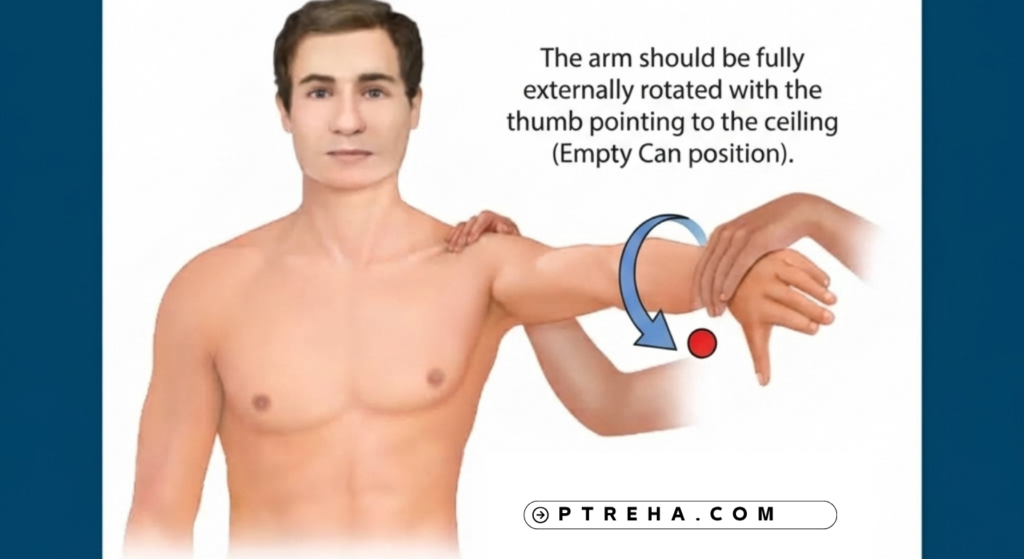
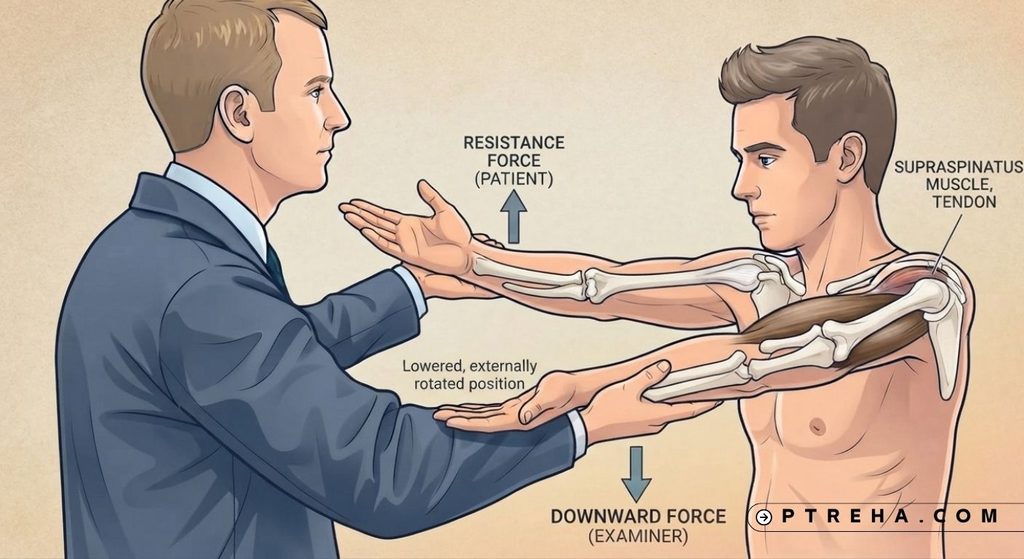
The Empty Can Test, also called the Jobe Test or supraspinatus test, is performed with the arm elevated in the scapular plane and the thumb directed downward, creating the appearance of “emptying a can.” The patient then resists a downward force applied by the examiner.
Clinically, the examiner observes whether the maneuver reproduces the patient’s familiar shoulder pain, produces a noticeable reduction in force, or reveals a meaningful side-to-side difference.
Although the test is traditionally associated with the supraspinatus, it does not selectively activate only the supraspinatus. Electromyographic research has demonstrated substantial activity from multiple shoulder muscles during both empty-can and full-can positions. Therefore, the maneuver should not be described as a pure isolation test of one muscle.
“A painful or weak response is a clinical finding, not a diagnosis by itself.”
Purpose of the Empty Can Test
The test is commonly used to:
- Assess the patient’s response to resisted shoulder elevation in the scapular plane.
- Investigate symptoms potentially related to rotator cuff pathology.
- Assess for pain or weakness that may increase suspicion of supraspinatus involvement.
- Compare the symptomatic shoulder with the opposite side when appropriate.
- Contribute to a broader shoulder examination that may include active and passive range of motion, resisted testing, palpation, and other special tests.
The principal value of the test is therefore clinical integration, rather than a single yes-or-no diagnosis.
Empty Can Test Indications
The maneuver may be considered when the patient presents with:
- Shoulder pain associated with arm elevation or loading.
- Suspected rotator cuff-related shoulder pain.
- Clinical features that raise suspicion of supraspinatus tendon pathology.
- Pain or weakness during resisted elevation that requires further assessment.
- Possible rotator cuff tear as part of a structured shoulder examination.
Its use should be guided by the patient’s history, symptom behavior, functional limitations, and findings from the rest of the examination rather than by the presence of one symptom alone.
Empty Can Test Contraindications and Precautions
There are no universally established test-specific contraindications that apply to every patient and every clinical setting. Instead, the maneuver should be modified or avoided when resisted shoulder loading is inappropriate.
Relevant safety precautions include:
- Use caution after recent shoulder surgery when resisted loading is restricted by the postoperative protocol.
- Use caution after acute traumatic injury when a fracture, dislocation, major tissue injury, or other unstable condition has not been adequately assessed.
- Stop or modify the test if it produces severe, escalating, or otherwise concerning pain.
- Avoid forcing the patient into a position that exceeds their comfortable active range.
- Match resistance to the patient’s ability rather than applying excessive downward force.
A painful response should not automatically be treated as evidence of structural damage. Pain during resisted shoulder movement is a clinical finding that must be interpreted in context.
Patient Position
A commonly described Empty Can Test position is:
- The patient is sitting or standing with the trunk upright.
- The arm is elevated to approximately shoulder height.
- The arm is positioned in the scapular plane, slightly forward of the frontal plane.
- The elbow is generally extended.
- The shoulder is internally rotated so that the thumb points downward.
- The patient maintains the position while resisting the examiner’s downward force.
Exact positioning varies somewhat between published protocols. The protocol being used should therefore be kept consistent when comparing findings over time or between examinations.
Examiner Position
The examiner should:
- Stand facing or slightly to the side of the patient.
- Position one hand or contact point over the distal arm or forearm to apply controlled downward resistance.
- Provide enough support for the patient to maintain the testing position safely.
- Observe the scapula, trunk, shoulder, and arm for compensatory movement.
- Compare the involved side with the opposite side when this comparison is clinically appropriate.
The examiner should avoid excessive force that makes pain the only outcome of the test.
How to Perform the Empty Can Test
- Explain the maneuver and tell the patient that the aim is to maintain the arm position while resisting the examiner.
- Position the patient’s arm in the scapular plane at approximately shoulder height.
- Ask the patient to rotate the shoulder so that the thumb points downward.
- Keep the elbow extended unless the selected protocol specifies otherwise.
- Ask the patient to hold the arm in position.
- Apply a controlled downward force while instructing the patient to resist without allowing the arm to drop.
- Observe for pain, weakness, inability to maintain the position, compensatory trunk or scapular movement, and differences compared with the opposite side.
- Document the patient’s response rather than simply recording the test as positive or negative when more detailed documentation is possible.
When pain is present, it is useful to ask whether the pain is familiar to the patient’s presenting complaint and to document its location and behavior.
What Constitutes a Positive Empty Can Test?
A positive Empty Can Test has not been defined identically across all research studies.
Some protocols have considered pain reproduction the key positive finding, while others have used weakness, or pain and weakness together. Research reviews have specifically noted this variation in positivity criteria.
For clinical documentation, it is therefore preferable to record the specific finding:
- Pain reproduced: yes/no
- Weakness or reduced force: yes/no
- Familiar pain: yes/no
- Side-to-side difference: present/absent
- Compensatory movement: present/absent
This approach preserves more clinical information than a simple positive/negative label.
What Does a Positive Empty Can Test Mean?
A painful response may increase suspicion that the tested shoulder is symptomatic during resisted elevation. Weakness may raise concern for rotator cuff dysfunction, including possible supraspinatus involvement, but the finding does not establish a tear by itself.
A positive finding can occur in different shoulder disorders, and pain and weakness should not automatically be interpreted as equivalent findings.
Importantly, the Empty Can Test does not demonstrate that a specific tendon is the sole source of symptoms. Multiple muscles contribute to the maneuver, and other structures may influence the patient’s response.
Negative Empty Can Test
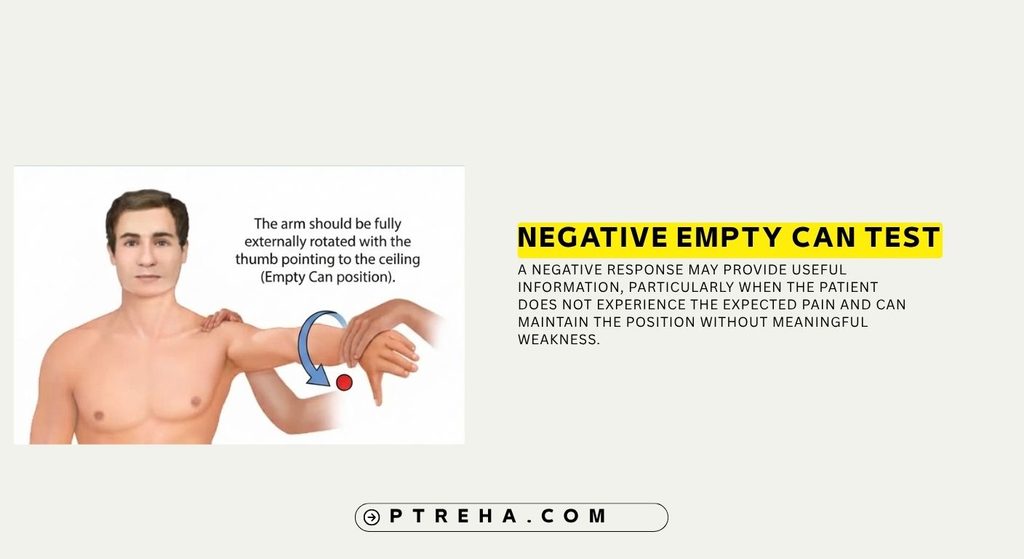
A negative response may provide useful information, particularly when the patient does not experience the expected pain and can maintain the position without meaningful weakness.
However, a negative Empty Can Test does not exclude all rotator cuff pathology. Systematic reviews have found that individual shoulder special tests have limited and variable diagnostic performance, and no single maneuver should be used in isolation to determine whether a rotator cuff tear is present.
Anatomy Involved in Empty Can Test
The maneuver involves several structures and systems:

- Supraspinatus: contributes to shoulder elevation and is the structure most traditionally associated with the test.
- Deltoid: contributes substantially to arm elevation and force production during the maneuver.
- Infraspinatus, subscapularis, and teres minor: the remaining rotator cuff muscles contribute to glenohumeral control and shoulder stability.
- Scapular stabilizers: muscles controlling the scapula contribute to maintaining the testing position.
- Glenohumeral joint and surrounding soft tissues: shoulder symptoms may arise from multiple structures during resisted elevation.
Because the maneuver recruits several muscles, the Empty Can Test should not be described as selectively isolating the supraspinatus.
Conditions Detected or Associated With the Test
The Empty Can Test has been investigated primarily in relation to:
- Supraspinatus tendon tears.
- Rotator cuff tears.
- Rotator cuff-related shoulder pain.
- Other painful shoulder conditions in which resisted elevation reproduces symptoms.
The test can contribute to clinical reasoning when a rotator cuff disorder is suspected, but it does not independently confirm any of these conditions. Studies have reported variable diagnostic performance depending on the patient population, reference standard, test protocol, and definition of a positive result.
Clinical Significance
The Empty Can Test can be clinically useful when it is integrated with other examination findings.
Its role may include:
- Identifying painful or weak resisted shoulder elevation.
- Helping determine whether rotator cuff pathology deserves further investigation.
- Supporting a working clinical hypothesis rather than establishing a definitive structural diagnosis.
- Providing a baseline finding that can be reassessed during rehabilitation.
- Helping the clinician decide whether additional shoulder testing or imaging should be considered.
Recent systematic-review evidence continues to emphasize that the diagnostic value of individual shoulder tests is limited and that combinations of clinical information are generally more informative than relying on a single maneuver.
“Use the Empty Can Test to add information to the examination—not to replace the examination.”
Sensitivity and Specificity
Reported sensitivity and specificity for the Empty Can or Jobe Test vary substantially across studies because the patient populations, reference standards, test techniques, and definitions of a positive response differ.
For example, studies have reported different results depending on whether pain, weakness, or a combination of both was considered positive. Systematic reviews have also found substantial heterogeneity and have concluded that no single shoulder special test provides sufficiently reliable diagnostic information on its own.
For this reason, there is no single universal sensitivity or specificity value that should be presented as applying to every patient.
Diagnostic Accuracy
The Empty Can Test has demonstrated diagnostic value in some studies, particularly when evaluating suspected supraspinatus or rotator cuff tears, but the magnitude of that value varies.
A systematic review and meta-analysis of shoulder physical examination tests found that the supraspinatus/Jobe test had diagnostic value for full-thickness rotator cuff tears, while also concluding that the clinical performance of individual physical examination tests remained limited.
A later systematic review focusing on posterosuperior rotator cuff tears reported that the Jobe Test had useful pooled sensitivity, but the authors emphasized that no single clinical test was sufficiently reliable to diagnose these tears on its own.
More recently, a 2024 systematic review and meta-analysis covering 20 studies and 3,438 patients described the overall evidence for shoulder physical examination diagnostic accuracy as low quality and again highlighted the limitations of relying on individual tests.
Common Mistakes in Empty Can Test
- Treating the test as a definitive test for a supraspinatus tear.
- Describing it as an isolated supraspinatus test despite multi-muscle activation.
- Using excessive resistance that unnecessarily provokes pain.
- Failing to observe compensatory trunk or scapular movement.
- Recording only “positive” without documenting whether the response was pain, weakness, or both.
- Comparing research values from protocols that used different positivity criteria.
- Ignoring the patient’s history and other shoulder examination findings.
- Assuming that pain automatically indicates structural tendon damage.
- Assuming that absence of pain or weakness rules out all rotator cuff pathology.
Tips for Performing the Empty Can Test
- Explain the maneuver before applying resistance.
- Use a reproducible arm position.
- Apply gradual, controlled resistance.
- Compare sides when an appropriate comparison is available.
- Ask about the patient’s familiar pain rather than simply asking whether the maneuver hurts.
- Observe the quality of movement as well as force production.
- Document pain and weakness separately.
- Consider the Empty Can Test alongside active and passive range of motion, resisted testing, symptom behavior, and other relevant shoulder tests.
- Use imaging or additional medical assessment when the overall clinical picture warrants structural investigation.
References and External Resources
1. Merck Manual Professional Edition — Evaluation of the Shoulder
Comprehensive clinical examination guidance, including the Empty Can/Jobe maneuver and shoulder strength testing.
Open source
2. Stanford Medicine 25 — Shoulder Exam Tutorial
Clinical teaching resource describing shoulder examination and the Empty Can Test.
Open source
3. Zhao Q, et al. — Evidence-based approach to the shoulder examination for subacromial bursitis and rotator cuff tears: systematic review and meta-analysis
Recent systematic review examining the diagnostic performance of physical examination tests for rotator cuff tears and subacromial conditions.
4. Hanchard NCA, et al. — Physical examination tests of the shoulder: a systematic review and meta-analysis
Review of shoulder physical examination tests and their diagnostic performance.
5. Hermans J, et al. — Most clinical tests cannot accurately diagnose rotator cuff pathology: a systematic review
Systematic review highlighting the limitations of individual clinical tests.
PubMed record
6. Gismervik SO, et al. — Reliable diagnosis of posterosuperior rotator cuff tears requires a combination of clinical tests
Systematic review addressing the diagnostic value of the Jobe Test and other shoulder tests.
PubMed record
7. Itoi E, et al. — Which is more useful, the full can test or the empty can test, in detecting the torn supraspinatus tendon?
Study comparing Empty Can and Full Can testing and examining pain and weakness as findings.
PubMed record
8. Boettcher CE, et al. — The “empty can” and “full can” tests do not selectively activate supraspinatus
Electromyographic evidence relevant to interpretation of the test as a muscle-specific maneuver.
PubMed record
Summary
The Empty Can Test is an orthopedic special test used during shoulder assessment, particularly when rotator cuff or supraspinatus-related pathology is suspected. It involves resisted arm elevation in the scapular plane with the thumb pointing downward.
Pain, weakness, or an inability to maintain the testing position may provide clinically useful information, but these findings are not synonymous with a diagnosis. Different protocols use different definitions of a positive result, so pain and weakness should ideally be documented separately.
The test also does not selectively activate the supraspinatus; several shoulder muscles contribute to the maneuver. Diagnostic accuracy varies between studies, and current evidence does not support using the Empty Can Test alone to confirm or exclude a rotator cuff tear.
Used as one component of a structured shoulder examination, the test can provide useful information that helps guide further clinical reasoning and management.