The Duncan-Ely Test, also called the Ely Test or prone rectus test, is a clinical assessment used primarily to examine velocity-dependent rectus femoris overactivity/spasticity, particularly in patients with cerebral palsy and stiff-knee gait.
It is performed with the patient prone while the examiner rapidly flexes the knee and observes for an associated rise or flexion of the ipsilateral hip and/or a sudden increase in resistance.
The finding contributes to the clinical examination but should not be interpreted as a stand-alone diagnosis or as a definitive measure of rectus femoris activity during gait.
What Is the Duncan-Ely Test?
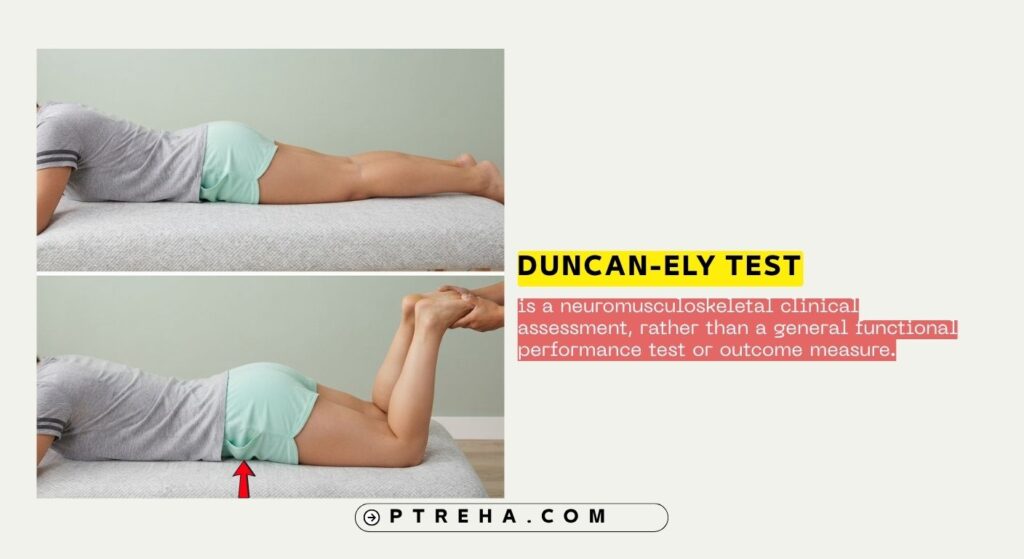
The Duncan-Ely Test is a neuromusculoskeletal clinical assessment, rather than a general functional performance test or outcome measure.
Its traditional clinical use is to assess rectus femoris spasticity or overactivity through a rapid passive knee-flexion maneuver.
The rectus femoris crosses both the hip and knee.
During rapid passive knee flexion, excessive velocity-dependent resistance or an associated movement of the ipsilateral hip can indicate abnormal rectus femoris response.
The classic examination is performed with the patient lying prone and relaxed.
The examiner rapidly flexes the knee while monitoring the pelvis and hip.
A commonly described positive response is ipsilateral hip flexion or elevation of the hip/pelvis during rapid knee flexion, sometimes accompanied by a perceived increase in resistance.
Importantly, the Duncan-Ely Test does not directly record muscle activity.
It is a bedside clinical examination.
Dynamic electromyography and three-dimensional gait analysis provide different types of information and may be necessary when precise assessment of rectus femoris activity during walking is required.
“A Duncan-Ely finding is a clinical observation, not a diagnosis by itself.”
Purpose of the Duncan-Ely Test
- Assess for a velocity-dependent response suggestive of rectus femoris spasticity or overactivity.
- Contribute to the examination of patients with stiff-knee gait.
- Help identify patients who may require more detailed gait assessment.
- Support preoperative clinical assessment in selected patients with cerebral palsy.
- Compare the response between limbs when clinically appropriate.
- Complement other assessments of muscle tone, passive range of motion, gait, and motor control.
Duncan-Ely Test Indications
The Duncan-Ely Test may be particularly relevant when clinical examination raises questions about:
- Rectus femoris spasticity or velocity-dependent overactivity.
- Stiff-knee gait.
- Reduced knee flexion during the swing phase of walking.
- Abnormal lower-extremity movement patterns in patients with cerebral palsy.
- Possible rectus femoris involvement when considering further gait assessment or surgical planning.
Duncan-Ely Test Contraindications and Precautions
There is no universally established list of Duncan-Ely-specific absolute contraindications.
Instead, the examiner should apply the usual precautions associated with passive movement of the knee and hip.
- Avoid or modify the maneuver when passive knee flexion is medically restricted.
- Consider recent surgery, acute injury, severe pain, or known joint instability before performing rapid passive movement.
- Do not force knee flexion through pain or marked resistance.
- Ensure that the patient understands the maneuver and can relax sufficiently for the examination.
- Use additional caution when abnormal tone, contracture, or musculoskeletal restriction makes interpretation difficult.
- Stop the test if the patient develops significant pain, distress, or an unexpected adverse response.
Patient Position
- Position the patient prone on a stable examination table.
- The legs should be positioned so the examiner can move the tested knee freely.
- Ask the patient to relax the lower limbs as much as possible.
- The pelvis should remain appropriately positioned on the examination surface.
- The examiner should be able to observe the ipsilateral hip and pelvis while moving the knee.
Examiner Position
- Stand beside the tested limb.
- Maintain control of the patient’s distal leg, commonly around the distal tibia or ankle.
- Monitor the ipsilateral hip and pelvis during knee flexion.
- Use the other hand when necessary to stabilize or monitor the pelvis.
- Perform the movement smoothly and rapidly according to the selected protocol.
- Avoid introducing unnecessary hip movement through poor handling.
How to Perform the Duncan-Ely Test
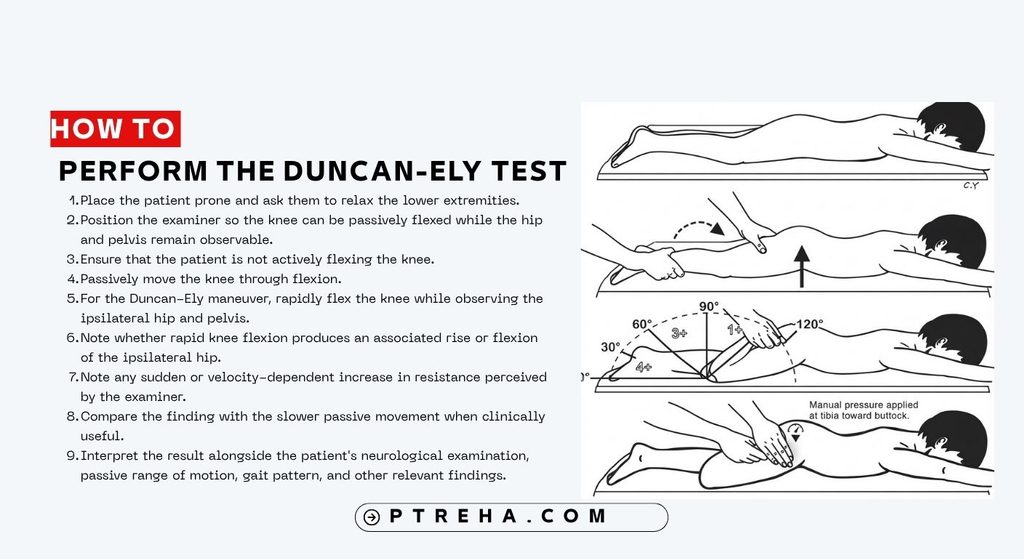
- Place the patient prone and ask them to relax the lower extremities.
- Position the examiner so the knee can be passively flexed while the hip and pelvis remain observable.
- Ensure that the patient is not actively flexing the knee.
- Passively move the knee through flexion.
- For the Duncan-Ely maneuver, rapidly flex the knee while observing the ipsilateral hip and pelvis.
- Note whether rapid knee flexion produces an associated rise or flexion of the ipsilateral hip.
- Note any sudden or velocity-dependent increase in resistance perceived by the examiner.
- Compare the finding with the slower passive movement when clinically useful.
- Interpret the result alongside the patient’s neurological examination, passive range of motion, gait pattern, and other relevant findings.
Test Findings and Interpretation
In the classic description, the Duncan-Ely Test is considered positive when rapid passive knee flexion produces ipsilateral hip flexion or elevation, and/or when the examiner detects increased resistance during the maneuver.
A positive response can support the clinical impression of rectus femoris spasticity or dysfunction, particularly in an appropriate neurological and gait context.
It does not, by itself, establish the cause of a patient’s gait abnormality.
Hip elevation is also not necessarily specific to rectus femoris spasticity.
Other muscular responses may contribute to the observed movement.
What Does a Positive Duncan-Ely Test Mean?
A positive Duncan-Ely response indicates an abnormal response during rapid passive knee flexion that is compatible with rectus femoris overactivity or spasticity in the appropriate clinical context.
A positive result therefore means that the clinician has identified a clinically relevant finding—not that rectus femoris spasticity is definitively established as the sole cause of stiff-knee gait.
Negative Duncan-Ely Test
A negative response generally means that the characteristic hip/pelvic response or clinically appreciable abnormal resistance was not observed during the maneuver.
It should not be interpreted as proof that the rectus femoris is functioning normally during walking.
Anatomy Involved in the Duncan-Ely Test
- Rectus femoris.
- Quadriceps mechanism.
- Hip joint.
- Knee joint.
- Pelvis.
- Neuromuscular system involved in the regulation of muscle tone.
Because the rectus femoris crosses both the hip and knee, rapid knee flexion changes its length while the examiner observes the resulting movement response.
Conditions Detected / Associated With the Test
The Duncan-Ely Test is most commonly associated with assessment of:
- Rectus femoris spasticity in cerebral palsy.
- Rectus femoris dysfunction associated with stiff-knee gait.
- Abnormal lower-extremity muscle tone in selected neurological patients.
- Preoperative assessment of rectus femoris dysfunction in selected patients with cerebral palsy.
The test should not be described as independently diagnosing cerebral palsy, stiff-knee gait, or another neurological condition.
Clinical Significance
The Duncan-Ely Test can be useful when a clinician needs to determine whether a rapid passive movement produces a response suggestive of rectus femoris overactivity.
Its value is greatest when the finding is interpreted alongside:
- Observed gait deviations.
- Passive knee and hip range of motion.
- Muscle tone examination.
- Strength and selective motor-control assessment.
- Other neurological findings.
- Instrumented gait analysis when clinically indicated.
In cerebral palsy, the test has been investigated as part of preoperative assessment for patients with stiff-knee gait.
However, its clinical usefulness depends on the patient population and the precise clinical question.
Research in chronic stroke has produced substantially different findings, demonstrating why results from one population should not automatically be generalized to another.
“The clinical context determines how much meaning a Duncan-Ely response should carry.”
Sensitivity and Specificity
Sensitivity and specificity are not universal characteristics of the Duncan-Ely Test.
Studies in ambulatory patients with cerebral palsy have reported different diagnostic characteristics depending on the gait variable, movement velocity, and comparison method.
These values are specific to the populations and protocols studied and should not be used as universal clinical thresholds.
Diagnostic Accuracy
The diagnostic usefulness of the Duncan-Ely Test varies according to the patient population and the clinical question.
In cerebral palsy, research has demonstrated an association between the test and rectus femoris dysfunction during gait, and the test has been used in preoperative assessment.
In contrast, research involving people with chronic stroke and stiff-knee gait found poor correspondence between Duncan-Ely findings and abnormal rectus femoris activity identified through surface electromyography.
Therefore, the Duncan-Ely Test should not be regarded as a universally accurate diagnostic test for rectus femoris overactivity.
Common Mistakes in Duncan-Ely Test
- Performing the test without adequately relaxing the patient.
- Moving the knee slowly when the clinical question concerns a velocity-dependent response.
- Failing to observe the ipsilateral hip and pelvis.
- Allowing unnecessary movement of the pelvis during the maneuver.
- Mistaking a fixed contracture for velocity-dependent spasticity.
- Interpreting every increase in resistance as proof of rectus femoris spasticity.
- Assuming that hip elevation is exclusively caused by the rectus femoris.
- Using the test alone to explain stiff-knee gait.
- Applying findings from cerebral palsy research directly to other neurological populations.
- Treating published research cutoffs as universal clinical thresholds.
Tips for Performing the Duncan-Ely Test
- Explain the procedure before beginning so the patient can relax.
- Observe the pelvis and hip rather than focusing only on the knee.
- Perform the maneuver consistently when comparing sides or monitoring change.
- Distinguish rapid-movement responses from restrictions that are also present during slow movement.
- Document the actual clinical finding rather than simply recording “positive.”
- Consider pain, contracture, joint restriction, and voluntary muscle activity as potential influences on the examination.
- Correlate the result with the patient’s gait pattern.
- Use instrumented gait analysis or electromyography when the clinical question requires direct information about muscle activity during walking.
- Do not use the Duncan-Ely Test as a substitute for a complete neurological or gait assessment.
Summary
- The Duncan-Ely Test is a clinical neuromusculoskeletal assessment primarily used to examine a velocity-dependent rectus femoris response.
- It is typically performed with the patient prone and relaxed while the examiner rapidly flexes the knee and observes the ipsilateral hip and pelvis.
- A classic positive finding is ipsilateral hip flexion or elevation and/or increased resistance during rapid knee flexion.
- The test is particularly relevant in the assessment of rectus femoris dysfunction and stiff-knee gait in cerebral palsy, but its findings should not be generalized automatically to other populations.
- A Duncan-Ely finding is not, by itself, a diagnosis, and it does not directly measure rectus femoris activity during gait.
The Duncan-Ely Test remains a useful bedside examination when applied to the appropriate clinical question, particularly as part of a broader assessment of patients with neurological movement disorders.
Its interpretation should always account for the examination technique, patient population, gait presentation, and limitations of the test.
Resources and Further Reading
Marks MC, Alexander J, Sutherland DH, Chambers HG.
Clinical utility of the Duncan-Ely test for rectus femoris dysfunction during the swing phase of gait. Developmental Medicine & Child Neurology.
Lee SY, Sung KH, Chung CY, et al.
Reliability and validity of the Duncan-Ely test for assessing rectus femoris spasticity in patients with cerebral palsy. Developmental Medicine & Child Neurology.
Drefus LC, Clarke S, Resnik K, et al.
The Root-Ely Modified Test of Rectus Femoris Spasticity Has Reliability in Individuals with Cerebral Palsy. Clinical Orthopaedics and Related Research.
Research examining the Duncan-Ely Test in chronic stroke populations provides additional evidence regarding the limitations of applying findings across different neurological populations.