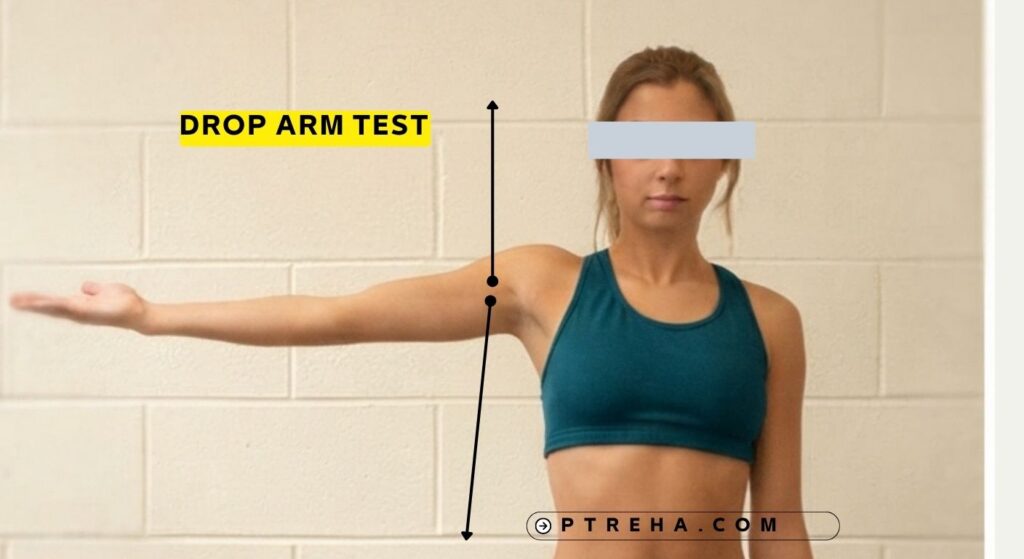
The Drop Arm Test, also known as Codman’s drop-arm test, is an orthopedic shoulder special test commonly used when a clinician suspects rotator cuff pathology, particularly a clinically significant supraspinatus deficit. The test examines whether the patient can actively control the arm while lowering it from an elevated position. A sudden drop or inability to control the descent can increase suspicion of a rotator cuff tear, but the finding must be interpreted alongside the history and the rest of the shoulder examination.
What Is the Drop Arm Test?
The Drop Arm Test is a clinical orthopedic special test, rather than a standalone diagnostic test or outcome measure. It challenges the patient’s ability to maintain and eccentrically control shoulder elevation during the lowering phase.
In the commonly described technique, the examiner passively elevates the patient’s arm in abduction and then asks the patient to lower it actively and slowly. Difficulty controlling the movement, a sudden drop, or marked weakness may constitute a positive finding according to the protocol being used.
The test is traditionally associated with the supraspinatus and rotator cuff. However, controlled lowering of the arm involves coordinated activity from multiple shoulder and scapular muscles, so the test should not be described as an isolated test of one tendon.
Purpose of the Drop Arm Test
The Drop Arm Test may be used to:
- Assess the patient’s ability to actively control lowering of an elevated arm.
- Identify a marked deficit in shoulder abduction control or strength.
- Support clinical suspicion of rotator cuff pathology.
- Contribute to the examination of a patient with shoulder pain, weakness, or loss of active elevation.
- Help determine whether additional shoulder testing or further investigation is warranted.
A useful clinical principle is that the test contributes to clinical reasoning; it does not replace a complete shoulder assessment.
“A controlled descent is as important to observe as the final position of the arm.”
Drop Arm Test Indications
The test may be considered when the patient presents with:
- Shoulder pain accompanied by weakness during arm elevation or lowering.
- Difficulty controlling the arm after it has been elevated.
- Clinical suspicion of a rotator cuff tear.
- Loss of active shoulder elevation that appears greater than the limitation of passive movement.
- Shoulder symptoms following an injury where rotator cuff dysfunction is part of the differential diagnosis.
In acute traumatic presentations, the broader examination should first establish whether active shoulder movement is appropriate and safe.
Drop Arm Test Contraindications and Precautions
There are no universally established Drop Arm Test-specific contraindications that apply to every patient. Instead, clinicians should consider general musculoskeletal safety and the patient’s clinical status.
- Defer or modify the maneuver when active shoulder movement could aggravate a suspected fracture, dislocation, or other unstable injury.
- Respect postoperative or post-injury movement restrictions.
- Use particular caution when the patient has severe pain, substantial guarding, or very limited active control.
- Stand close enough to support the arm if it unexpectedly drops.
- Do not repeatedly provoke severe pain simply to obtain a test result.
The purpose of a special test is to obtain clinically useful information safely, not to force a movement that the patient cannot tolerate.
Patient Position
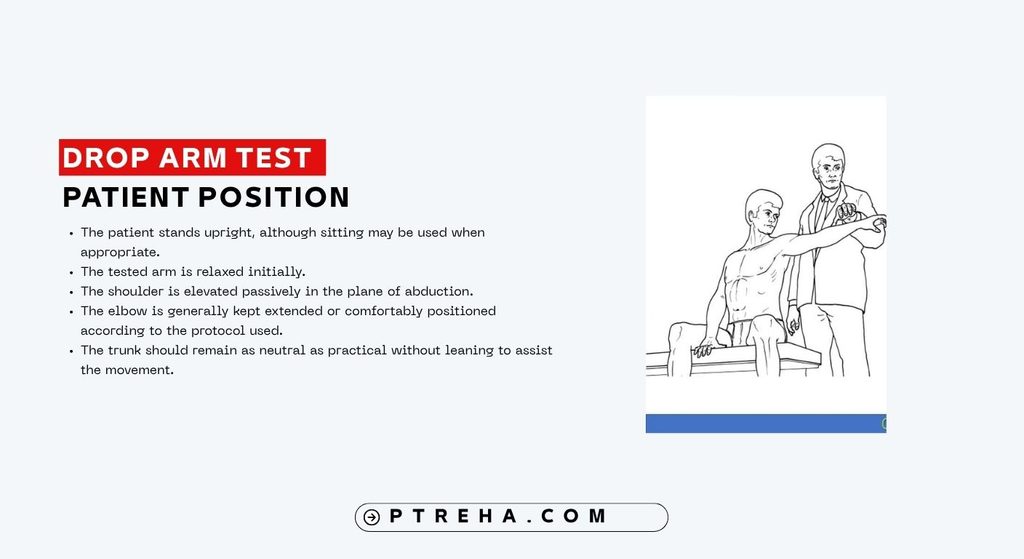
A commonly described position is:
- The patient stands upright, although sitting may be used when appropriate.
- The tested arm is relaxed initially.
- The shoulder is elevated passively in the plane of abduction.
- The elbow is generally kept extended or comfortably positioned according to the protocol used.
- The trunk should remain as neutral as practical without leaning to assist the movement.
Different descriptions of the Drop Arm Test use somewhat different starting positions, so the clinician should document the protocol used rather than assuming that every published version is identical.
Examiner Position
The examiner should:
- Stand beside and slightly behind the tested shoulder.
- Support the patient’s arm during passive elevation.
- Remain close enough to catch or support the limb if control is suddenly lost.
- Observe the movement throughout the lowering phase.
- Monitor pain, weakness, sudden loss of control, and compensatory trunk or scapular movement.
A clear instruction such as “Slowly lower your arm and try to control the movement” helps ensure that the observed performance reflects active control rather than a misunderstanding of the task.
How to Perform the Drop Arm Test
Using a commonly described protocol:
- Position the patient standing with the tested arm relaxed.
- Passively elevate the arm into abduction, commonly above the horizontal position.
- Remove the examiner’s support once the desired position has been reached.
- Ask the patient to maintain control of the arm and slowly lower it toward the side.
- Observe whether the patient can control the descent smoothly.
- Note any sudden dropping, inability to maintain the position, marked weakness, pain, or compensatory movement.
- Stop the maneuver when further movement is unsafe or poorly tolerated.
The original description of the test is not consistently reproduced in modern literature, and published protocols differ. Contemporary diagnostic studies therefore use specified procedures rather than a single universally standardized technique.
What Constitutes a Positive Test?
For the conventional orthopedic interpretation, the test is considered positive when the patient cannot adequately control the arm during the lowering maneuver and the arm drops abruptly or the patient cannot maintain the required position.
Pain may accompany the finding, but pain alone should not automatically be equated with a positive Drop Arm Test. The exact definition should follow the protocol being used.
In diagnostic research, the interpretation has generally focused on loss of active control or an abrupt drop rather than simply reporting any shoulder discomfort.
What Does a Positive Drop Arm Test Mean?
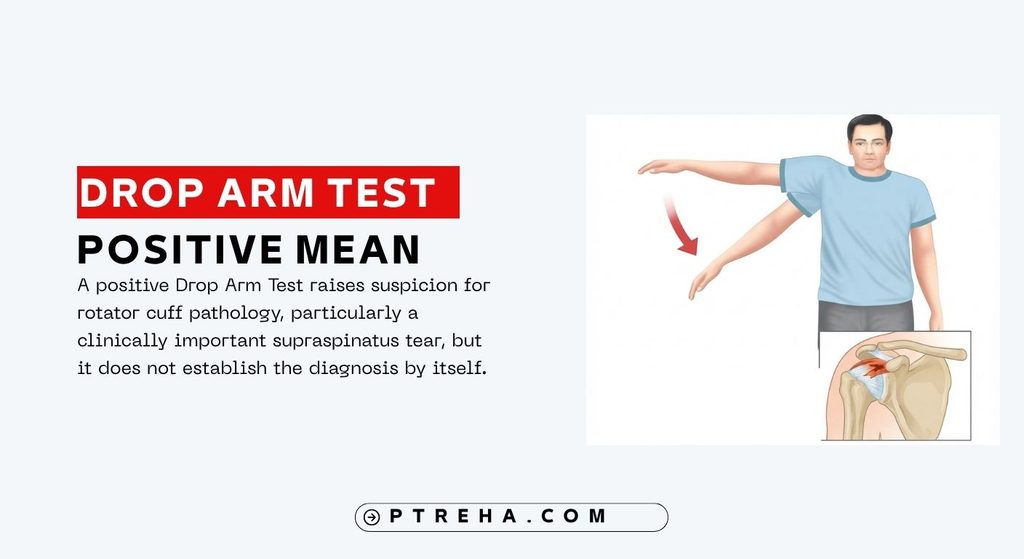
A positive Drop Arm Test raises suspicion for rotator cuff pathology, particularly a clinically important supraspinatus tear, but it does not establish the diagnosis by itself.
The finding may be more informative when it occurs together with a compatible history, loss of active elevation, weakness on other cuff tests, and other examination findings. A sudden loss of control is clinically important because substantial weakness can make controlled lowering difficult.
A positive result can also be influenced by pain inhibition, generalized weakness, poor motor control, or other shoulder problems. Therefore, the clinician should describe the actual observation rather than assuming that every sudden drop represents a tendon rupture.
“A positive Drop Arm Test supports a hypothesis; it does not complete the diagnostic examination.”
Negative Drop Arm Test
A controlled lowering movement does not reliably exclude a rotator cuff tear.
This limitation is especially important because the Drop Arm Test has shown relatively low sensitivity in diagnostic research. Consequently, a patient with a rotator cuff tear may still be able to complete the maneuver with reasonable control.
A negative result should therefore be interpreted as one piece of the examination rather than as evidence that the rotator cuff is definitely intact.
Anatomy Involved in Drop Arm Test
Relevant anatomical and physiological systems include:
- Supraspinatus: an important rotator cuff muscle involved in shoulder elevation and commonly considered in interpretation of this test.
- Deltoid: contributes substantially to shoulder abduction and participates in controlled lowering of the arm.
- Other rotator cuff muscles: contribute to glenohumeral stability and coordinated shoulder movement.
- Scapular stabilizers: coordinated scapular motion contributes to efficient elevation and lowering of the upper limb.
- Glenohumeral joint: provides the principal shoulder articulation involved in the movement.
- Motor control and pain response: the patient’s ability to control the limb can be affected by pain, weakness, apprehension, and neuromuscular factors.
Because several structures contribute to the maneuver, the Drop Arm Test should not be presented as a test that mechanically isolates the supraspinatus tendon.
Conditions Detected / Associated With the Test
The Drop Arm Test is most commonly associated with:
- Suspected rotator cuff tear.
- Suspected supraspinatus tendon tear or substantial supraspinatus dysfunction.
- Significant shoulder abduction weakness in an appropriate clinical context.
- Rotator cuff-related shoulder dysfunction.
The term “associated with” is more appropriate than “detects” because the test does not independently identify the structural cause of the observed movement deficit.
A patient can fail the maneuver because of pain or weakness without having a rotator cuff tear, while a patient with a tear may still perform the movement successfully.
Clinical Significance
The Drop Arm Test can be useful when interpreted as part of a broader shoulder examination.
Clinically, the finding can help the examiner decide whether to investigate further with:
- Active and passive range-of-motion assessment.
- Resisted shoulder testing.
- Other rotator cuff special tests.
- Neurological examination when weakness is unexplained.
- Functional assessment relevant to the patient’s complaints.
- Imaging or specialist assessment when the overall clinical presentation warrants it.
The test is particularly useful as a hypothesis-generating examination finding. It becomes more meaningful when several independent findings point toward the same clinical problem.
Sensitivity and Specificity
Diagnostic accuracy estimates for the Drop Arm Test vary considerably between studies and populations, so a single percentage should not be treated as a universal property of the test.
A 2024 systematic review and meta-analysis pooled data from five studies evaluating the Drop Arm Test for suspected rotator cuff tears. The pooled sensitivity was 0.26 (95% CI 0.11–0.51) and specificity was 0.85 (95% CI 0.20–0.99). The authors characterized the overall evidence for physical examination tests as low quality, and the wide confidence intervals indicate substantial uncertainty around the pooled estimate.
These findings are clinically consistent with an important practical limitation: the test may be more useful when a clearly abnormal result increases suspicion than when a normal result is used to rule out a tear.
In the ROW cohort study of patients older than 45 years with shoulder pain evaluated in specialty settings, the Drop Arm Test had a sensitivity of 24% (95% CI 14–34%) and specificity of 96% (95% CI 93–100%) for rotator cuff tears involving the supraspinatus in the study population.
These figures should not be transferred directly to every patient population because diagnostic accuracy depends on factors such as patient selection, prevalence, reference standard, test protocol, and the clinical definition of disease.
Diagnostic Accuracy
The Drop Arm Test has documented diagnostic value, but its accuracy is not sufficiently consistent to support standalone diagnosis.
A systematic review published in JAMA found that a positive Drop Arm Test could increase the likelihood of rotator cuff disease, but the evidence base was limited and the generalizability to nonreferred populations was uncertain.
More recent evidence also emphasizes that shoulder special tests should be interpreted within the complete clinical examination rather than used independently. The 2024 systematic review and meta-analysis specifically concluded that the available diagnostic-accuracy evidence for physical examination tests was generally low quality.
Common Mistakes in Drop Arm Test
- Treating any shoulder pain during lowering as automatically positive.
- Assuming that a positive test proves a supraspinatus tear.
- Assuming that a negative test excludes a rotator cuff tear.
- Failing to support the arm when unexpected loss of control is possible.
- Allowing excessive trunk leaning or other compensation to go unnoticed.
- Using a different test protocol from the one intended without documenting the variation.
- Repeating the maneuver excessively in a patient with severe pain.
- Interpreting the result without considering active versus passive range of motion.
- Ignoring other causes of shoulder weakness.
Tips for Performing the Drop Arm Test
- Explain the movement clearly before starting.
- Use a consistent protocol when comparing sides or monitoring change.
- Observe the entire lowering movement rather than looking only for a dramatic drop.
- Distinguish pain, weakness, and loss of motor control in your documentation.
- Guard the arm throughout the maneuver.
- Compare the finding with other shoulder examination results.
- Consider the patient’s age, mechanism of injury, symptom behavior, and functional limitations.
- Record unusual compensations because they can affect interpretation.
Summary
- The Drop Arm Test is an orthopedic shoulder special test, not a standalone diagnostic test or outcome measure.
- It assesses the patient’s ability to control the arm during active lowering after passive elevation.
- A sudden drop or inability to control the movement may increase suspicion of rotator cuff pathology, particularly significant supraspinatus involvement.
- A positive finding does not independently establish a tear, and a negative finding does not reliably exclude one.
- Diagnostic accuracy varies across populations and protocols; recent evidence indicates low sensitivity and substantial uncertainty, reinforcing the need for a comprehensive shoulder examination.
The Drop Arm Test remains a useful clinical observation when performed carefully and interpreted in context. Its greatest value is not in answering the entire diagnostic question, but in adding one well-defined piece of information to a structured assessment of shoulder pain and weakness.
Resources and External References
Does this patient with shoulder pain have rotator cuff disease? — The Rational Clinical Examination Systematic Review
PubMed — Rational Clinical Examination systematic review
Evidence-based approach to the shoulder examination for subacromial bursitis and rotator cuff tears — Systematic Review and Meta-analysis
BMC Musculoskeletal Disorders — Zhao et al.
The Diagnostic Accuracy of Special Tests for Rotator Cuff Tear: The ROW Cohort Study
PMC — Jain et al.
Most clinical tests cannot accurately diagnose rotator cuff pathology: a systematic review
PubMed — Hughes, Taylor and Green
Physical tests for shoulder impingements and local lesions of bursa, tendon or labrum
PMC — Review of shoulder physical examination tests