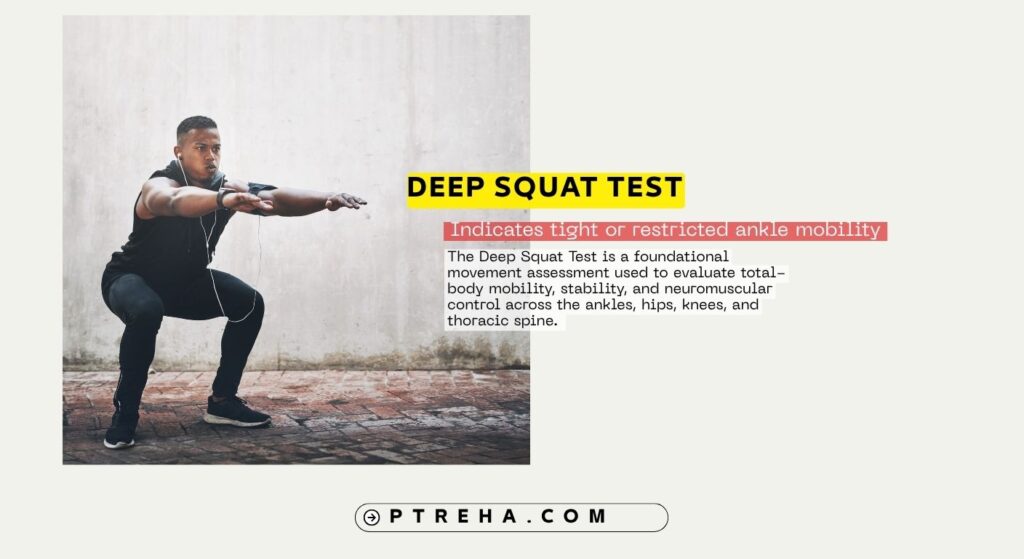
The Deep Squat Test is a functional movement assessment used to observe how a person performs a deep bilateral squat. It is commonly associated with the Deep Squat component of the Functional Movement Screen (FMS), although clinicians may also use a deep squat as a general functional assessment outside the FMS.
The movement requires coordinated motion at the ankle, knee, hip, and trunk while the individual maintains balance and control. Depending on the protocol, the position of the upper limbs is also assessed.
The test does not directly isolate one muscle, joint, ligament, or other anatomical structure. A limitation in the observed movement can result from several interacting factors, including mobility, strength, motor control, balance, pain, anthropometry, previous injury, or familiarity with the movement.
Research specifically examining the FMS Deep Squat has found only limited relationships between its score and independently measured joint mobility. Therefore, the Deep Squat Test should not be treated as a substitute for specific range-of-motion, strength, neurological, or orthopedic examination when those assessments are clinically indicated.
“The deep squat is a movement observation, not a diagnosis.”
Purpose of the Deep Squat Test
The Deep Squat Test can be used to:
- Observe the quality of a bilateral squat movement.
- Examine coordination between the lower limbs and trunk.
- Identify visible movement limitations that may warrant further assessment.
- Observe balance and postural control during a demanding functional movement.
- Examine the ability to achieve and maintain a deep squat position.
- Monitor changes in movement performance during rehabilitation or training when the same protocol is repeated consistently.
- Provide one component of a broader functional movement assessment.
When used within the FMS, the Deep Squat is one movement pattern within a larger screening system. It should therefore not be interpreted independently as a diagnosis or as a comprehensive assessment of physical function. Evidence concerning the broader FMS also indicates that reliability can be acceptable when standardized procedures and appropriate rater training are used, while questions remain regarding its validity for measuring specific underlying physical qualities.
Deep Squat Test Indications
A deep squat assessment may be appropriate when the clinician wants to:
- Observe a patient’s functional squat pattern.
- Examine movement during a task requiring substantial lower-limb and trunk coordination.
- Establish a baseline movement pattern before rehabilitation or exercise progression.
- Monitor changes in movement quality over time.
- Identify movement characteristics that justify more specific clinical examination.
- Assess an individual’s ability to perform a squat-related functional task when that task is relevant to their activities or goals.
The test should be selected because the movement is clinically relevant to the patient’s presentation, not simply because it is available as a screening maneuver.
Deep Squat Test Contraindications and Precautions
There are no universally established Deep Squat Test-specific contraindications that apply to every patient and every protocol.
Instead, the clinician should consider general safety and the individual’s clinical status before asking them to perform a deep squat.
Relevant precautions include:
- Acute or significant pain that may be aggravated by loaded or repeated squatting.
- Recent surgery or injury where deep weight-bearing movement has not yet been permitted.
- Existing weight-bearing restrictions.
- Marked instability or impaired balance that makes the movement unsafe.
- Symptoms such as dizziness or other problems that could compromise safe performance.
- Inability to understand or follow the movement instructions.
- A clinical presentation in which deep knee, hip, or ankle flexion has not yet been established as appropriate.
Pain or an inability to perform the movement should not automatically be interpreted as evidence of a specific tissue lesion. The clinician should determine whether the movement is appropriate and investigate the underlying finding using an appropriate examination.
Patient Position
For a commonly used FMS-style Deep Squat, the patient is positioned as follows:
- Stand facing forward with the feet approximately shoulder-width apart.
- Position the feet according to the standardized protocol being used.
- Hold a dowel or similar implement overhead when following the FMS protocol.
- Maintain an upright starting posture.
- Keep the implement positioned above the head as instructed by the protocol.
- Begin from a comfortable standing position with the body prepared to perform a controlled squat.
The exact setup should follow the protocol being used. A general deep squat performed without the FMS equipment should not automatically be interpreted using FMS scoring criteria.
Examiner Position
The examiner should position themselves so that the relevant movement can be clearly observed.
For an FMS-style assessment, observation from the front and side can help identify movement characteristics such as:
- Symmetry between the lower limbs.
- Foot and ankle position.
- Knee movement.
- Depth of the squat.
- Trunk position.
- Upper-limb position.
- Balance and control.
Video recording may also be used when appropriate, particularly when the clinician wants to review movement more carefully or compare performance over time. However, the same recording and scoring procedures should be maintained when repeated measurements are intended to be compared.
How to Perform the Deep Squat Test
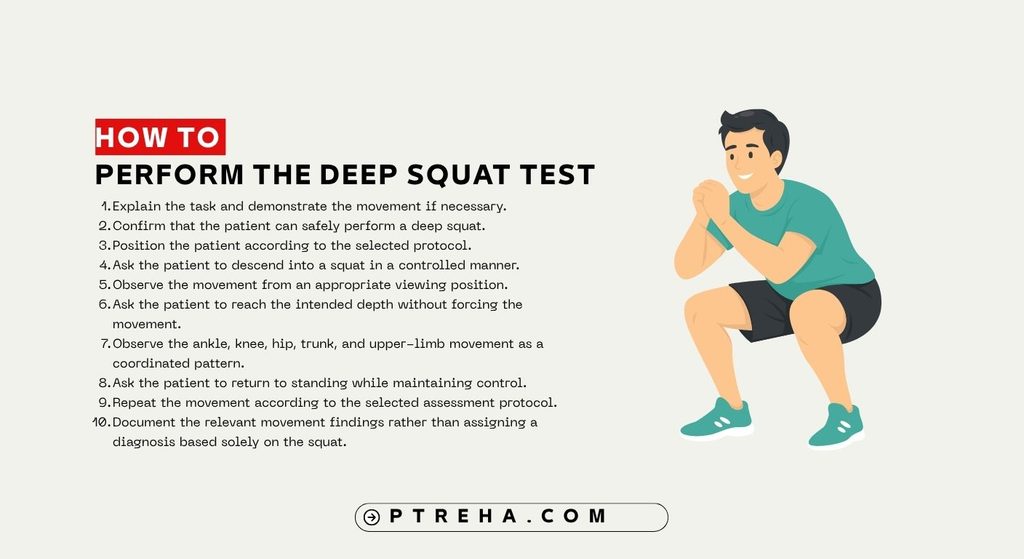
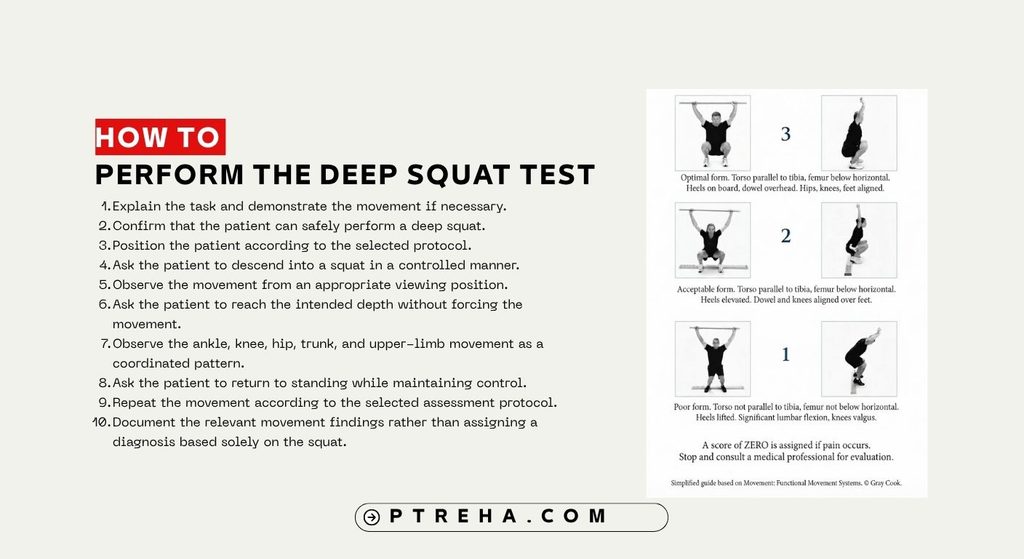
A general deep squat assessment can be performed using the following sequence:
- Explain the task and demonstrate the movement if necessary.
- Confirm that the patient can safely perform a deep squat.
- Position the patient according to the selected protocol.
- Ask the patient to descend into a squat in a controlled manner.
- Observe the movement from an appropriate viewing position.
- Ask the patient to reach the intended depth without forcing the movement.
- Observe the ankle, knee, hip, trunk, and upper-limb movement as a coordinated pattern.
- Ask the patient to return to standing while maintaining control.
- Repeat the movement according to the selected assessment protocol.
- Document the relevant movement findings rather than assigning a diagnosis based solely on the squat.
When the FMS Deep Squat is being performed, the official FMS procedure and scoring criteria should be followed rather than substituting an informal squat protocol. The FMS uses a structured scoring system for the movement pattern, and deviations are incorporated into the score according to the established procedure.
Interpretation of the Deep Squat Test
The Deep Squat is not appropriately interpreted as simply “positive” or “negative” in the same way as a provocative orthopedic special test.
Instead, the clinician should describe the observed movement.
Potential findings may include:
- Difficulty achieving the desired depth.
- Loss of balance.
- Excessive trunk movement.
- Changes in foot position.
- Asymmetry between the lower limbs.
- Altered knee or hip movement.
- Difficulty maintaining the required upper-limb position.
- Pain during a particular phase of the movement.
- Compensatory movement elsewhere in the kinetic chain.
These findings are observations, not diagnoses.
For example, limited squat depth does not by itself establish restricted ankle dorsiflexion, hip mobility impairment, weakness, or a particular knee disorder. A separate examination is required to determine which factors may be contributing.
Research has demonstrated relationships between aspects of deep-squat performance and joint range of motion, but these relationships do not mean that observing the squat can accurately measure a particular joint’s range of motion.
FMS Deep Squat Scoring
When the Deep Squat is specifically performed as an FMS assessment, performance is categorized using the FMS scoring system rather than an informal clinical judgment.
The FMS scoring framework uses ordinal categories to describe movement performance. Broadly, higher scores represent better execution of the specified movement criteria, while lower scores reflect greater deviation from those criteria. Pain during the movement is handled separately within the FMS framework rather than being interpreted simply as a movement-quality deficit.
The important clinical point is that an FMS score is protocol-dependent. It should not be converted into a universal measure of joint mobility, strength, injury status, or overall physical health.
A 2024 study specifically examining the FMS Deep Squat found low convergent validity when its score was compared with three-dimensional measures of joint mobility and did not find that the score could adequately discriminate participants according to their measured joint mobility.
“A movement score should guide further assessment, not replace it.”
Anatomy Involved in Deep Squat Test
The Deep Squat involves coordinated movement throughout the lower extremity and trunk.
Relevant structures and systems include:
- Ankle and foot: The ankle and foot contribute to maintaining the base of support and accommodating the movement required during descent and ascent.
- Knee: The knee undergoes substantial flexion and extension during the squat.
- Hip: The hip contributes through flexion during descent and extension during the return to standing.
- Pelvis: Pelvic position changes as the individual moves through the squat.
- Lumbar and thoracic spine: The trunk must be controlled throughout the movement rather than functioning as an isolated region.
- Shoulder complex: In FMS-style testing, the upper limbs are positioned overhead, adding a requirement for shoulder and thoracic control.
- Neuromuscular system: Balance, proprioception, motor planning, coordination, and postural control contribute to successful performance.
The movement therefore represents an interaction between multiple joints and physiological systems. It should not be described as a test that isolates a particular muscle or anatomical structure.
Conditions Detected or Associated With the Test
The Deep Squat Test does not independently diagnose a specific medical condition.
Abnormal or painful squat performance may be observed in people with a variety of musculoskeletal or functional problems, but the finding is nonspecific.
Depending on the clinical context, altered squat performance may be associated with:
- Lower-limb mobility limitations.
- Pain affecting the ankle, knee, hip, or other regions.
- Reduced movement coordination.
- Balance or postural-control limitations.
- Strength or load-tolerance limitations.
- Previous musculoskeletal injury.
- Movement adaptations related to an individual’s physical characteristics or task demands.
These associations should not be interpreted as evidence that the Deep Squat Test identifies the cause of the problem.
A patient who demonstrates altered squat mechanics may require targeted examination of joint range of motion, muscle performance, pain behavior, neurological function, or other relevant factors.
Clinical Significance
The Deep Squat Test can be clinically useful when interpreted as part of a broader assessment.
Its findings can help the clinician:
- Decide whether a more specific mobility assessment is warranted.
- Identify movement characteristics relevant to rehabilitation.
- Establish a baseline for functional movement.
- Monitor changes in movement performance.
- Select exercises that are appropriate for the patient’s current abilities.
- Compare movement performance under a consistent protocol.
- Discuss movement strategies with patients in a practical and understandable way.
The test is particularly useful when the squat itself is relevant to the patient’s functional goals, occupational demands, sport, exercise program, or daily activities.
It should not, however, be used as a stand-alone measure of overall mobility, strength, balance, injury risk, or musculoskeletal health.
Sensitivity and Specificity
Universal sensitivity and specificity values are not established for the Deep Squat Test as a general clinical assessment.
The terminology of sensitivity and specificity is most appropriate when a test has been evaluated against a defined reference standard for a specific diagnostic question. The Deep Squat is primarily a functional movement assessment, and its interpretation varies according to the protocol, population, and clinical question.
For this reason, a single sensitivity or specificity value should not be presented as applying universally to the Deep Squat Test.
Diagnostic Accuracy
The Deep Squat Test should not be considered a stand-alone diagnostic test.
Evidence concerning the FMS indicates that although the screening system can demonstrate acceptable scoring reliability under some conditions, its validity for representing specific underlying physical characteristics is more limited. A systematic review found that correlations between FMS scores and independent measures of stability or joint mobility were generally weak or absent, while a more recent study specifically examining the Deep Squat reported low convergent validity for joint mobility.
Therefore, an observed squat deficit should be treated as a reason to investigate further rather than as evidence of a specific diagnosis.
Common Mistakes in Deep Squat Test
Common problems include:
- Treating the test as an orthopedic special test with a simple positive or negative result.
- Assuming that poor squat depth automatically means poor ankle mobility.
- Assuming that knee movement during the squat identifies a specific knee pathology.
- Using FMS scoring criteria when an entirely different squat protocol was performed.
- Comparing scores obtained using different equipment or instructions.
- Ignoring pain because the movement can technically be completed.
- Focusing on one joint while ignoring compensations elsewhere.
- Treating a movement deviation as a diagnosis.
- Using a single squat observation to make broad conclusions about strength or balance.
- Failing to consider the patient’s previous injury, functional goals, and current clinical status.
- Forcing a patient into a depth or position that is inappropriate for their condition.
Tips for Performing the Deep Squat Test
For more consistent clinical assessment:
- Use the same protocol each time you repeat the test.
- Explain the instructions clearly before testing.
- Make sure the patient understands the required movement.
- Observe the entire movement rather than focusing on only the knees.
- Assess the movement from more than one viewing angle when appropriate.
- Document pain separately from movement quality.
- Avoid forcing range of motion.
- If a limitation is observed, follow it with a more specific assessment rather than assuming its cause.
- Use the patient’s functional goals to determine whether the squat is clinically relevant.
- When using the FMS, follow its standardized setup and scoring procedure rather than modifying the test and retaining the original scoring interpretation.
Summary
- The Deep Squat Test is primarily a functional movement assessment, not a diagnostic orthopedic special test.
- It examines a coordinated whole-body squat involving the ankle, knee, hip, trunk, and, in FMS-style testing, the upper limbs.
- An altered squat pattern can identify a movement characteristic that deserves further assessment, but it does not establish the underlying diagnosis.
- FMS Deep Squat scoring is protocol-specific and should not be treated as a universal measurement of joint mobility, strength, or injury risk.
- Current evidence suggests that the FMS Deep Squat has limited ability to represent independently measured joint mobility, reinforcing the importance of specific follow-up assessments when clinically indicated.
The most useful way to apply the Deep Squat Test is therefore to treat it as one piece of clinical information. A skilled physical therapist combines the observed movement with the patient’s symptoms, history, functional goals, and targeted examination findings before reaching a clinical conclusion.
Resources and External References
- Deep squat test – Functional Movement Screen: Convergent validity and ability to discriminate subjects with different levels of joint mobility. Aleixo et al., Journal of Bodywork & Movement Therapies. PubMed — Deep Squat Test and Joint Mobility Study
- Convergent validity of the Functional Movement Screen regarding stability and joint mobility: A systematic review. Bhudarally et al., Journal of Bodywork & Movement Therapies. PubMed — Functional Movement Screen Systematic Review
- The relationship between the deep squat movement and the hip, knee and ankle range of motion and muscle strength. Endo et al., Journal of Physical Therapy Science. PubMed — Deep Squat Movement Study
- The interrater and intrarater reliability of the Functional Movement Screen: A systematic review with meta-analysis. Cuchna et al., Physical Therapy in Sport. PubMed — FMS Reliability Systematic Review
- How reliable are Functional Movement Screening scores? A systematic review of rater reliability. PubMed — Functional Movement Screening Reliability Review
- Functional Movement Screen Professional Manual. Functional Movement Systems. FMS Professional Manual