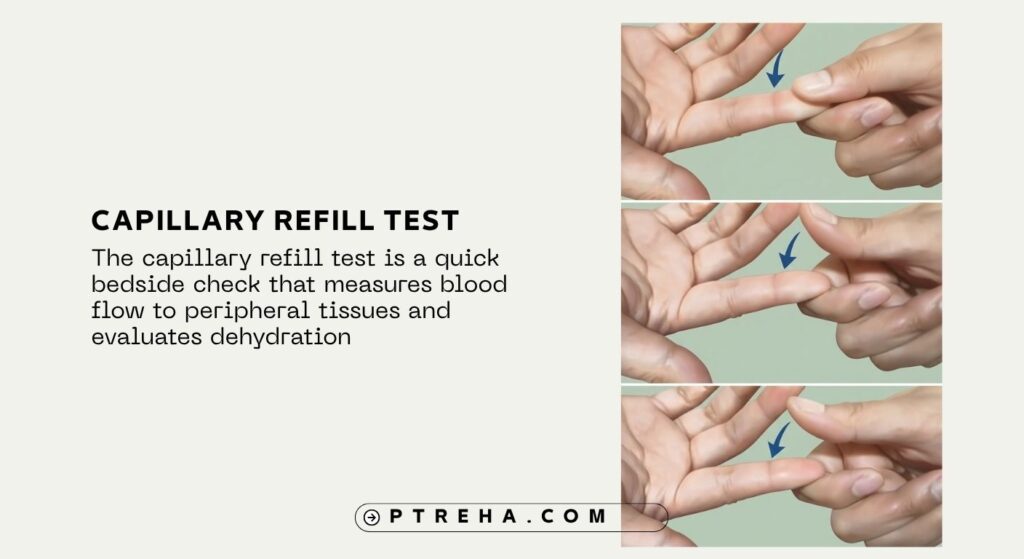
The Capillary Refill Test (CRT) is a rapid bedside assessment used to evaluate peripheral perfusion by observing how quickly skin color returns after temporary compression. It requires minimal equipment and can provide useful information about peripheral circulation, particularly when interpreted alongside the patient’s overall clinical presentation rather than as an isolated diagnostic test.
What Is the Capillary Refill Test?
The Capillary Refill Test is a clinical assessment and physiological measurement of peripheral perfusion. It estimates the time required for an externally compressed area of skin or nail bed to regain its baseline color after pressure is released.
The underlying principle is simple: compression temporarily reduces blood within superficial capillaries. When pressure is released, visible color returns as blood flow is restored to the compressed tissue.
CRT is therefore primarily concerned with peripheral tissue perfusion. It does not directly measure blood pressure, cardiac output, tissue oxygenation, or the function of a particular muscle, nerve, artery, or other isolated anatomical structure.
The measurement is influenced by the technique used and by factors such as the measurement site and skin or environmental temperature. Research, particularly in children, has demonstrated considerable variation between protocols.
“Capillary refill is a perfusion finding, not a diagnosis.”
Purpose of the Capillary Refill Test
The Capillary Refill Test may be used to:
- Assess peripheral perfusion during a physical examination.
- Contribute to the initial assessment of an acutely unwell patient.
- Identify a peripheral perfusion abnormality that may warrant further clinical assessment.
- Monitor peripheral circulation over time when the same standardized technique is repeated.
- Complement other findings such as heart rate, blood pressure, skin temperature, mental status, urine output, and other relevant clinical observations.
- Contribute to assessment of circulatory compromise in appropriate acute-care settings.
CRT should be regarded as one component of clinical assessment, rather than a standalone measurement of overall cardiovascular status. Evidence in both children and adults indicates that its clinical usefulness depends substantially on the population, clinical context, and quality of measurement.
Capillary Refill Test Indications
The test may be considered when peripheral perfusion is clinically relevant, including:
- Initial assessment of an acutely unwell patient.
- Suspected circulatory compromise or impaired peripheral perfusion.
- Assessment of a patient with possible shock, when used together with other clinical findings.
- Pediatric assessment when serious illness or dehydration is being considered.
- Monitoring changes in peripheral perfusion during acute clinical management.
- Situations in which a rapid, non-invasive bedside assessment is appropriate.
In physical therapy practice, CRT is not routinely required for every patient. It becomes more relevant when the patient’s presentation raises concern about peripheral circulation or systemic instability.
Capillary Refill Test Contraindications and Precautions
CRT is generally a low-risk, non-invasive examination technique. Rather than assigning arbitrary test-specific contraindications, clinicians should consider circumstances that can make the measurement difficult or misleading.
Important precautions include:
- Avoid excessive pressure that could cause discomfort or unnecessarily prolong tissue blanching.
- Consider local skin injury, wounds, burns, dressings, or other conditions that prevent reliable assessment at the selected site.
- Consider marked peripheral cooling or warming because skin temperature can influence refill time.
- Be cautious when peripheral vasoconstriction or other circulatory abnormalities may substantially alter the finding.
- Use the same measurement site and technique when monitoring changes over time.
- Do not interpret an abnormal CRT without considering the rest of the clinical picture.
- If the patient appears clinically unstable, CRT should not delay appropriate medical assessment or emergency management.
Temperature, body site, pressure duration, and measurement technique can all affect the observed result.
Patient Position
There is no single universal patient position that applies to every CRT protocol.
For a routine peripheral assessment:
- Position the patient comfortably.
- Expose the selected measurement site sufficiently to observe skin color.
- Keep the limb in a consistent position when serial measurements are being compared.
- Avoid unnecessary movement during the measurement.
- If the patient’s overall condition is unstable, position the patient according to the broader clinical situation rather than modifying positioning solely for CRT.
The measurement site itself is important. Finger, toe, foot, chest, and other sites can produce different measurements, so results should not automatically be compared across different anatomical locations.
Examiner Position
The examiner should:
- Stand or sit where the selected site can be clearly visualized.
- Have direct access to the finger, toe, or other chosen measurement site.
- Use a consistent hand position and pressure technique.
- Use a timer or stopwatch when precise measurement is clinically important.
- Ensure adequate lighting for judging the return of color.
Using a timer can reduce variability compared with estimating the duration by an informal count.
How to Perform the Capillary Refill Test
Because protocols differ, the following describes a commonly studied finger-based approach, particularly relevant to pediatric clinical assessment.
- Explain the procedure to the patient when appropriate.
- Select a suitable finger and inspect the skin and nail region before testing.
- Ensure that the selected area is visible and that its baseline color can be assessed.
- Apply firm, controlled pressure to the selected area until the skin or nail bed blanches.
- Maintain the pressure for the duration specified by the chosen protocol.
- Release the pressure.
- Observe the return of the original color.
- Measure the elapsed time with a timer when quantitative recording is required.
- Record the actual observed result rather than relying only on terms such as “normal” or “abnormal.”
- If the result is unexpectedly abnormal or inconsistent with the rest of the examination, repeat the measurement using the same technique and site when clinically appropriate.
A standardized pediatric protocol described in the literature uses moderate pressure on a finger for 5 seconds and recommends timing the return of color. Importantly, that protocol and its associated interpretation were developed from pediatric evidence and should not automatically be transferred to every adult population or every measurement site.
Interpretation
CRT should be interpreted as a clinical finding concerning peripheral perfusion, not as a standalone diagnostic test.
A prolonged or delayed return of color may occur when peripheral perfusion is reduced. However, the finding can also be affected by factors unrelated to systemic circulatory failure, including temperature and the precise measurement technique.
For this reason, an isolated prolonged CRT should prompt consideration of the broader clinical picture rather than an automatic diagnosis.
Likewise, a relatively rapid refill does not establish that the patient’s cardiovascular or systemic status is normal. In children, systematic-review evidence has shown that CRT can have relatively high specificity for some serious outcomes while sensitivity is variable or low; therefore, a normal result should not be used by itself to exclude serious illness.
Measurement Considerations and Reference Values
There is no single universally applicable CRT value that should be used across all patients, anatomical sites, and protocols.
In healthy children, one systematic review found that measurements obtained from the finger generally differed from those obtained from the chest or foot. The same review also identified effects from ambient temperature and the duration of applied pressure.
Consequently, when a numerical threshold is used clinically, the clinician should know which population, anatomical site, measurement method, and clinical guideline support that threshold.
For example, pediatric literature has commonly used a finger-based protocol in which a refill time of 3 seconds or more is treated as abnormal. This should not be presented as a universal adult cutoff or applied without regard to the protocol used.
Anatomy Involved in Capillary Refill Test
The Capillary Refill Test involves several physiological structures and processes:
- Skin and superficial tissues: The visible color change occurs within the superficial vascular bed.
- Capillary circulation: Blood temporarily displaced by compression returns after pressure is released.
- Arterioles and small vessels: Regulation of peripheral blood flow influences the amount and speed of blood reaching the capillary bed.
- Peripheral microcirculation: CRT provides indirect bedside information about peripheral tissue perfusion.
- Autonomic vascular regulation: Vasoconstriction and vasodilation can alter peripheral blood flow and therefore affect the observed result.
CRT does not isolate one artery, nerve, muscle, or other anatomical structure. It represents an observable response of the peripheral vascular system.
Conditions Detected / Associated With the Test
CRT does not independently diagnose a specific disease. A delayed measurement can be associated with conditions involving impaired peripheral perfusion, including:
- Acute circulatory compromise.
- Shock states.
- Severe systemic illness.
- Some presentations of dehydration, particularly in children.
- Peripheral vasoconstriction or reduced peripheral blood flow.
The clinical significance depends strongly on the patient population and accompanying findings. Studies in critically ill adults and acutely unwell children have investigated CRT in relation to adverse outcomes, but its diagnostic and prognostic performance is not uniform across clinical settings.
Clinical Significance
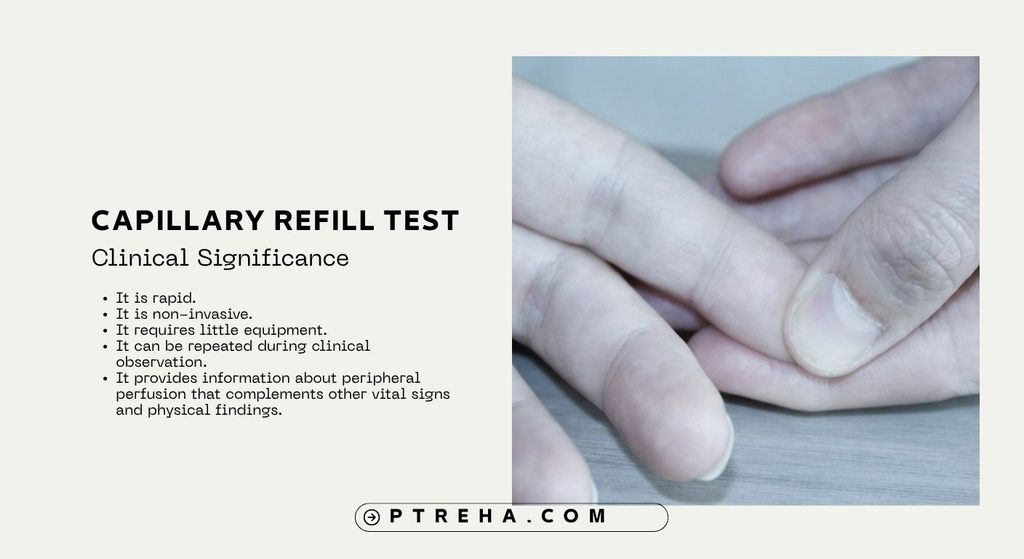
CRT can be particularly useful when it is incorporated into a structured clinical assessment.
Its advantages include:
- It is rapid.
- It is non-invasive.
- It requires little equipment.
- It can be repeated during clinical observation.
- It provides information about peripheral perfusion that complements other vital signs and physical findings.
However, CRT should not be used as a surrogate for blood pressure. Pediatric clinical literature specifically cautions that CRT does not have an established relationship that allows it to replace blood-pressure assessment.
In acute circulatory failure, contemporary evidence also suggests that the quality and standardization of CRT measurement influence its usefulness. A recent systematic review in adults found only modest overall prognostic performance, emphasizing that CRT should be interpreted as part of a broader assessment rather than as an independent predictor of outcome.
“A consistent technique makes serial observations more clinically useful.”
Sensitivity and Specificity
Sensitivity and specificity are not universal characteristics of CRT. They depend on the population studied, clinical outcome, measurement technique, and threshold used.
A systematic review and meta-analysis in children evaluating CRT against mortality found pooled sensitivity of approximately 35% and specificity of approximately 92% for the outcome examined. These values apply to the specific pediatric evidence base and should not be generalized to adults or to other clinical outcomes.
In adults with or at risk of acute circulatory failure, a later systematic review and meta-analysis reported different pooled diagnostic-performance estimates and concluded that CRT had limited ability to predict death or adverse events overall. Accuracy was better when the measurement was performed with high quality.
Therefore, CRT should not be described simply as a highly sensitive or highly specific test without specifying the population and clinical question.
Diagnostic Accuracy
CRT has been studied as a marker associated with serious illness and circulatory impairment, but its diagnostic accuracy varies considerably between clinical contexts.
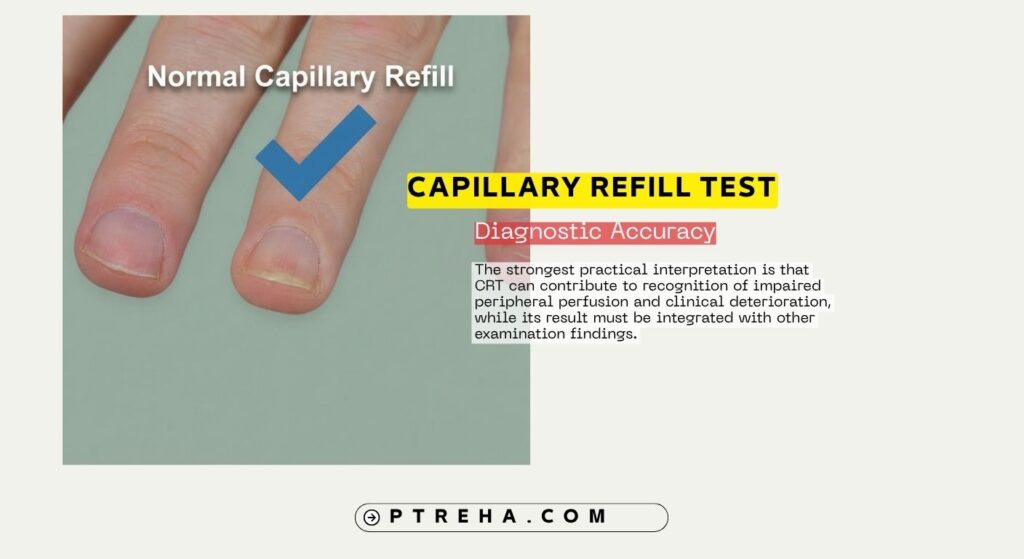
The strongest practical interpretation is that CRT can contribute to recognition of impaired peripheral perfusion and clinical deterioration, while its result must be integrated with other examination findings.
In children, systematic-review evidence suggests that prolonged CRT may function as a useful warning sign for serious illness, but a normal CRT does not reliably exclude serious disease.
In adults with acute circulatory failure, evidence likewise does not support treating CRT as a standalone diagnostic or prognostic test.
Common Mistakes in Capillary Refill Test
- Using excessive or inconsistent pressure.
- Changing the measurement site between examinations.
- Failing to time the measurement accurately.
- Estimating the result from memory rather than observing the actual return of color.
- Performing the test on very cold peripheral tissue without considering the effect of temperature.
- Comparing measurements obtained with different protocols.
- Treating a pediatric threshold as a universal adult reference.
- Describing CRT as a direct measurement of cardiac output or blood pressure.
- Diagnosing shock or dehydration from CRT alone.
- Assuming a normal CRT excludes serious illness.
- Ignoring other clinical findings when CRT is delayed.
- Using vague descriptions without documenting the observed time when a quantitative measurement is required.
Tips for Performing the Capillary Refill Test
- Standardize the anatomical site whenever possible.
- Use a consistent pressure and compression duration.
- Use a timer when accurate timing matters.
- Consider skin and ambient temperature before interpreting the result.
- Record the observed measurement clearly.
- Repeat an unexpected result using the same technique when clinically appropriate.
- Interpret CRT together with vital signs and other relevant examination findings.
- Use population- and protocol-specific reference values rather than applying one universal cutoff.
- Remember that CRT assesses peripheral perfusion; it does not provide a complete assessment of cardiovascular function.
Summary
- The Capillary Refill Test is a clinical assessment of peripheral perfusion, not an orthopedic special test or functional performance test.
- It is performed by temporarily compressing a vascularized area and observing the time required for color to return.
- Measurement technique, anatomical site, temperature, and patient population can substantially influence the result.
- A delayed CRT may indicate impaired peripheral perfusion but does not independently establish a diagnosis.
- A normal CRT should not be interpreted as proof that serious circulatory or systemic illness is absent.
- The most useful approach is standardized measurement combined with the patient’s history, vital signs, physical examination, and overall clinical presentation.
CRT remains a simple and potentially valuable bedside observation, particularly in acute assessment. Its greatest clinical value comes from consistent technique and appropriate interpretation within the complete clinical picture, rather than from treating one numerical value as a universal diagnostic threshold.
Resources and External References
- Validity and reliability of measurement of capillary refill time in children: a systematic review — systematic review examining measurement methods, normal ranges, reliability, body site, pressure duration, and temperature.
- The Diagnostic Value of Capillary Refill Time for Detecting Serious Illness in Children — systematic review and meta-analysis examining diagnostic value across serious pediatric outcomes.
- Capillary Refill Time — StatPearls, NCBI Bookshelf — clinical overview of CRT, measurement, physiological interpretation, and limitations.
- Capillary refill time in sick children: a clinical guide for general practice — practical discussion of pediatric measurement standardization and interpretation.
- Prognostic value of capillary refill time in adult patients: a systematic review with meta-analysis — systematic review of CRT in adults with or at risk of acute circulatory failure. https://pubmed.ncbi.nlm.nih.gov/25260515/