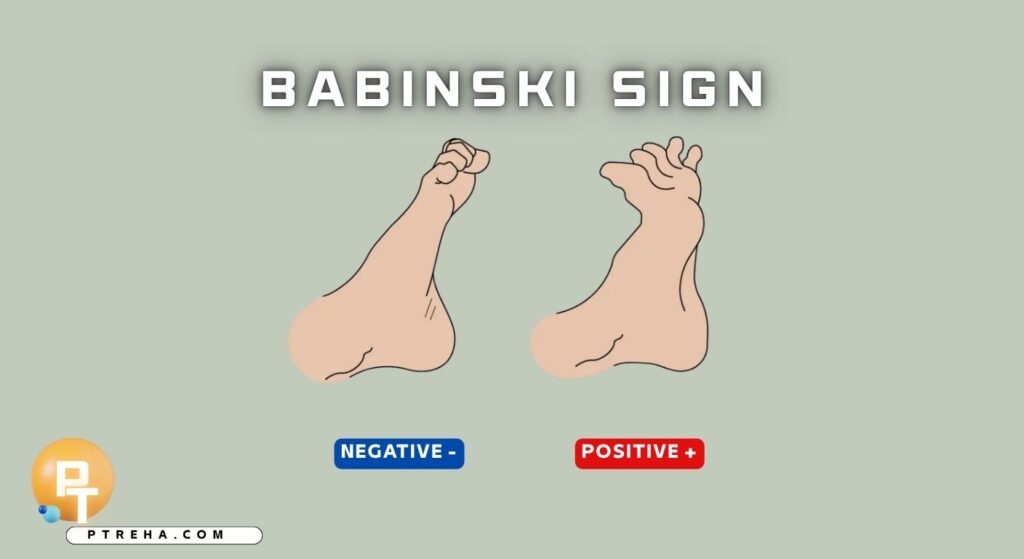
The Babinski Sign is a neurological examination finding used to assess the plantar response and provide information about corticospinal tract function.
In neurologically mature patients, extension of the great toe after appropriate plantar stimulation is an abnormal extensor response that can support suspicion of upper motor neuron pathway dysfunction, but the finding must always be interpreted with the rest of the neurological examination.
What Is the Babinski Sign?
The Babinski Sign is a neurological test and clinical sign assessed during examination of the plantar reflex.
It is not an orthopedic special test, functional performance test, or stand-alone diagnostic test.
The examiner applies a controlled cutaneous stimulus to the sole of the foot and observes the movement of the great toe and, when present, the other toes.
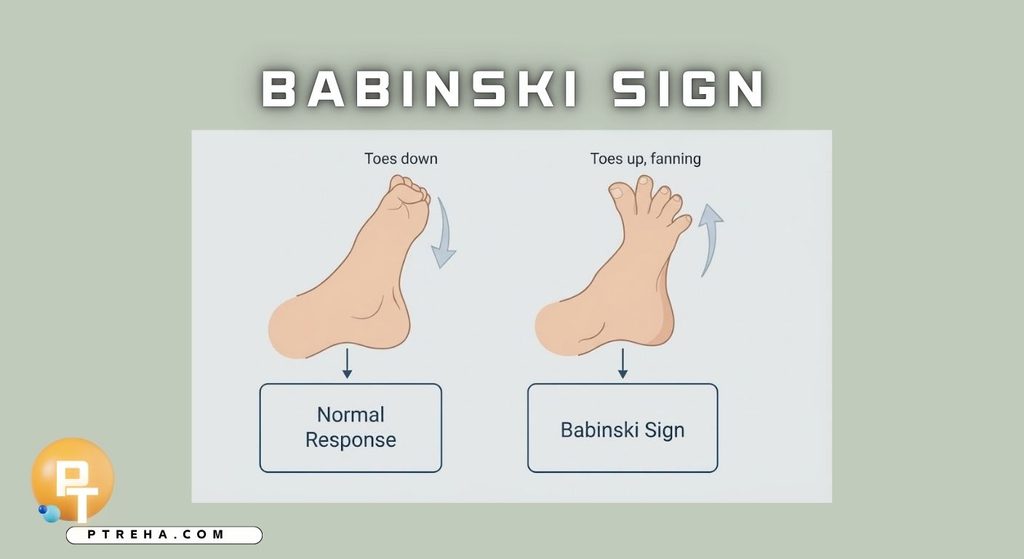
In a neurologically mature adult, an extensor plantar response consists primarily of extension, or dorsiflexion, of the great toe.
The other toes may also fan or abduct.
A flexor response, in which the toes move downward, is the typical mature plantar response.
Some patients produce little or no visible response, which should be documented rather than automatically interpreted as evidence that neurological disease is absent.
The clinical overview in the NCBI Bookshelf review of the Babinski reflex describes the examination as part of the neurological assessment of corticospinal tract integrity and emphasizes the need to distinguish a true extensor response from withdrawal caused by uncomfortable plantar stimulation.
“The Babinski Sign is a neurological finding, not a diagnosis by itself.”
Purpose of the Babinski Sign
The Babinski Sign is commonly assessed to:
- Examine the plantar reflex.
- Look for an extensor plantar response.
- Contribute to assessment of corticospinal tract function.
- Help identify a pattern consistent with upper motor neuron dysfunction.
- Compare neurological findings between the right and left sides.
- Complement examination of muscle tone and strength.
- Complement deep tendon reflex testing.
- Support neurological localization when interpreted with other findings.
- Contribute to assessment following suspected central nervous system injury.
- Document changes during repeated neurological examinations when clinically appropriate.
The sign should not be interpreted independently from the patient’s history, motor examination, sensory findings, reflexes, coordination, gait, and other relevant neurological observations.
Babinski Sign Indications
Assessment of the plantar response may be appropriate during a neurological examination when there is concern about central motor pathway dysfunction.
Common clinical situations include:
- Unexplained limb weakness.
- Suspected upper motor neuron involvement.
- Changes in muscle tone.
- Abnormally brisk deep tendon reflexes.
- Clonus or other upper motor neuron findings.
- New neurological symptoms following neurological injury or disease.
- Suspected spinal cord involvement.
- Suspected cerebral motor pathway involvement.
- Asymmetric neurological findings.
- Follow-up examination of a known neurological disorder.
The finding may contribute to assessment in disorders involving the brain or spinal cord, but it does not identify the specific cause or anatomical level of a lesion by itself.
Babinski Sign Contraindications and Precautions
There is not a broad, universally established list of test-specific contraindications for examining the plantar response.
However, the examiner should avoid or modify direct stimulation when the plantar surface cannot be safely or meaningfully tested.
Relevant precautions include:
- Do not stroke directly across an open wound.
- Avoid an area of active infection or significant skin injury.
- Use caution when plantar stimulation produces significant pain.
- Avoid sharp instruments that could damage the skin.
- Consider whether recent foot trauma makes stimulation inappropriate.
- Explain the examination beforehand because the stimulus can feel unpleasant or ticklish.
- Keep the stimulus controlled rather than excessively forceful.
- Watch for generalized withdrawal that can obscure toe movement.
- Allow the patient to relax before repeating an unclear examination.
- Interpret an equivocal response cautiously.
A painful stimulus can produce withdrawal of the entire limb.
This is not equivalent to a Babinski response and is a common source of examination error.
Patient Position
The plantar response can be examined in more than one clinical position.
A commonly used approach is with the patient lying supine and relaxed.
Useful positioning principles include:
- Position the patient comfortably.
- Keep the tested lower limb supported.
- Expose the plantar surface of the foot.
- Encourage the patient to relax the leg and foot.
- Avoid unnecessary voluntary movement.
- Position the foot so the examiner can clearly see the toes.
- Compare both feet when clinically appropriate.
A seated position can also be used when necessary, provided that the foot is adequately supported and the examiner can observe the response clearly.
The objective is not to reproduce one rigid posture but to minimize voluntary activity and allow accurate observation of the plantar response.
Examiner Position
The examiner should position themselves so both the stimulation and toe response can be seen clearly.
Practical considerations include:
- Stand or sit near the patient’s foot.
- Maintain a clear view of the great toe.
- Observe the other toes and the remainder of the limb as well.
- Stabilize the foot gently when required.
- Avoid restraining the foot so firmly that normal movement is prevented.
- Use a blunt examination object rather than a sharp point.
- Compare the response with the opposite side when indicated.
Observation of the entire limb can be useful because a strong flexor withdrawal response may otherwise be mistaken for an abnormal plantar response.
How to Perform the Babinski Sign
Several variations of plantar stimulation have been described.
The following is the commonly used conventional plantar technique.
- Explain briefly what you are going to do.
- Position the patient comfortably with the leg and foot relaxed.
- Inspect the plantar surface for wounds, infection, or other reasons to avoid stimulation.
- Use a blunt object suitable for neurological examination.
- Begin near the lateral aspect of the heel.
- Apply a firm but noninjurious stimulus along the lateral plantar surface toward the forefoot.
- Continue the stimulus across the forefoot toward the medial side near the base of the great toe.
- Observe the great toe throughout the maneuver.
- Note any movement of the other toes.
- Observe whether the leg withdraws from the stimulus.
- Repeat cautiously if the initial response is unclear and repetition is clinically justified.
- Test the opposite side when bilateral comparison is relevant.
The stimulus should be sufficient to evoke the plantar response without intentionally producing pain.
Excessive pressure can trigger generalized withdrawal, making interpretation more difficult rather than more accurate.
What Constitutes a Positive Babinski Sign?
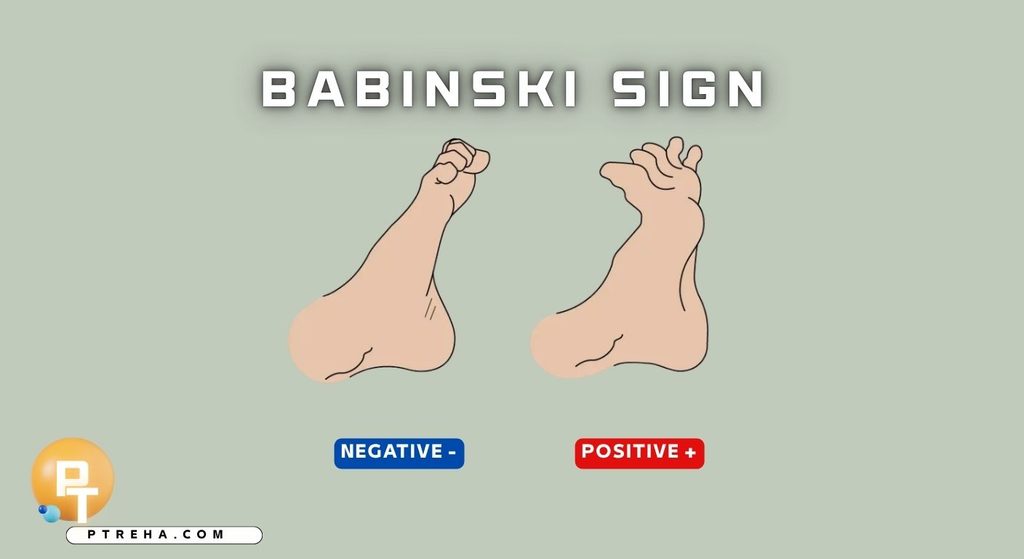
The term positive Babinski Sign is commonly used clinically and is appropriate in this context.
The principal finding is:
- Extension, or dorsiflexion, of the great toe following appropriate plantar stimulation.
Fanning or abduction of the other toes may accompany the response, but the great-toe response is the central observation.
The examiner should distinguish this pattern from rapid withdrawal of the entire foot and leg due to discomfort.
A genuine extensor plantar response is best interpreted as part of the complete motor examination rather than from toe movement in isolation.
What Does a Positive Babinski Sign Mean?
In a neurologically mature patient, a true Babinski Sign is associated with dysfunction involving the corticospinal or pyramidal motor system.
It may therefore support the presence of an upper motor neuron pattern when accompanied by findings such as:
- Weakness with an upper motor neuron distribution.
- Increased muscle tone.
- Hyperreflexia.
- Clonus.
- Loss of selective motor control.
- Other pathological reflex findings.
The Babinski Sign does not determine the underlying disease by itself.
An extensor plantar response does not tell the examiner whether the cause is a stroke, spinal cord lesion, demyelinating disorder, structural lesion, or another central nervous system process.
Further history, neurological examination, medical evaluation, and appropriate diagnostic investigations are required when clinically indicated.
Negative Babinski Sign
A so-called negative Babinski Sign generally refers to the absence of an abnormal extensor great-toe response.
A flexor plantar response typically involves downward movement of the toes following stimulation.
However, three broad patterns may be encountered:
- Flexor plantar response.
- Extensor plantar response.
- Equivocal or absent response.
An absent Babinski Sign does not reliably exclude corticospinal tract dysfunction.
This limitation is important.
A patient may have clinically important upper motor neuron disease without demonstrating an extensor plantar response during a particular examination.
“An absent Babinski Sign should never overrule a convincing neurological examination.”
Anatomy Involved in the Babinski Sign
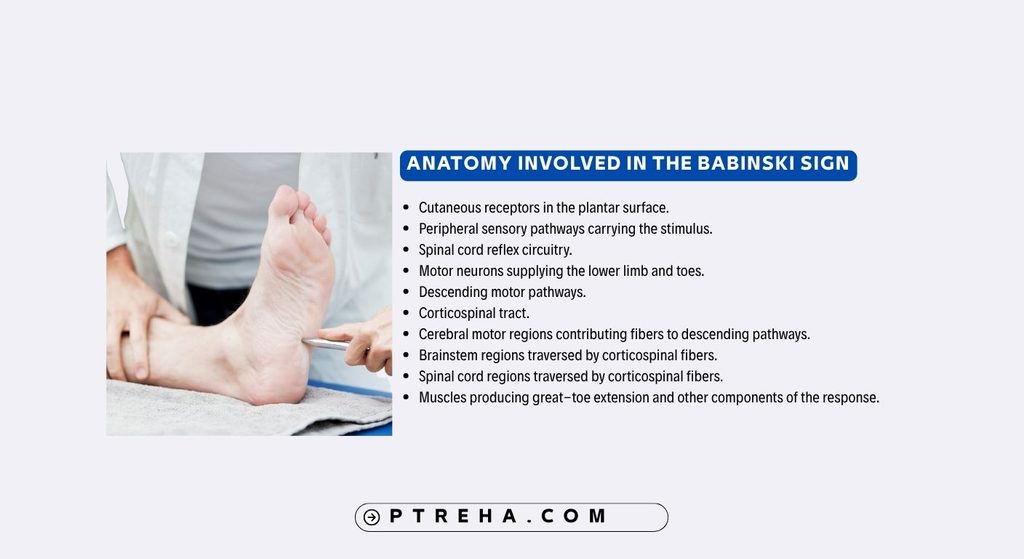
The response involves a neurological network rather than an isolated muscle or peripheral nerve.
Relevant structures and systems include:
- Cutaneous receptors in the plantar surface.
- Peripheral sensory pathways carrying the stimulus.
- Spinal cord reflex circuitry.
- Motor neurons supplying the lower limb and toes.
- Descending motor pathways.
- Corticospinal tract.
- Cerebral motor regions contributing fibers to descending pathways.
- Brainstem regions traversed by corticospinal fibers.
- Spinal cord regions traversed by corticospinal fibers.
- Muscles producing great-toe extension and other components of the response.
The Babinski examination therefore should not be described as directly “testing” one muscle, one nerve root, or one isolated anatomical structure.
The clinically important concept is the influence of descending motor control over spinal reflex activity.
When that control is disrupted, the plantar response may change to an extensor pattern.
Age and the Babinski Response
Age substantially changes the interpretation of the plantar response.
An extensor plantar response can occur physiologically in infants because descending motor systems are still developing.
It therefore does not carry the same pathological implication in early childhood that it does in a neurologically mature adult.
The transition from an immature extensor response to the mature plantar response is developmental rather than an exact universal birthday cutoff.
For this reason, interpretation in infants and young children requires:
- The child’s developmental age.
- Neurological development.
- Symmetry of the response.
- Other neurological findings.
- The examination technique.
- The broader clinical context.
The presence of toe extension in a young infant should therefore not simply be interpreted according to adult criteria.
Conditions Associated With an Abnormal Babinski Sign
An extensor plantar response can occur with disorders affecting central descending motor pathways.
Associated clinical contexts can include:
- Cerebral stroke.
- Traumatic brain injury involving motor pathways.
- Spinal cord injury.
- Spinal cord compression.
- Multiple sclerosis and other central demyelinating disorders.
- Central nervous system tumors affecting motor pathways.
- Other structural brain lesions.
- Other structural spinal cord lesions.
- Disorders producing corticospinal tract dysfunction.
These conditions are associated with the finding; they are not diagnosed by the Babinski Sign.
For example, observing an extensor plantar response cannot determine whether a patient has multiple sclerosis or a spinal cord lesion.
It indicates that further interpretation of the central motor system is warranted.
Clinical Significance
The Babinski Sign remains clinically useful because it provides bedside information about the central motor system with minimal equipment and limited active participation from the patient.
Its clinical value includes:
- Supporting identification of an upper motor neuron pattern.
- Complementing strength testing.
- Complementing muscle-tone examination.
- Complementing deep tendon reflexes.
- Supporting neurological localization.
- Identifying asymmetry between lower limbs.
- Contributing to serial neurological examinations.
- Helping determine whether neurological referral or further investigation may be appropriate.
- Providing information when active motor testing is limited by patient cooperation.
For physical therapists, an unexpected extensor plantar response is particularly important when it appears alongside new weakness, abnormal tone, hyperreflexia, coordination changes, gait disturbance, or other neurological findings.
The appropriate response is not to assign a medical diagnosis from the sign.
Instead, the therapist should integrate the finding into the neurological assessment and determine whether medical evaluation is required based on the overall clinical presentation.
Sensitivity and Specificity
Diagnostic performance is not universal and varies according to the population, reference standard, examiner, and methodology.
One study published in the Journal of the Neurological Sciences evaluated 107 adult hospital and outpatient neurology patients.
Using an expert neurological assessment incorporating history, physical examination, imaging, and complementary testing as the reference standard for pyramidal tract dysfunction, the investigators reported a sensitivity of 50.8% and specificity of 99% for the Babinski Sign.
These values apply to that study population and methodology and should not be treated as universal test characteristics.
The study of Babinski Sign accuracy in pyramidal tract dysfunction also illustrates why the absence of the sign cannot be used to rule out corticospinal tract disease.
Another investigation involving neurological inpatients found substantial limitations in observer agreement and reported different performance characteristics.
The plantar reflex observer-agreement study reinforces that technique and examiner interpretation materially affect the clinical usefulness of the sign.
These findings support a practical principle:
- A clearly elicited extensor plantar response can be clinically meaningful.
- Failure to elicit one does not exclude corticospinal tract dysfunction.
- Test performance should not be separated from examiner technique and the overall neurological examination.
Diagnostic Accuracy and Limitations
The Babinski Sign should not be treated as a stand-alone diagnostic test.
Important limitations include:
- Sensitivity may be limited.
- The response can be absent despite corticospinal tract pathology.
- Examiner interpretation can vary.
- Plantar stimulation can produce withdrawal.
- Ticklish patients may voluntarily move the foot.
- Excessive force can distort the response.
- Minimal toe movement can be difficult to classify.
- Age changes the meaning of the response.
- Local foot problems may interfere with testing.
- A unilateral response does not independently identify lesion location.
- The sign cannot determine the underlying disease.
Diagnostic accuracy studies have also used different patient populations and reference standards.
Their numerical findings should therefore not be generalized to every neurological examination.
The Babinski Sign is most useful when considered as one component of a pattern of neurological findings.
Common Mistakes in Babinski Sign Testing
Using a sharp object
A sharp instrument is unnecessary and may cause pain or skin injury.
Use a blunt examination tool and a controlled stimulus.
Applying excessive force
More force does not make the test more accurate.
Excessively painful stimulation increases the likelihood of a withdrawal response.
Watching only the small toes
Fanning can occur, but great-toe movement is the key observation.
Watch the hallux carefully from the beginning of stimulation.
Confusing withdrawal with a Babinski response
The patient may flex the hip and knee or rapidly pull the foot away when the stimulus is uncomfortable.
A generalized withdrawal response should not automatically be documented as a positive Babinski Sign.
Ignoring patient relaxation
Voluntary movement, guarding, and ticklish reactions can interfere with interpretation.
Allow the patient to settle before repeating an uncertain examination.
Treating absence of the sign as exclusionary
A flexor or equivocal plantar response does not rule out central motor pathway dysfunction.
The remainder of the neurological examination remains essential.
Ignoring age
Adult interpretation should not automatically be applied to an infant.
Developmental context matters.
Diagnosing from the Babinski Sign alone
A positive sign supports corticospinal pathway dysfunction in an appropriate clinical context.
It does not identify the underlying disease.
Tips for Performing the Babinski Sign
For a clearer and more reproducible examination:
- Explain the procedure first.
- Make sure the patient is comfortable.
- Inspect the sole before stimulation.
- Use a blunt examination object.
- Use a smooth, deliberate stimulus.
- Avoid unnecessary painful pressure.
- Watch the great toe continuously.
- Observe the entire lower limb.
- Distinguish toe extension from withdrawal.
- Compare both sides when relevant.
- Repeat only when necessary.
- Document equivocal findings as equivocal.
- Interpret the result with tone, reflexes, strength, and other neurological signs.
- Consider developmental age in pediatric patients.
- Refer or escalate concerns according to the overall neurological presentation rather than one isolated finding.
Clear documentation is preferable to forcing the response into an artificial binary category.
For example, documentation might state that plantar stimulation produced great-toe extension with associated toe fanning on the right, rather than simply recording “Babinski positive” without describing the observed response.
Summary
- The Babinski Sign is a neurological examination finding used to assess the plantar response and contribute information about corticospinal tract function.
- The conventional technique involves controlled stimulation along the lateral plantar surface while observing primarily for movement of the great toe.
- In a neurologically mature patient, great-toe extension represents an extensor plantar response associated with corticospinal or upper motor neuron dysfunction.
- A positive Babinski Sign does not establish the underlying diagnosis, while an absent sign does not reliably exclude corticospinal tract pathology.
- Accurate interpretation requires appropriate technique, consideration of age, distinction from withdrawal, and integration with the complete neurological examination.
The Babinski Sign is most valuable when it is treated as a clinical sign within a neurological pattern rather than a stand-alone diagnostic answer.
For physical therapists, careful observation and appropriate interpretation can help identify findings that warrant broader neurological assessment or further medical evaluation.