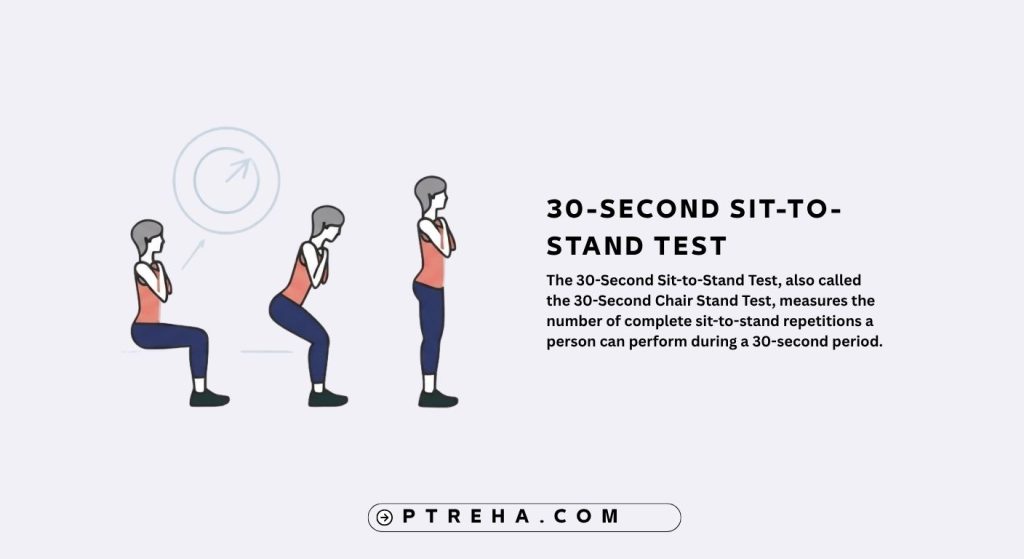
The 30-Second Sit-to-Stand Test is a functional performance assessment used to examine how many times a person can rise from a chair and return to sitting within 30 seconds. It is particularly useful for evaluating functional lower-extremity performance in older adults and can be incorporated into broader assessments of mobility, physical function, and fall risk.
Unlike an orthopedic special test, it is not interpreted as positive or negative and does not independently diagnose a musculoskeletal, neurological, or cardiovascular condition. The result is a performance score that must be interpreted in relation to the patient’s characteristics, clinical presentation, and the exact testing protocol used.
What Is the 30-Second Sit-to-Stand Test?
The 30-Second Sit-to-Stand Test, also called the 30-Second Chair Stand Test, measures the number of complete sit-to-stand repetitions a person can perform during a 30-second period.
The test was developed as a practical measure of lower-body functional performance in older adults. The original research examined its relationship with lower-body strength, while clinical resources such as the CDC STEADI program use it to assess leg strength and endurance.
The assessment requires minimal equipment and can be completed in a clinical, rehabilitation, community, or research setting. Because chair height, arm use, instructions, footwear, and other protocol characteristics can influence performance, the same protocol should be used when comparing results over time.
“The score is a measure of performance—not a diagnosis.”
Purpose of the 30-Second Sit-to-Stand Test
The test can be used to:
- Assess functional lower-extremity performance during repeated chair-rise movements.
- Examine the ability to repeatedly transfer between sitting and standing.
- Monitor functional performance during rehabilitation.
- Establish a baseline for subsequent reassessment.
- Contribute to a broader evaluation of mobility and physical function.
- Help identify individuals whose functional performance warrants further assessment.
- Provide an objective outcome that can be compared when the testing conditions are standardized.
The test should not be treated as a direct measurement of isolated muscle strength. Although performance is influenced by lower-extremity strength, the movement also requires coordination, balance, postural control, joint mobility, motor strategy, and sufficient cardiovascular and muscular endurance.
30-Second Sit-to-Stand Test Indications
The assessment may be useful when a clinician wants to evaluate functional chair-rise performance in a patient with:
- Reduced mobility or functional capacity.
- Difficulty rising from a chair.
- Age-related changes in physical function.
- Deconditioning.
- Frailty or suspected functional decline.
- Lower-extremity musculoskeletal limitations.
- Neurological conditions affecting mobility.
- Reduced exercise tolerance, when the patient is medically appropriate for the activity.
- A need to monitor functional changes during rehabilitation.
The indication should always be based on the patient’s clinical presentation rather than the presence of a particular diagnosis alone.
30-Second Sit-to-Stand Test Contraindications and Precautions
There is no single universally applicable disease-specific contraindication that defines whether the 30-Second Sit-to-Stand Test can be performed in every patient. Instead, clinicians should consider whether repeated standing and sitting are medically and functionally appropriate.
Important precautions include:
- Do not proceed if the patient is medically unstable or unable to safely perform repeated transfers.
- Consider current pain, dizziness, marked weakness, impaired balance, or other symptoms that could make repeated chair rises unsafe.
- Use appropriate guarding and remain close enough to assist if loss of balance occurs.
- Consider the patient’s need for an assistive device and whether the selected protocol permits its use.
- Stop the assessment if concerning symptoms develop.
- Follow relevant precautions associated with the patient’s underlying medical or surgical condition.
- Ensure the chair is stable and positioned on a secure surface.
Safety takes priority over obtaining a score. If the patient cannot safely perform the standardized movement, the clinician should document the limitation rather than forcing completion of the test.
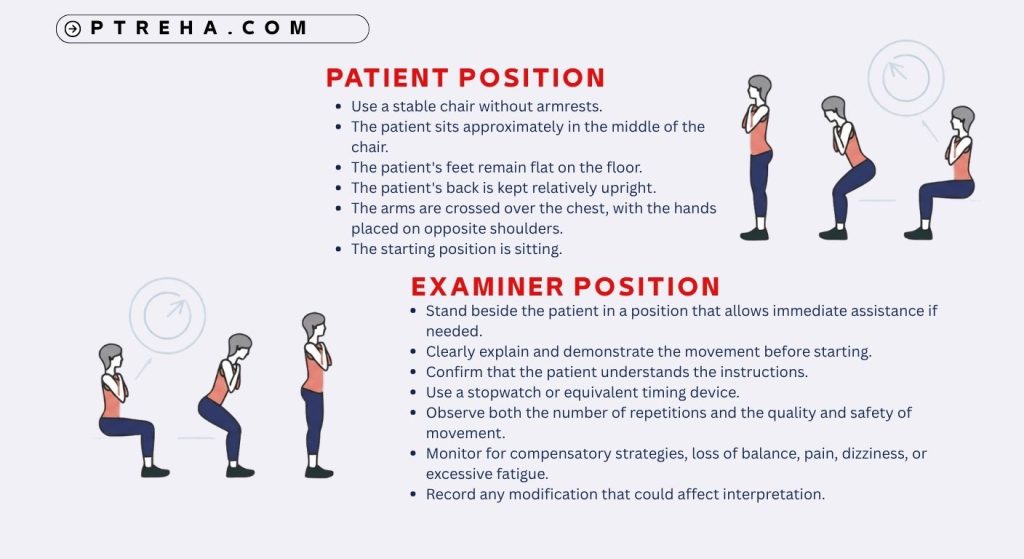
Patient Position
For the commonly used CDC STEADI-style protocol:
- Use a stable chair without armrests.
- The patient sits approximately in the middle of the chair.
- The patient’s feet remain flat on the floor.
- The patient’s back is kept relatively upright.
- The arms are crossed over the chest, with the hands placed on opposite shoulders.
- The starting position is sitting.
The original chair-stand research and subsequent clinical protocols have used specific chair characteristics and standardized instructions. Because chair height and other testing conditions can affect performance, the protocol should be documented and reproduced during follow-up testing.
Examiner Position
The examiner should:
- Stand beside the patient in a position that allows immediate assistance if needed.
- Clearly explain and demonstrate the movement before starting.
- Confirm that the patient understands the instructions.
- Use a stopwatch or equivalent timing device.
- Observe both the number of repetitions and the quality and safety of movement.
- Monitor for compensatory strategies, loss of balance, pain, dizziness, or excessive fatigue.
- Record any modification that could affect interpretation.
The examiner should not focus solely on counting repetitions. Movement quality and patient safety provide clinically relevant information that may explain why a score is high or low.
How to Perform the 30-Second Sit-to-Stand Test
The following describes a commonly used 30-second chair-stand protocol:
- Position the patient in the middle of a stable, armless chair.
- Ask the patient to place both feet flat on the floor.
- Instruct the patient to cross the arms over the chest, with the hands on opposite shoulders.
- Explain that the patient should stand fully and then return to a seated position.
- Demonstrate the movement if necessary.
- Position yourself beside the patient for safety.
- Begin timing when the patient starts the first standing movement.
- The patient repeatedly stands fully and returns to sitting for 30 seconds.
- Count each completed stand according to the selected protocol.
- Record the total number of completed repetitions.
- Document any use of the arms, assistance, modification, pain, symptoms, or inability to complete the protocol.
In the CDC protocol, if the patient has to use the arms to stand, the standardized score is recorded as zero. The CDC instructions also specify how to handle a repetition that is already more than halfway toward standing when the 30-second interval ends.
For clinical documentation, it is useful to record not only the repetition count but also whether the test was performed according to the intended protocol.
Scoring and Performance Criteria
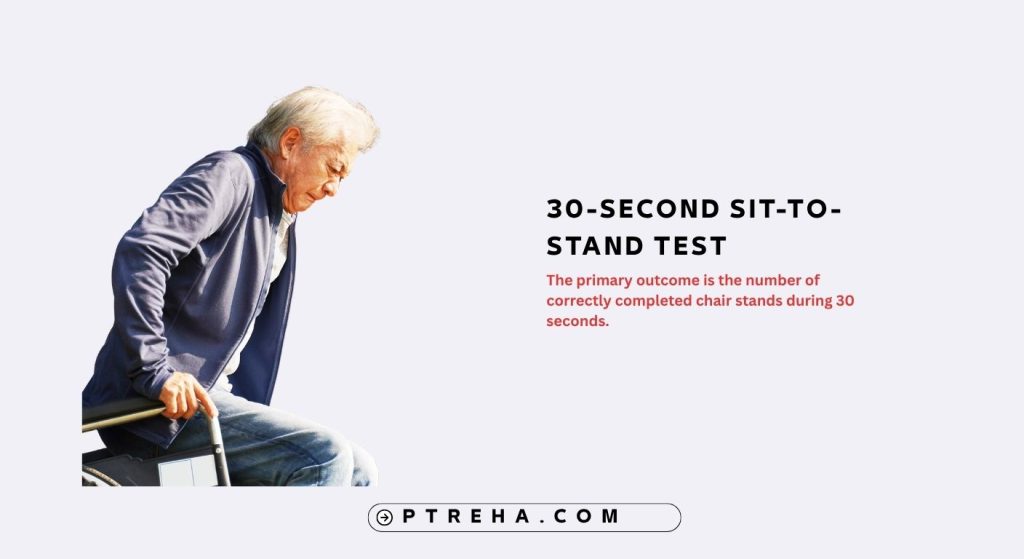
The primary outcome is the number of correctly completed chair stands during 30 seconds.
A higher repetition count generally represents greater ability to repeatedly perform the tested movement under the specified conditions. However, the score should not be interpreted independently of the patient’s age, sex, functional status, symptoms, chair characteristics, instructions, and testing protocol.
Reference values have been published for particular populations, and clinical resources provide age- and sex-specific interpretation for their intended populations. These values should not be converted into universal normal or abnormal thresholds for every patient.
Changes in score can be useful during rehabilitation when testing conditions remain consistent. A change should be interpreted together with other clinical findings rather than assumed to represent a change in isolated muscle strength.
Interpretation
The 30-Second Sit-to-Stand Test provides information about the patient’s ability to repeatedly perform a functional sit-to-stand task.
A lower performance may be associated with reduced lower-extremity functional capacity, but it does not identify the specific reason for the limitation. Possible contributors include weakness, pain, restricted joint motion, impaired motor control, balance limitations, reduced endurance, fear of movement, or other functional impairments.
Conversely, a relatively high score does not establish that the patient has normal strength, normal balance, or low fall risk.
The most useful interpretation combines the repetition count with observation of the movement and the patient’s broader clinical presentation.
Anatomy Involved in the 30-Second Sit-to-Stand Test
The movement involves multiple anatomical structures and physiological systems rather than a single muscle or joint.
- Hip joint: contributes to the transition between sitting and standing through coordinated hip movement.
- Knee joint: undergoes substantial movement during the chair-rise task and contributes to extension during standing.
- Ankle and foot: provide a base of support and contribute to forward and upward movement during the transfer.
- Quadriceps: contributes to knee extension during rising.
- Gluteal muscles: contribute to hip extension during the transition to standing.
- Trunk musculature: contributes to trunk control and positioning during the movement.
- Calf and ankle musculature: contributes to postural control and the interaction between the lower limb and the supporting surface.
- Neuromuscular system: coordinates force production, timing, postural adjustments, and repeated movement.
- Cardiorespiratory system: contributes to tolerance of repeated chair-rise activity.
These structures work together during the task. The test therefore should not be described as an isolated test of quadriceps strength, hip strength, balance, or any other single anatomical structure.
Conditions Detected or Associated With the Test
The 30-Second Sit-to-Stand Test does not independently detect or diagnose a specific disease.
Reduced performance may be associated with functional limitations occurring in populations with:
- Frailty.
- Age-related functional decline.
- Deconditioning.
- Neurological disorders.
- Musculoskeletal disorders.
- Reduced lower-extremity physical function.
- Conditions associated with reduced exercise capacity.
The appropriate interpretation depends heavily on the population being assessed. A low score should prompt clinical consideration of potential contributing factors rather than being used as a diagnosis by itself.
Clinical Significance
The test can contribute to clinical decision-making by providing a simple, reproducible measure of functional chair-rise performance.
Clinically useful observations include:
- Repetition count: provides the primary quantitative outcome.
- Movement strategy: may reveal compensations or difficulty generating sufficient force.
- Symmetry: differences between limbs may be clinically relevant when clearly observable, although the test itself is not a validated isolated measure of limb symmetry.
- Use of the upper limbs: may indicate that the standardized task cannot be completed as intended.
- Balance: loss of stability during the movement may warrant further assessment.
- Pain: symptoms during rising or sitting may help identify a need for additional examination.
- Fatigue: excessive fatigue may affect performance and should be documented.
- Change over time: repeated testing under standardized conditions can help monitor functional progress.
The test is particularly valuable when combined with other assessments rather than used as a stand-alone representation of overall physical function.
Sensitivity and Specificity
Universal sensitivity and specificity values should not be assigned to the 30-Second Sit-to-Stand Test.
Diagnostic accuracy depends on the population, outcome of interest, protocol, comparison standard, and threshold used. The test is primarily a functional performance assessment rather than a stand-alone diagnostic test for a specific disease.
Therefore, a single sensitivity or specificity value should not be presented as applying to all patients or clinical settings.
Diagnostic Accuracy
The 30-Second Sit-to-Stand Test should not be treated as a stand-alone diagnostic test.
Research has examined its validity and relationship with measures of lower-body strength and physical function, particularly in older adults. However, demonstrating an association with another clinical measure does not mean that the test can independently diagnose the condition represented by that measure.
Clinical diagnosis should be based on the complete history, physical examination, appropriate outcome measures, and other investigations when indicated.
Common Mistakes in the 30-Second Sit-to-Stand Test
Common errors include:
- Allowing the patient to push from the chair when the selected protocol requires crossed arms.
- Using a different chair between assessments without documenting the change.
- Failing to stabilize the chair.
- Starting the stopwatch before the patient is ready.
- Inconsistent verbal instructions between assessments.
- Counting an incomplete repetition as a full stand.
- Failing to define what constitutes a completed repetition.
- Standing too far away to provide effective assistance.
- Ignoring pain, dizziness, or other symptoms because the test is time-limited.
- Comparing results obtained with substantially different protocols.
- Treating the repetition count as a direct measurement of isolated muscle strength.
- Applying reference values from one population to a substantially different population without appropriate consideration.
- Describing the result as “positive” or “negative.”
Tips for Performing the 30-Second Sit-to-Stand Test
For reliable clinical use:
- Use the same chair and protocol whenever possible.
- Give standardized instructions.
- Keep the testing environment consistent.
- Explain the task before starting the timer.
- Position yourself appropriately for safety.
- Count only repetitions that satisfy the defined performance criteria.
- Document deviations from the protocol.
- Record symptoms or movement limitations that affect performance.
- Use the test as one component of a broader functional assessment.
- When monitoring rehabilitation, compare results only when testing conditions are sufficiently similar.
“Consistency of the protocol is essential when using the test to monitor change.”
Summary
- The 30-Second Sit-to-Stand Test is a functional performance assessment, not an orthopedic special test with positive and negative findings.
- It measures how many chair-rise repetitions a patient can complete during a standardized 30-second period.
- Performance reflects multiple factors, including lower-extremity force production, coordination, postural control, joint function, and exercise tolerance.
- The score should be interpreted according to the patient’s characteristics and the specific testing protocol rather than against a universal normal value.
- The test does not independently diagnose weakness, frailty, falls, neurological disease, or any other condition.
The 30-Second Sit-to-Stand Test is most useful when performed consistently, safely, and alongside other clinical findings. Its simplicity makes it valuable for documenting functional performance, but its result should always be interpreted as one part of the patient’s overall physical therapy assessment.