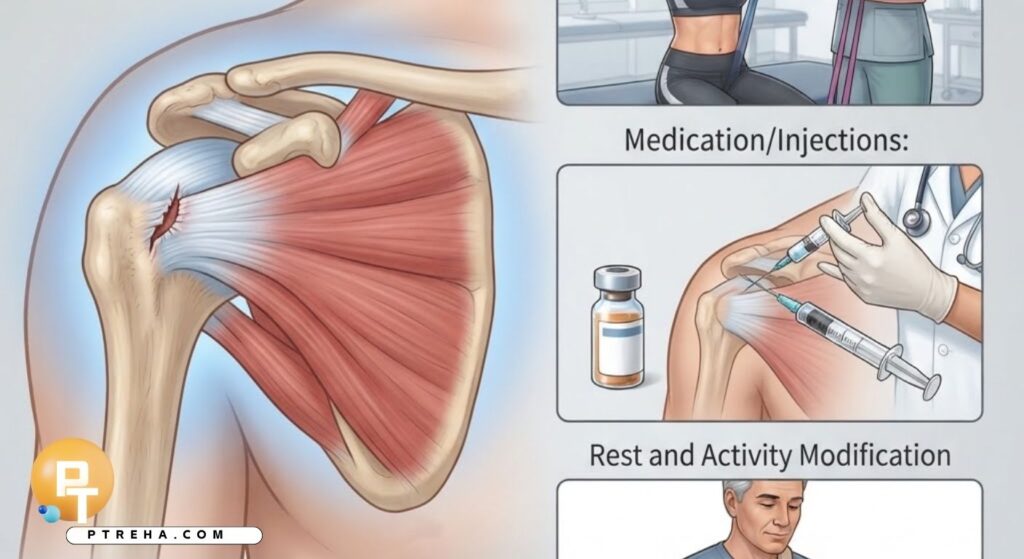
A rotator cuff tear does not automatically mean surgery is required.
Conservative management can reduce pain, restore shoulder movement, improve strength and function, and help many people return to daily activities through individualized activity modification, physical therapy, progressive strengthening, and appropriate symptom management.
Understanding a Rotator Cuff Tear
The rotator cuff is a group of four muscles and their tendons that help control shoulder movement and stability.
A tear may be partial or full thickness and can occur after trauma, repetitive loading, or age-related tendon changes.
The presence of a tear on ultrasound or MRI does not by itself determine how much pain or disability a person will experience.
Clinical findings, functional limitations, activity demands, tear characteristics, and the patient’s goals all need to be considered.
Conservative management is particularly relevant when symptoms are manageable, shoulder function can be improved without surgery, or the person prefers to begin with non-operative care.
Current guidance from the American Academy of Orthopaedic Surgeons supports physical therapy as an effective option for improving symptoms and function in appropriate patients with rotator cuff tears.
The AAOS clinical practice guideline on rotator cuff injuries provides the current evidence framework for these decisions.
When Conservative Management May Be Appropriate
A non-operative approach can be reasonable for many symptomatic rotator cuff tears, but the decision should be individualized rather than based only on the MRI report.
Conservative treatment may be considered when:
- Shoulder pain is manageable with activity modification.
- Daily activities remain possible.
- Strength can be improved with rehabilitation.
- The tear is not associated with a major acute loss of function.
- The patient prefers to avoid or postpone surgery.
- Symptoms are improving with rehabilitation.
- Work and recreational demands can be modified temporarily.
- The tear is being monitored clinically when appropriate.
- There is no urgent indication for surgical assessment.
- Functional goals can realistically be achieved without repair.
A different approach may be necessary after a significant traumatic injury, particularly when there is sudden weakness or a major loss of active shoulder elevation.
An orthopaedic assessment is especially important when a person cannot actively raise the arm after an injury, has substantial new weakness, or has symptoms that are progressively worsening.
Physical Therapy as the Core of Conservative Care
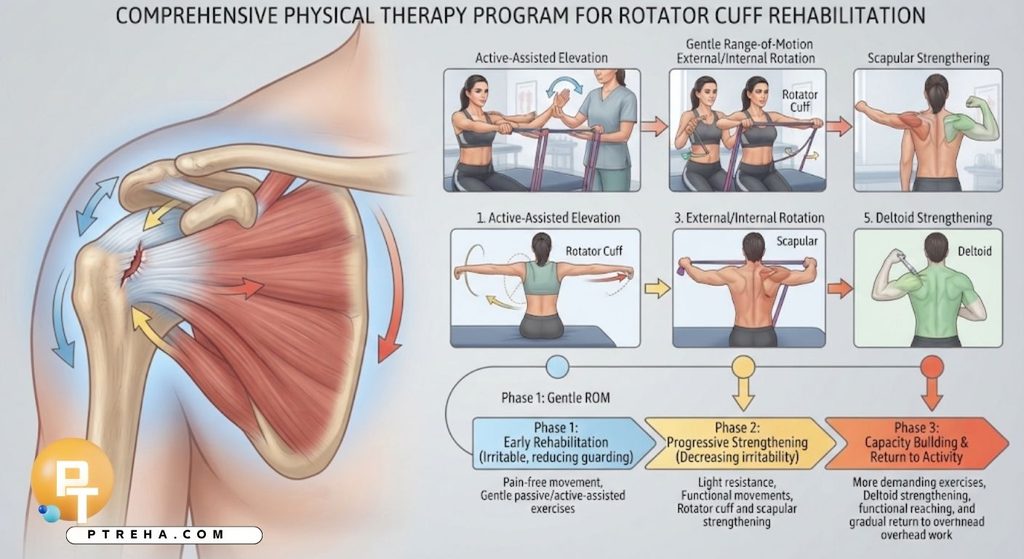
Physical therapy is usually the central component of conservative management because the main goals are to restore useful movement, improve shoulder capacity, and increase tolerance to everyday loading.
A rehabilitation program should be based on the person’s examination rather than simply prescribing a standard list of rotator cuff exercises.
A typical program may include:
- Gentle range-of-motion exercises.
- Active-assisted shoulder elevation.
- Progressive active movement.
- Scapular muscle strengthening.
- Rotator cuff strengthening.
- Deltoid strengthening when appropriate.
- External rotation exercises.
- Internal rotation exercises.
- Functional reaching exercises.
- Gradual return to overhead activities.
Early rehabilitation may emphasize comfortable movement and reducing protective guarding.
Strengthening can then become progressively more demanding as irritability decreases and movement improves.
The aim is not to repeatedly provoke the torn tendon.
Instead, the shoulder is gradually exposed to tolerable loads so that muscles and movement strategies can become more capable.
The AAOS rotator cuff and shoulder conditioning program provides examples of commonly used mobility and strengthening exercises, although an individual program should be adjusted by a qualified clinician.
Activity Modification Without Complete Rest
Complete immobilization is usually not the goal of conservative rehabilitation.
Excessive rest can reduce shoulder capacity and make normal activities feel more difficult when they are resumed.
Activity modification means temporarily changing activities that produce substantial symptoms while maintaining tolerable movement and general physical activity.
Useful strategies include:
- Reduce repetitive overhead work temporarily.
- Keep frequently used objects within a comfortable reach.
- Avoid repeatedly lifting heavy loads away from the body.
- Break demanding tasks into shorter sessions.
- Use both hands for heavier objects when appropriate.
- Keep loads close to the trunk.
- Alternate demanding and easier activities.
- Modify sleeping positions if night pain is present.
- Resume overhead activity progressively rather than suddenly.
- Maintain comfortable shoulder movement throughout the day.
For example, someone who develops pain while repeatedly placing boxes on a high shelf may not need to stop all activity.
Lowering the shelf height, reducing load size, using both hands, and gradually rebuilding overhead capacity may allow continued work while symptoms settle.
Pain Management During Conservative Treatment
Pain control can make rehabilitation easier, but pain management should support functional recovery rather than replace it.
Depending on the individual situation, a healthcare professional may discuss:
- Short-term activity modification.
- Cold application for symptom relief.
- Heat when it helps reduce stiffness before movement.
- Appropriate over-the-counter pain medication.
- Prescription medication when clinically indicated.
- Corticosteroid injection in selected cases.
- Sleep-position modifications.
- Education about expected symptom fluctuations.
Medication decisions should consider other medical conditions, current medications, gastrointestinal and cardiovascular risks, kidney function, and other contraindications.
A corticosteroid injection can provide short-term improvement in pain and function for selected patients, but it should not be treated as a substitute for rehabilitation.
Current AAOS guidance also emphasizes caution with repeated corticosteroid injections, particularly when surgery may subsequently be considered.
Progressive Strengthening: What Should It Look Like?
Strengthening should progress according to symptoms, movement quality, functional ability, and the demands placed on the shoulder.
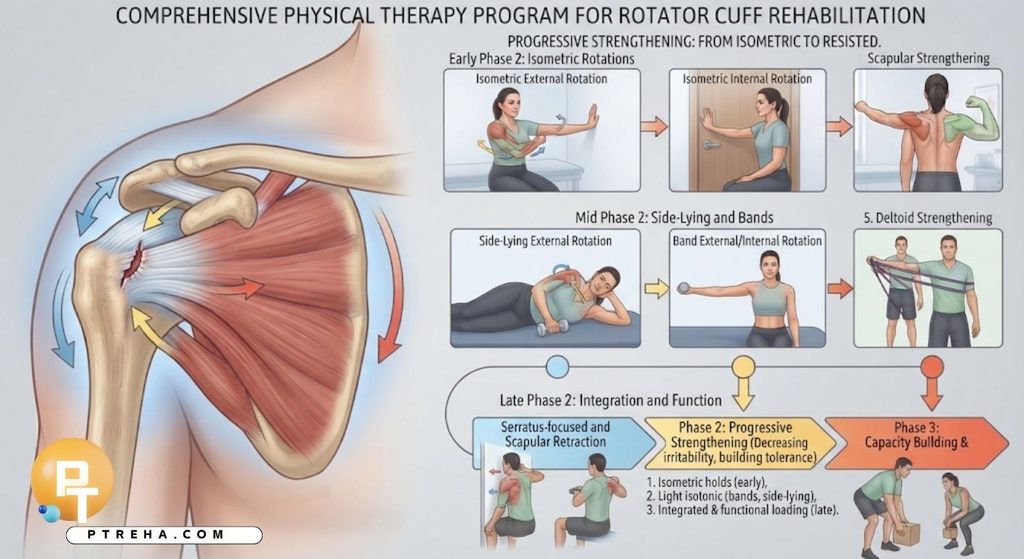
Early exercises may use very light resistance or body weight.
Later stages can include resistance bands, cables, dumbbells, or task-specific loading.
Examples include:
- Isometric external rotation.
- Isometric internal rotation.
- Side-lying external rotation.
- Band external rotation.
- Band internal rotation.
- Scapular retraction exercises.
- Supported shoulder elevation.
- Serratus-focused exercises.
- Deltoid strengthening.
- Progressive resisted lifting.
The exercise does not have to reproduce the exact function of the torn tendon to be useful.
Improving the overall capacity of the shoulder complex can help a person perform activities with less difficulty.
A practical progression might begin with a comfortable range of motion, then add low-load resistance, followed by greater resistance or repetitions, and finally more demanding functional movements.
Progression should be gradual.
A large increase in resistance, repetitions, or overhead volume can temporarily increase symptoms even when the overall rehabilitation strategy is appropriate.
Managing Sleep, Work, and Daily Activities
Night pain can be one of the most frustrating symptoms of a rotator cuff tear.
Sleeping directly on the painful shoulder may increase compression and discomfort for some people.
Helpful adjustments include:
- Avoid lying directly on the painful side if it increases symptoms.
- Try sleeping on the opposite side.
- Support the affected arm with a pillow.
- Keep the shoulder in a comfortable position.
- Avoid prolonged positions that reproduce pain.
- Change position when discomfort begins.
- Adjust the height and location of frequently used objects.
- Reduce prolonged overhead work.
- Take brief movement breaks during sedentary tasks.
- Plan demanding activities when symptoms are usually lower.
Work modification should be specific to the person’s duties.
A desk worker and an overhead construction worker may have the same tear but very different rehabilitation requirements.
The goal is not simply to eliminate every painful movement.
The goal is to identify which loads are currently excessive and then rebuild tolerance progressively.
When Conservative Care Needs Reassessment
Conservative management should be monitored rather than continued indefinitely without checking progress.
Useful measures include pain during daily activities, active range of motion, strength, sleep, work tolerance, and specific functional goals.
Reassessment is appropriate when:
- Pain remains substantially limiting.
- Shoulder strength is declining.
- Active range of motion is worsening.
- Function is not improving despite appropriate rehabilitation.
- New symptoms develop.
- A traumatic event causes sudden deterioration.
- Night pain becomes progressively more severe.
- Work demands cannot be resumed.
- Rehabilitation repeatedly causes significant flare-ups.
- The person’s goals cannot be achieved with the current approach.
Persistent symptoms do not automatically mean that conservative treatment has failed.
The rehabilitation program may need to be modified, the diagnosis reconsidered, or other shoulder conditions assessed.
For people with partial-thickness tears, the AAOS guideline notes that physical therapy can improve outcomes, while surgery may be considered when pain and functional impairment persist despite appropriate non-operative treatment.
Conservative Management Compared With Surgery
Conservative treatment and surgery should not be viewed as two completely separate pathways.
A patient may begin with rehabilitation and later reconsider the treatment strategy if symptoms and functional limitations remain significant.
| Factor | Conservative management | Surgical management |
|---|---|---|
| Main approach | Exercise, education, activity modification, symptom management | Tendon repair or another procedure when indicated |
| Rehabilitation | Progressive physical therapy | Structured postoperative rehabilitation |
| Recovery demands | Gradual loading and functional progression | Longer protected healing and rehabilitation process |
| Tendon repair | Does not surgically restore the torn tendon | Attempts to restore tendon attachment when repairable |
| Best suited to | Selected patients whose symptoms and function can be managed without surgery | Selected patients with appropriate clinical and structural indications |
| Decision factors | Pain, function, strength, goals, response to therapy | Tear characteristics, symptoms, weakness, trauma, goals and response to non-operative care |
| Follow-up | Monitor symptoms and function | Monitor healing, function, and rehabilitation progress |
The current AAOS guidance reports that physical therapy can improve symptoms in patients with complete tears, while also recognizing that tear enlargement can occur without surgery.
For selected patients, surgery may provide better outcomes when a repair heals successfully.
This does not mean every full-thickness tear should be repaired.
Treatment decisions require clinical assessment rather than imaging alone.
A Practical Conservative Rehabilitation Example
Consider a person with a symptomatic rotator cuff tear who has shoulder pain when reaching overhead but can still perform most daily activities.
A rehabilitation plan might initially focus on comfortable movement, scapular control, and low-load strengthening.
As symptoms become more manageable, resistance can gradually increase.
A practical progression could include:
- Phase 1: Maintain comfortable shoulder movement.
- Phase 2: Improve active control and scapular coordination.
- Phase 3: Introduce progressive rotator cuff resistance.
- Phase 4: Increase resistance and repetitions gradually.
- Phase 5: Add reaching and lifting tasks.
- Phase 6: Reintroduce overhead work or sport-specific activities.
- Phase 7: Build tolerance to repeated functional loading.
- Phase 8: Continue a maintenance strengthening program.
The exact exercises, resistance, frequency, and progression should be individualized.
A person whose goal is dressing independently needs a different endpoint from an electrician who must repeatedly work overhead or an athlete who performs high-load throwing.
Warning Signs That Require Medical Assessment
Some presentations should not simply be managed as routine shoulder pain.
Seek timely medical assessment after:
- A fall or sudden traumatic shoulder injury.
- Sudden major loss of active shoulder elevation.
- New substantial weakness.
- An obvious change in shoulder function after an injury.
- Severe pain that does not settle.
- Progressive loss of movement.
- Neurological symptoms such as persistent numbness or marked weakness.
- Fever or other systemic illness accompanying severe shoulder symptoms.
- Significant swelling, redness, or unexplained deterioration.
- Failure to improve despite an appropriate rehabilitation program.
An acute traumatic tear can require different decision-making from a chronic degenerative tear.
Early assessment may be particularly important when there is substantial weakness after trauma.
Conclusion
Rotator cuff tear conservative management options center on restoring useful shoulder function rather than simply treating an imaging finding.
Physical therapy, progressive strengthening, appropriate activity modification, symptom management, and gradual return to meaningful activities can provide substantial benefits for appropriately selected patients.
The key is individualized progression.
A persistent or traumatic problem, substantial weakness, worsening function, or failure to improve with appropriate rehabilitation should prompt reassessment so that the treatment plan can be reconsidered.
Frequently Asked Questions
Can a rotator cuff tear heal without surgery?
A person can improve substantially without surgical repair, particularly in pain, strength, movement, and function.
However, symptomatic improvement does not necessarily mean that a full-thickness tendon tear has structurally healed.
Is physical therapy useful for a full-thickness rotator cuff tear?
Yes.
Physical therapy can improve symptoms and function in appropriate patients with full-thickness tears.
Rehabilitation focuses on maintaining movement and progressively improving the capacity of the shoulder muscles and surrounding musculature.
Should I avoid using my shoulder if I have a rotator cuff tear?
Usually, complete avoidance of shoulder movement is unnecessary.
Activities that substantially aggravate symptoms may need temporary modification while comfortable movement and appropriately prescribed exercise are maintained.
Can I exercise with a rotator cuff tear?
Many people can exercise with a rotator cuff tear, but the exercises and loading level should match their symptoms, strength, movement, and functional goals.
Heavy or highly provocative loading should not be introduced abruptly.
Are resistance bands safe for a rotator cuff tear?
Resistance bands can be useful for progressive shoulder strengthening when appropriately selected and performed.
The resistance should be low enough initially to allow controlled movement and should be progressed gradually.
Should I use ice or heat?
Either may provide short-term symptom relief depending on the individual.
Ice can be useful when the shoulder feels irritated after activity, while heat may help some people feel less stiff before movement.
Do corticosteroid injections repair a rotator cuff tear?
No.
Corticosteroid injections are intended primarily to reduce pain and may provide short-term improvement in pain and function.
They do not reattach a torn tendon to its normal anatomical insertion.
When should I consider seeing an orthopaedic specialist?
Assessment is particularly important after significant trauma, sudden major weakness, substantial loss of active movement, or persistent functional limitations despite appropriate conservative treatment.
Can a rotator cuff tear become larger without surgery?
Some tears can enlarge over time, and structural progression does not always correspond directly with pain or disability.
This is one reason clinical monitoring and individualized decision-making are important.
How long should I try conservative management?
There is no single appropriate duration for every patient.
The decision depends on the type of tear, symptoms, functional limitations, rehabilitation response, activity demands, and treatment goals; persistent disability despite appropriate rehabilitation warrants reassessment rather than simply continuing the same program indefinitely.