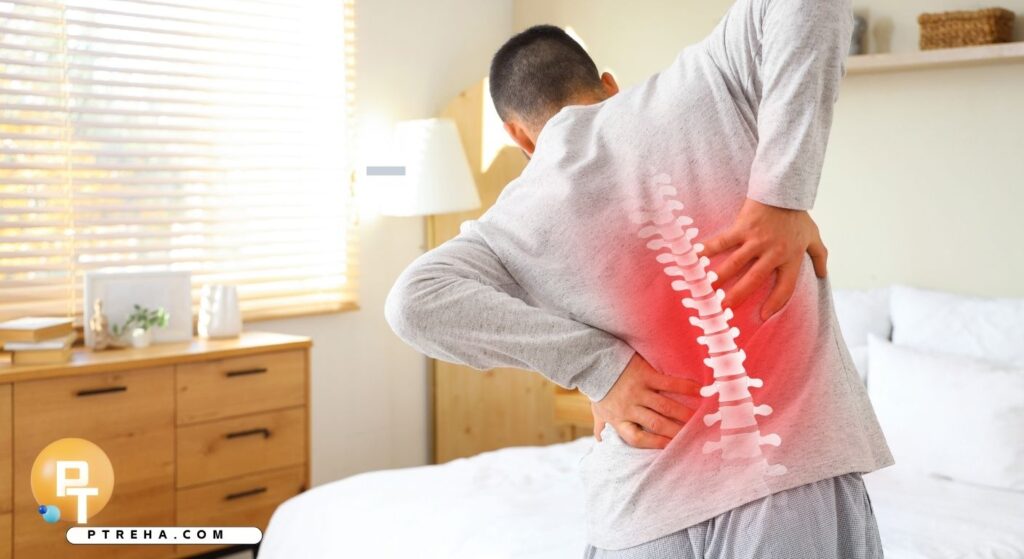
Lower back pain can become especially frustrating when your work requires hours at a desk.
The goal is not to find one “perfect” sitting posture, but to reduce prolonged static loading, make the workstation comfortable, change positions regularly, stay active, and use appropriate exercises without provoking symptoms.
Why Does Sitting at a Desk Cause Lower Back Pain?
Sitting itself is not automatically harmful to the lower back.
However, staying in one position for a prolonged period can increase discomfort, particularly when combined with limited movement, poor workstation setup, fatigue, or an existing back problem.
Lower back pain has many possible causes, and in many people no single structure can be identified as the source.
For desk workers, symptoms may be influenced by sustained postures, reduced physical activity, muscle fatigue, stress, sleep, previous episodes of pain, and other individual factors.
A useful approach is therefore to focus less on maintaining a rigid “perfect posture” and more on comfortable movement and regular position changes.
For example, if sitting for an hour causes increasing low back discomfort, repeatedly forcing yourself to sit perfectly upright may not solve the problem.
Standing briefly, walking, changing the chair position, or performing a comfortable movement may be more useful.
The best sitting position is usually not one fixed position. It is a position you can tolerate comfortably and change regularly.
Adjust Your Desk and Chair
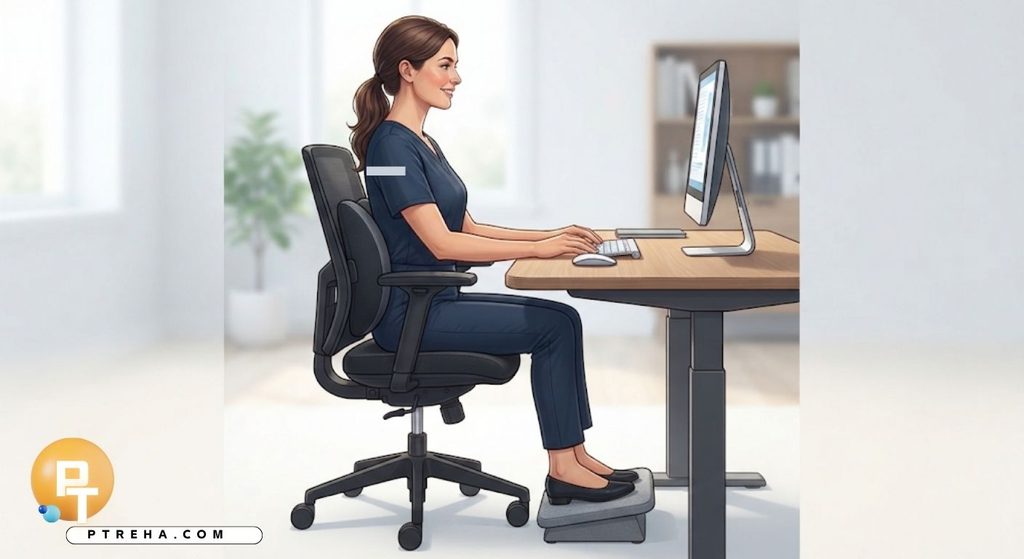
A comfortable workstation can make it easier to work without constantly loading the same tissues.
Ergonomic changes should be individualized rather than based on a single ideal measurement for everyone.
Start with the chair because it provides the main support for your pelvis and trunk.
Useful adjustments include:
- Keep both feet supported on the floor or on a footrest.
- Adjust the chair so your feet are stable.
- Avoid allowing the knees to remain excessively higher or lower than the hips if this feels uncomfortable.
- Use the backrest rather than continuously holding your trunk away from it.
- Adjust the backrest so it provides comfortable support.
- Position the keyboard close enough that you do not need to reach forward constantly.
- Keep the mouse within easy reach.
- Place the monitor where you can view it without repeatedly leaning forward.
- Keep frequently used objects close to reduce repeated twisting and reaching.
- Adjust the workstation according to your body size and the tasks you actually perform.
The purpose is not to create a rigid posture that you must maintain all day.
The purpose is to make neutral or comfortable positions easier to achieve while allowing you to move freely.
What If Your Feet Do Not Reach the Floor?
If the chair needs to be raised to position the desk correctly but your feet no longer rest comfortably on the floor, a footrest can help.
The important point is that the footrest should provide stable support without forcing the hips or knees into an uncomfortable position.
Change Position Instead of Searching for Perfect Posture
One of the most practical strategies for how to relieve lower back pain while sitting at a desk is to stop treating sitting posture as a fixed position.
Even a comfortable posture can become uncomfortable when maintained for too long.
Try alternating between:
- Sitting with your back supported.
- Sitting slightly differently when reading.
- Standing during appropriate tasks.
- Walking while taking a phone call when practical.
- Getting up to collect documents instead of keeping everything within reach.
- Changing between keyboard and other work tasks.
- Performing a brief movement break when symptoms begin to build.
A sit-stand desk can be useful for reducing uninterrupted sitting, but it should not be viewed as a cure for back pain.
Research suggests that sit-stand workstations may reduce discomfort in some workers, while the optimal amount and pattern of standing are not firmly established.
The practical principle is simple: use the desk to create opportunities for movement rather than replacing prolonged sitting with prolonged standing.
Take Regular Movement Breaks
Movement breaks do not need to be long or complicated.
If you notice that your lower back becomes increasingly uncomfortable after sitting, use that symptom as a cue to change position before the discomfort becomes difficult to manage.
A short movement break might include:
- Standing beside the desk.
- Walking to another room.
- Walking to refill your water.
- Performing a few comfortable pelvic movements.
- Gently extending or flexing the hips while standing.
- Taking several relaxed steps around the office.
- Changing your chair position.
- Performing a brief mobility exercise.
- Standing during a suitable phone call.
- Walking for part of a scheduled break.
There is no universal requirement that every person must stand or walk after a specific number of minutes.
Individual tolerance matters.
If a particular schedule works well for you, use it.
If your back starts becoming uncomfortable earlier, change position earlier.
Exercises That May Help After Prolonged Sitting
Exercise is an important part of managing low back pain, particularly when symptoms persist.
However, there is no single exercise that is appropriate for every person.
The exercise should match your symptoms, physical capacity, and goals.
Gentle Standing Back Extension
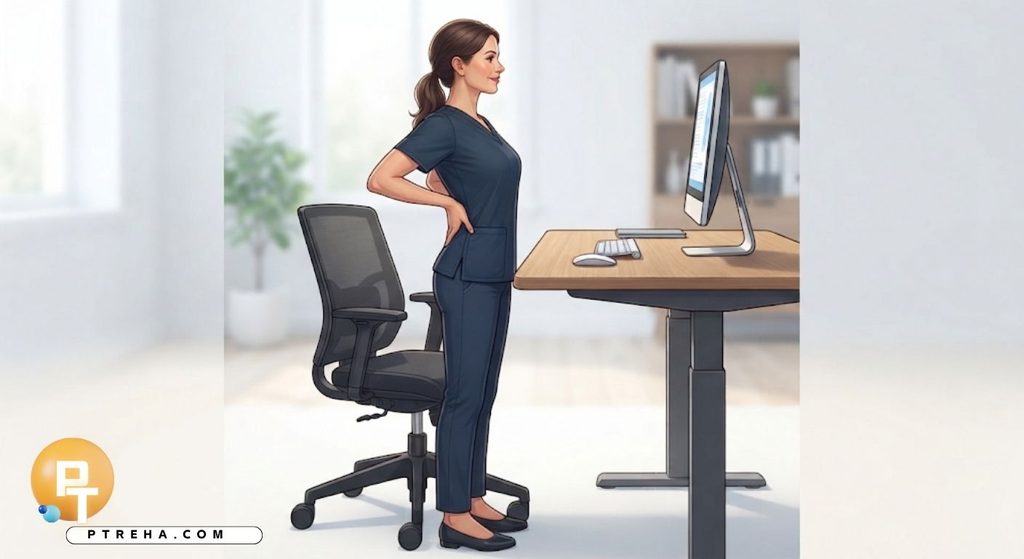
Some people feel more comfortable after gently moving the lumbar spine toward extension following prolonged sitting.
This is not appropriate for everyone, so use symptoms as your guide.
A simple option is:
- Stand upright with your feet comfortable apart.
- Place your hands on your hips or lower back.
- Gently move your trunk backward within a comfortable range.
- Return to the starting position.
- Repeat slowly several times if the movement feels comfortable.
Do not force the movement or repeatedly perform it simply because someone else finds it helpful.
Stop if it substantially increases pain, particularly if symptoms begin traveling farther down the leg.
Gentle Hip Movement
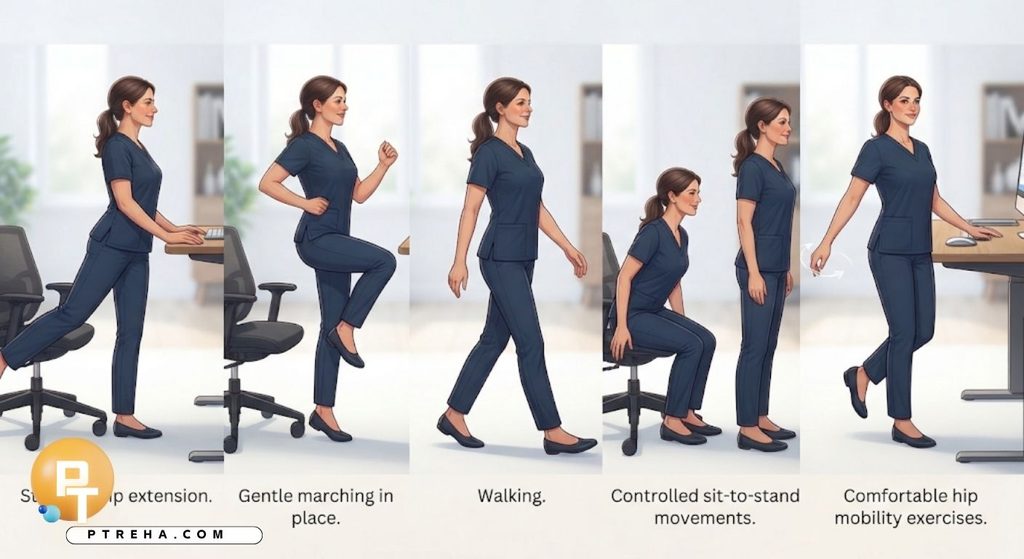
Prolonged sitting keeps the hips in a flexed position.
Gentle hip movement can be useful as part of a general mobility routine.
Try:
- Standing hip extension.
- Gentle marching in place.
- Walking.
- Controlled sit-to-stand movements.
- Comfortable hip mobility exercises.
The objective is not to “stretch the pain away.” It is to restore comfortable movement and reduce the amount of time spent in one static position.
Sit-to-Stand Exercise
The sit-to-stand movement is a practical exercise because it combines lower-limb strength with repeated movement away from the seated position.
To perform it:
- Sit near the front of a stable chair.
- Place your feet comfortably underneath you.
- Lean forward slightly from the hips.
- Stand up in a controlled manner.
- Sit down slowly.
- Repeat for a comfortable number of repetitions.
Use your hands for assistance if necessary.
If the movement produces significant or progressively worsening symptoms, reduce the range or repetitions and consider professional assessment.
Strengthen the Muscles That Support Everyday Movement
For people with persistent low back pain, exercise programs may include strengthening, aerobic exercise, movement control, or other approaches depending on the person’s needs and preferences.
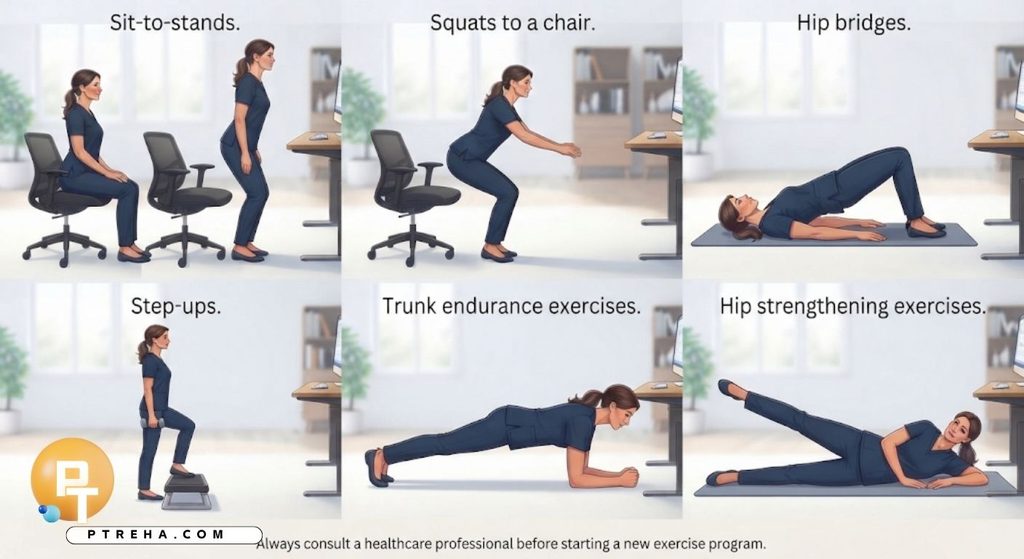
A desk worker does not necessarily need a complicated gym program.
Useful exercises may include:
- Sit-to-stands.
- Squats to a chair.
- Hip bridges.
- Step-ups.
- Walking.
- Trunk endurance exercises.
- Hip strengthening exercises.
- General resistance training.
- Aerobic exercise that is comfortable and sustainable.
The most appropriate program depends on the individual.
A physiotherapist can help select exercises when symptoms are persistent, recurrent, limiting activity, or difficult to interpret.
Use Walking as a Simple Strategy
Walking is one of the easiest ways to interrupt prolonged sitting.
You can incorporate it into the working day without turning every break into a formal workout.
Examples include:
- Walking during suitable phone calls.
- Taking the stairs when appropriate.
- Walking to speak with a colleague instead of sending a message.
- Taking a short walk during lunch.
- Walking around the building between tasks.
- Walking after finishing a prolonged computer task.
For many people with uncomplicated low back pain, continuing normal activities and staying active is preferable to prolonged bed rest or avoiding movement out of fear.
If walking consistently worsens your symptoms, particularly if it produces increasing leg symptoms, seek an appropriate clinical assessment.
Heat, Cold, and Comfortable Positions
Heat may provide temporary relief for some people, particularly when stiffness or muscle spasm contributes to discomfort.
A heat pack or hot-water bottle should be used safely and should not be applied directly to the skin for prolonged periods.
Cold may also provide short-term symptom relief for some people, particularly after an acute flare.
Neither heat nor cold addresses every possible cause of back pain, so their role is primarily symptom management.
You can also experiment with comfortable positions when resting.
For example:
- Lie on your back with the legs supported if this feels comfortable.
- Lie on your side with a pillow between the knees if that feels better.
- Use a supported sitting position for short periods.
- Change position rather than remaining in one position simply because it is considered “correct.”
Comfort should guide the choice.
What Should You Do When Sitting Suddenly Makes the Pain Worse?
If your lower back suddenly becomes more painful while working, first reduce the activity that is aggravating the symptoms.
You can try standing, walking gently, or changing position and then reassessing how you feel.
A practical response is:
| Situation | Practical response |
|---|---|
| Mild discomfort after prolonged sitting | Change position and walk briefly |
| Back feels stiff when standing | Move gently and avoid sudden forceful movements |
| Pain improves when walking | Include more short walking periods |
| Sitting causes increasing symptoms | Reduce uninterrupted sitting and review workstation setup |
| Pain travels into the leg | Stop provoking movements and consider clinical assessment |
| Symptoms are repeatedly limiting work | Arrange an assessment with a healthcare professional |
| New weakness or significant neurological symptoms | Seek prompt medical assessment |
| Bladder or bowel changes with back symptoms | Seek emergency medical assessment |
The table is a guide, not a diagnostic tool.
The pattern, severity, duration, associated symptoms, and medical history all matter.
When Should You See a Physiotherapist or Doctor?
Many episodes of uncomplicated lower back pain improve with appropriate self-management and continued activity.
However, persistent, recurrent, severe, or functionally limiting symptoms deserve professional assessment.
Consider arranging an assessment when:
- Pain is not improving.
- Symptoms repeatedly return.
- Pain significantly interferes with work.
- You are avoiding normal activities because of the pain.
- Pain travels into the leg.
- You develop persistent numbness or tingling.
- You notice weakness.
- You are uncertain which exercises are appropriate.
- You have a history that increases concern for a specific medical cause.
- Your symptoms are progressively worsening.
A physiotherapist can assess movement, function, strength, neurological findings, and contributing factors and can help develop an individualized management plan.
Routine imaging is not generally recommended for uncomplicated low back pain unless the result is expected to change management.
Red Flags: When Back Pain Needs Urgent Attention
Most lower back pain is not caused by a serious condition, but certain symptoms require urgent medical evaluation.
Seek urgent medical attention if back pain is accompanied by new problems such as:
- New loss of bladder control.
- New loss of bowel control.
- Numbness around the genitals, anus, or buttocks.
- Significant or rapidly worsening weakness in the legs.
- New severe symptoms affecting both legs.
- Back pain following a significant trauma.
- Fever or signs of serious infection together with concerning back symptoms.
- Unexplained weight loss or other systemic symptoms that concern you.
- A history of cancer combined with new concerning back symptoms.
These symptoms do not establish a diagnosis by themselves.
They indicate that further medical assessment is important.
A Practical Desk Routine for Lower Back Pain
You can create a simple routine around your normal working day rather than waiting until your back becomes very uncomfortable.
Before starting work:
- Adjust your chair.
- Check that your feet are supported.
- Position your keyboard and mouse comfortably.
- Place the monitor where you can view it without repeatedly leaning forward.
- Decide where you can stand or walk during the day.
During work:
- Change position regularly.
- Avoid remaining in one posture for prolonged periods.
- Walk during appropriate breaks.
- Use standing for suitable tasks if available.
- Perform comfortable movements when stiffness develops.
- Avoid working through progressively worsening pain simply to finish a task.
After work:
- Take a walk if comfortable.
- Perform an exercise program appropriate for your symptoms.
- Avoid spending the entire evening in another prolonged sitting position.
- Gradually return to normal physical activities rather than becoming increasingly inactive.
The most sustainable plan is usually one that fits your actual working environment.
Common Mistakes That Can Make Desk-Related Back Pain Harder to Manage
Trying to “fix” your posture by holding your spine rigid all day can increase fatigue and make sitting less comfortable.
Other common mistakes include:
- Staying completely still for long periods.
- Assuming one posture is correct for everyone.
- Buying ergonomic equipment without changing prolonged sitting habits.
- Using a standing desk while remaining stationary for hours.
- Stopping all physical activity because of mild back discomfort.
- Performing aggressive stretches that increase symptoms.
- Continuing an exercise that consistently worsens pain.
- Relying exclusively on heat or massage.
- Ignoring symptoms that progressively worsen.
- Waiting too long to seek assessment when neurological symptoms appear.
Ergonomics can support comfort, but it is only one part of managing lower back pain.
Conclusion
Learning how to relieve lower back pain while sitting at a desk is less about finding one perfect posture and more about creating a workday that allows regular movement, comfortable positioning, appropriate exercise, and gradual return to normal activity.
Adjust your workstation, avoid prolonged static sitting, use short movement breaks, and choose exercises that your symptoms tolerate.
If pain persists, repeatedly interferes with work, travels into the leg, or is accompanied by neurological or other concerning symptoms, professional assessment is more appropriate than continuing to modify your chair or exercise routine on your own.
Frequently Asked Questions
Can sitting at a desk cause lower back pain?
Prolonged sitting can contribute to discomfort in some people, particularly when it involves limited movement, sustained postures, fatigue, or other contributing factors.
Sitting is not necessarily harmful by itself, and the relationship between sitting and back pain is individual.
What is the best sitting position for Desk Back Pain?
There is no single sitting position that is best for everyone.
A supported, comfortable position that allows you to work without significant symptoms is useful, but changing position regularly is generally more practical than trying to maintain one posture throughout the day.
How often should I get up from my desk?
There is no universally established interval that applies to every person with low back pain.
Instead, avoid prolonged uninterrupted sitting and use your symptoms, work demands, and personal tolerance to guide when you stand, walk, or change position.
Is a standing desk better for lower back pain?
A standing desk can make it easier to reduce uninterrupted sitting, and research suggests sit-stand workstations may reduce discomfort in some workers.
However, standing continuously is not necessarily better, and a standing desk should be used as a way to introduce movement and position changes rather than as a replacement for all sitting.
Should I use a lumbar support when sitting?
A lumbar support may make sitting more comfortable for some people by providing support to the lower back.
It is not essential for everyone, and the appropriate amount of support depends on the chair, your body, your symptoms, and your preferred sitting position.
Should I stretch my lower back after sitting?
Gentle movement can be useful when your back feels stiff after sitting.
However, the most appropriate movement depends on your symptoms, and a stretch should not be forced or repeatedly performed if it substantially increases pain or causes symptoms to travel farther into the leg.
Is walking good for lower back pain?
Walking is commonly recommended as a way to remain active during episodes of uncomplicated low back pain, provided it is tolerated.
It can also be an easy way for desk workers to interrupt prolonged sitting.
Should I stop exercising when my lower back hurts?
Not necessarily.
Many people benefit from continuing appropriate physical activity, but exercises may need to be modified according to symptoms.
An exercise that repeatedly causes significant or progressively worsening symptoms should not simply be pushed through without assessment.
When should I see a physiotherapist for desk-related back pain?
A physiotherapist may be helpful when pain persists, repeatedly returns, interferes with work or daily activities, or when you are unsure which movements and exercises are appropriate.
Assessment is particularly useful when symptoms extend into the leg or are associated with neurological changes.
When is lower back pain an emergency?
Back pain requires urgent assessment when it occurs with concerning neurological symptoms such as new bladder or bowel dysfunction, numbness around the genital or anal region, or significant or rapidly worsening weakness in the legs.
Significant trauma or symptoms suggesting a serious systemic condition can also require urgent medical evaluation.
Resources
- World Health Organization — Low Back Pain: https://www.who.int/news-room/fact-sheets/detail/low-back-pain
- World Health Organization — Guideline for non-surgical management of chronic primary low back pain: https://www.who.int/publications/i/item/9789240081789
- NICE — Low back pain and sciatica in over 16s: assessment and management: https://www.nice.org.uk/guidance/ng59
- NHS — Back pain: https://www.nhs.uk/conditions/back-pain/
- CDC/NIOSH — Sit-stand workstations and low back discomfort: https://stacks.cdc.gov/view/cdc/212249