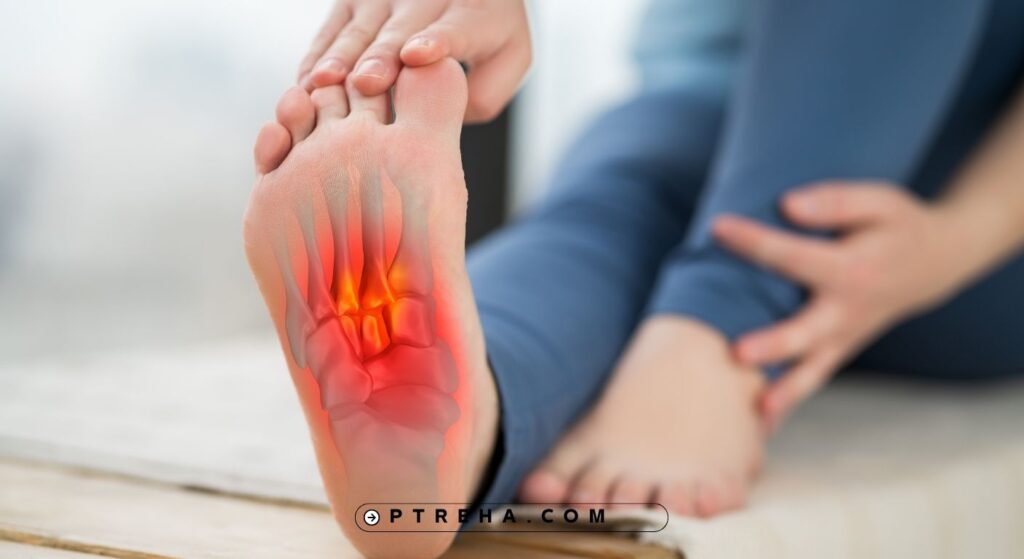
Plantar fasciitis can make the first few steps after getting out of bed surprisingly painful. The discomfort is commonly felt around the heel or along the arch of the foot and may ease as you begin moving, only to return after prolonged standing, walking, or running.
A combination of gentle stretching, appropriate footwear, and sensible activity management can help many people reduce symptoms. The key is not simply to stretch harder, but to gradually improve the tolerance of the plantar fascia, calf, and foot to everyday loading.
Why is plantar fasciitis pain worse in the morning?
Morning pain is one of the characteristic features of plantar fasciitis. People often notice their heel pain most strongly when they take their first steps after sleeping or after sitting for a prolonged period.
During rest, the tissues around the foot are relatively unloaded and the ankle remains in a resting position. When you suddenly stand and walk, the plantar fascia and surrounding structures have to accept load again.
This helps explain why the first few steps can feel particularly uncomfortable. The pain may decrease after several minutes of movement, although prolonged walking or standing can make it return.
Plantar fasciitis is not necessarily an inflammatory condition despite the name. It is better understood as a load-related disorder of the plantar fascia, with symptoms often developing after changes in activity, repetitive loading, or other contributing factors.
A sudden increase in running, walking, or standing, especially when combined with inadequate recovery or a change in footwear or surface, can increase stress on the foot.
What should you do before getting out of bed?
If your first steps are particularly painful, you do not have to immediately put your full body weight through the foot.
A simple morning routine can prepare the foot for loading.
1. Gentle plantar fascia stretch
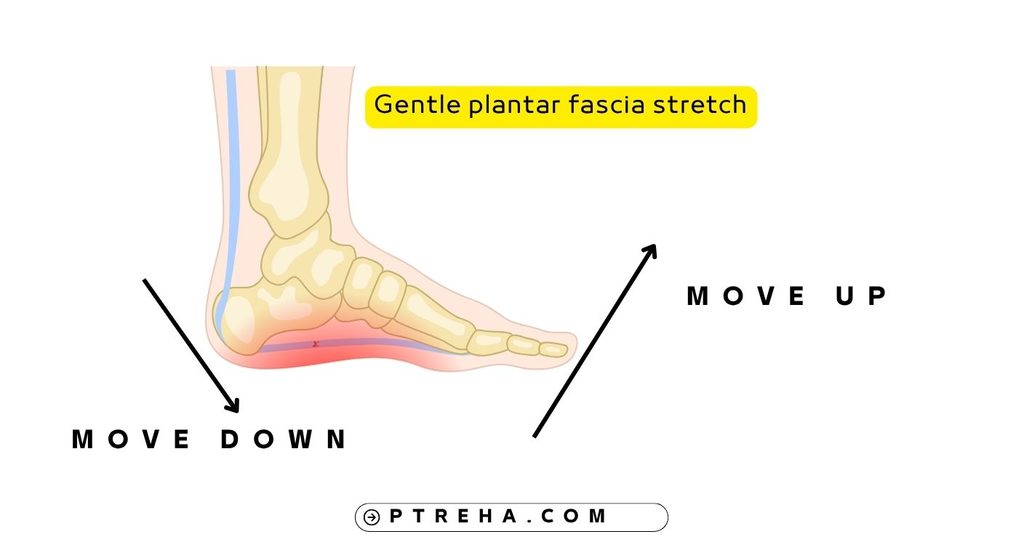
Sit on the edge of the bed and place the affected ankle across the opposite knee.
With one hand, hold the heel. With the other hand, gently pull the toes and forefoot back toward the shin until you feel a comfortable stretch along the sole of the foot.
Hold the position comfortably, then release slowly.
The purpose is to gently lengthen the plantar fascia and associated tissues before the first weight-bearing steps. This type of plantar fascia-specific stretching is commonly included in physiotherapy advice for plantar fasciitis.
The stretch should feel controlled rather than aggressive. Do not force the toes backward or try to create pain in an attempt to make the exercise more effective.
2. Gentle ankle movements
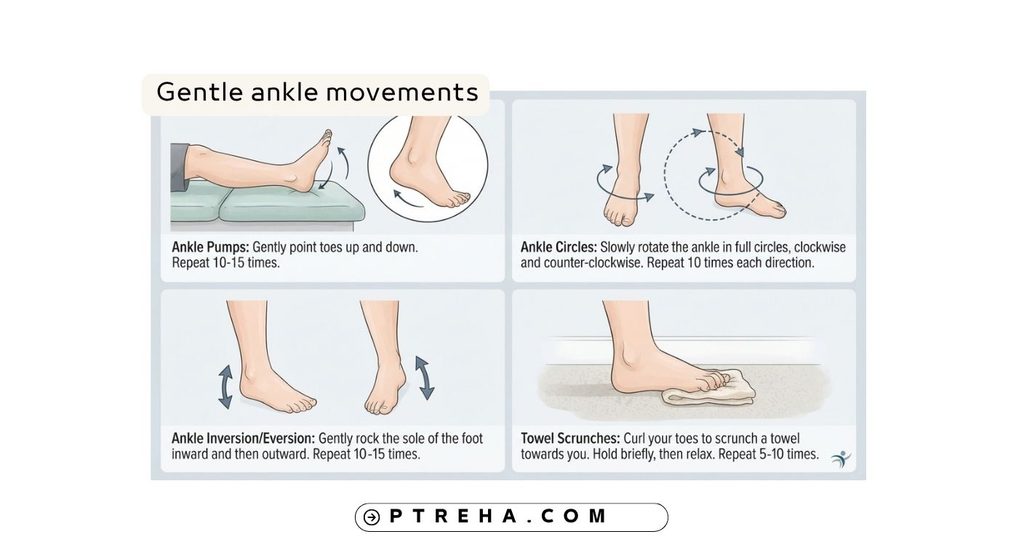
Before standing, slowly move the ankle up and down several times.
You can also make small, comfortable ankle circles if they do not increase your symptoms.
These movements are not a treatment by themselves, but they can provide a gradual transition from prolonged rest to weight-bearing.
3. Calf stretch

Once you are standing safely, a gentle calf stretch can be useful.
Place the affected leg behind you, keep the heel in contact with the floor, and lean your body forward while using a wall or another stable surface for support.
Keep the movement controlled and stop when you feel a mild stretch in the calf.
Both straight-knee and bent-knee calf stretches may be used to address different portions of the calf complex. Physiotherapy guidance for plantar fasciitis commonly includes calf and plantar fascia stretching.
The most useful stretches for plantar fasciitis
There is no single stretch that is automatically the best for every person with plantar fasciitis. A practical program usually combines plantar fascia stretching with calf flexibility work.
Plantar fascia stretch
Sit down and cross the affected leg over the opposite leg.
Hold the heel with one hand and gently pull the toes backward with the other hand.
You should feel the stretch along the sole of the foot, particularly around the arch.
This can be particularly practical before the first steps in the morning or after a prolonged period of sitting.
Straight-knee calf stretch
Stand facing a wall.
Place the affected leg behind the other leg, keeping the back heel on the floor. Slowly lean toward the wall while keeping the back knee relatively straight.
A stretch should be felt in the calf.
Avoid bouncing or forcing the heel downward.
Bent-knee calf stretch
Use the same basic position, but allow the back knee to bend slightly while keeping the heel down.
This changes the emphasis of the stretch within the calf complex.
The movement should remain comfortable and controlled.
Toe and foot mobility
Gentle movement of the toes can also be incorporated into your routine.
For example, while seated, slowly move the toes and ankle through comfortable ranges without forcing the plantar surface of the foot.
The goal is to maintain movement while avoiding repeated irritation.
How often should you stretch?
Consistency is generally more useful than performing an aggressive stretching session occasionally.
You can incorporate gentle stretching into predictable parts of the day, such as:
- Before getting out of bed.
- After prolonged sitting.
- Before walking after a period of rest.
- Around exercise sessions when appropriate.
- During the day if stiffness returns.
Different clinical leaflets provide different exercise schedules, so there is no single universal number of repetitions that applies to everyone. The exercises should be adjusted according to symptoms and tolerance.
If a stretch repeatedly causes a clear increase in heel pain rather than a manageable stretching sensation, reduce the intensity or seek individual assessment from a physiotherapist.
What type of footwear is helpful?
Footwear can make a significant difference to how much load your feet experience during daily activities.
For people with plantar fasciitis, commonly recommended features include adequate cushioning, a comfortable fit, and sufficient support for the individual’s foot. NHS guidance specifically recommends comfortable footwear with cushioning and arch support and advises against walking barefoot on hard surfaces when this aggravates symptoms.
A useful everyday shoe should generally:
- Fit comfortably without squeezing the toes.
- Provide adequate cushioning under the heel.
- Feel stable during walking.
- Provide appropriate support for your foot.
- Be in reasonably good condition.
- Allow enough room for the toes to move naturally.
The exact shoe that works best varies between individuals. Foot shape, activity level, walking demands, and personal tolerance all matter.
Avoid very worn-out shoes
Shoes that have become heavily compressed or damaged may no longer provide the cushioning or support they originally offered.
If your plantar fasciitis symptoms started around the same time that you changed or significantly wore down your everyday or running shoes, footwear is worth considering as one possible contributing factor.
Be careful with unsupportive footwear
Flip-flops, backless slippers, very flat unsupportive shoes, and prolonged barefoot walking on hard floors can aggravate symptoms in some people.
This does not mean that every person with plantar fasciitis must permanently avoid these types of footwear. The more practical approach is to identify whether they consistently increase your symptoms and modify your footwear accordingly. NHS patient guidance commonly recommends avoiding flip-flops, backless slippers, and prolonged barefoot walking when managing plantar fasciitis.
Should you wear shoes around the house?
If walking barefoot on hard flooring makes your morning heel pain worse, wearing comfortable supportive footwear indoors may be useful.
This can be particularly relevant during the first part of the morning, when the first few steps are often the most painful.
Some NHS physiotherapy services specifically advise avoiding barefoot walking on hard surfaces and using supportive footwear or a suitable house shoe instead.
The goal is not to keep the foot permanently protected. Rather, footwear can temporarily reduce aggravating loads while you gradually restore the foot’s ability to tolerate normal activity.
Do insoles or heel pads help?
Insoles and heel pads can be useful for some people with plantar fasciitis.
They may provide cushioning or alter how pressure is distributed through the foot. Over-the-counter options can be considered before moving to more specialized orthoses.
However, an insole is not automatically necessary for everyone, and a more expensive device is not necessarily more effective for every individual.
If symptoms persist despite appropriate footwear and exercise, a physiotherapist or podiatrist can assess your foot, footwear, activity demands, and movement pattern to determine whether an orthotic intervention is appropriate.
What activities should you avoid?
Complete rest is usually not the goal.
Instead, temporarily reducing activities that clearly aggravate the heel can help control symptoms while maintaining appropriate movement.
For example, if a sudden increase in running volume caused your symptoms, reducing running temporarily and maintaining fitness through a more comfortable activity may be more practical than stopping all physical activity.
Swimming and other activities that place less repetitive load through the foot can be useful alternatives for some people.
Also pay attention to cumulative loading.
A day involving a long walk, prolonged standing, a workout, and extensive time on hard flooring may place considerably more demand on the plantar fascia than any one activity considered separately.
A useful principle: reduce the activity that is aggravating the pain, rather than stopping all movement.
A simple morning routine
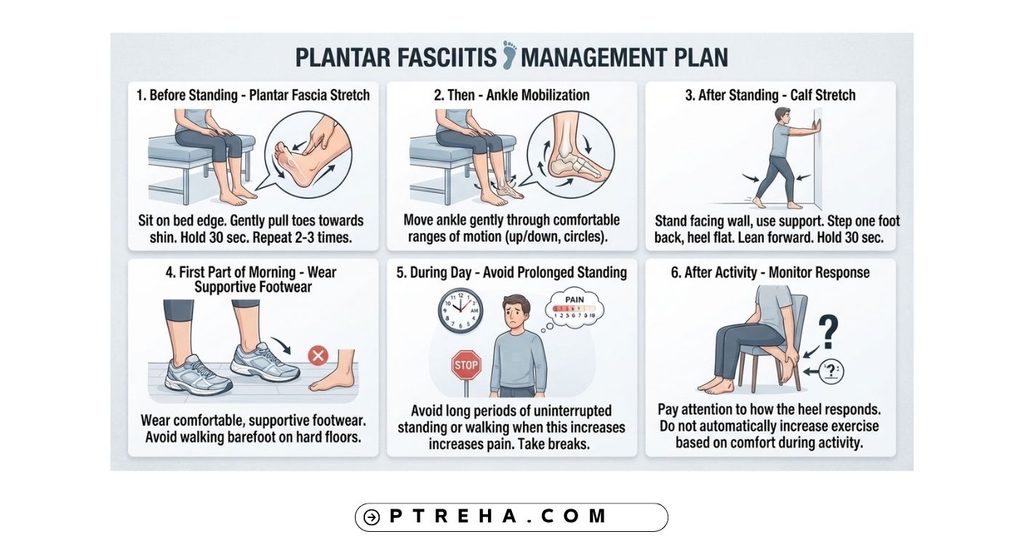
If morning heel pain is your main problem, a simple routine can look like this:
Before standing:
Sit on the edge of the bed and gently stretch the plantar fascia by pulling the toes toward the shin.
Then:
Move the ankle gently through comfortable ranges.
After standing:
Perform a gentle calf stretch using a wall or stable support.
For the first part of the morning:
Wear comfortable footwear rather than immediately walking barefoot on a hard floor if barefoot walking aggravates your symptoms.
During the day:
Avoid long periods of uninterrupted standing or walking when these clearly increase your pain.
After activity:
Pay attention to how the heel responds rather than automatically increasing exercise because the movement felt comfortable during the activity.
Common mistakes when treating morning heel pain
One common mistake is stretching the foot aggressively because the pain feels tight.
More force is not necessarily better. Irritating the plantar fascia repeatedly can make it harder to determine which activities are actually helping.
Another mistake is changing several things simultaneously.
For example, someone may purchase new shoes, start intensive stretching, increase walking, begin running again, and add several foot exercises at the same time. If symptoms change, it then becomes difficult to know which factor contributed.
A gradual approach is usually easier to monitor.
Another common issue is focusing only on the morning pain while ignoring the overall loading pattern. If your daily walking, running, standing, or training volume remains substantially higher than your current tolerance, stretching alone may not solve the problem.
When should you see a healthcare professional?
Most cases of plantar fasciitis can initially be managed conservatively, but persistent or severe heel pain deserves assessment.
Seek professional advice if the pain is severe, interferes significantly with normal activities, continues to worsen, or repeatedly returns despite appropriate self-management. NHS guidance also recommends seeking medical advice for tingling or loss of sensation in the foot, and people with diabetes and foot pain should seek professional assessment because foot problems can require additional care.
A physiotherapist or podiatrist can help determine whether the symptoms are consistent with plantar fasciitis and whether another cause of heel pain needs to be considered.
This is particularly important when the symptoms do not follow the typical pattern of pain around the heel or arch that is worse with the first steps after rest.
Final takeaway
Plantar fasciitis morning pain is often most noticeable during the first steps after sleeping or prolonged rest. A gentle plantar fascia stretch before standing, followed by appropriate calf mobility and gradual loading, can be a practical part of symptom management.
Footwear also matters. Comfortable shoes with suitable cushioning and support may reduce aggravating loads, while prolonged barefoot walking on hard surfaces or unsupportive footwear may worsen symptoms in some people.
The most important principle is consistency rather than aggressively stretching or completely resting the foot. Give the tissues an appropriate amount of load, modify activities that clearly aggravate symptoms, and progress gradually as your tolerance improves.
Persistent, severe, or atypical heel pain should be assessed by an appropriate healthcare professional rather than assumed to be plantar fasciitis.
Frequently asked questions
Why does plantar fasciitis hurt most when I get out of bed?
Pain is commonly worse during the first steps after sleeping or another prolonged period of rest. The foot has been unloaded for an extended period and then suddenly has to accept body weight and movement.
Should I stretch my plantar fascia in the morning?
A gentle plantar fascia stretch can be incorporated before the first steps, particularly when morning pain is prominent. The movement should be comfortable and controlled rather than aggressive.
Is walking barefoot bad for plantar fasciitis?
Not necessarily for everyone. However, if barefoot walking on hard surfaces increases your symptoms, temporarily using comfortable supportive footwear may reduce aggravation.
Are supportive shoes better than flat shoes?
Footwear response varies between individuals, but comfortable shoes with appropriate cushioning and support are commonly recommended for plantar fasciitis.
Can calf stretching help plantar fasciitis?
Calf stretching is commonly included in conservative management because calf and ankle flexibility can influence the loads experienced by the foot. It is generally combined with plantar fascia-specific stretching rather than used alone.
Should I stop exercising if I have plantar fasciitis?
Not necessarily. It is often more useful to modify activities that clearly aggravate symptoms while maintaining comfortable forms of movement. Low-impact activities may be useful alternatives for some people.
Do insoles cure plantar fasciitis?
Insoles do not guarantee a cure. They can provide cushioning or support and may be useful for some people as part of a broader management plan.
How long does plantar fasciitis take to improve?
Recovery varies considerably between individuals. Symptoms can persist for months in some cases, so improvement is not always immediate. Persistent symptoms should be assessed rather than repeatedly self-treating without reassessment.
When should heel pain be checked by a professional?
Seek assessment when pain is severe, worsening, repeatedly returning, limiting normal activities, or associated with symptoms such as tingling or loss of sensation. People with diabetes and foot pain should also seek professional advice.
Can footwear prevent plantar fasciitis from coming back?
Appropriate footwear may help reduce aggravating loads, but footwear alone cannot guarantee prevention. Managing training and activity increases, maintaining appropriate exercise, and responding to recurring symptoms are also important.