
Red flags every physical therapy student should know are signs, symptoms, historical findings, or clinical patterns that may indicate serious pathology requiring further medical assessment rather than routine musculoskeletal treatment.
Learning to recognize them does not mean diagnosing cancer, thrombosis, spinal cord compression, or another medical condition; it means recognizing when the presentation falls outside the expected pattern and deciding whether referral or emergency action is appropriate.
What Does a Red Flag Mean in Physical Therapy?
A red flag is a finding that increases concern about a potentially serious condition.
It should change clinical reasoning, but an isolated red flag does not automatically establish a diagnosis.
Physical therapists need screening skills because patients may enter rehabilitation with symptoms that resemble ordinary musculoskeletal pain while the underlying problem requires medical investigation.
The American Physical Therapy Association emphasizes systems screening and assessment of cardiovascular, pulmonary, neurological, integumentary, musculoskeletal, and other body systems when determining whether additional medical evaluation may be needed.
The [APTA guidance on patient screening] APTA guidance on patient screening is a useful foundation for students developing this reasoning process.
A student should think about:
- Does the history fit a musculoskeletal disorder?
- Is the symptom behavior mechanically plausible?
- Are neurological findings stable or worsening?
- Are systemic symptoms present?
- Are important risk factors present?
- Did the symptoms appear after significant trauma?
- Is pain unusually severe or rapidly changing?
- Are vital signs concerning?
- Is function deteriorating unexpectedly?
- Does the patient need treatment, medical referral, or emergency care?
The important distinction is that red flags are screening information, not stand-alone diagnostic tests.
A patient with one nonspecific feature such as night pain does not automatically have serious pathology.
The complete clinical picture matters.
Cauda Equina Syndrome and Severe Lumbosacral Neurological Changes
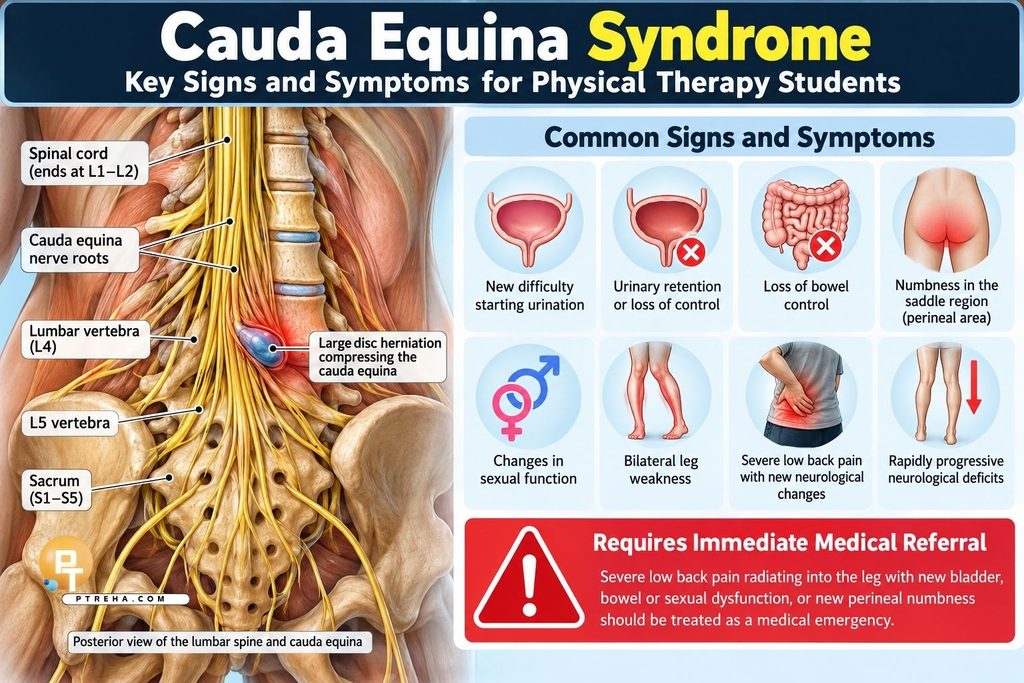
Cauda equina syndrome is one of the most important conditions for a physical therapy student to recognize because delayed assessment can result in significant neurological consequences.
The concerning presentation is not simply “low back pain with sciatica.” Attention should increase when new bladder, bowel, sexual, saddle-region, or substantial neurological dysfunction accompanies lumbar or lower-extremity symptoms.
Important findings include:
- New difficulty starting urination.
- New urinary retention or loss of urinary control.
- New loss of bowel control.
- New numbness around the perineum or saddle region.
- New disturbance of sexual function associated with neurological symptoms.
- Marked or progressive bilateral leg weakness.
- Rapid deterioration in lower-extremity neurological function.
- Severe low back pain with major new neurological changes.
NICE specifically recommends immediate referral when severe low back pain radiating into the leg occurs with new bladder, bowel or sexual dysfunction, or new perineal numbness.
Students can review the [NICE neurological recognition and referral guideline] NICE neurological recognition and referral guideline for this clinical pathway.
Clinical example: A patient referred for “sciatica” reports that since the previous evening they have difficulty sensing when the bladder is full and have developed numbness around the inner thighs and perineal region.
This is no longer an ordinary lumbar radiculopathy presentation.
Routine exercise progression should not take priority over urgent medical assessment.
Students should also avoid relying on one question such as “Any bowel or bladder problems?” Ask clear, specific questions when the history raises suspicion.
Spinal Cord Compression and Progressive Neurological Deficits
Neurological symptoms frequently occur in physical therapy, but progressive neurological loss deserves particular attention.
A stable sensory deficit associated with a known peripheral nerve lesion is different from weakness that is becoming noticeably worse over hours or days.
Concerning neurological changes can include:
- Rapidly increasing limb weakness.
- New foot drop with progressive loss of strength.
- Increasing difficulty walking.
- New loss of hand dexterity.
- Bilateral neurological symptoms.
- New pathological reflex findings.
- Increasing hyperreflexia or clonus.
- New bowel or bladder dysfunction.
- New widespread sensory disturbance.
- Progressive balance or gait deterioration.
For cervical presentations, symptoms involving both upper and lower limbs deserve careful neurological assessment because the problem may extend beyond a single nerve root.
For example, a patient describing neck stiffness, dropping objects, difficulty buttoning clothing, increasing leg stiffness, and deteriorating balance requires a different level of concern from a patient with isolated mechanical neck pain.
The student’s responsibility is not to declare “cervical myelopathy” after one examination finding.
The responsibility is to identify a concerning neurological pattern, document the findings, communicate them, and follow the appropriate referral pathway.
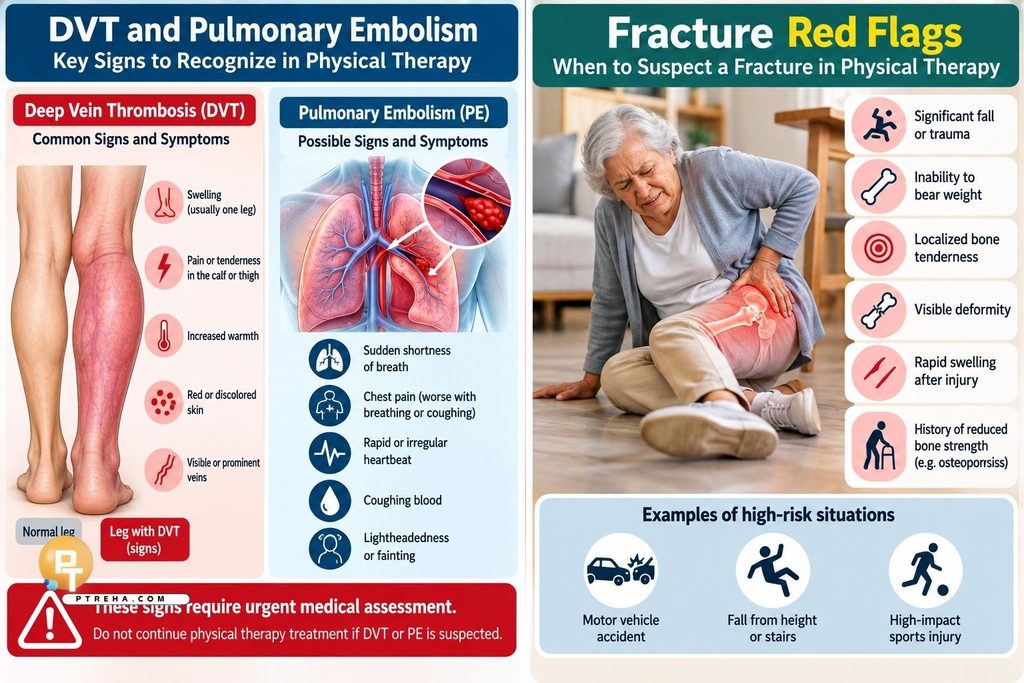
Fracture and Significant Trauma Red Flags
Trauma does not always produce dramatic symptoms immediately.
Fracture risk depends on the mechanism, anatomical region, bone health, age, medication history, and clinical findings.
Suspicion should rise when pain begins after a mechanism capable of causing structural injury or when relatively minor trauma occurs in someone with increased skeletal fragility.
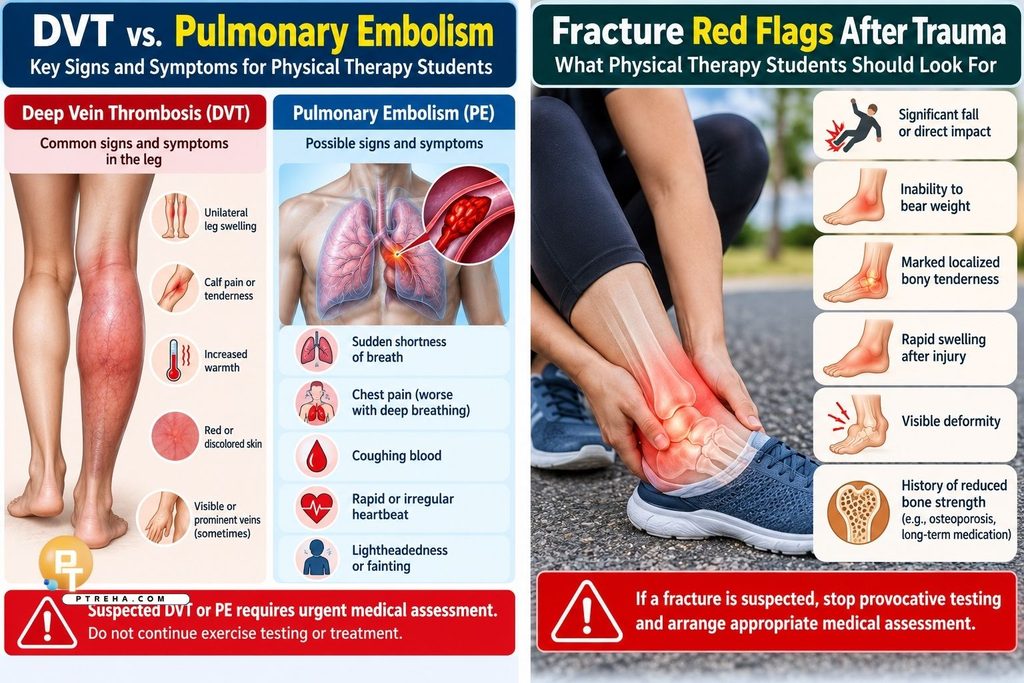
Important historical and examination findings include:
- Significant fall or collision.
- Direct impact to a bone or joint.
- Sudden inability to bear weight after trauma.
- Marked localized bony tenderness.
- Visible deformity.
- Rapid swelling after injury.
- Loss of function inconsistent with a minor soft-tissue injury.
- History suggesting reduced bone strength.
- Prolonged systemic corticosteroid exposure.
- New severe spinal pain after trauma.
Consider a patient presenting after a fall with hip pain who cannot comfortably bear weight.
Repeated resisted testing or aggressive mobility assessment is unlikely to provide useful information if fracture is a meaningful possibility.
Similarly, severe focal spinal pain after trauma should not automatically be classified as a muscular strain merely because the patient can still move.
A useful student question is:
“Does the mechanism and the patient’s health profile make the severity of this presentation reasonable for a routine musculoskeletal injury?”
When the answer is uncertain, the examination should become more cautious rather than more aggressive.
Cancer and Serious Systemic Disease Patterns
Cancer screening illustrates why red flags must be interpreted collectively rather than as isolated checkboxes.
Night pain, fatigue, age, or weight change individually can occur for many benign reasons.
Concern becomes stronger when multiple findings combine with an atypical symptom pattern or relevant history.
Features that deserve attention include:
- Previous history of cancer.
- Unexplained weight loss.
- Progressive symptoms without a clear mechanical explanation.
- Persistent constitutional illness.
- Unusual fatigue or malaise.
- Pain that behaves differently from the expected musculoskeletal pattern.
- Progressive neurological deficits.
- New unexplained bone pain.
- Symptoms involving several body systems.
- Failure of the clinical presentation to behave as expected.
A history of cancer is particularly important because new musculoskeletal symptoms may sometimes require investigation for recurrence or metastatic disease.
However, students should avoid statements such as:
“Night pain means cancer.”
It does not.
Instead, reason through the combination:
Night pain + previous cancer + unexplained weight loss + progressive nonmechanical pain carries a substantially different clinical meaning from mild shoulder discomfort when sleeping on the affected side.
The same principle applies throughout red-flag screening: patterns are usually more informative than isolated findings.
Infection and Systemic Inflammatory Warning Signs
Musculoskeletal pain accompanied by evidence of systemic illness should prompt consideration of conditions outside routine mechanical rehabilitation.
Possible warning features include:
- Fever associated with unexplained musculoskeletal symptoms.
- Chills or rigors.
- Unusual malaise.
- Recent significant infection.
- Recent invasive procedure or surgery.
- Immunosuppression.
- Unexplained severe spinal pain.
- Persistent wound drainage.
- Increasing redness or warmth around a surgical site.
- Rapid deterioration rather than expected recovery.
Local warmth alone is not enough to diagnose infection.
Warmth and swelling commonly occur after injury or surgery.
Context changes the meaning.
For example, gradually decreasing warmth around a healing knee replacement is very different from increasing redness, wound drainage, systemic illness, and worsening pain.
Students should learn the expected recovery pattern of the population they are treating.
Recognizing what is abnormal requires knowing what normal recovery usually looks like.
When significant infection is suspected, exercise progression should not be used as a test of whether the patient “loosens up.”
DVT and Pulmonary Embolism
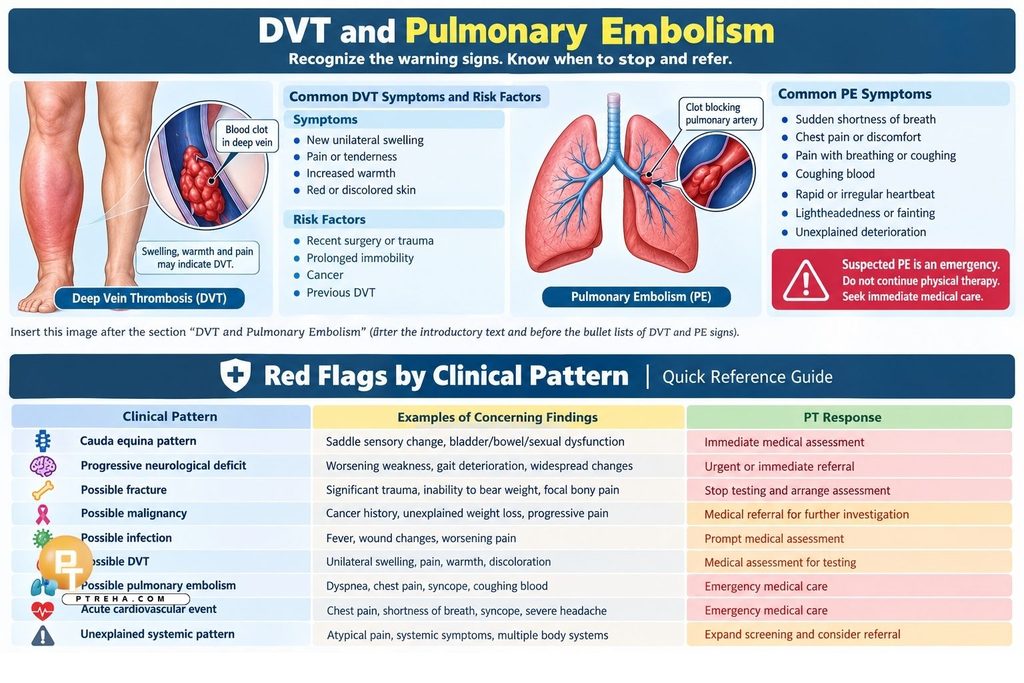
Venous thromboembolism is particularly relevant in rehabilitation because patients may have recent surgery, hospitalization, trauma, cancer, reduced mobility, or other risk factors.
Deep vein thrombosis commonly involves the lower extremity, although thrombosis can occur elsewhere.
Possible DVT findings include:
- New unilateral limb swelling.
- Unexplained calf or limb pain.
- Tenderness without an obvious musculoskeletal explanation.
- Increased warmth.
- Red or discolored skin.
- Recent prolonged immobility.
- Recent hospitalization.
- Recent major surgery.
- Previous venous thromboembolism.
- Other relevant thrombotic risk factors.
The CDC notes that DVT can also occur without obvious symptoms, while pulmonary embolism may occur even without recognized symptoms of DVT.
The [CDC clinical information on venous thromboembolism] CDC clinical information on venous thromboembolism provides useful information about signs, risk factors, and the need for medical testing.
Possible pulmonary embolism symptoms include:
- Sudden unexplained shortness of breath.
- Chest pain or discomfort.
- Pain aggravated by breathing or coughing.
- Coughing blood.
- Rapid or irregular heartbeat.
- Lightheadedness.
- Fainting.
- Marked unexplained deterioration.
These findings require medical assessment rather than continued exercise testing.
Suspected pulmonary embolism is an emergency.
A frequent student mistake is searching for one physical test that can “rule in” DVT.
Physical therapists screen risk and presentation; definitive diagnosis requires appropriate medical testing.
Cardiovascular, Vascular, and Neurological Emergencies
Not every patient attending physical therapy with shoulder, neck, back, jaw, leg, or chest-region discomfort has a musculoskeletal disorder.
Symptoms deserve immediate escalation when they suggest an acute cardiovascular, vascular, or neurological event.
Potential emergency features include:
- New chest pressure or severe chest discomfort.
- Unexplained shortness of breath.
- Syncope or near-syncope.
- Sudden facial weakness.
- New unilateral limb weakness.
- Sudden speech difficulty.
- Sudden confusion.
- Sudden severe neurological change.
- Sudden severe unusual headache.
- Acute loss of coordination.
- Sudden visual disturbance.
- New severe neck or head pain accompanied by neurological symptoms.
A patient referred for shoulder pain who becomes pale and sweaty and develops central chest pressure during assessment should not simply be given a shoulder exercise modification.
Likewise, a patient reporting sudden unilateral weakness and speech disturbance needs emergency assessment rather than a detailed musculoskeletal differential examination.
For neck presentations, unexpected cranial neurological symptoms, severe unusual headache or neck pain, visual changes, balance disturbance, or other acute neurological abnormalities require caution.
The central question is not “Which orthopedic test should I perform next?”
It is:
“Is continuing the physical therapy examination safe?”
Red Flags by Clinical Pattern: Quick Reference Table
The table below is a screening aid rather than a diagnostic checklist.
| Clinical pattern | Examples of concerning findings | PT response |
|---|---|---|
| Cauda equina pattern | New saddle sensory change, bladder/bowel/sexual dysfunction with lumbar symptoms | Immediate medical assessment |
| Progressive neurological deficit | Rapidly worsening weakness, gait deterioration, widespread neurological changes | Urgent or immediate referral depending on severity |
| Possible fracture | Significant trauma, inability to bear weight, focal bony pain, fragility risk | Stop provocative testing and arrange appropriate medical assessment |
| Possible malignancy | Cancer history plus progressive atypical pain or systemic features | Medical referral for further investigation |
| Possible infection | Fever/systemic illness with worsening focal pain, wound changes or relevant risk factors | Prompt medical assessment |
| Possible DVT | New unilateral swelling, pain, warmth or discoloration with relevant risk profile | Medical assessment for diagnostic testing |
| Possible pulmonary embolism | Acute dyspnea, chest symptoms, syncope or coughing blood | Emergency medical care |
| Acute neurological event | Sudden weakness, facial change, speech or coordination disturbance | Emergency medical care |
| Cardiovascular emergency | Acute chest symptoms, unexplained dyspnea, collapse or concerning autonomic features | Emergency medical care |
| Unexplained systemic pattern | Symptoms inconsistent with mechanical presentation plus constitutional/systemic findings | Expand screening and consider referral |
The response depends on the entire clinical presentation.
“Refer” does not always mean the same degree of urgency.
Some patients need routine communication with their medical provider.
Others need same-day assessment, and some presentations require immediate emergency care.
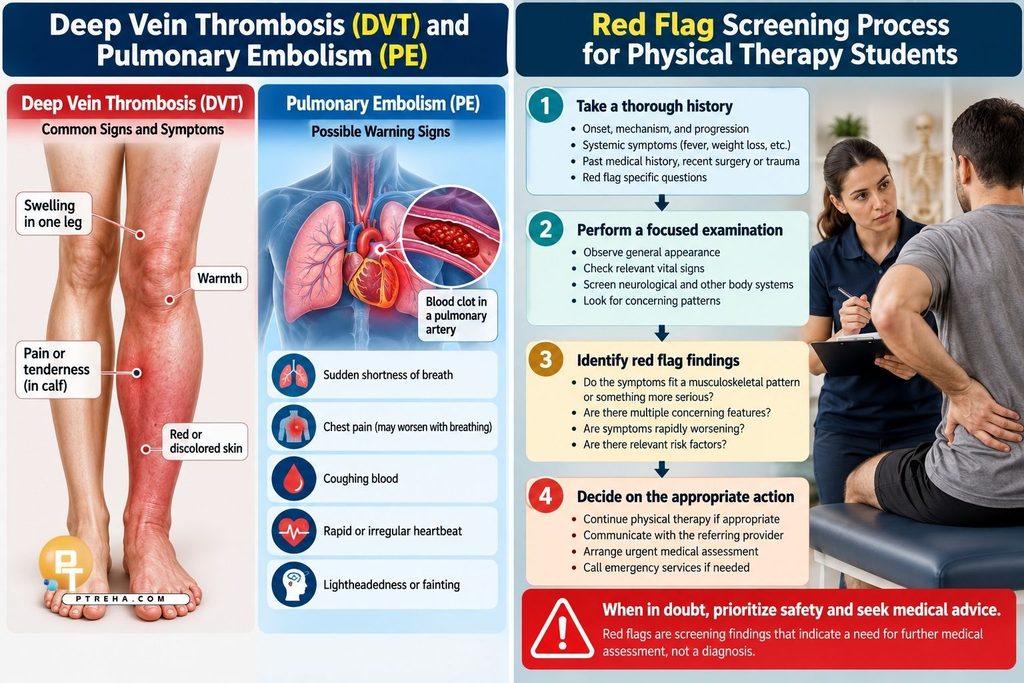
How Physical Therapy Students Should Screen for Red Flags
Good screening begins before special tests.
History taking is often where the most important information appears.
Listen carefully to onset, progression, associated symptoms, previous disease, medication history, recent procedures, trauma, and whether the problem behaves mechanically.
A practical screening sequence is:
- Establish the main complaint.
- Clarify onset and mechanism.
- Ask how symptoms have changed.
- Determine the 24-hour symptom pattern.
- Identify aggravating and easing factors.
- Ask about relevant systemic symptoms.
- Review significant medical history.
- Review recent surgery, hospitalization, trauma, or infection.
- Screen neurological symptoms when relevant.
- Check appropriate vital signs.
- Perform a focused systems review.
- Compare subjective findings with objective findings.
- Decide whether the clinical pattern makes sense.
- Re-screen when the patient’s condition changes.
Students should also remember that screening continues throughout the episode of care.
A patient may appear appropriate for rehabilitation during the first visit and develop a concerning symptom later.
Watch for:
- Unexpected deterioration.
- New neurological symptoms.
- New systemic complaints.
- Major changes in pain behavior.
- Reduced exercise tolerance without explanation.
- New swelling or respiratory symptoms.
- Recovery that substantially deviates from the expected pattern.
Reassessment is part of safety, not evidence that the initial examination was poor.
Common Red-Flag Mistakes Physical Therapy Students Make
The first mistake is treating red flags as a memorization exercise.
Clinical reasoning requires interpretation.
Another mistake is assuming that the presence of any red flag proves serious pathology.
Many red flags have limited value when considered independently.
Common errors include:
- Diagnosing from a single red flag.
- Ignoring combinations of findings.
- Asking vague screening questions.
- Failing to clarify new versus chronic symptoms.
- Continuing treatment despite rapid deterioration.
- Assuming all pain is musculoskeletal.
- Relying exclusively on orthopedic special tests.
- Failing to perform an appropriate neurological screen.
- Forgetting relevant systemic risk factors.
- Ignoring vital signs when indicated.
- Treating referral as evidence that the PT “failed.”
- Failing to document the reason for escalation.
Students should also distinguish red flags from psychosocial factors sometimes called yellow flags.
Fear, catastrophizing, low mood, poor recovery expectations, and social barriers can strongly influence pain and disability, but they usually represent different clinical reasoning issues from suspected fracture, thromboembolism, infection, malignancy, or acute neurological compromise.
A Simple Clinical Reasoning Framework
When something does not fit, use a structured reasoning process rather than immediately naming a disease.
Ask:
- Pattern: Does this resemble a typical musculoskeletal presentation?
- Severity: Is the severity disproportionate or unexpectedly changing?
- Progression: Is neurological or functional loss progressing?
- Systems: Are non-musculoskeletal systems involved?
- Risk: Does the patient have meaningful medical risk factors?
- Safety: Could continuing examination or treatment expose the patient to harm?
- Action: Does the patient need monitoring, referral, urgent assessment, or emergency care?
Imagine a patient with calf pain.
After running, localized calf pain reproduced by resisted plantarflexion may fit a muscular presentation.
Now change the history: the patient recently had surgery, has spent prolonged periods relatively immobile, and develops unexplained unilateral swelling, warmth, and tenderness.
The body region is identical.
The clinical reasoning is completely different.
The same applies to back pain.
Back pain that changes predictably with movement and gradually improves behaves differently from severe lumbar symptoms accompanied by new perineal numbness and bladder dysfunction.
This ability to recognize a change in clinical pattern is more valuable than memorizing hundreds of isolated warning signs.
Conclusion
Red flags every physical therapy student should know are best understood as signals that change the probability of serious pathology and therefore change the plan of care.
Students should screen systematically, recognize clusters rather than diagnose from isolated findings, repeat screening when symptoms change, document clearly, and escalate care when the presentation no longer appears appropriate for routine physical therapy.
Strong physical therapy practice includes knowing when exercise, manual therapy, education, and rehabilitation are appropriate—and when the safest intervention is to stop, communicate, and refer.
Frequently Asked Questions
What is a red flag in physical therapy?
A red flag is a historical finding, symptom, sign, examination finding, or clinical pattern that raises concern about potentially serious pathology or another condition requiring medical assessment.
It is a screening concept rather than a diagnosis.
Does one red flag mean that a patient has serious pathology?
No.
Many individual red flags are nonspecific and may occur in people without serious disease.
Concern generally becomes more meaningful when findings form a coherent pattern alongside relevant risk factors, examination findings, or unexpected progression.
What are the most important spinal red flags?
Important patterns include new bladder or bowel dysfunction, new perineal sensory change, progressive neurological loss, significant trauma with possible fracture, systemic illness suggesting infection, and findings raising concern for malignancy.
Their significance depends on the full clinical context.
Is night pain always a red flag for cancer?
No.
Night pain can occur with many musculoskeletal conditions and can also result from sleeping position or mechanical loading.
It becomes more concerning when combined with findings such as previous cancer, unexplained systemic changes, progressive symptoms, or pain that does not behave as expected.
What should a student do if cauda equina syndrome is suspected?
Routine treatment should not continue as though the presentation were uncomplicated low back pain.
New bladder, bowel or sexual dysfunction or new perineal numbness associated with severe lumbar and radiating symptoms requires immediate assessment through the appropriate medical pathway.
Can a physical therapist diagnose a DVT from physical examination?
A physical therapist can identify a presentation that raises suspicion and determine that medical assessment is necessary, but definitive diagnosis requires appropriate medical testing.
Several musculoskeletal and non-musculoskeletal conditions can resemble DVT.
What DVT symptoms should physical therapy students remember?
New unilateral swelling, unexplained pain or tenderness, warmth, and skin discoloration are important findings, particularly when relevant risk factors are present.
A DVT can also occur without obvious symptoms, so risk assessment remains important.
When should physical therapy be stopped immediately?
Treatment should stop when continuing could place the patient at unnecessary risk—for example, during suspected pulmonary embolism, acute neurological emergency, significant cardiovascular symptoms, or another unstable presentation requiring immediate medical care.
The therapist should follow local emergency and referral procedures.
Should red flags only be checked during the initial evaluation?
No.
Screening is continuous.
A patient’s condition may change between visits, after surgery, during recovery, or during treatment, so new symptoms should trigger appropriate reassessment.
What is the best way for a physical therapy student to memorize red flags?
Do not memorize them only as unrelated lists.
Organize them into clinical patterns: neurological compromise, trauma/fracture, malignancy, infection, vascular disease, cardiopulmonary emergencies, and systemic illness.
Then ask one practical question throughout the examination: Does this patient’s presentation still make sense as a condition that is safe and appropriate for physical therapy management?