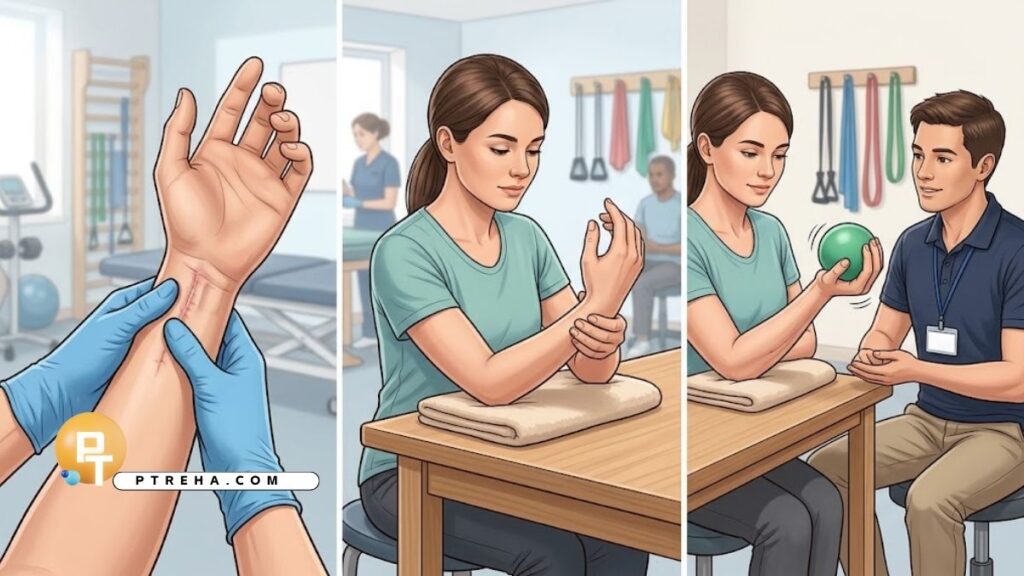
A post-fracture wrist can remain stiff even after the bone has healed, particularly after a period of immobilization.
A well-planned post-fracture wrist stiffness rehabilitation routine should gradually restore wrist and forearm mobility, reduce swelling, rebuild strength, and return the hand to practical activities without repeatedly irritating healing tissues.
Why the Wrist Becomes Stiff After a Fracture
Wrist stiffness is common after fracture because the joint and surrounding tissues may spend weeks with limited movement.
Swelling, pain, scar tissue, muscle weakness, and reduced tendon or joint mobility can all contribute.
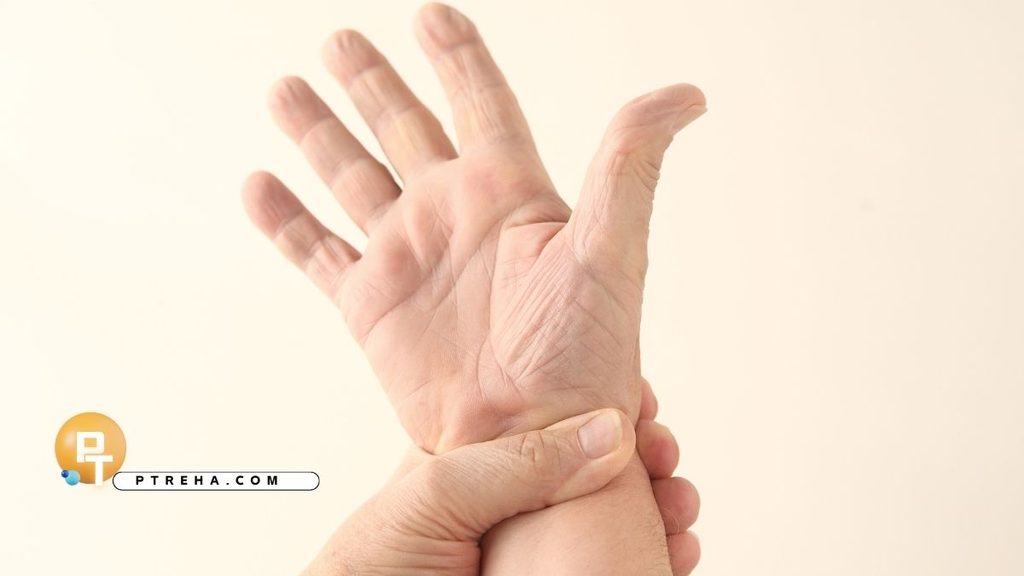
The most important principle is that rehabilitation must match the stage of bone healing and the treatment used.
A person treated with a cast may have different restrictions from someone who underwent fixation surgery.
Common contributors include:
- Prolonged immobilization
- Joint swelling and edema
- Pain-related muscle guarding
- Reduced wrist flexion and extension
- Limited radial and ulnar deviation
- Restricted forearm pronation and supination
- Tendon adhesions or reduced tendon excursion
- Scar sensitivity after surgery
- Loss of grip and pinch strength
- Fear of using the injured hand
The American Academy of Orthopaedic Surgeons notes that distal radius fracture management should be individualized according to the fracture and treatment circumstances.
Its clinical guidance can be useful background for understanding why rehabilitation should not follow one identical protocol for every wrist fracture.
(aaos.org)
When to Begin Wrist Rehabilitation
The timing of wrist movement depends on fracture stability, imaging, surgical fixation, cast or splint use, and instructions from the treating orthopedic clinician.
Finger, elbow, and shoulder movement is often encouraged earlier because these joints can become stiff while the wrist is protected.
Wrist-specific movement should begin when the treating clinician confirms that it is appropriate.
A practical rehabilitation plan should consider:
- Fracture location and pattern
- Whether surgery was performed
- Stability of the fixation
- Current radiographic healing
- Presence of pain and swelling
- Soft-tissue or tendon involvement
- Weight-bearing restrictions
- Occupational and sporting demands
Do not force wrist movement simply because the cast has been removed.
Bone healing and functional recovery are related but are not identical processes.
Patient guidance from hand-therapy services commonly emphasizes gradual restoration of movement, followed by progressive strengthening and functional use as healing permits.
(ASPH)
Initial Mobility Routine for a Stiff Wrist
Once wrist movement has been cleared, begin with controlled active range-of-motion exercises rather than aggressive stretching.
The purpose is to repeatedly expose the wrist to comfortable movement while allowing irritated tissues to settle between sessions.
Wrist Flexion and Extension

Rest the forearm on a table with the hand extending beyond the edge. Slowly allow the hand to move downward into flexion and then upward into extension.
Perform:
- 8–12 repetitions
- Slow, controlled movements
- 2–4 sessions per day
- A comfortable range initially
Do not bounce at the end of the movement.
Radial and Ulnar Deviation

With the forearm supported, move the wrist toward the thumb side and then toward the little-finger side. Keep the forearm relatively still so the movement comes primarily from the wrist.
Try:
- 8–12 repetitions
- Gentle end-range exposure
- Slow movement in both directions
- More repetitions only if symptoms remain settled
Forearm Rotation

Keep the elbow close to the side and bent approximately 90 degrees. Slowly rotate the palm upward and then downward. This movement is particularly important after fractures around the distal radius because pronation and supination can become restricted.
A simple routine can include:
- Palm-up rotation
- Palm-down rotation
- 8–12 repetitions
- A brief pause at each comfortable limit
- No forced twisting
Wrist Circles

Once basic wrist movements are comfortable, make small, controlled circles with the hand. Gradually enlarge the circle rather than immediately seeking maximum range.
Progressing the Stretching Routine
Active movement is usually the starting point, but persistent stiffness may require carefully dosed assisted or passive mobility work.
The key is to create a gentle stretching sensation rather than sharp pain.
Useful options include:
- Assisted wrist flexion
- Assisted wrist extension
- Gentle forearm rotation
- Table-supported extension
- Table-supported flexion
- Prayer-position stretching when appropriate
- Towel-assisted rotation
- Short-duration end-range holds
For example, during assisted wrist extension, place the forearm on a table with the palm down and gently use the opposite hand to increase the movement.
Hold the stretch for about 5–10 seconds, repeat several times, and reassess how the wrist responds later that day.
NHS physiotherapy guidance similarly describes gradual wrist movement and short assisted holds as useful approaches for post-fracture stiffness, while emphasizing that discomfort should not progressively worsen.
Swelling and Soft-Tissue Management
Swelling can mechanically restrict movement and make exercise more uncomfortable.
Managing edema is therefore an important part of restoring wrist mobility.
A simple routine can include:
- Elevating the hand when resting
- Regular finger opening and closing
- Gentle tendon-gliding movements
- Frequent light use of the hand
- Avoiding prolonged dependent positioning
- Using compression only when clinically appropriate
- Performing movement exercises throughout the day
- Monitoring changes in swelling
- Keeping the skin and surgical scar protected
- Using therapist-directed scar management when indicated
Finger movement is particularly useful because the hand can become stiff while the wrist is immobilized.
AAOS guidance specifically recognizes regular finger motion as an important part of care following distal radius fracture.
(aaos.org)
Strengthening After Wrist Mobility Improves
Strengthening should follow adequate fracture healing and clearance for resistance exercise.
Starting resistance too aggressively can increase pain and irritability even when basic range of motion is improving.
Begin with low-load exercises.
Isometric Wrist Strengthening
Place the affected hand against the opposite hand or a stable surface and gently contract without allowing the wrist to move.
Examples include:
- Wrist flexion isometric
- Wrist extension isometric
- Radial deviation isometric
- Ulnar deviation isometric
- Gentle grip contraction
Hold each contraction for approximately 3–5 seconds and repeat several times.
Grip Strengthening
A soft therapy ball, sponge, or appropriate resistance device can be used when gripping is permitted.
Start with:
- Gentle squeeze
- Hold briefly
- Slowly release
- Rest
- Repeat 8–15 times
The resistance should be light enough that the wrist does not compensate excessively.
Progressive Resistance
As tolerance improves, resistance can gradually increase using:
- Therapy putty
- Light dumbbells
- Resistance bands
- Small household objects
- Hand grippers when appropriate
Strengthening should support function rather than simply produce fatigue.
Functional Wrist Rehabilitation
The final objective is not a perfect measurement on a goniometer.
It is the ability to use the wrist confidently and safely during everyday tasks.
Begin with light activities that resemble the person’s normal routine.
Examples include:
- Holding a cup
- Using a computer mouse
- Turning pages
- Folding clothes
- Handling lightweight utensils
- Opening lightweight containers
- Writing
- Carrying a light bag
- Using a phone
- Performing gentle household tasks
Progress the activity gradually by changing one variable at a time, such as weight, duration, speed, or complexity.
For example, someone who struggles to turn a door handle might practice forearm rotation with a light object before progressing to more resistant twisting activities.
Sample Post-Fracture Wrist Stiffness Rehabilitation Routine
The following table is a general framework rather than a substitute for fracture-specific medical clearance.
| Rehabilitation focus | Example exercises | Typical approach | Progression goal |
|---|---|---|---|
| Finger mobility | Open/close hand, tendon glides | 8–15 repetitions | Full comfortable finger motion |
| Wrist flexion | Active flexion, assisted flexion | 8–12 repetitions | Gradually increase range |
| Wrist extension | Active extension, table stretch | 8–12 repetitions | Improve functional extension |
| Deviation | Radial/ulnar deviation | 8–12 repetitions | Restore side-to-side control |
| Forearm rotation | Palm up/palm down | 8–12 repetitions | Improve reaching and turning |
| Isometric strength | Flexion/extension holds | 3–5 second holds | Tolerate light loading |
| Grip | Sponge or therapy putty | 8–15 repetitions | Improve hand function |
| Resistance | Band or light weight | Low resistance | Gradually rebuild strength |
| Functional use | Light household tasks | Short periods | Return toward normal activity |
A useful principle is mobility first, controlled loading second, functional loading third.
However, these stages can overlap when the fracture is stable and the treating clinician permits progressive activity.
How Often Should You Exercise?
Consistency is usually more useful than performing one exhausting session.
Stiff wrists often respond better to regular, controlled movement distributed throughout the day.
A practical home routine might include:
- Mobility exercises 2–4 times daily
- 8–12 repetitions per movement
- Short stretching holds
- Strengthening once appropriately cleared
- Light functional use between exercise sessions
- Rest periods when symptoms increase
Do not assume that doing more repetitions will automatically produce faster recovery.
A useful response-monitoring system is to compare symptoms before exercise, shortly afterward, and later the same day.
If pain or swelling repeatedly remains elevated, reduce the range, resistance, repetitions, or frequency.
Evidence reviewed by AAOS does not establish that every person requires supervised therapy rather than a home program after distal radius fracture.
Some patients can progress effectively with home exercise, while others benefit from individualized hand therapy because of stiffness, weakness, pain, complications, or difficulty progressing.
(aaos.org)
Common Mistakes During Wrist Rehabilitation
A technically correct exercise can still be inappropriate if it is performed at the wrong stage or with excessive intensity.
Avoid these common errors:
- Forcing painful end-range movement
- Using heavy resistance too early
- Ignoring increasing swelling
- Exercising through sharp pain
- Comparing recovery with another person’s fracture
- Neglecting forearm rotation
- Focusing only on wrist movement
- Avoiding all movement because of mild stiffness
- Returning suddenly to heavy lifting
- Continuing an exercise that consistently worsens symptoms
Another common mistake is treating the range-of-motion measurement as the only goal.
A person may have modest wrist extension but excellent functional use, while another may have a larger measured range but significant pain or weakness.
Rehabilitation should therefore consider movement, symptoms, strength, dexterity, and meaningful activities together.
When to Seek Further Assessment
Some stiffness is expected after immobilization, but persistent or worsening symptoms deserve clinical review.
Seek professional assessment if you develop:
- Increasing rather than decreasing pain
- Rapidly increasing swelling
- New or worsening numbness
- Persistent tingling
- Significant color or temperature changes
- Inability to move the fingers
- Severe pain with gentle movement
- New instability or deformity
- A wound that becomes increasingly red or painful
- Unexpected loss of function
- Stiffness that stops improving despite appropriate rehabilitation
After surgery, follow the specific wound, loading, and exercise instructions provided by the surgical and therapy team.
A particularly important point is that not every stiff wrist is simply a problem of “tight muscles.” Structural restrictions, tendon problems, nerve symptoms, complex regional pain syndrome, malunion, or other complications may require assessment rather than more aggressive stretching.
Conclusion
A successful post-fracture wrist stiffness rehabilitation routine combines gradual mobility work, swelling management, progressive strengthening, and meaningful functional activity.
The safest program is individualized to the fracture, healing status, treatment method, symptoms, and functional demands.
Start with controlled movement, progress resistance only when appropriate, and use symptom response to guide the workload.
If progress plateaus or symptoms worsen, reassessment by an orthopedic clinician or hand therapist is more appropriate than simply increasing exercise intensity.
Frequently Asked Questions
How long does wrist stiffness last after a fracture?
Stiffness can persist for several months after the cast or splint is removed, particularly when immobilization was prolonged or the fracture was complex.
Recovery is usually gradual, and range of motion and strength may continue improving well after basic bone healing.
Should I exercise my wrist if it feels stiff?
If wrist movement has been medically cleared, gentle exercise is commonly used to restore mobility.
A feeling of tightness or mild discomfort can occur, but sharp pain or progressively worsening symptoms are reasons to reduce the intensity and seek professional guidance.
How many times a day should I do wrist exercises?
Many rehabilitation programs use short exercise sessions several times throughout the day.
Rather than completing one long session, regular controlled movement can help prevent the wrist from becoming stiff between activities.
Should wrist exercises hurt after a fracture?
Mild stretching discomfort can occur when a stiff wrist is moved toward its available range.
Exercise should not produce severe, sharp, or progressively increasing pain, and symptoms that remain significantly aggravated should be discussed with a clinician.
When can I start strengthening my wrist?
Strengthening should begin when the fracture is sufficiently healed and your treating clinician has cleared resistance exercise.
The timing varies according to fracture stability, fixation, imaging findings, and the individual’s clinical progress.
Is forearm rotation important after a wrist fracture?
Yes.
Pronation and supination allow the palm to turn up and down and are essential for tasks such as using utensils, turning keys, opening containers, and positioning the hand during reaching.
Restriction in these movements can significantly affect everyday function.
Can I use weights for a stiff wrist?
Light weights may become useful once resistance exercise is permitted.
Start with low resistance and controlled repetitions, then gradually increase the load according to symptoms, strength, healing status, and functional goals.
Why is my wrist still swollen after the fracture has healed?
Soft-tissue swelling can remain after the initial fracture has stabilized.
Reduced movement, dependent positioning, tissue irritation, and changes in circulation can contribute, so elevation, appropriate movement, and gradual functional use may help.
Do I need physical therapy after a wrist fracture?
Not everyone requires the same level of supervised therapy.
A home program may be adequate for some uncomplicated recoveries, while persistent stiffness, weakness, pain, reduced function, surgery, or difficulty progressing can make individualized hand or physical therapy particularly valuable.
What should I do if my wrist stops improving?
A plateau does not necessarily mean that rehabilitation has failed, but it should prompt reassessment of the exercise dose, joint mobility, strength, pain, swelling, and underlying structural factors.
Persistent or worsening symptoms should be reviewed by an appropriate orthopedic or rehabilitation professional rather than treated by increasingly aggressive stretching.