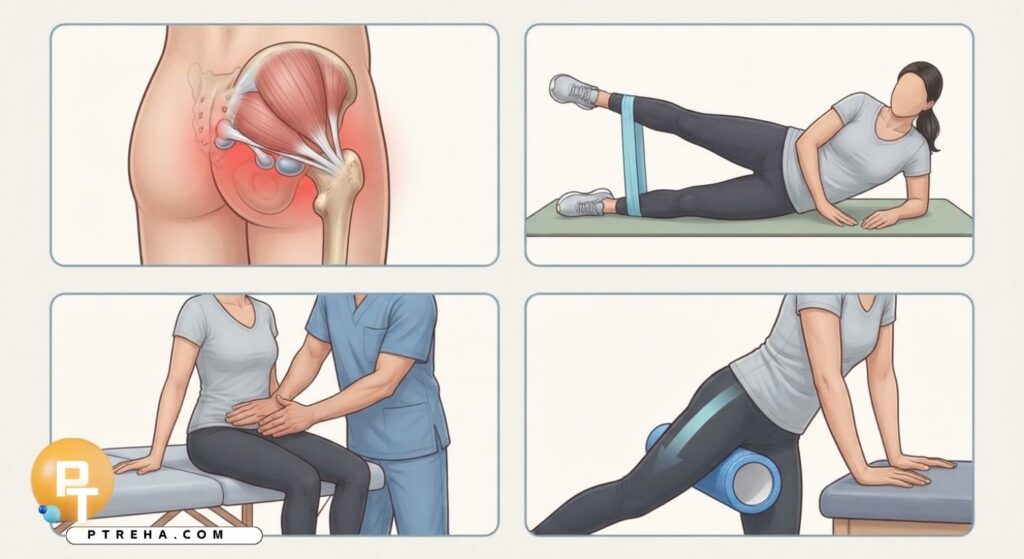
Greater trochanteric pain syndrome (GTPS), often called hip bursitis, is a common cause of pain on the outside of the hip.
Effective greater trochanteric pain syndrome management usually combines careful assessment, reduction of irritating loads, patient education, and progressive strengthening of the hip muscles rather than relying on rest alone.
What Is Greater Trochanteric Pain Syndrome?
Greater trochanteric pain syndrome describes pain arising from structures around the greater trochanter, the prominent bony area on the outside of the upper femur.
The term is broader and more clinically useful than “trochanteric bursitis.” In many patients, the gluteus medius or gluteus minimus tendons are involved, with or without irritation of the nearby bursae.
GTPS may involve:
- Gluteus medius tendinopathy.
- Gluteus minimus tendinopathy.
- Partial gluteal tendon injury.
- Trochanteric bursal irritation.
- Mechanical compression of lateral hip structures.
- Reduced hip abductor capacity.
- Altered control during single-leg activities.
- Occasionally external snapping around the lateral hip.
Modern clinical management therefore focuses on the entire lateral hip region rather than assuming that inflammation of a bursa is the only problem.
The international consensus on assessment and treatment of GTPS supports evaluating both local hip structures and possible competing sources of symptoms, including intra-articular hip and lumbosacral conditions.
international consensus on assessment and treatment of GTPS
Common Symptoms and Clinical Presentation
The characteristic symptom is pain around the lateral aspect of the hip, usually close to the greater trochanter.
Pain may remain localized or extend into the lateral thigh.
Some people also describe discomfort extending toward the buttock.
Common complaints include:
- Pain when lying on the affected side.
- Pain after prolonged walking.
- Pain when climbing stairs.
- Pain during prolonged standing.
- Discomfort while standing on one leg.
- Pain when getting out of a chair.
- Symptoms when walking uphill.
- Pain during running or repetitive loading.
- Difficulty sleeping because of lateral hip pain.
- Tenderness when pressing around the greater trochanter.
Single-leg activities can be particularly provocative because the hip abductors must control the pelvis while supporting body weight.
For example, someone may be comfortable sitting but develop lateral hip pain after walking through a shopping centre, repeatedly climbing stairs, or standing on one leg while dressing.
Symptoms can also become worse after a sudden increase in activity.
Examples include:
- Increasing walking distance too quickly.
- Beginning a new running program.
- Adding hills to regular walks.
- Returning to sport after inactivity.
- Performing excessive hip exercises.
- Suddenly increasing gym training volume.
The relationship between symptoms and mechanical loading is therefore an important part of the physiotherapy assessment.
Why GTPS Is Not Simply Hip Bursitis
Historically, lateral hip pain was frequently attributed to inflammation of the trochanteric bursa.
Current understanding is more complex.
Gluteal tendon pathology is frequently associated with the clinical presentation, and isolated bursitis does not explain every case.
The gluteus medius and gluteus minimus muscles are important hip abductors.
Their tendons attach around the greater trochanter and help stabilize the pelvis during walking and other single-leg activities.
These structures are exposed to both tensile and compressive forces.
Compression may increase when the hip moves into excessive adduction, meaning the thigh moves toward or across the body’s midline.
Examples include:
- Standing with body weight hanging on one hip.
- Crossing the legs tightly when sitting.
- Sleeping on the painful side.
- Sleeping on the opposite side without supporting the upper leg.
- Walking with poor frontal-plane pelvic control.
- Repeatedly allowing the knee and hip to move inward during functional tasks.
This does not mean hip adduction must always be avoided.
Normal movement requires hip adduction.
The rehabilitation goal is to reduce unnecessarily provocative loading temporarily and then progressively restore the person’s tolerance to normal movement.
Physiotherapy Assessment of Greater Trochanteric Pain Syndrome
GTPS is primarily assessed clinically.
Imaging is not automatically necessary for every person with lateral hip pain.
A physiotherapist begins by understanding the location, behavior, duration, and mechanical pattern of the symptoms.
Important history questions include:
- Where exactly is the pain?
- Does the pain extend below the hip?
- Is lying on either side painful?
- Does walking increase symptoms?
- Are stairs difficult?
- Did activity levels recently change?
- Is there associated groin pain?
- Is there back pain?
- Are neurological symptoms present?
- Has there been a recent fall or trauma?
- What activities can the patient no longer perform?
- How do symptoms behave during the following day?
The physical assessment may examine:
- Greater trochanteric tenderness.
- Hip range of motion.
- Hip abductor strength and capacity.
- Symptoms during resisted hip movements.
- Single-leg control.
- Walking pattern.
- Stair performance.
- Functional loading tolerance.
- Lumbar spine contribution when clinically relevant.
- Signs suggesting intra-articular hip involvement.
A combination of history and examination findings is more useful than relying on one test in isolation.
Conditions That Can Resemble GTPS
Not every case of lateral hip pain is GTPS.
The differential assessment can include:
- Hip osteoarthritis.
- Lumbar referred pain.
- Lumbar radiculopathy.
- Femoroacetabular or other intra-articular hip disorders.
- Gluteal tendon tears.
- Femoral stress injury.
- Other hip muscle-tendon disorders.
- Neurological conditions affecting the lateral thigh.
- Trauma-related injury.
A person with significant groin pain, substantial restriction of hip movement, neurological symptoms, unexplained systemic symptoms, major trauma, or an atypical presentation may require further medical assessment.
Imaging can also become useful when symptoms are persistent, the clinical presentation is unclear, or another pathology needs to be investigated.
Can Weight Loss Help Trochanteric Bursitis?
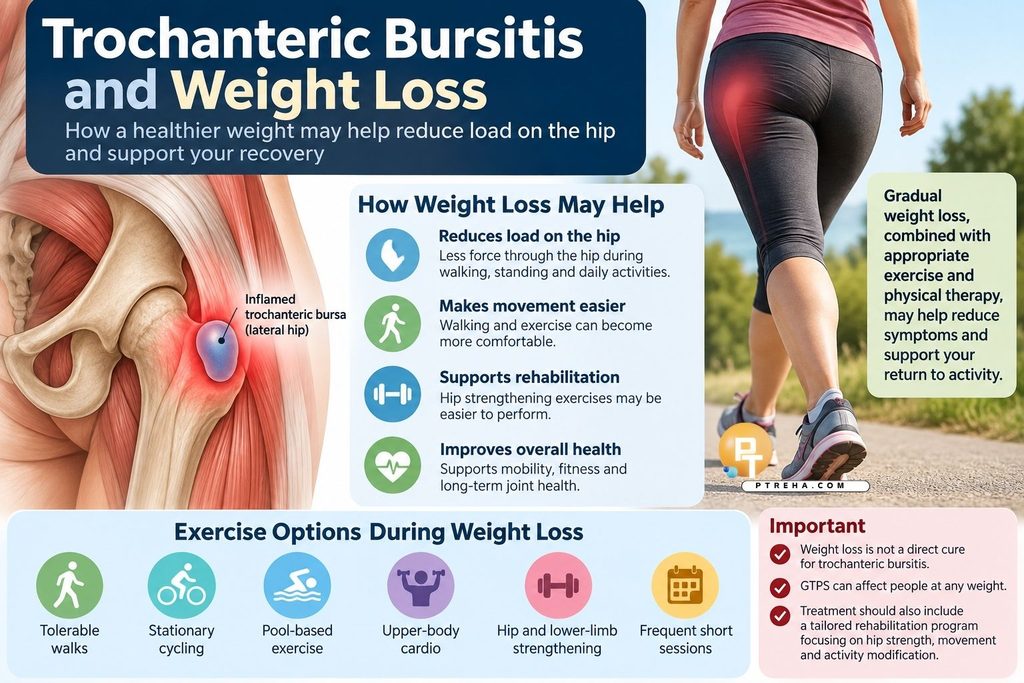
Weight loss may be helpful for some people with trochanteric bursitis or greater trochanteric pain syndrome (GTPS), particularly when excess body weight increases the mechanical load placed on the hips during walking, stair climbing, and prolonged standing.
However, weight loss should not be presented as a direct cure for trochanteric bursitis. GTPS is often related to several factors, including gluteal tendon overload, hip muscle weakness, repetitive compression around the greater trochanter, changes in activity level, and movement patterns.
For people who are overweight, gradual weight reduction may help by:
- Reducing overall load on the hip during daily activities.
- Making walking and exercise more comfortable.
- Supporting gradual return to physical activity.
- Reducing the physical demand placed on painful hip structures.
- Making rehabilitation exercises easier to perform.
- Improving general mobility and cardiovascular health.
Weight management should normally be combined with an appropriate rehabilitation program rather than used alone. Physical therapy may include progressive strengthening of the gluteal muscles, modification of aggravating activities, and gradual exposure to walking and other weight-bearing tasks.
Exercise During Weight Loss
People with lateral hip pain do not necessarily need to stop exercising while trying to lose weight. Instead, activities can be modified according to symptoms.
Lower-impact options may include:
- Short, tolerable walks.
- Stationary cycling if comfortable.
- Pool-based exercise.
- Upper-body cardiovascular exercise.
- Progressive hip and lower-limb strengthening.
- Frequent short periods of activity instead of one long session.
Exercises or activities that repeatedly increase lateral hip pain should be reduced or modified temporarily. The goal is usually to maintain activity while gradually improving the hip’s capacity to tolerate load.
Does Being Overweight Cause Trochanteric Bursitis?
Higher body weight may contribute to increased mechanical loading around the hip, but it is not the only cause of trochanteric bursitis or GTPS. People at a healthy body weight can also develop lateral hip pain because of tendon overload, sudden increases in activity, muscle weakness, running-related loading, prolonged compression, or other biomechanical factors.
For this reason, treatment should focus on the individual factors contributing to the person’s symptoms rather than weight alone.
Load Management: The Foundation of GTPS Rehabilitation
One of the most important parts of greater trochanteric pain syndrome management is identifying loads that repeatedly irritate the lateral hip.
Complete rest is usually not the objective.
Instead, physiotherapy aims to temporarily reduce the most provocative activities while maintaining as much comfortable activity as possible.
Useful strategies may include:
- Reduce unusually long walks temporarily.
- Limit repeated stair climbing when highly provocative.
- Break prolonged standing into shorter periods.
- Avoid repeatedly “hanging” on one hip.
- Modify running volume when running aggravates symptoms.
- Temporarily reduce steep hills.
- Avoid sudden increases in exercise volume.
- Change exercises that repeatedly reproduce lateral hip pain.
- Gradually rebuild activity rather than returning suddenly.
Daily posture can also influence compression around the gluteal tendons.
A common example is standing with the pelvis shifted sideways and most body weight placed through one leg.
Instead, patients can practice distributing weight more evenly between both legs when prolonged standing becomes painful.
Sleeping With Lateral Hip Pain
Night pain can be one of the most frustrating GTPS symptoms.
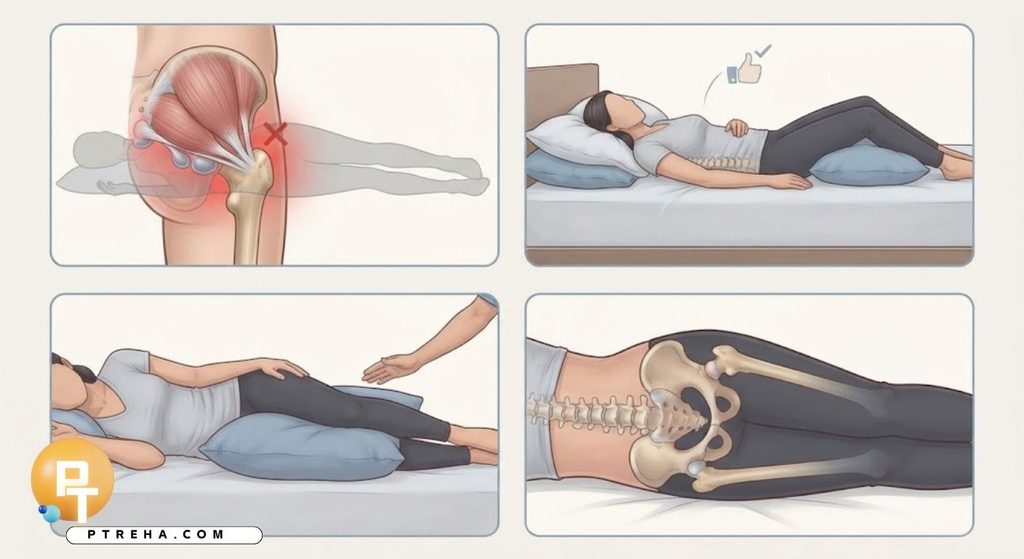
Sleeping directly on the painful hip increases local compression and may aggravate symptoms.
Practical options include:
- Avoid sleeping directly on the painful side during an irritable phase.
- Sleep on the back when comfortable.
- When lying on the opposite side, support the upper leg.
- Place a pillow between the knees and thighs.
- Avoid allowing the upper thigh to fall far across the body’s midline.
The objective is comfort rather than maintaining one rigid sleeping position all night.
Exercise Therapy for Greater Trochanteric Pain Syndrome
Exercise is a central part of physiotherapy management because avoiding painful activities indefinitely does not restore the capacity of the gluteal muscles and tendons.
The program should be progressive.
An appropriate starting exercise for one person may be too difficult or too easy for another.
Rehabilitation commonly progresses through:
- Low-load muscle activation.
- Controlled hip abductor strengthening.
- Progressive resistance exercises.
- Functional weight-bearing exercises.
- Single-leg control.
- Walking tolerance.
- Higher-level occupational or sporting loads.
A major clinical trial comparing education plus exercise, corticosteroid injection, and a wait-and-see approach found that the physiotherapy-led education and exercise program produced favorable outcomes and supported combining tendon load education with targeted exercise.
The full education and exercise clinical trial for gluteal tendinopathy provides useful evidence for this approach.
education and exercise clinical trial for gluteal tendinopathy
Example Early-Stage Exercises
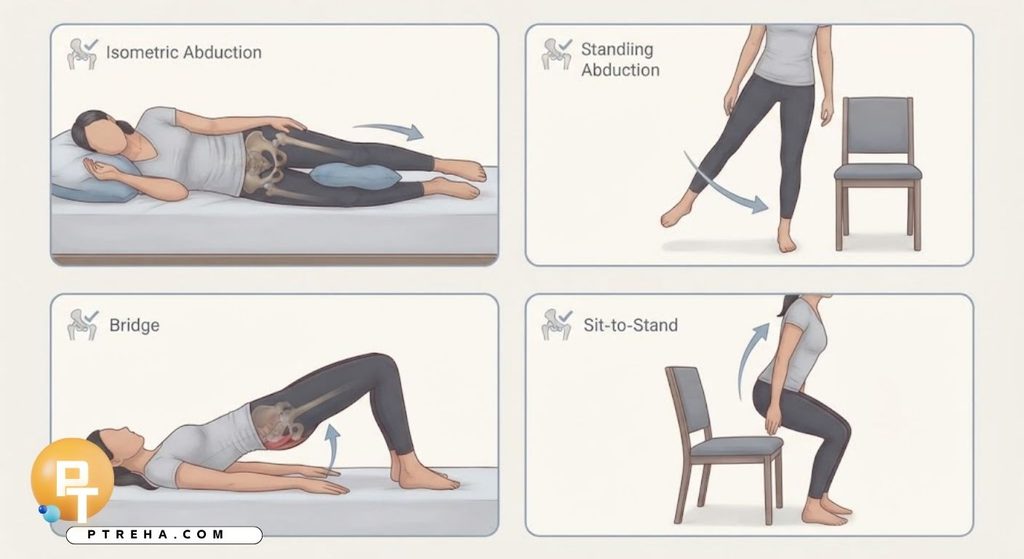
Early rehabilitation may include controlled exercises that allow the hip abductors to work without excessive symptom provocation.
Possible examples include:
- Isometric hip abduction.
- Controlled standing hip abduction.
- Bridge variations when tolerated.
- Low-level functional weight shifting.
- Sit-to-stand exercises with good lower-limb control.
Exercise selection should depend on irritability and function rather than following the same routine for every patient.
Progressing Hip Abductor Strength
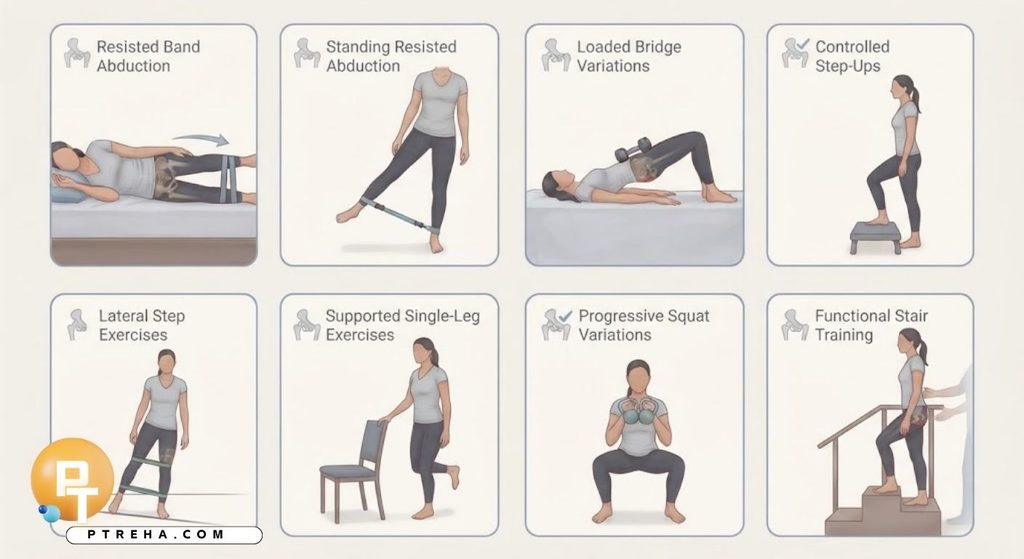
As symptoms become more manageable, resistance can gradually increase.
Progressions may include:
- Resistance-band hip abduction.
- Standing resisted abduction.
- Loaded bridge variations.
- Controlled step-ups.
- Lateral step exercises.
- Supported single-leg exercises.
- Progressive squat variations.
- Functional stair training.
The gluteal muscles need sufficient capacity to control the pelvis during walking, stair climbing, running, and other weight-bearing tasks.
Advanced Functional Rehabilitation
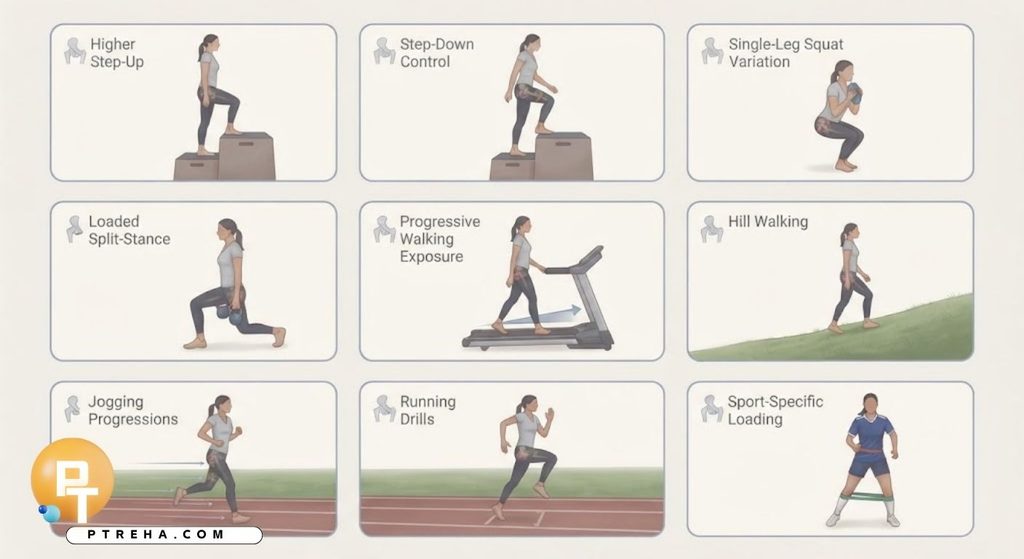
Later rehabilitation should resemble the activities the patient needs to perform.
A recreational runner, warehouse employee, and sedentary office worker should not necessarily finish rehabilitation with identical programs.
Later exercises may include:
- Higher step-ups.
- Step-down control.
- Single-leg squat variations.
- Loaded split-stance exercises.
- Progressive walking exposure.
- Hill walking.
- Jogging progressions.
- Running drills when appropriate.
- Sport-specific loading.
The goal is not simply to make an exercise harder.
The goal is to prepare the hip for the patient’s real functional demands.
A contemporary review of hip tendinopathy diagnosis and rehabilitation similarly emphasizes education and progressive exercise as important management strategies for gluteal tendinopathy.
hip tendinopathy diagnosis and rehabilitation
How Much Pain Is Acceptable During Exercise?
Exercise does not always need to be completely pain-free, but pain should not be ignored.
There is no single pain number that is appropriate for every patient.
The physiotherapist should consider:
- Symptom intensity during exercise.
- Whether pain increases from repetition to repetition.
- Movement quality.
- Baseline irritability.
- Functional ability afterward.
- Night symptoms.
- Symptoms later that day.
- Symptoms the following day.
A useful principle is to avoid exercise loads that clearly produce a sustained worsening of the patient’s usual symptoms.
For example, if a strengthening session causes progressively increasing lateral hip pain and noticeably worse night pain afterward, the exercise dosage may need modification.
Possible adjustments include:
- Reduce resistance.
- Reduce repetitions.
- Reduce exercise range.
- Increase recovery time.
- Change the exercise.
- Reduce frequency temporarily.
- Progress more gradually.
This approach makes the program responsive to the individual rather than dependent on rigid numerical rules.
Practical GTPS Rehabilitation Progression
The following framework illustrates how physiotherapy can progress.
It is not a fixed protocol.
| Rehabilitation stage | Main objective | Examples |
|---|---|---|
| Irritable stage | Reduce excessive compression and provocative load | Activity modification, sleep positioning, gentle muscle loading |
| Early strengthening | Restore comfortable hip muscle loading | Isometrics, controlled abduction, basic functional exercises |
| Strength development | Improve hip abductor capacity | Progressive resistance, step-ups, bridges, squat variations |
| Functional loading | Improve control during daily activities | Step-downs, single-leg tasks, longer walking |
| Return to higher demand | Prepare for work, running, or sport | Heavier resistance, hills, jogging, sport-specific tasks |
Progression should be based on tolerance and functional improvement rather than a predetermined calendar.
A patient who can comfortably perform strengthening exercises but still develops pain after ten minutes of walking needs a different progression from someone who walks comfortably but cannot tolerate running.
Treatments Beyond Exercise and Education
Some patients ask about massage, medication, injections, shockwave therapy, or other passive treatments.
These interventions should not replace appropriate assessment and progressive rehabilitation.
Manual Therapy and Soft-Tissue Techniques
Manual techniques may sometimes be used to help manage accompanying stiffness or discomfort.
However, rehabilitation should not depend entirely on repeatedly treating the painful point.
Potential supportive treatments include:
- Appropriate manual therapy.
- Movement retraining.
- Short-term symptom-relieving strategies.
- Education about activity modification.
- Progressive exercise.
Aggressive pressure directly over a highly irritable greater trochanter may be uncomfortable and is not automatically necessary.
Medication and Injection Options
Medication decisions fall outside the physiotherapist’s independent prescribing role unless the clinician has the appropriate prescribing authority.
Patients requiring medication advice should discuss suitable options with their physician, pharmacist, or other qualified prescribing professional.
Corticosteroid injections may provide symptom relief for some patients, but they should not be viewed as a substitute for addressing load tolerance, strength, and function.
Persistent or severe symptoms may require coordinated medical assessment alongside rehabilitation.
Shockwave Therapy and Other Procedures
Shockwave therapy has been investigated for persistent GTPS, but rehabilitation decisions should consider the individual clinical presentation and available evidence.
Patients who do not improve as expected may require reassessment before simply adding more treatments.
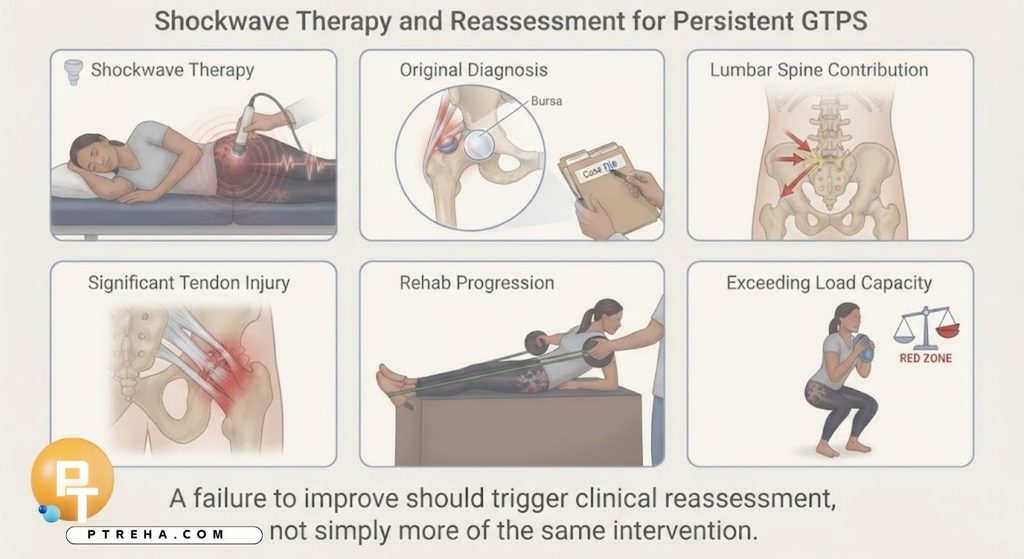
The key questions are:
- Is the original diagnosis still appropriate?
- Is another hip disorder present?
- Is the lumbar spine contributing?
- Is there significant gluteal tendon injury?
- Has rehabilitation been progressed appropriately?
- Is the patient repeatedly exceeding current load capacity?
A failure to improve should trigger clinical reassessment, not simply more of the same intervention.
Common Mistakes That Can Delay Recovery
GTPS management is often less successful when the balance between protection and progressive loading is lost.
Common problems include:
- Complete rest for prolonged periods.
- Continuing the same aggravating activity without modification.
- Increasing walking or running too quickly.
- Performing excessive strengthening immediately.
- Stretching aggressively into painful hip adduction.
- Repeatedly sleeping directly on the painful hip.
- Depending only on passive treatment.
- Treating every case as isolated bursitis.
- Ignoring possible lumbar or intra-articular hip involvement.
- Progressing exercises without monitoring the symptom response.
Another common mistake is interpreting every painful response as evidence of tissue damage.
Symptoms are better used as feedback about current load tolerance.
Rehabilitation aims to gradually expand that tolerance.
When Should a Patient Be Referred for Further Assessment?
Most uncomplicated GTPS presentations can be managed conservatively, but physiotherapists should remain alert to findings that do not fit the expected pattern.
Further medical assessment may be appropriate when there is:
- Significant trauma.
- Inability to weight-bear after injury.
- Rapidly worsening unexplained symptoms.
- Marked neurological changes.
- Significant unexplained weakness.
- Suspicion of fracture or stress injury.
- Severe or unusual groin pain.
- Systemic illness features.
- Persistent symptoms despite appropriate rehabilitation.
- Clinical suspicion of substantial gluteal tendon injury.
Referral does not mean rehabilitation has failed.
It may simply provide additional information needed to determine why symptoms are persisting and how management should be adjusted.
Conclusion
Greater trochanteric pain syndrome management is more effective when the condition is approached as a load-sensitive lateral hip disorder rather than simply “hip bursitis.” Physiotherapy should combine accurate clinical assessment, modification of provocative compression and activity, progressive hip abductor strengthening, functional retraining, and gradual return to the patient’s required activities.
Exercise should be individualized according to symptom response, function, and load tolerance, while persistent or atypical cases should be reassessed for competing diagnoses or additional pathology.
Frequently Asked Questions
Is greater trochanteric pain syndrome the same as hip bursitis?
Not exactly.
Hip bursitis may be part of the presentation, but GTPS is a broader term that can include gluteus medius or minimus tendon problems and other structures around the greater trochanter.
For this reason, treating GTPS purely as an inflamed bursa can overlook important contributors to lateral hip pain.
What does greater trochanteric pain syndrome feel like?
GTPS commonly produces pain and tenderness on the outside of the hip.
It may become worse with side lying, prolonged walking, stairs, standing on one leg, or other activities that increase loading around the lateral hip.
Symptoms can sometimes extend into the lateral thigh.
Should I stop walking if I have GTPS?
Not automatically.
Complete inactivity is rarely the main rehabilitation goal.
If walking clearly aggravates symptoms, temporarily reducing distance, speed, hills, or frequency may help.
Walking can then be increased gradually as tolerance improves.
Can I exercise with hip bursitis or GTPS?
Exercise is commonly an important part of management, but the exercise dosage and selection should match the current irritability of the condition.
Exercises that cause a clear and sustained worsening of symptoms may need modification rather than simply being pushed through.
Is stretching good for GTPS?
Stretching is not automatically necessary.
Positions involving substantial hip adduction can increase compression around the lateral hip and may irritate some patients.
Stretching should therefore be prescribed according to the individual’s examination rather than as a universal treatment.
Why does GTPS hurt when sleeping?
Side lying can compress sensitive structures around the greater trochanter.
Sleeping directly on the painful side may therefore worsen symptoms.
Supporting the upper leg with pillows when lying on the opposite side can also reduce uncomfortable hip positions.
How long does GTPS take to improve?
Recovery time varies considerably depending on symptom duration, tendon involvement, physical capacity, activity demands, and how well loading can be modified.
Progress should be judged by improving function and load tolerance rather than expecting every patient to recover according to the same schedule.
Are glute strengthening exercises helpful for GTPS?
Progressive gluteal strengthening is commonly an important component of rehabilitation.
The exercises should progress from tolerable loading toward the strength and control required for walking, stairs, work, running, or sport.
Do I need an MRI for greater trochanteric pain syndrome?
Not necessarily.
GTPS is commonly identified from the clinical history and physical examination.
Imaging may become useful when the diagnosis is uncertain, symptoms are persistent, substantial tendon injury is suspected, or another hip condition needs to be investigated.
Can greater trochanteric pain syndrome come back?
Symptoms can recur, particularly after sudden increases in physical activity or repeated exposure to loads that exceed the current capacity of the hip.
Maintaining hip strength, increasing activity progressively, and recognizing early changes in load tolerance can help patients manage future flare-ups more effectively.