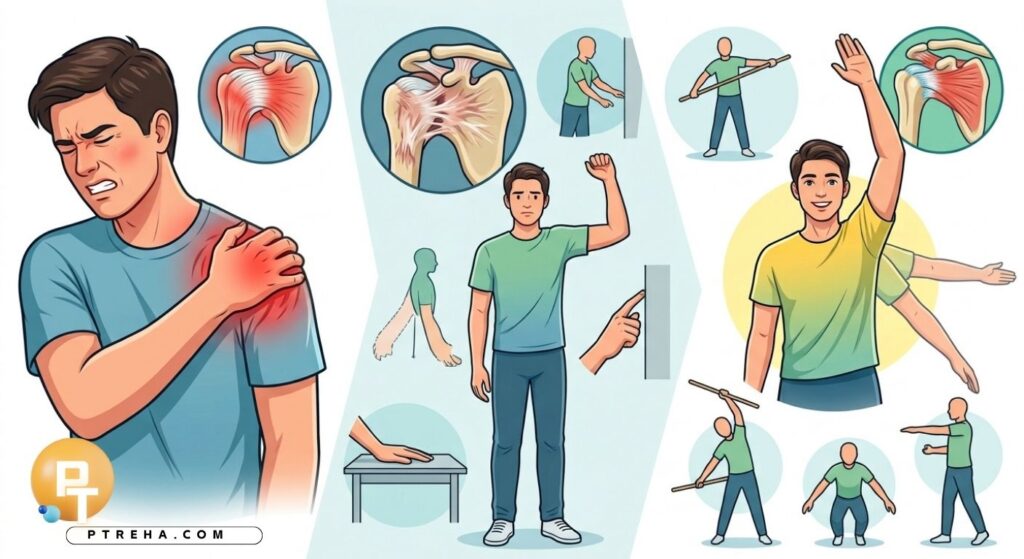
Frozen shoulder, also called adhesive capsulitis, causes progressive shoulder pain and stiffness because the joint capsule becomes thickened and tightened. Understanding the phase of the condition helps guide movement: the early painful phase usually calls for gentle motion and symptom control, while later phases allow more focused stretching, strengthening, and restoration of function.
What Is Frozen Shoulder?
Adhesive capsulitis is a clinical shoulder disorder characterized by pain and restriction of both active and passive glenohumeral movement. External rotation is often particularly limited, and the loss of movement can interfere with dressing, reaching overhead, grooming, sleeping, and placing the hand behind the back.
The condition may develop without an obvious injury, although shoulder immobilization, previous shoulder surgery or injury, diabetes, and thyroid disorders are recognized associations. The exact biological trigger is not always clear.
The traditional clinical model describes three overlapping phases: freezing, frozen, and thawing. These phases are useful for rehabilitation planning, but they are not rigid boxes; a person can have substantial pain and stiffness at the same time, and the transition between phases is gradual.
Typical features that raise suspicion for adhesive capsulitis include:
- Gradual onset of shoulder pain.
- Progressive loss of shoulder movement.
- Restriction of passive as well as active range of motion.
- Particularly noticeable loss of external rotation.
- Difficulty reaching behind the back.
- Pain that can disturb sleep.
- Increasing difficulty with dressing or grooming.
Figure 1. Shoulder anatomy relevant to movement assessment. The glenohumeral joint and surrounding structures are central to understanding why capsular restriction can affect multiple directions of shoulder motion. Source: National Institute of Arthritis and Musculoskeletal and Skin Diseases via Wikimedia Commons; public-domain source.
The Three Phases of Frozen Shoulder
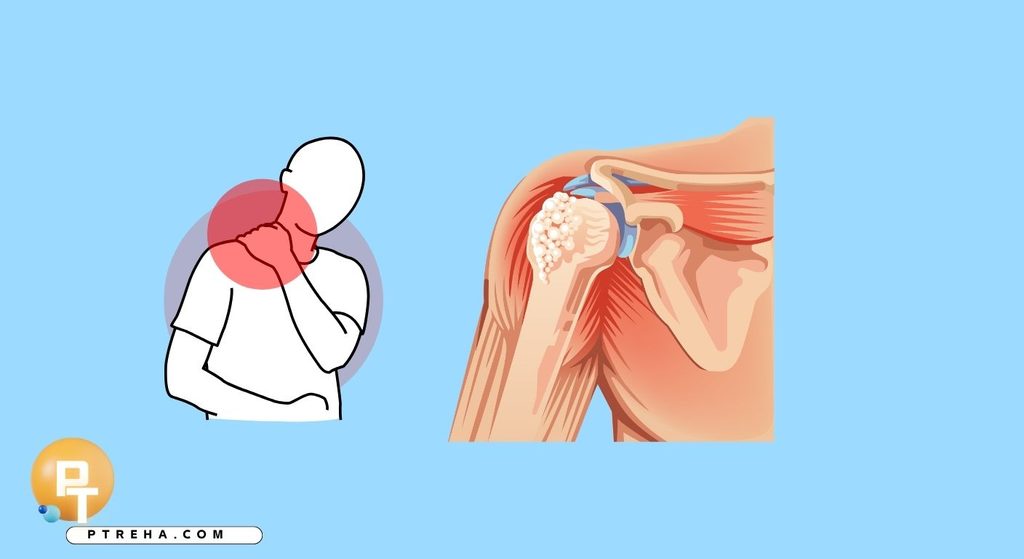
The phases help describe the changing relationship between pain and stiffness, but they should not be used as a substitute for clinical assessment.
| Phase | Main clinical pattern | Movement focus | Practical rehabilitation emphasis |
|---|---|---|---|
| Freezing | Pain becomes increasingly prominent and movement gradually decreases | Gentle movement within tolerance | Pain control, maintain available mobility, avoid aggressive stretching |
| Frozen | Pain may become less dominant while stiffness becomes prominent | Progressive mobility work | Restore restricted movement and introduce or progress strengthening |
| Thawing | Movement gradually returns | Active mobility and strengthening | Regain function, strength, endurance, and confidence |
The overall course can be prolonged, and recovery does not necessarily follow a perfectly predictable timetable. describes the condition as progressing through these three stages, with substantial variation between individuals.
Phase 1: Freezing — When Pain Controls Movement
The freezing phase is generally the most pain-dominant period. Movement becomes increasingly uncomfortable, night pain may interfere with sleep, and the person often begins using the arm less because movement feels threatening or difficult.
A common rehabilitation mistake at this stage is treating stiffness as if the shoulder simply needs to be forced open. The shoulder may be irritable, and overly aggressive stretching can increase symptoms rather than producing useful movement gains. Physical therapy guidance emphasizes matching exercise intensity to symptoms and avoiding excessive stretching during more painful stages.
Main priorities in the freezing phase are:
- Reduce unnecessary aggravating activity.
- Keep using the arm for tolerable daily tasks.
- Maintain available shoulder motion.
- Avoid prolonged immobilization.
- Use gentle active or assisted movement.
- Monitor the response after exercise.
- Address sleep positions that increase symptoms.
Movement Tips for the Freezing Phase
Movement should feel controlled rather than forceful. A useful principle is “move frequently, but do not repeatedly provoke the shoulder.”
Pendulum movements can provide low-load motion when lifting the arm is difficult. The arm is allowed to hang while the body creates a small, relaxed oscillation rather than actively pulling the shoulder through a large painful range. specifically includes pendulum movements among commonly used shoulder mobility exercises.
Table-supported forward movement can also be useful. The patient places the hand or forearm on a stable surface and gently shifts the body to allow the shoulder to move without having to actively lift the entire arm.
Useful early-stage strategies include:
- Small pendulum movements.
- Supported shoulder flexion.
- Gentle active-assisted movement.
- Comfortable elbow and wrist movement to avoid unnecessary inactivity.
- Short movement sessions repeated across the day.
- Position changes rather than holding the shoulder still for prolonged periods.
The goal is not to achieve a dramatic increase in range during one session. The immediate objective is to preserve usable movement while keeping the symptom response manageable.
Phase 2: Frozen — When Stiffness Becomes the Main Problem
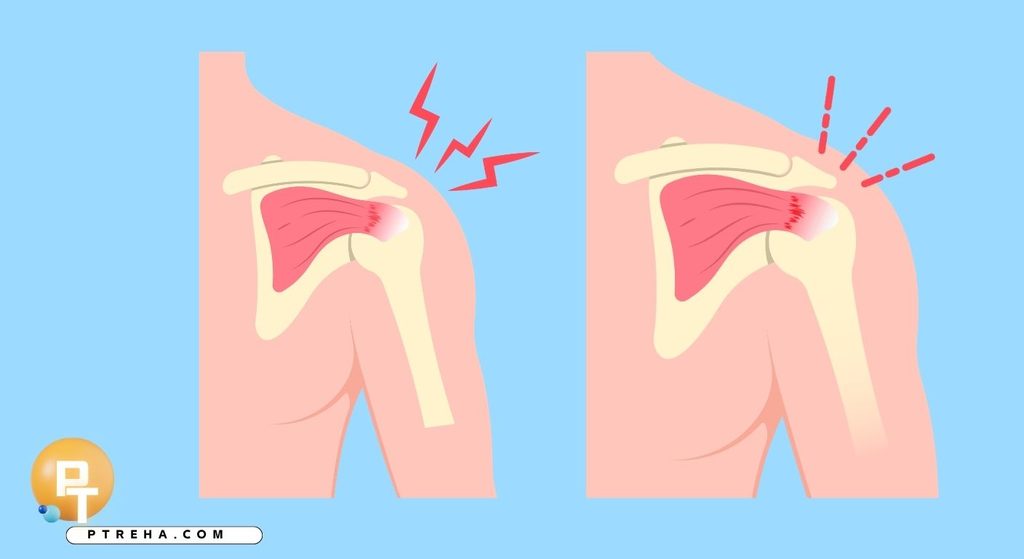
In the frozen phase, pain may become less severe, especially at rest, while the restriction of movement becomes more obvious. Patients may notice that the shoulder is substantially harder to lift, rotate, reach behind the back, or position for everyday tasks.
This phase is often more suitable for progressively directed mobility work because stiffness has become a major contributor to disability. Physical therapists may combine exercise with manual therapy depending on the examination findings and the person’s goals.
Practical goals during the frozen phase include:
- Improve functional shoulder elevation.
- Address external-rotation restriction.
- Gradually improve internal rotation where needed.
- Restore useful reaching patterns.
- Reduce compensatory movement.
- Reintroduce strength within the available range.
- Build tolerance for daily activities.
The evidence does not support one universal exercise or a single ideal dosage for every person. Systematic reviews have found benefits from exercise-based rehabilitation, but the studies vary considerably in intervention type, dosage, disease stage, and outcomes.
Movement Tips for the Frozen Phase
Wall slides are a practical option because the wall provides external support while the patient gradually moves the arm upward. The movement should be controlled, and the person should avoid substituting excessive trunk lean or shoulder shrugging for actual shoulder motion.
Gentle external rotation can be performed with the elbow supported at the side and a stick or other light aid assisting the movement. The objective is to explore the available range rather than aggressively forcing the arm outward.
Examples of useful mobility exercises are:
- Wall-assisted shoulder elevation.
- Table slides.
- Stick-assisted external rotation.
- Supine assisted elevation.
- Gentle cross-body movement when appropriate.
- Functional reaching practice.
- Gradual hand-behind-back practice as tolerated.
Figure 2. Example of a supported shoulder stretch using a table. The image illustrates a low-load method of gradually increasing shoulder movement. Source: Cancer Research UK via Wikimedia Commons, licensed under CC BY-SA 4.0
An important clinical point is that more stretching is not automatically better. A systematic review of end-range interventions found potential short- and medium-term improvements, but rated the certainty of evidence as very low. This supports individualized use rather than assuming that aggressive end-range treatment is universally superior.
Phase 3: Thawing — Rebuilding Movement and Strength
During the thawing phase, shoulder movement gradually begins to return. Pain can still occur, but the dominant pattern changes from progressive loss toward progressive recovery of motion.
Rehabilitation can therefore shift toward more active movement, functional strengthening, and gradually increasing use of the arm.
Common priorities in this phase include:
- Increase active range of motion.
- Improve movement quality.
- Restore strength across the available range.
- Improve endurance for repetitive tasks.
- Rebuild overhead function.
- Practice work- or sport-related movements when appropriate.
- Reduce reliance on the unaffected arm.
Strengthening does not need to begin with heavy resistance. Isometric shoulder exercises, light resistance-band work, scapular exercises, and controlled isotonic strengthening can be introduced according to available motion and symptom response. A clinical review also describes scapular retraction and isometric external-rotation work as examples of exercises that can be used while avoiding unnecessarily aggressive loading.
How to Choose Movement Intensity
There is no single pain score that determines whether an exercise is safe for every patient. What matters clinically is the overall response: whether movement is controlled, whether symptoms settle appropriately, and whether the exercise is helping function rather than progressively aggravating the shoulder.
A useful rehabilitation approach is to compare the shoulder’s response during the exercise with how it feels afterward and during ordinary activities.
Use these practical rules when progressing movement:
- Start with the range the patient can control.
- Increase range gradually rather than suddenly.
- Prefer smooth repetitions to forced end-range movements.
- Reduce intensity when symptoms are repeatedly aggravated.
- Reassess function, not only pain.
- Progress resistance after movement tolerance improves.
- Consider the person’s daily goals when selecting exercises.
A patient who can move farther during treatment but is increasingly uncomfortable for the rest of the day may be receiving more load than the shoulder currently tolerates.
Conversely, avoiding movement completely because the shoulder feels stiff can contribute to further loss of practical function. advises continuing to use the shoulder and arm as much as pain and range limitations reasonably permit.
Common Movement Mistakes to Avoid
Patients with adhesive capsulitis often receive conflicting advice: one person may tell them to “push through it,” while another may recommend complete rest. Neither extreme is an appropriate general rule.
The better approach is to match loading to the clinical presentation and current irritability.
Common mistakes include:
- Forcing the shoulder into severe pain.
- Using heavy resistance before adequate mobility returns.
- Performing large movements with poor trunk control.
- Repeatedly testing the painful end range.
- Keeping the arm completely still for long periods.
- Treating every stiff shoulder as adhesive capsulitis.
- Changing several exercises at once, making the response difficult to interpret.
The diagnosis matters. Rotator cuff disease, glenohumeral osteoarthritis, cervical disorders, fracture, instability, and other shoulder conditions can produce overlapping symptoms. Frozen shoulder classically causes restriction of passive as well as active movement, which is an important part of the clinical assessment.
When Professional Assessment Is Important

A physiotherapist or medical professional should assess a shoulder when pain and stiffness are persistent, progressive, significantly affect sleep or function, or do not fit a typical presentation.
Assessment should consider the history, active range of motion, passive range of motion, symptom behavior, strength, neurological findings when relevant, and alternative diagnoses. Imaging is not always necessary to identify frozen shoulder, but X-rays, ultrasound, or MRI may be used when another disorder needs to be considered.
Seek prompt medical assessment when shoulder symptoms are associated with:
- Significant trauma.
- Suspected fracture or dislocation.
- New neurological deficits.
- Marked swelling, redness, or systemic illness.
- Unexplained severe or rapidly worsening symptoms.
- Chest symptoms or breathing difficulty.
- Persistent symptoms that do not follow an expected musculoskeletal pattern.
Management may involve physical therapy, analgesic strategies, and, in selected cases, corticosteroid injection or hydrodilatation. For refractory cases, specialist procedures including manipulation or arthroscopic capsular release may be considered. The appropriate choice depends on the individual clinical presentation rather than the phase label alone.
A Practical Movement Plan for Daily Life
Exercise is only part of rehabilitation. The way a person uses the shoulder between exercise sessions can influence whether the shoulder remains active or becomes increasingly avoided.
For example, someone who cannot reach a high shelf may temporarily place frequently used items at waist or chest level. This reduces repeated painful attempts while still allowing the shoulder to participate in manageable activities.
Helpful daily movement habits include:
- Use the affected arm for light tasks within tolerance.
- Change position regularly.
- Avoid unnecessary prolonged sling use unless specifically prescribed.
- Use supported positions during painful periods.
- Continue moving the elbow, wrist, and hand normally.
- Practice useful functional movements rather than only isolated exercises.
- Increase activity gradually as movement improves.
The most useful exercise is often the one that addresses the person’s actual limitation. A patient whose main problem is reaching a seat belt may need a different progression from someone whose main limitation is overhead work.
Conclusion
Frozen shoulder rehabilitation is best understood as a changing process rather than a fixed exercise program. In the painful freezing phase, gentle movement and symptom control are central; during the frozen phase, progressive mobility becomes increasingly important; and during thawing, active movement, strengthening, and functional recovery can take a larger role.
The key principle is to respect irritability while avoiding unnecessary inactivity. Exercise and manual therapy can be useful components of care, but current evidence does not establish one universal dosage or one superior technique for every patient. Individual assessment should determine which movements, intensity, and progression are appropriate.
For patients with frozen shoulder (adhesive capsulitis), the best exercises
1. Pendulum Exercise
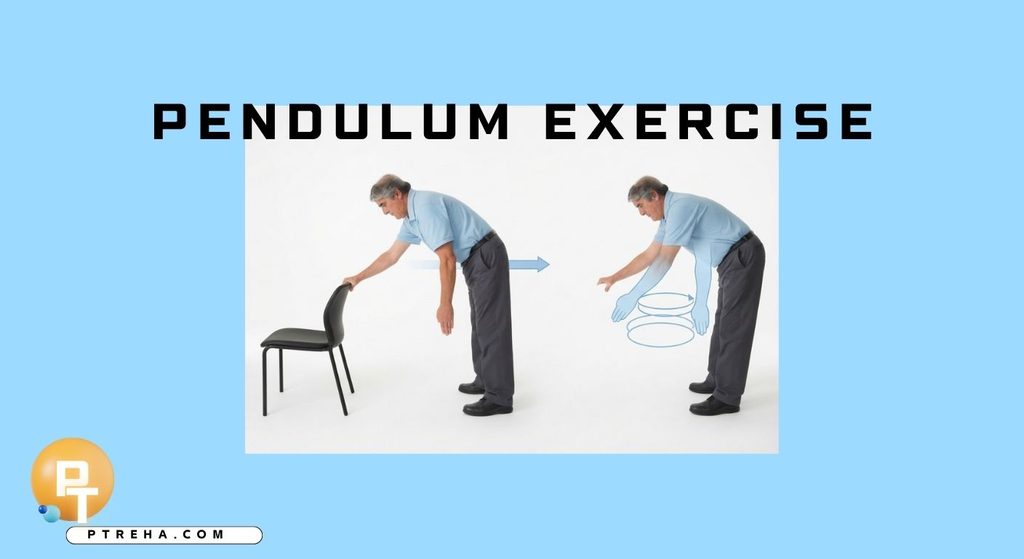
Useful particularly when pain is high and active elevation is difficult.
- Lean forward while supporting the unaffected arm.
- Let the affected arm hang relaxed.
- Make small forward/backward, side-to-side, or circular movements.
- Keep the shoulder relaxed rather than actively swinging the arm.
- Perform 30–60 seconds, 2–3 repetitions.
2. Table Slides
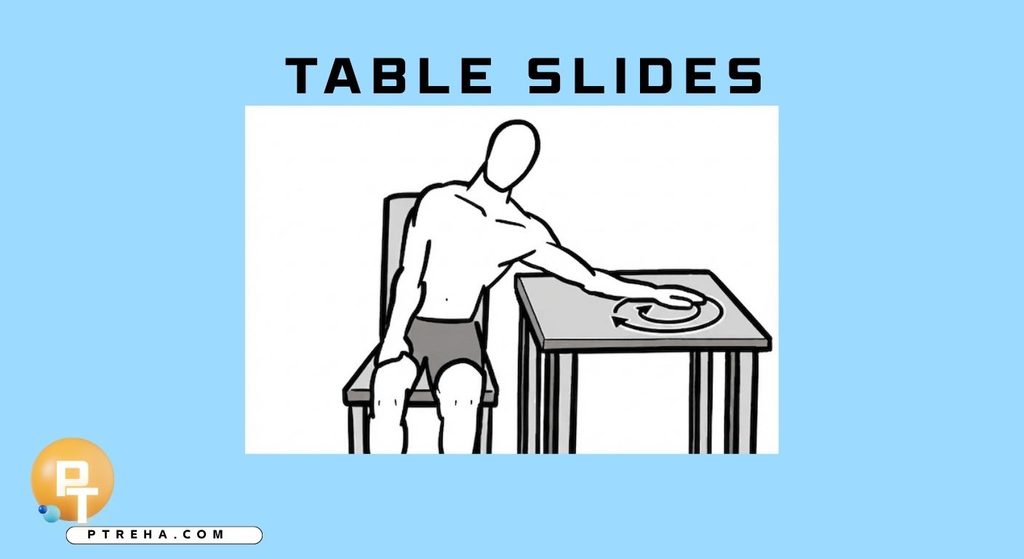
A gentle way to work on shoulder flexion with the table providing support.
- Sit facing a table.
- Place the affected hand on a towel.
- Slowly slide the hand forward while leaning the trunk forward.
- Stop before the movement becomes strongly painful.
- Return slowly.
- Perform 8–12 repetitions.
3. Supine Assisted Shoulder Flexion
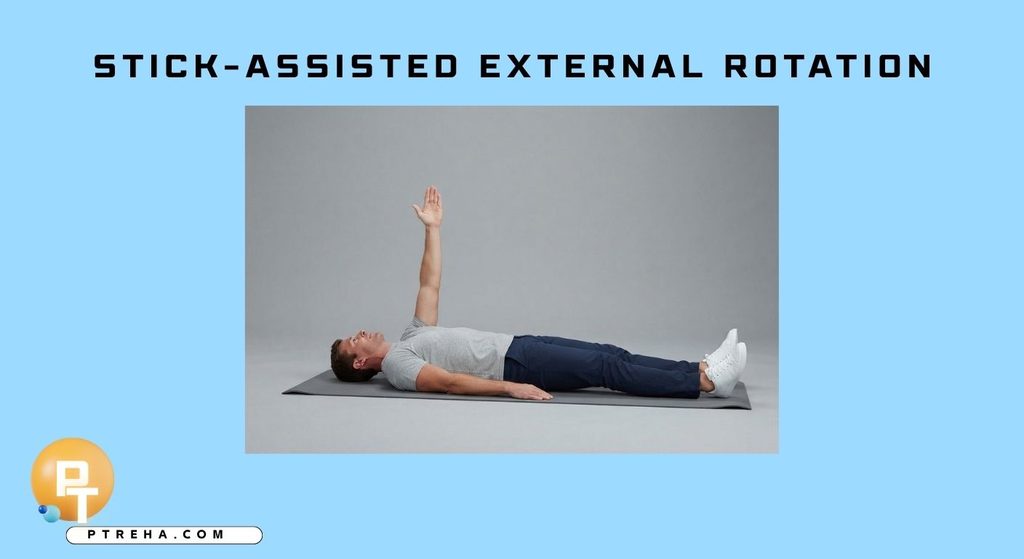
Particularly useful for gradually increasing elevation.
- Lie on your back.
- Hold the affected wrist or hand with the opposite hand.
- Use the unaffected arm to gently guide the affected arm overhead.
- Keep the movement controlled.
- Avoid forcing the final range.
- Perform 8–12 repetitions.
4. Stick-Assisted External Rotation
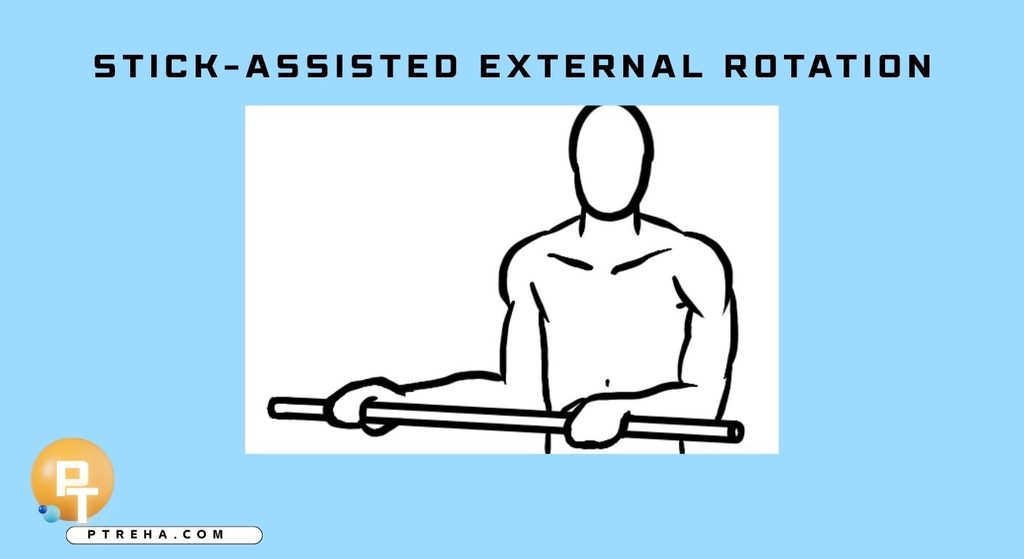
External rotation is commonly restricted in adhesive capsulitis, making this an important movement to address.
- Lie on your back or sit comfortably.
- Keep the affected elbow close to your side.
- Hold a stick with both hands.
- Use the unaffected arm to gently move the affected forearm outward.
- Stop at a tolerable stretch rather than forcing the range.
- Perform 8–10 repetitions, with a brief hold at the comfortable limit.
5. Wall Slides

More appropriate as shoulder mobility improves and the patient can tolerate upright movement.
- Stand facing a wall.
- Place the affected hand or fingers on the wall.
- Slowly slide the hand upward.
- Keep the movement controlled and minimize excessive shoulder shrugging.
- Slide back down slowly.
- Perform 8–12 repetitions.
How I would use them by phase
| Frozen shoulder phase | Main exercises |
|---|---|
| Freezing / highly painful | Pendulum, table slides, gentle assisted flexion |
| Frozen / stiffness dominant | Table slides, assisted flexion, external rotation, wall slides |
| Thawing / improving mobility | Wall slides, active elevation, external rotation, progressive strengthening |
Important clinical point: there is no universally correct number of repetitions or stretch intensity for every patient. During the painful phase, aggressive end-range stretching may aggravate symptoms, so exercise intensity should be guided by irritability and the patient’s response after exercise.
FAQ
What are the three phases of frozen shoulder?
The commonly described phases are the freezing phase, frozen phase, and thawing phase. Freezing is dominated by increasing pain and progressive loss of movement, the frozen phase is characterized by prominent stiffness, and thawing involves gradual recovery of motion. The phases overlap rather than switching abruptly.
Should I stretch a frozen shoulder every day?
Regular movement is generally important, but the appropriate amount depends on pain, stiffness, irritability, and the stage of the condition. Gentle mobility may be appropriate during a painful phase, while more sustained mobility work may become useful as stiffness becomes the dominant problem.
Should frozen shoulder exercises hurt?
Some stretching or movement discomfort can occur, particularly near a restricted range, but exercise should not automatically be pushed into severe pain. Repeatedly provoking symptoms can make rehabilitation harder, particularly during the more irritable phase.
Are pendulum exercises useful for frozen shoulder?
Pendulum exercises can provide gentle movement without requiring the patient to actively lift the arm through a large range. They are commonly included among shoulder mobility exercises, especially when more demanding movements are uncomfortable.
Is the hand-behind-the-back movement important?
It can be important because internal rotation and combined shoulder movements are required for tasks such as dressing, fastening clothing, and reaching behind the body. However, this movement can be particularly restricted and uncomfortable, so it should usually be progressed gradually rather than forced.
Can strengthening exercises help adhesive capsulitis?
Yes. Strengthening can be incorporated according to the person’s available movement and symptom tolerance. Early work may involve low-load or isometric exercises, while later rehabilitation can progress toward resistance exercises and functional strengthening.
Should I completely rest my shoulder during the painful phase?
Complete rest is generally not the goal. The shoulder should normally continue to be used for tolerable activities, while movements that significantly aggravate symptoms can be modified temporarily. Maintaining some movement helps reduce unnecessary inactivity.
How do I know whether my shoulder is frozen shoulder or another problem?
Frozen shoulder typically involves restriction of both active and passive shoulder movement, particularly with external rotation. Because other disorders can produce pain and stiffness, a proper clinical examination is important rather than relying on one symptom or one exercise test.
Do steroid injections replace physiotherapy?
No. Corticosteroid injections may be considered for selected patients, particularly when pain is a major barrier to movement, but rehabilitation remains an important part of restoring shoulder function. Evidence supports several treatment options, and the appropriate combination depends on the clinical presentation.
Can frozen shoulder recover without surgery?
Many cases improve without surgery, although recovery can be prolonged. Persistent severe symptoms or substantial functional limitation despite appropriate conservative management may lead to consideration of other interventions, including injections, hydrodilatation, or specialist procedures.
Article Resources
Clinical and patient resources
— Frozen Shoulder: Diagnosis and Treatment
ChoosePT — Physical Therapy Guide to Frozen Shoulder
BMJ — What is the most effective treatment for frozen shoulder?
Research resources
PubMed — Effects of Exercise Intervention With and Without Joint Mobilization in Adhesive Capsulitis
PubMed — Manual Therapy and Exercise for Adhesive Capsulitis: Systematic Review With Meta-analysis
PubMed — End-range Interventions in Primary Adhesive Capsulitis: Systematic Review and Meta-analysis
Image resources

Wikimedia Commons — Shoulder Stretch Exercise, Cancer Research UK, CC BY-SA 4.0
