
Exercise with degenerative disc disease usually means staying active, starting at a manageable level and adjusting movements that aggravate symptoms. The aim is better strength, mobility and everyday function—not a promise to reverse disc changes. Here are practical exercise dos and don’ts, mainly for lower-back symptoms, with separate cautions for neck involvement.
Do understand what the diagnosis tells you
Degenerative disc disease describes changes in the cushioning discs between spinal bones, commonly in the lower back or neck. These changes do not always cause symptoms, so an imaging report alone cannot explain every pain or determine every exercise restriction.
Cleveland Clinic’s explanation of degenerative disc disease describes both symptomatic and symptom-free changes. Exercise decisions should also consider your examination, nerve symptoms, health and current activity tolerance.
- Ask whether the findings fit your symptoms.
- Clarify any restrictions following surgery or a recent injury.
- Choose a practical goal, such as walking to the shops or getting out of a chair more easily.
Disc degeneration is not the same diagnosis as a fracture, and it does not automatically mean a nerve is compressed. If you have another spinal condition, its advice may change the exercise plan.
Don’t exercise through warning signs
Stop and seek emergency assessment for back pain with new bladder or bowel changes, numbness around the genitals or anus, or symptoms in both legs. The NHS back pain guidance also identifies chest pain or pain after a serious accident as reasons for emergency care.
- Difficulty passing urine or new loss of bladder or bowel control needs immediate attention.
- New genital-area numbness or bilateral leg weakness is not ordinary exercise soreness.
- Sudden severe or rapidly worsening pain, or pain with fever or feeling unwell, needs urgent medical advice.
With neck symptoms, new walking problems or sudden loss of coordination, such as difficulty buttoning a shirt, also need emergency assessment. NHS cervical spine advice explains these warning signs. New or worsening limb weakness needs prompt medical assessment even without severe pain.
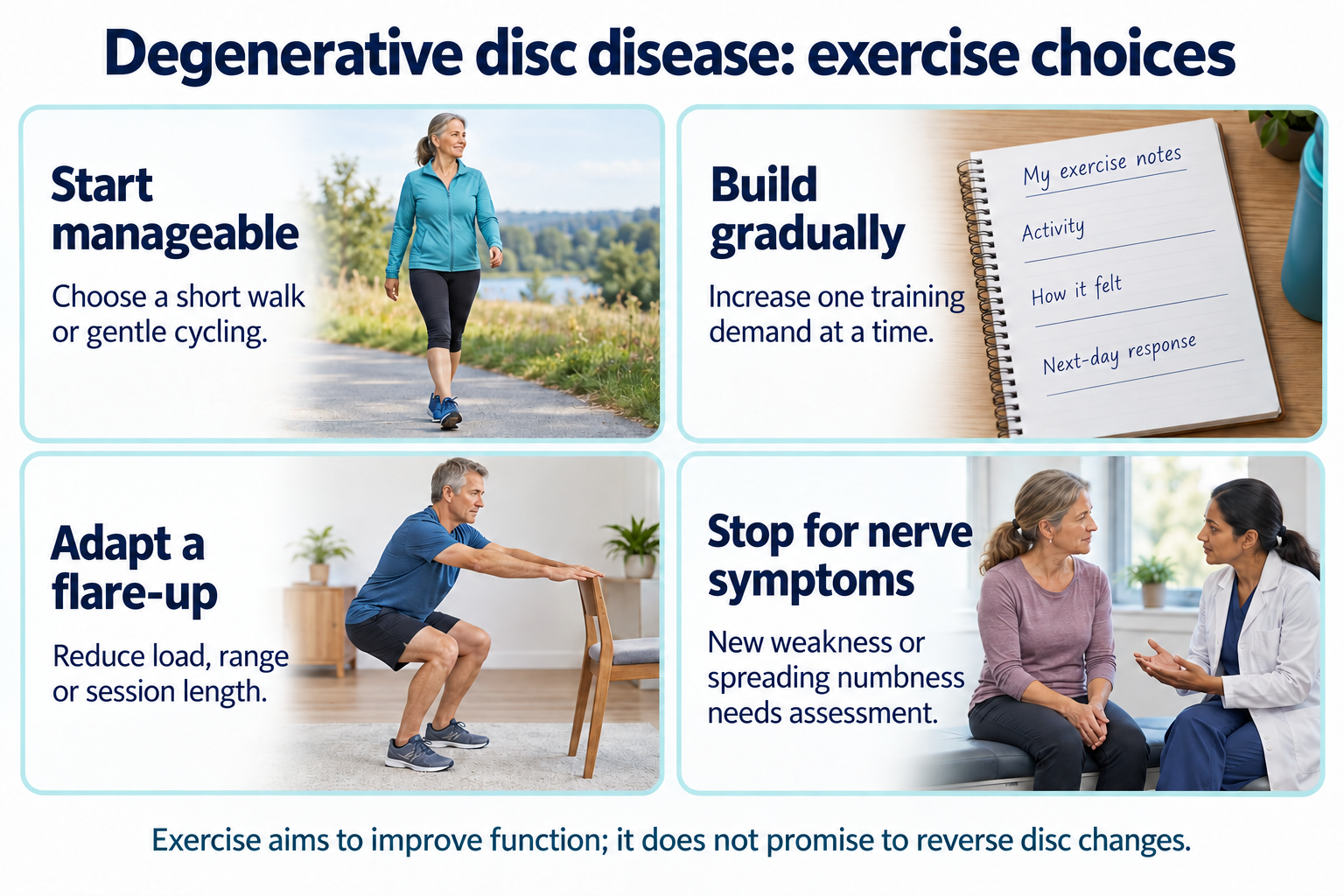
Do start with a repeatable amount of activity
Choose a starting dose that leaves you able to manage the rest of your day. A short session repeated consistently is more useful than an ambitious workout followed by several days of avoidable aggravation.
- Warm up with easy movement.
- Start below your current limit rather than testing your maximum.
- Keep breathing normally and allow rests.
- Record the activity and how you feel afterward.
The NIAMS advice on living with back pain recommends avoiding bed rest and increasing activity gradually as tolerated. If pain has prevented activity for some time, ask a physiotherapist to help establish a starting point.
Do choose an aerobic activity you can tolerate
Walking, gentle stationary cycling and water-based activity are possible options. They are choices to compare, not a ranking in which one exercise is best for every person with disc degeneration.
- For walking, try a level route with places to rest.
- For cycling, adjust the seat and handlebars so the position feels comfortable.
- For pool exercise, choose movements and strokes that do not reproduce symptoms.
For example, if a continuous walk becomes uncomfortable, split it into shorter outings. If cycling consistently worsens leg symptoms, change the activity and seek advice rather than assuming that every low-impact exercise must suit you.
| Activity | Potential role | Adjustment to consider |
|---|---|---|
| Walking | Build everyday endurance | Shorter bouts, level ground or slower pace |
| Stationary cycling | Alternative aerobic activity | Comfortable setup and lower resistance |
| Chair rise | Practise a daily task and leg strength | Higher stable seat or hand support |
| Gentle pelvic tilt | Explore comfortable lower-back movement | Smaller range or a different position |
| Resistance exercise | Develop strength for your goals | Lighter load, fewer repetitions or simpler variation |
Do include appropriate strength work
Strength training can involve the legs, hips, trunk and upper body, depending on your goals. You do not have to begin with difficult planks or heavy weights to start building capacity.
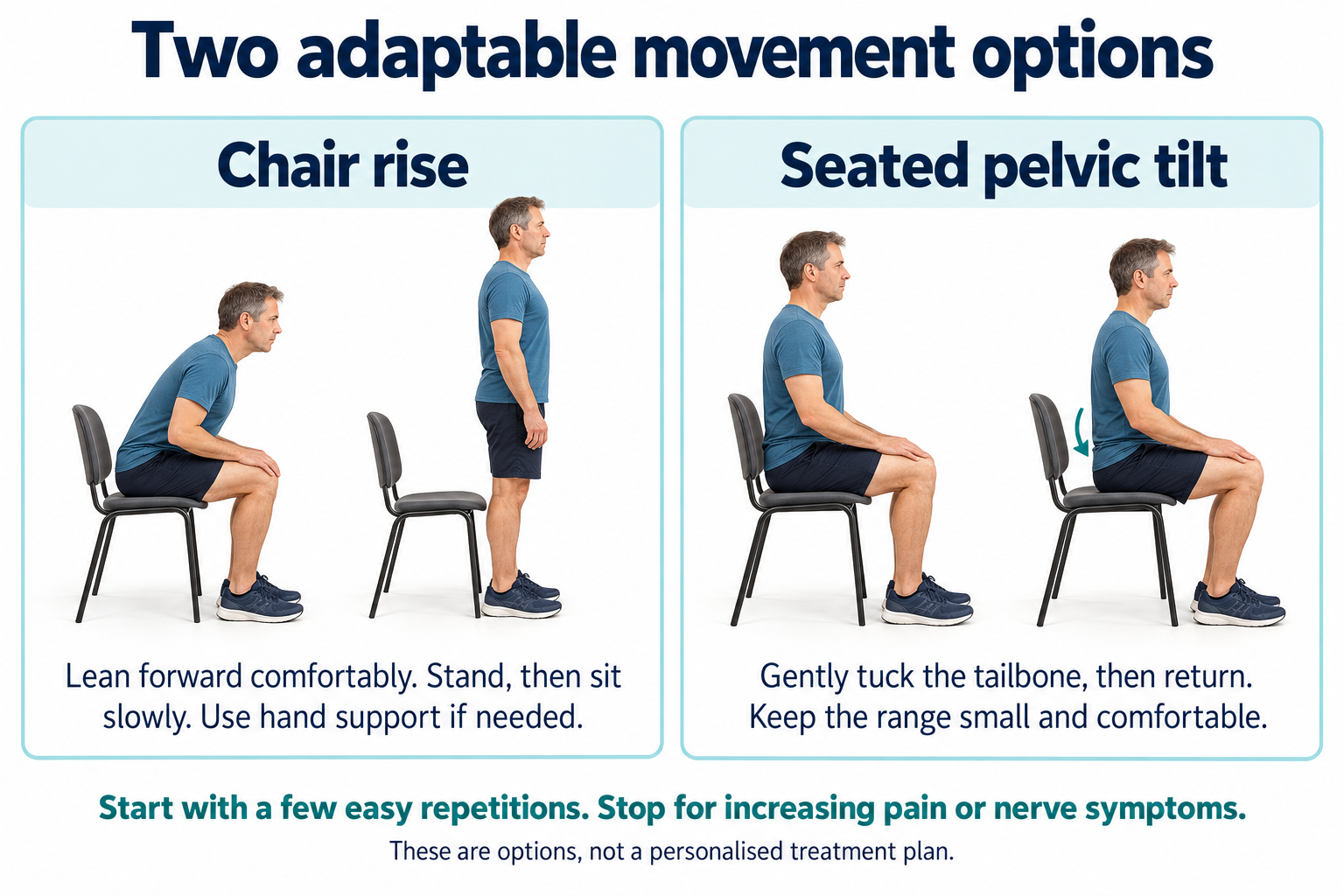
A chair rise is one practical example, adapted from the NHS home strength exercises. Use a stable chair that cannot slide, with your feet flat and comfortably apart.
- Move toward the front of the seat and lean forward comfortably.
- Stand smoothly, using your hands for support if needed.
- Return to sitting slowly rather than dropping onto the seat.
- Begin with a few easy repetitions and stop if symptoms increase.
This trains a useful task; it does not isolate or repair a disc. A therapist may add trunk endurance or movement-control exercises when appropriate, with the difficulty matched to your symptoms and ability.
Do use mobility exercises without forcing the range
For lower-back stiffness, a small seated pelvic tilt may be worth trying if sitting is comfortable. This movement is included among Royal Free London’s physiotherapy exercise resources.
- Sit on a stable chair with both feet supported.
- Gently tuck your tailbone to soften the lower-back curve.
- Return to your comfortable starting position.
- Keep the movement small and stop if it increases back or leg symptoms.
A stretch should not become a contest to reach farther. The AAOS spine conditioning guidance advises warming up and discussing painful exercise with a clinician. Select exercises from a programme with professional guidance rather than assuming every movement in it suits your diagnosis.
If the problem is mainly in your neck:
- Ask for neck-specific assessment and exercise advice.
- Do not use lower-back exercises as a substitute for assessing arm symptoms.
- Avoid forcing neck movement through radiating pain, dizziness or neurological symptoms.
Don’t turn the diagnosis into a permanent list of banned movements
Some people need to reduce demanding lifting, repeated bending, twisting or impact activity while symptoms are irritable. Whether those activities can be reintroduced depends on the person, associated conditions and response to gradual practice.
- Do not suddenly restart heavy lifting after a long break.
- Do not repeatedly force a painful end position.
- Do not copy an advanced online workout simply because it is labelled “disc-safe.”
- Do not ignore restrictions given for surgery, fracture or another specific condition.
Temporary modification and long-term avoidance are different decisions. For example, a lighter object lifted from a raised surface may be a suitable step toward an everyday lifting goal, if your clinician agrees.
Do check your response during and after exercise
A brief, mild muscular ache from a new activity can occur, but a session should not leave your existing back pain worse overall. NHS inform’s exercise advice recommends checking that symptoms are no worse the following morning.
- Reduce the range, repetitions, load or session length if symptoms build.
- Stop movements that cause increasing radiating pain, tingling or numbness.
- Seek advice for repeated flare-ups rather than continually restarting the same dose.
The next-morning check is a practical guide, not a diagnostic test or permission to push through severe pain. New weakness or emergency symptoms override any routine monitoring plan.
Do progress one demand at a time
Once the current version feels manageable and recovery is acceptable, make a small change. Increasing several demands at once makes it harder to identify what caused a problem.
- Add a little time to an aerobic session before also adding pace or hills.
- Add a few repetitions before choosing a much heavier resistance.
- Keep an easier version available for a more symptomatic day.
- Track function as well as pain, such as easier stairs or longer comfortable walking.
These are planning examples, not compulsory progression rules. There is no universal weekly increase that is appropriate for every person with degenerative disc disease.
Don’t rely on exercise alone when the plan needs review
Arrange assessment if symptoms are not improving, limit normal activities or repeatedly interrupt sleep. A physiotherapist can review exercise selection, workload and nerve function; a clinician can check whether another cause needs investigation.
- Bring a brief record of activities and symptom responses.
- Ask which movements to modify and how to reintroduce them.
- Discuss fears that are stopping all activity.
- Request a clear review point if the programme is not helping.
Sleep, stress, work demands and recovery time can affect how manageable a programme feels. A useful plan should fit your life and be adjusted when circumstances change, rather than treating missed exercise as failure.
Conclusion
The most useful degenerative disc disease exercise dos and don’ts are to start at a manageable level, combine suitable activity with strength and mobility work, and adapt according to your response. Avoid sudden overload, forced painful movement and promises of disc repair. Seek assessment for persistent limitations and urgent care for new neurological warning signs.
Frequently asked questions
Is exercise recommended for degenerative disc disease?
Appropriately chosen activity and physiotherapy are common parts of nonsurgical care. The type and dose should reflect your symptoms, examination and any other conditions or restrictions.
Can exercise reverse disc degeneration?
An exercise programme should not promise to restore a disc to its original appearance. Its practical goals include improved strength, endurance, mobility and ability to manage daily activities.
What is a good first activity?
A short comfortable walk may be a useful starting option. Gentle stationary cycling or water exercise may suit others; choose according to tolerance rather than the activity’s label alone.
Are squats and chair rises always safe?
No exercise suits everyone. A supported chair rise may be easier to adapt than a deep or loaded squat, but stop if it aggravates symptoms and seek advice if you cannot find a comfortable version.
Should I avoid bending forever?
The diagnosis alone does not establish a lifelong ban. Painful or heavily loaded bending may need temporary modification, followed by an individual plan for rebuilding the activities you need.
Should I strengthen my core every day?
There is no universal daily core routine for disc degeneration. Exercise frequency and recovery should match the type of training, your current ability and your treatment plan.
What if exercise makes my leg pain worse?
Stop the provoking movement and seek advice, especially if symptoms spread farther down the leg or include numbness or weakness. Do not repeatedly use the exercise to test the nerve symptoms.
Is running permanently off limits?
Not necessarily, but returning to impact activity requires individual judgement. Consider your symptoms, other spinal conditions, previous running capacity and a gradual return plan with a clinician when needed.
Do these exercises also treat neck disc problems?
The chair-rise and pelvic-tilt examples mainly address general function and lower-back movement. Neck pain with arm symptoms needs a separate assessment and appropriately selected exercises.
When should I seek emergency care?
Back pain with bladder or bowel changes, genital-area numbness or symptoms in both legs needs emergency assessment. With neck symptoms, new walking problems or sudden loss of coordination also requires emergency care.