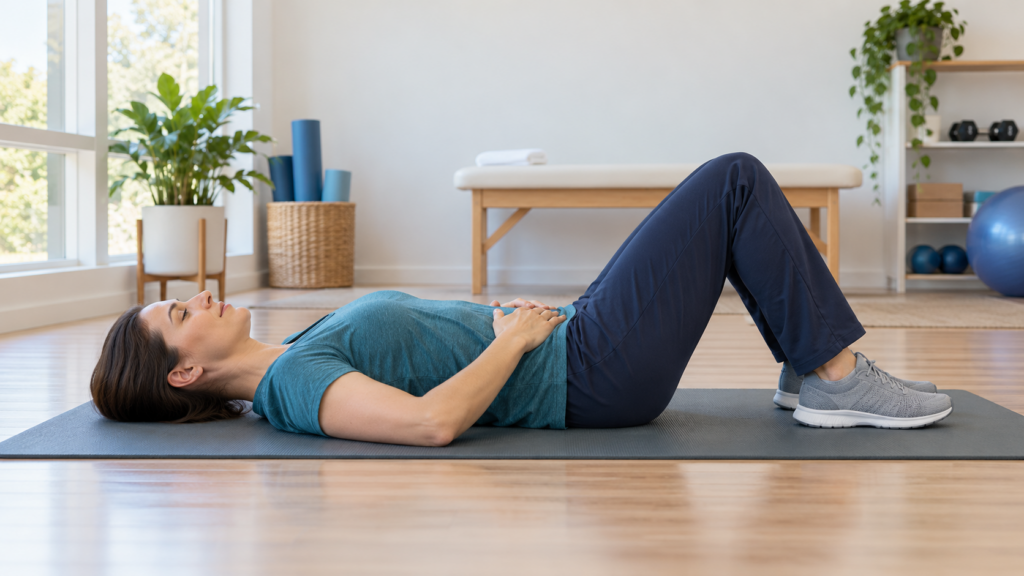
Gentle abdominal activation, small bridges, and supported all-fours exercises can be useful core stabilization options for some people with lower back pain. Start with movements you can control comfortably, keep breathing, and adjust the difficulty to your symptoms rather than treating any exercise as universally safe.
What makes a core exercise suitable for a painful back?
A suitable exercise fits your current abilities and any diagnosis or restrictions you have been given. “Bad back” covers many different problems, so an exercise that helps one person may irritate another.
Core training is one way to practise trunk strength and control. It does not establish that your spine is unstable or that weak abdominal muscles caused your pain.
- Choose a starting position you can enter and leave comfortably.
- Use a manageable movement range and light effort initially.
- Keep enough control to breathe normally and stop when needed.
Cambridge University Hospitals’ explanation of core stability myths makes a useful point: core exercises are not the only effective form of exercise for back pain. Walking or another tolerable activity can also belong in your plan.
Check symptoms and restrictions before starting
If you have recently had surgery, a fracture, or another condition with movement restrictions, follow your treating clinician’s rehabilitation plan. Do not use a general routine to override it.
Arrange assessment if pain is worsening, limiting daily activities, or failing to improve. New or changing leg symptoms also deserve attention before you increase exercise difficulty.
- Check whether you have restrictions on lifting, bending, or weight bearing.
- Tell your clinician about numbness, weakness, or pain travelling down a leg.
- Ask for a suitable alternative if lying down or kneeling is difficult.
Seek emergency care for back pain accompanied by new bladder or bowel changes, numbness around the genitals or anus, or pain, tingling, numbness, or weakness in both legs. Back pain with chest pain or following a serious accident also needs emergency assessment; the NHS back-pain guidance explains these warning signs.
Begin with gentle abdominal activation
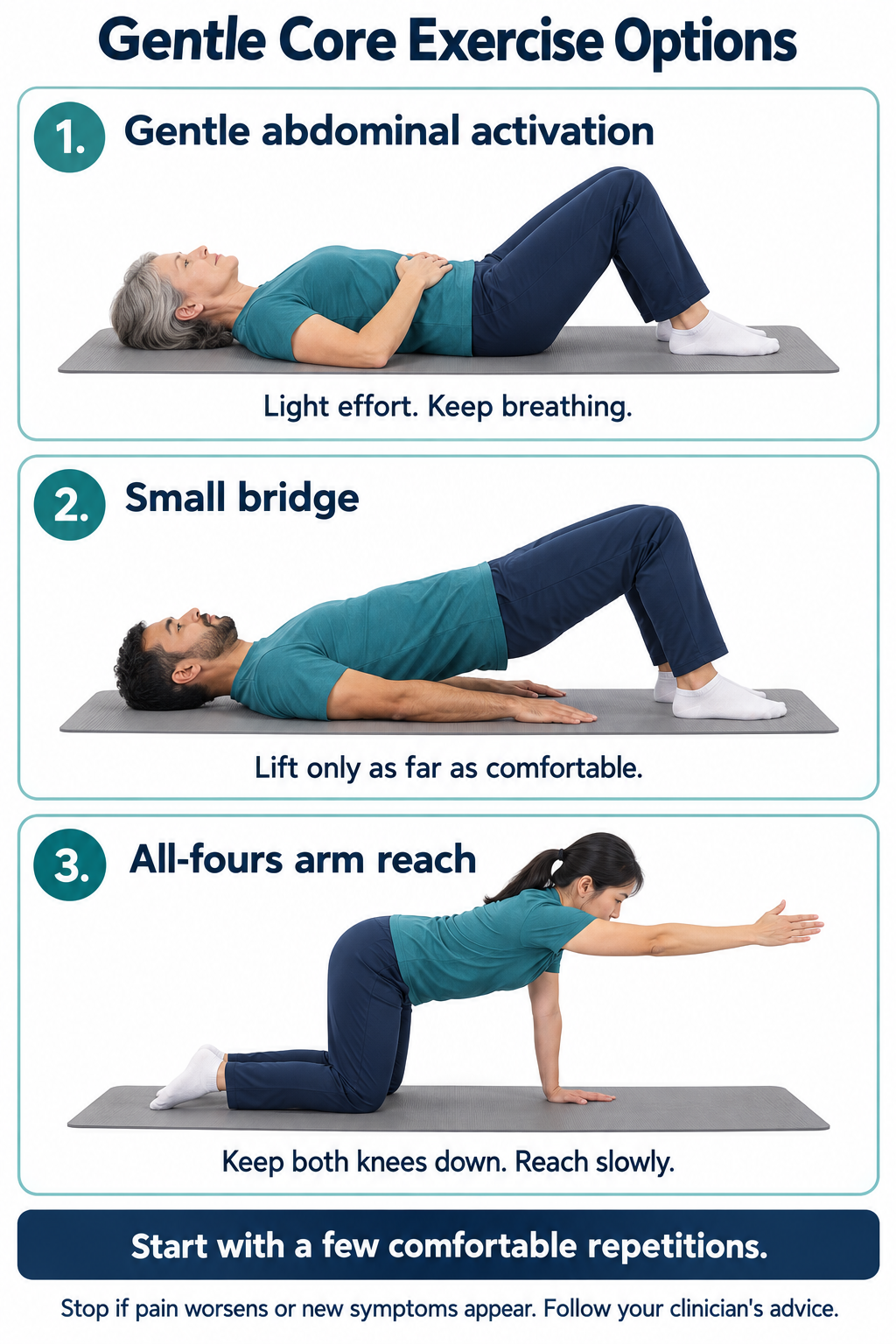
Lie on your back with your knees bent and feet supported. Gently tighten your lower abdominal muscles, keep your shoulders relaxed, and continue breathing; release the contraction between attempts.
The aim is to learn a comfortable amount of effort, not to squeeze as hard as possible. If you cannot breathe easily, reduce the effort or stop and reset.
- Let your hands rest on your abdomen as a reminder to keep the effort light.
- Avoid pushing through back pain to achieve a particular shape.
- Relax fully before the next attempt.
The Cambridge University Hospitals back-exercise leaflet includes abdominal contraction with normal breathing. Your therapist can help you decide whether this cue is useful or whether a more relaxed approach suits you better.
Try a small bridge if lying exercises feel comfortable
From the same bent-knee position, place your arms beside you. Gently engage your buttocks and lift your hips a short distance, then lower slowly; keep your head and shoulders supported.
Begin with the height you can manage without increasing symptoms. You do not need a large lift or a long hold to test whether the movement suits you.
- Keep both feet on the surface.
- Use a smooth lift and controlled return.
- Reduce the height or omit the exercise if it provokes back pain.
For example, a small lift that feels steady is a more useful starting point than a high bridge that requires straining. The American Academy of Orthopaedic Surgeons’ spine conditioning program illustrates bridging and other trunk exercises, but its full routine is not a prescription for every painful back.
Build toward an all-fours arm reach
Start on your hands and knees, with hands beneath shoulders and knees beneath hips. If that position is comfortable, slowly reach one arm forward, return it to the mat, and repeat on the other side while keeping both knees down.
Use a smaller reach if you feel unsteady. Arthritis UK’s back exercise instructions include this arm-only back-stabiliser option.
- Look toward the mat rather than lifting your chin.
- Reach slowly without forcing your trunk to stay rigid.
- Skip this position if it causes wrist, knee, shoulder, or back pain.
A later option is the bird dog: extending one arm and the opposite leg, then returning with control. Consider that progression only when the simpler version is comfortable; a therapist can check whether it is appropriate.
Compare the starting options
Choose one or two movements to test rather than completing every option at once. This makes it easier to identify what your back tolerates.
| Exercise | Main task | Make it easier | Reconsider it when |
|---|---|---|---|
| Abdominal activation | Gentle trunk muscle effort with breathing | Use less effort and shorter attempts | You strain or pain increases |
| Small bridge | Controlled hip lift and return | Lift a shorter distance | Symptoms increase during the lift |
| All-fours arm reach | Control while moving one arm | Reach less far or keep the hand down | Kneeling or arm support is painful |
| Bird dog progression | Control with opposite arm and leg movement | Return to the arm-only version | You cannot manage the movement comfortably |
Before choosing a floor exercise, check the setup:
- Leave enough space to move an arm without hitting furniture.
- Use a surface that feels stable and comfortable.
- Make sure you can get down and back up safely; ask for help or an alternative if needed.
The table is a selection aid, not a diagnostic tool. Being unable to tolerate one exercise does not establish a particular injury.
Use a small trial dose and review the response
There is no single set-and-repetition target that makes core stabilization exercises safe for all backs. A cautious practical trial is a few comfortable repetitions of one or two exercises, with rest between attempts, rather than a full workout.
This is a starting approach to discuss or adapt, not a validated dose for your condition. Follow an individual prescription if your clinician has provided one.
- Stop while you still have comfortable control.
- Notice symptoms during the session and afterward.
- Check whether your normal activities feel different later or the next morning.
If the session clearly aggravates symptoms, stop that exercise and seek advice before repeating it. Do not use a new number on a pain scale as permission to ignore spreading pain, weakness, or numbness.
- Record the exercise and the amount you tried.
- Describe where symptoms occurred, rather than only giving a score.
- Note how long any increase lasted and what you could do afterward.
A brief record helps a therapist adjust the plan. It is more informative than repeatedly trying a harder version without knowing how the previous session affected you.
Progress one thing at a time
When an exercise is consistently manageable, choose a single small change: another repetition, a slightly longer reach, or a more demanding version. Avoid increasing all three together.
You do not need to progress on a fixed calendar. The useful question is whether the next step remains manageable in the context of your usual activities.
- Keep the easier version available for less comfortable days.
- Rest between attempts instead of rushing to finish.
- Ask for a review if every progression repeatedly causes a flare.
Long planks, sit-ups, or resistance equipment are not compulsory milestones. Select exercises that serve your goals, such as getting out of a chair, walking farther, or returning to a preferred activity.
Avoid turning exercise cues into all-day rules
Light abdominal effort during a particular exercise does not mean you need to hold your stomach tight throughout the day. Allow yourself to relax between efforts and move in a way that feels manageable.
Exercise selection should reflect your preferences and capabilities. NICE’s recommendations for low back pain and sciatica support considering different exercise approaches rather than requiring a single core routine.
- Combine exercise with tolerable everyday movement.
- Choose an activity you can realistically continue.
- Discuss persistent symptoms rather than assuming more abdominal work is the answer.
If your main goal is returning to gardening, for example, tell your therapist about the reaching, kneeling, and lifting involved. A useful plan should eventually address those tasks, not only performance on a mat.
Conclusion
Core stabilization exercises can provide manageable ways to practise strength and control, but suitability depends on your symptoms and circumstances. Start gently, keep breathing, review the response, and build toward activities that matter to you.
Frequently asked questions
Which core exercise should I start with?
Start with a comfortable position and a simple task, such as gentle abdominal activation. If it increases pain or feels difficult to coordinate, ask a physical therapist for another starting point.
Does back pain mean my core is weak?
No. Pain alone does not identify abdominal weakness or spinal instability. An assessment can explore your symptoms and functional needs without assuming one muscle group caused the problem.
Should I hold my breath while bracing?
Keep breathing during these gentle exercises. If the effort makes you hold your breath, reduce it or take a break before trying again.
Are bridges suitable for everyone?
No. A small bridge is one option to test when appropriate, not a universal recommendation. Recent surgery, specific restrictions, or increasing symptoms may require a different exercise.
Do I need to perform a full bird dog?
No. An arm-only reach or another easier exercise may be sufficient for your current goal. Progression should have a practical purpose rather than simply making the routine look harder.
How many repetitions should I do?
Use your clinician’s prescription when available. Otherwise, begin with a small comfortable trial and assess the response before adding more; there is no universal dose for every back problem.
What if exercise makes pain worse?
Stop the provoking exercise and reassess rather than pushing through. Seek medical or physiotherapy advice if the increase persists, symptoms change, or you are unsure how to continue.
Can I exercise if I have sciatica?
Exercise may form part of a sciatica care plan, but selection needs to account for leg symptoms. Get advice for new or worsening numbness or weakness instead of relying on a generic core routine.
Should I keep my abdomen tight while walking?
You do not need to turn an exercise cue into a constant rule. Walk in a comfortable way and discuss it with your therapist if you notice persistent tension or breath holding.
When do back symptoms need emergency care?
New bladder or bowel changes, numbness around the genitals or anus, or symptoms affecting both legs require emergency assessment with back pain. Stop exercising and seek immediate help.