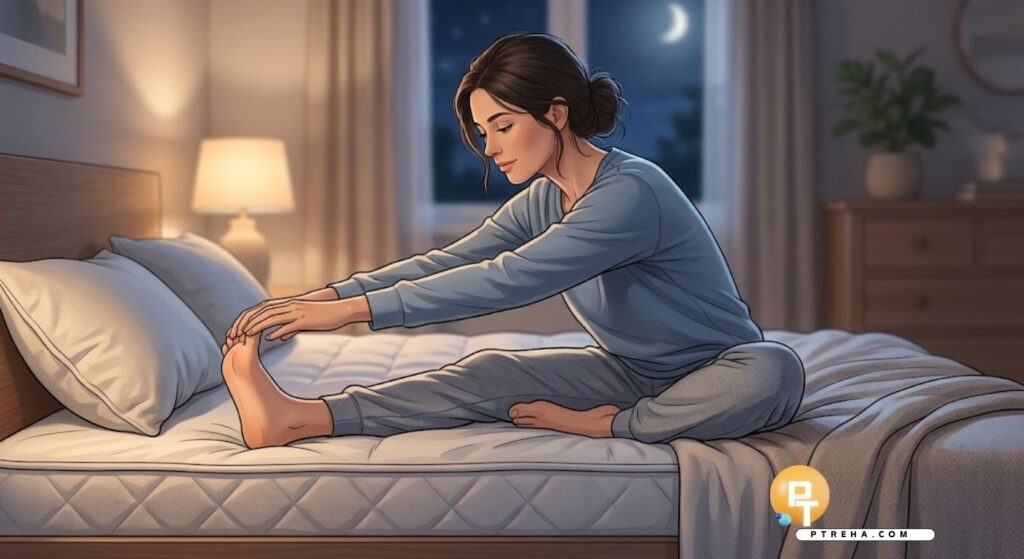
Bedtime relaxation stretches for restless legs and tension can help settle muscular tightness, reduce the discomfort associated with prolonged sitting, and create a calmer transition into sleep.
Gentle stretching may temporarily ease symptoms for some people, but persistent restless legs—especially a strong urge to move that becomes worse during rest and at night—can reflect restless legs syndrome and deserves appropriate medical assessment rather than stretching alone.
Why Your Legs May Feel Restless or Tense at Bedtime
Many people describe their legs as tight, restless, heavy, twitchy, or simply unable to get comfortable when they lie down.
From a physical therapy perspective, it is useful to separate muscular tension from the characteristic pattern of restless legs syndrome (RLS).
Muscular tension may develop after:
- Prolonged sitting during work or travel
- Standing for much of the day
- A demanding workout
- Reduced daily movement
- Repetitive leg activity
- Holding the body in one position
- Stress-related muscle guarding
- Limited ankle or hip mobility
- Sudden increases in exercise
- Poor recovery between workouts
Restless legs syndrome has a more specific clinical pattern.
The National Institute of Neurological Disorders and Stroke overview of restless legs syndrome describes RLS as a neurological condition involving an urge to move the legs, often accompanied by uncomfortable sensations.
Typical features include:
- An urge to move the legs
- Symptoms beginning or worsening during rest
- Temporary improvement with movement
- Greater symptoms in the evening or at night
- Difficulty remaining still in bed
- Sleep disruption
This distinction matters because stretching may be useful for comfort without addressing the underlying cause of true RLS.
How Bedtime Stretching May Help
A gentle bedtime routine is not intended to aggressively increase flexibility.
The goal is to reduce excessive muscle tension, introduce comfortable movement after a sedentary evening, and gradually shift the body away from demanding activity.
In clinical practice, people often tolerate bedtime mobility better when movements are slow and comfortable rather than intense.
A useful routine should:
- Feel relaxing rather than challenging
- Avoid bouncing
- Avoid forcing end-range positions
- Use slow breathing
- Include the hips, thighs, calves, and ankles
- Be performed in a comfortable environment
- Avoid reproducing sharp pain
- Finish before the person feels physically stimulated
- Allow easy transitions between positions
- Be adjusted according to mobility level
The NHS also lists walking, stretching, and massaging the legs among self-help measures that may reduce restless legs symptoms.
Stretching should therefore be considered a symptom-management strategy, not a guaranteed treatment for RLS.
Bedtime Relaxation Stretch Routine at a Glance
The following sequence targets muscle groups that commonly feel tense after walking, sitting, standing, training, or working throughout the day.
| Exercise | Main area | Suggested approach | Main purpose |
|---|---|---|---|
| Ankle pumps | Ankles and calves | Slow repetitions | Gentle lower-leg movement |
| Calf stretch | Calf | Comfortable static hold | Reduce calf tightness |
| Hamstring stretch | Back of thigh | Gentle hold | Reduce posterior thigh tension |
| Hip flexor stretch | Front of hip | Controlled hold | Counter prolonged sitting |
| Figure-four stretch | Hip/gluteal region | Gentle hold | Relax posterior hip |
| Knee-to-chest stretch | Hip/lower back | Comfortable hold | General relaxation |
| Lower trunk rotation | Hips/lower back | Slow alternating movement | Gentle spinal mobility |
| Diaphragmatic breathing | Whole body | Slow breathing | Down-regulate tension |
You do not need to complete every exercise every night.
A short routine that feels comfortable and is performed consistently is usually more practical than forcing yourself through a long stretching program.
1. Begin With Gentle Ankle Pumps
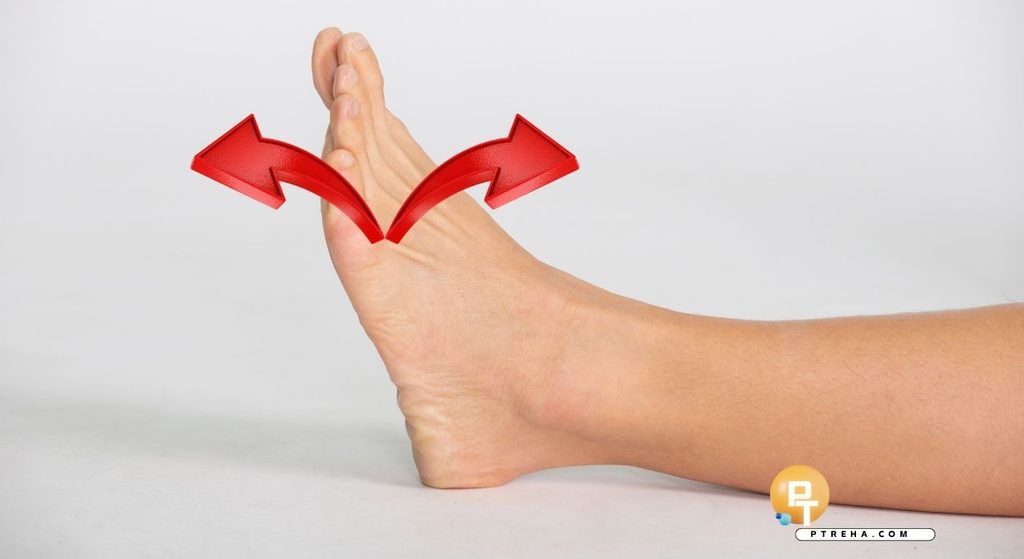
Before holding any stretch, introduce movement.
Lie on your back or sit comfortably with your legs supported.
Slowly point your feet away and then bring your toes toward you.
Keep the motion easy rather than forcing maximum ankle range.
Try:
- Moving both ankles together
- Alternating right and left
- Keeping your knees relaxed
- Using approximately 10 to 20 slow repetitions
- Moving through a pain-free range
- Breathing normally throughout
Ankle movement can be particularly useful after long periods of sitting because it introduces gentle movement without demanding much physical effort.
It can also provide a simple movement option when the legs feel uncomfortable staying still.
If walking briefly around the room feels better than stretching, that is also reasonable.
2. Gentle Calf Stretch
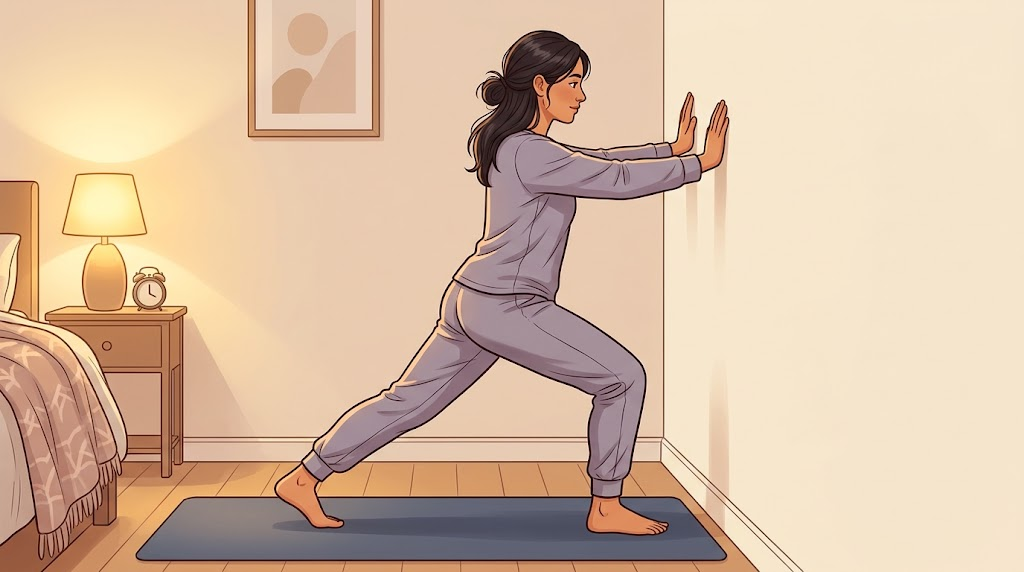
The calf muscles frequently feel tight after walking, running, standing, or spending long periods with the ankles relatively inactive.
Stand facing a wall and place both hands against it.
Step one foot backward while keeping the heel comfortably toward the floor.
Keep the back knee straight and gently shift your body forward until you feel a mild stretch in the calf.
Aim for:
- A mild pulling sensation
- No sharp pain
- A relaxed back foot
- The toes facing generally forward
- About 20 to 30 seconds if comfortable
- One or two repetitions per side
Do not push the heel forcefully into the floor.
People with limited balance can perform a supported version while holding a stable surface.
For more emphasis on the deeper calf region, repeat with the back knee slightly bent while keeping the heel down.
3. Supine Hamstring Relaxation Stretch
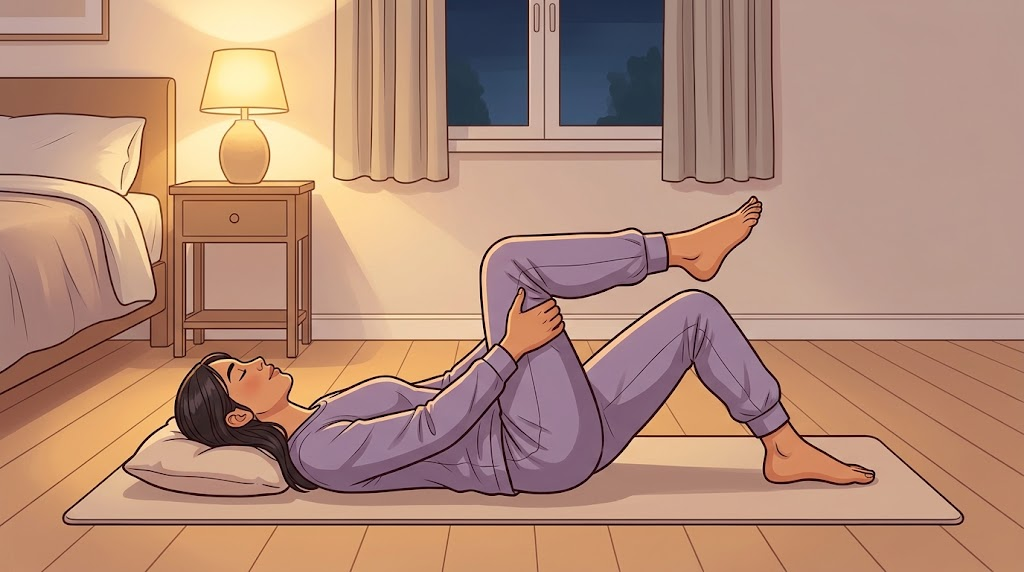
An aggressive toe-touch is usually unnecessary before bed.
A supported hamstring stretch allows the leg to relax while the back remains supported.
Lie on your back with both knees bent.
Lift one thigh toward you and support behind the thigh.
Gradually straighten the knee only until a comfortable stretch develops along the back of the thigh.
Useful technique points include:
- Keep your head supported
- Keep the opposite leg comfortable
- Do not pull behind the knee joint
- Avoid forcing the knee completely straight
- Relax your ankle
- Keep breathing slowly
- Stop if symptoms travel down the leg
Holding approximately 20 to 30 seconds is reasonable when comfortable.
A towel or strap around the thigh or foot may assist people with limited flexibility, but it should not be used to force the leg farther.
4. Hip Flexor Stretch After a Day of Sitting
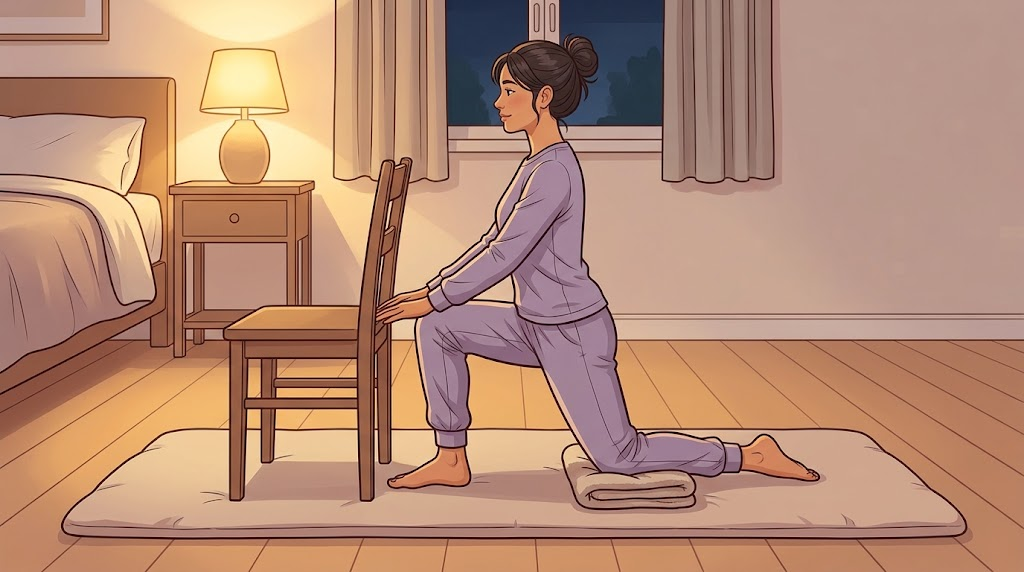
People who sit extensively often report stiffness around the front of the hips when they finally stand or lie down.
A gentle hip flexor stretch can provide a comfortable change of position.
Use a half-kneeling position with one knee on a padded surface and the opposite foot in front.
Maintain an upright trunk and gently shift your pelvis forward until you notice a mild stretch near the front of the hip on the kneeling side.
Key points:
- Use padding beneath the knee
- Hold a stable surface if needed
- Keep the trunk upright
- Avoid excessive lower-back arching
- Move from the pelvis rather than lunging deeply
- Keep the stretch comfortable
- Change sides slowly
If kneeling is uncomfortable, perform the movement while standing in a split stance instead.
The purpose is relaxation, not achieving the largest possible range.
5. Figure-Four Stretch for Hip and Gluteal Tension
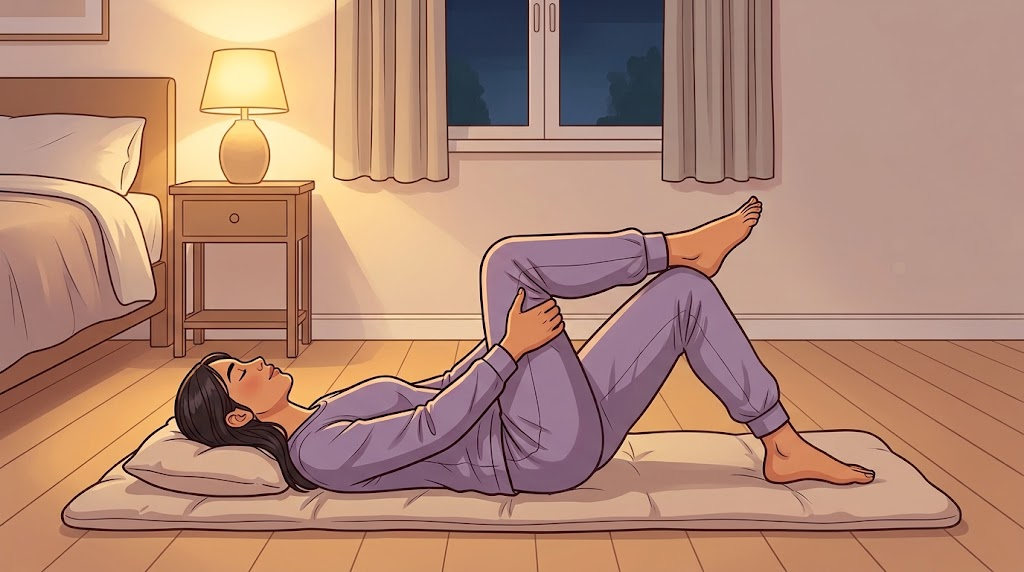
The posterior hip and gluteal region may feel tight after prolonged sitting or demanding lower-body activity.
Lie on your back with both knees bent.
Place one ankle across the opposite thigh, forming a figure-four position.
If you already feel a comfortable stretch, remain there.
If additional movement is comfortable, gently bring the supporting thigh toward your chest.
Focus on:
- Keeping the head relaxed
- Supporting behind the thigh rather than the knee
- Maintaining comfortable breathing
- Avoiding downward pressure on the crossed knee
- Keeping the movement controlled
- Stopping if groin or knee pain develops
You may hold the position for approximately 20 to 30 seconds before changing sides.
A smaller range is completely acceptable.
6. Knee-to-Chest Relaxation Stretch
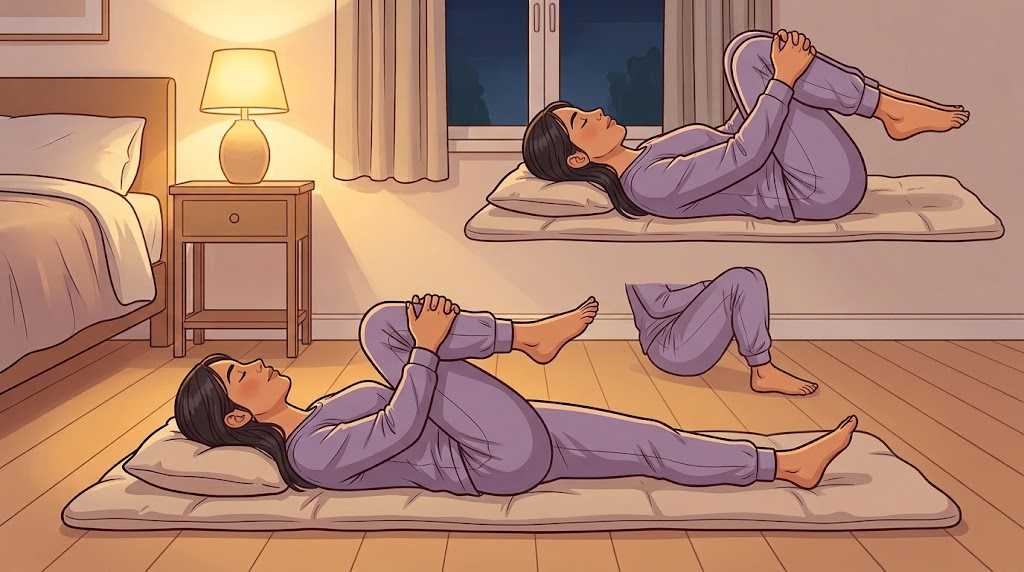
A knee-to-chest movement can provide gentle hip and lower-back movement before sleep.
Lie comfortably on your back.
Bring one knee toward your chest and support the thigh or upper shin with your hands.
Keep the other leg bent or extended depending on which position feels better.
Try the following:
- Draw the knee inward gradually
- Keep your shoulders relaxed
- Avoid pulling aggressively
- Breathe slowly
- Hold only within a comfortable range
- Repeat on the opposite side
You can then bring both knees toward you if this feels comfortable.
For some people, single-leg stretching is better tolerated than pulling both knees toward the chest.
The movement should feel calming rather than like a strong lower-back stretch.
7. Slow Lower-Trunk Rotations
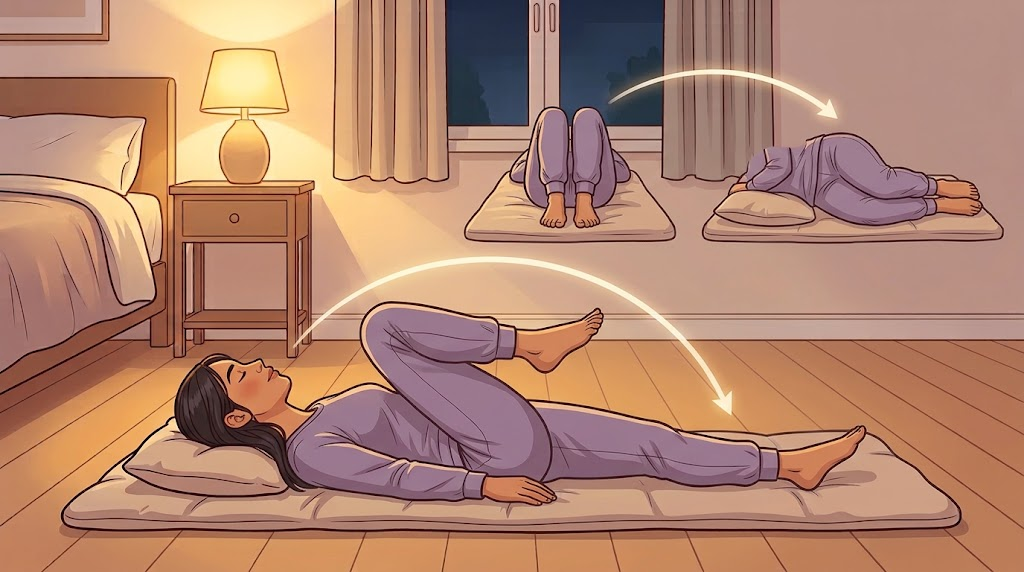
Gentle trunk rotation can combine hip and lumbar movement without placing the body under significant load.
Lie on your back with your knees bent and feet resting on the mattress or floor.
Keep the knees together and slowly allow them to move toward one side.
Return toward the center and repeat to the other side.
Use:
- A small comfortable range
- Slow transitions
- Approximately 5 to 10 movements each direction
- Relaxed shoulders
- Easy breathing
- No bouncing
There is no need to force your knees all the way to the surface.
People with sensitive backs often tolerate smaller rhythmic movements better than prolonged end-range stretching.
8. Finish With Slow Breathing and Muscle Relaxation
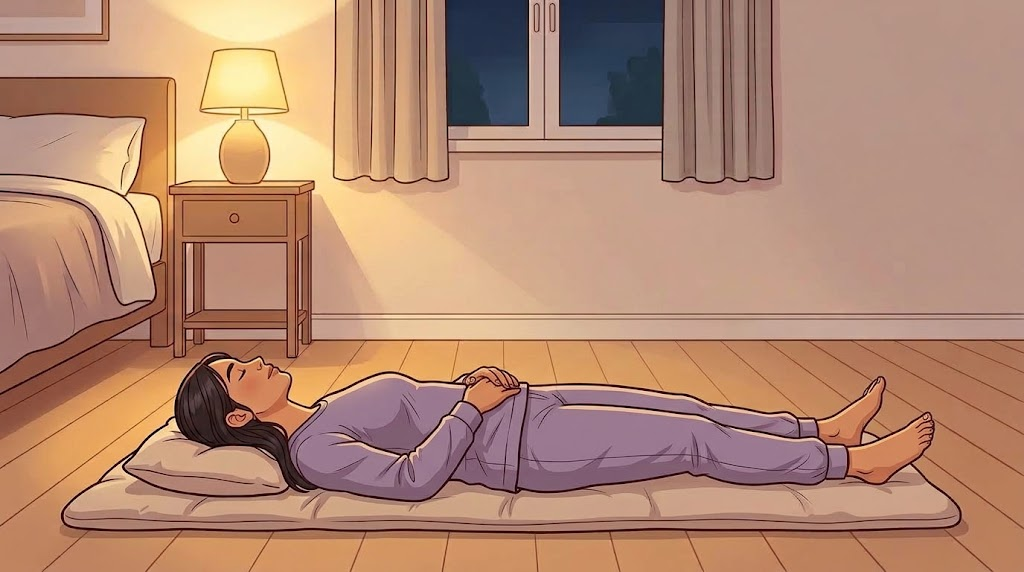
Muscle tension is not always caused by shortened muscles.
Stress, fatigue, attention to uncomfortable sensations, and increased nervous-system arousal can contribute to difficulty settling at night.
After your stretches, lie comfortably and place one hand over your lower rib cage or abdomen.
Breathe slowly through the nose if comfortable, allowing the lower ribs and abdomen to expand naturally.
Then breathe out gently without forcing the air.
For several breaths:
- Relax your jaw
- Let your shoulders drop
- Unclench your hands
- Allow your thighs to rest
- Relax the calves
- Let the ankles become heavy
- Avoid deliberately taking very large breaths
- Keep the breathing quiet and comfortable
The objective is not to achieve a particular breathing number.
Instead, gradually allow breathing and muscle activity to become less effortful.
A Practical 10-Minute Bedtime Routine
A bedtime routine should be simple enough that you will actually use it.
For example:
- 1 minute of ankle pumps
- Calf stretch on each side
- Hamstring stretch on each side
- Hip flexor stretch on each side
- Figure-four stretch on each side
- Several gentle trunk rotations
- 2 to 3 minutes of relaxed breathing
Someone who has been sitting at a desk all evening may emphasize hip flexor and calf mobility.
A recreational runner who trained earlier in the day may prefer gentle calf, hamstring, and hip stretches.
Someone experiencing an urge to move may find that briefly walking around the room before beginning the routine feels more comfortable.
Do not assume that stronger stretching produces better results.
If your legs feel more irritated after the routine, reduce the intensity, shorten the holds, or use comfortable rhythmic movement instead.
What to Avoid Before Bed
Some routines intended to improve flexibility can become too stimulating for bedtime.
Avoid turning relaxation stretching into a demanding workout.
Common mistakes include:
- Stretching into pain
- Bouncing at the end of a stretch
- Forcing the knee or hip
- Holding your breath
- Performing intense strengthening immediately before sleep
- Using painful foam rolling
- Trying to achieve maximum flexibility
- Continuing a movement that increases tingling
- Stretching through significant joint pain
- Assuming every uncomfortable leg sensation is muscular tightness
Very strenuous exercise close to bedtime may also be counterproductive for some people.
The NHS advises regular daytime exercise while discouraging strenuous exercise late at night for people managing restless legs symptoms.
Your response to activity matters more than completing a predetermined routine.
Stretching Is Not the Same as Treating Restless Legs Syndrome
This is one of the most important distinctions in the article.
RLS is not simply tight calves or poor flexibility.
The characteristic symptoms involve an urge to move, usually associated with uncomfortable sensations that begin or become worse when resting, improve temporarily with movement, and are more prominent later in the day or at night.
That means a person may have flexible muscles and still experience significant RLS.
Likewise, someone with calf tightness after exercise does not automatically have RLS.
When clinically significant RLS is suspected, assessment extends beyond flexibility.
The American Academy of Sleep Medicine emphasizes evaluating iron status in people with clinically significant RLS and addressing aggravating factors such as caffeine, alcohol, certain medications, and untreated sleep apnea.
Do not start iron supplements simply because your legs feel restless.
Iron therapy should be based on appropriate clinical evaluation and laboratory findings because unnecessary supplementation is not risk-free.
When Bedtime Leg Symptoms Need Medical Assessment
Occasional leg tension after a long day often responds to movement, recovery, and changes in activity.
Persistent or worsening symptoms deserve more attention.
Arrange appropriate medical assessment when:
- Symptoms regularly prevent you from sleeping
- The urge to move is frequent or persistent
- Symptoms significantly interfere with daily life
- Self-management is not helping
- Symptoms are progressively worsening
- You suspect a medication may be contributing
- You are pregnant and symptoms are substantial
- You have persistent numbness or altered sensation
- You have unexplained weakness
- The symptoms do not fit ordinary muscular tension
Do not assume that all nighttime leg symptoms are RLS.
Leg cramps, peripheral nerve problems, musculoskeletal pain, medication effects, and other conditions can create symptoms that sound similar.
Urgent assessment is appropriate for new symptoms such as substantial one-sided leg swelling, redness or warmth accompanied by significant pain, sudden neurological weakness, or other rapidly developing symptoms that are clearly different from your usual pattern.
How a Physical Therapist Approaches Nighttime Leg Tension
In physical therapy, I would not evaluate nighttime symptoms by looking at flexibility alone.
The first questions are usually about the pattern.
Useful information includes:
- When the symptoms begin
- Whether sitting triggers them
- Whether walking relieves them
- Which areas of the leg are involved
- Whether symptoms are painful or simply uncomfortable
- Recent changes in exercise
- Daily sitting and standing duration
- Previous injuries
- Neurological symptoms
- Sleep disruption
- Activities that improve symptoms
A musculoskeletal examination may then consider joint mobility, muscle function, movement tolerance, neural symptoms, strength, and functional activity when appropriate.
The purpose is to identify whether a modifiable movement-related factor appears to be contributing.
When the symptom pattern suggests a neurological or sleep-related disorder rather than a musculoskeletal problem, medical evaluation becomes important.
Physical therapy and medical assessment therefore have complementary roles rather than competing ones.
Conclusion
Bedtime relaxation stretches for restless legs and tension work best as a gentle comfort routine rather than an aggressive flexibility program.
Ankle movements, calf and hip stretches, supported hamstring mobility, trunk rotation, and relaxed breathing can help many people settle physically after a long or demanding day.
However, recurring symptoms characterized by a strong urge to move, worsening during rest, nighttime predominance, and temporary relief from movement should not automatically be treated as muscle tightness.
Persistent sleep-disrupting symptoms deserve appropriate evaluation so that the underlying problem can be addressed.
Frequently Asked Questions
Can stretching stop restless legs at night?
Stretching may temporarily reduce uncomfortable sensations for some people and is commonly used as a self-management strategy.
It does not reliably eliminate restless legs syndrome or treat every underlying contributor.
If symptoms repeatedly disrupt sleep, further assessment is appropriate.
What is the best stretch for restless legs before bed?
There is no single best stretch.
Gentle calf, hamstring, hip flexor, and posterior hip stretches are reasonable options.
Comfortable walking or ankle movements may be more useful than static stretching when there is a strong urge to move.
How long should I stretch before sleeping?
A short routine of roughly five to ten minutes is often sufficient for relaxation.
The quality and comfort of the movements matter more than stretching for a long period.
Should bedtime stretches feel strong?
No.
A bedtime stretch should usually produce mild tension rather than pain or an intense pulling sensation.
Strong stretching can make some people feel more uncomfortable rather than more relaxed.
Why do my legs become restless only when I lie down?
Symptoms of RLS characteristically develop or worsen during rest and are usually more prominent in the evening or at night.
However, nighttime symptoms have several possible causes, so recurrent symptoms should not be self-diagnosed solely from this feature.
Does walking help restless legs?
Movement can temporarily relieve the characteristic symptoms of RLS, and some people find a short walk useful when symptoms begin.
If you constantly need to get out of bed and walk because symptoms return when you lie down, discuss the pattern with an appropriate healthcare professional.
Can tight calves cause restless legs syndrome?
Calf tightness and RLS are different problems.
Tight calf muscles may cause stiffness or pulling sensations, while RLS is a neurological condition characterized primarily by an urge to move associated with rest and nighttime symptoms.
Should I stretch if my legs are tingling?
Mild positional sensations may sometimes change with movement, but persistent tingling should not automatically be treated with stretching.
If a stretch increases tingling, numbness, burning, or radiating symptoms, stop the movement and seek assessment if the symptoms persist.
Can exercise make restless legs worse?
Regular daytime activity can be useful, while excessive or strenuous activity near bedtime may aggravate symptoms for some people.
Exercise should therefore be adjusted according to your individual response rather than simply increased.
When should I see a healthcare professional about restless legs?
Seek assessment when symptoms frequently interfere with sleep, affect your daytime functioning, persist despite reasonable self-management, or become progressively worse.
Medical assessment is particularly important when symptoms suggest true RLS because evaluation may include potential contributing factors that cannot be identified through stretching or physical examination alone.